What is ecommerce compliance: Shopify guide 2026
Master ecommerce compliance for your Shopify dropshipping store in 2026. Learn essential legal requirements, tax obligations, data protection rules, and avoid costly penalties with this comprehensive guide.

Dropshipping looks deceivingly simple until legal obligations surface. Many Shopify sellers believe opening a store means instant legitimacy, yet compliance spans licences, taxes, data protection, and transparent policies. Misunderstanding these requirements exposes your business to fines, shutdowns, and lost customer trust. This guide clarifies ecommerce compliance essentials for dropshippers operating in 2026, helping you navigate complex regulations confidently and build a sustainable online business.
Table of Contents
- Understanding Ecommerce Compliance In 2026
- Navigating Legal And Business Structure Requirements
- Mastering Tax Compliance: Sales Tax, VAT, And International Rules
- Ensuring Data Privacy, Payment Security, And Customer Policy Compliance
- Optimise Your Ecommerce Compliance With EcomEye
Key takeaways
| Point | Details |
|---|---|
| Compliance scope | Ecommerce compliance covers business licences, tax registrations, data security standards, and customer-facing policies required for legal operation. |
| Geographic variation | Different countries impose unique legal requirements, with US sales tax nexus rules and EU VAT obligations presenting distinct challenges for dropshippers. |
| Business structure impact | Choosing between sole proprietorship, LLC, or corporation directly affects your liability exposure, tax obligations, and legal protections. |
| Non-compliance risks | Operating without proper compliance risks substantial fines, forced business closure, loss of legal protections, and permanent damage to brand reputation. |
| Trust building | Transparent policies, secure payment processing, and data protection compliance establish customer confidence and reduce disputes substantially. |
Understanding ecommerce compliance in 2026
Ecommerce compliance involves adhering to legal regulations to avoid penalties and build customer trust. For Shopify dropshippers, this means understanding obligations across multiple jurisdictions whilst managing supplier relationships and customer expectations simultaneously. The regulatory landscape continues evolving rapidly in 2026, with governments worldwide tightening rules around online commerce.
Compliance spans several critical areas. Business licences establish your legal right to operate in specific locations. Tax obligations include sales tax collection, VAT remittance, and income tax filings across potentially dozens of jurisdictions. Data protection laws like GDPR and CCPA mandate how you collect, store, and use customer information. Payment security standards protect transaction data from breaches.
Dropshipping adds unique complexity because you never physically handle inventory. You’re forwarding customer orders to suppliers who ship directly, creating legal questions about responsibility for product quality, shipping delays, and customs documentation. Your compliance obligations don’t diminish simply because suppliers handle fulfilment.
Non-compliance carries severe consequences. Tax authorities impose substantial penalties for unpaid obligations, often with interest accruing daily. Data breaches without proper security measures trigger massive fines under GDPR, reaching up to €20 million or 4% of annual turnover. Operating without required licences risks immediate shutdown orders and criminal charges in some jurisdictions.
Pro Tip: Consult a legal advisor specialising in ecommerce before launching your store to identify jurisdiction-specific obligations and establish compliant systems from day one.
Key compliance categories include:
- Business registration and licensing requirements based on location and products
- Tax collection, registration, and remittance across multiple jurisdictions
- Data privacy and security standards protecting customer information
- Payment processing security meeting industry standards like PCI DSS
- Customer-facing policies covering terms, returns, and privacy clearly
Understanding Shopify dropshipping essentials helps you build compliant operations whilst avoiding common pitfalls that derail new sellers.
Navigating legal and business structure requirements
Your business structure choice fundamentally shapes compliance obligations and legal protections. Sole proprietorships offer simplicity but expose personal assets to business liabilities. Limited liability companies separate personal and business assets whilst maintaining flexible tax treatment. Corporations provide maximum liability protection but involve complex governance requirements and double taxation in some scenarios.

Shopify does not require a business licence to create a store, but compliance with local, state, and federal laws remains mandatory regardless of platform. Licensing requirements vary dramatically based on your physical location, where customers reside, and what products you sell. Operating from home might trigger home occupation permits. Selling regulated products like cosmetics, food, or electronics often requires specialised licences.
| Structure | Liability Protection | Tax Treatment | Compliance Complexity |
|---|---|---|---|
| Sole Proprietorship | None (personal assets exposed) | Pass-through to personal return | Low (minimal filings) |
| Limited Liability Company | Strong (assets separated) | Flexible (pass-through or corporate) | Moderate (annual reports required) |
| Corporation | Maximum (complete separation) | Corporate rate plus dividends | High (extensive governance rules) |
Revenue thresholds trigger additional requirements. Exceeding certain sales volumes requires VAT registration in EU countries or sales tax permits in US states. Crossing registration thresholds without filing creates immediate compliance violations, even if you later register and remit properly.
Missing required licences blocks access to business banking, payment processors, and legal dispute resolution mechanisms. Courts may refuse to enforce contracts signed by unlicensed businesses operating illegally. Insurance companies deny claims from improperly structured or unlicensed operations.
Pro Tip: Monitor regulatory changes quarterly through government websites and industry associations, as new licence requirements or threshold adjustments often take effect with minimal advance notice.
Specific licence triggers include:
- Operating retail or wholesale businesses from residential properties
- Selling age-restricted products requiring verification systems
- Handling regulated goods needing safety certifications or testing
- Exceeding revenue thresholds mandating commercial registrations
Explore Shopify store features that support compliance through proper documentation and reporting. Additional guidance on ecommerce development helps structure technically compliant stores from launch.
Mastering tax compliance: sales tax, VAT, and international rules
Tax compliance represents the most complex ecommerce challenge, particularly for dropshippers selling internationally. Ecommerce sales tax refers to tax applied to online transactions, governed by rules varying across states, counties, and local jurisdictions. Understanding nexus, the connection triggering tax obligations in specific locations, proves essential for legal operation.
Sales tax nexus traditionally required physical presence, but economic nexus now creates obligations based purely on sales volume or transaction counts. Most US states mandate registration after crossing thresholds like $100,000 in sales or 200 transactions annually. Exceeding thresholds in multiple states simultaneously creates overwhelming registration and filing obligations for small sellers.
VAT compliance in the EU follows entirely different rules. Dropshippers face complex VAT obligations due to OSS and FBA sales across multiple countries. The One Stop Shop system simplifies some filings but doesn’t eliminate all local registration requirements, particularly for businesses storing inventory through fulfilment services.

| Tax Type | Registration Trigger | Filing Frequency | Penalty Range |
|---|---|---|---|
| US Sales Tax | Economic nexus thresholds | Monthly or quarterly | 5-25% of unpaid tax plus interest |
| EU VAT | €10,000 cross-border sales or local presence | Monthly or quarterly | Up to 30% of unpaid VAT plus penalties |
| Income Tax | Earning business income | Annually (quarterly estimated payments) | 0.5% monthly penalty plus interest |
Managing tax compliance effectively requires systematic processes:
- Identify all jurisdictions where your sales exceed nexus thresholds immediately
- Register for appropriate tax collection permits before reaching deadlines
- Configure Shopify tax settings to collect correct rates automatically for each jurisdiction
- Maintain detailed sales records separated by tax jurisdiction and rate applied
- File returns and remit collected taxes by jurisdiction-specific deadlines consistently
- Monitor sales approaching new nexus thresholds to register proactively before violations occur
- Reconcile collected taxes against remittances monthly to identify discrepancies early before audits
Tax automation services help manage multi-jurisdiction complexity, though they add monthly costs. Manual tracking remains viable for sellers operating in few jurisdictions but becomes unmanageable beyond five to seven locations. Mistakes trigger audits examining multiple years of transactions, creating massive unexpected liabilities.
Understanding ecommerce localisation helps manage tax complexity whilst optimising international sales through proper market adaptation and compliance management.
Ensuring data privacy, payment security, and customer policy compliance
Data protection regulations fundamentally changed ecommerce operations over recent years, with 2026 enforcement becoming increasingly aggressive. Protecting customer data involves implementing GDPR and CCPA compliant privacy policies alongside SSL encryption for secure transactions. Violations trigger substantial fines and permanent reputation damage that destroys customer trust irreparably.
GDPR applies to any business selling to EU residents regardless of company location. Requirements include explicit consent for data collection, clear explanations of data usage, customer rights to access and delete data, and mandatory breach notifications within 72 hours. CCPA grants California residents similar rights, with other US states rapidly adopting comparable legislation.
Payment security requires strict adherence to PCI DSS standards. Payment security must follow PCI DSS standards to protect customer payment data from breaches and fraud. Using reputable payment gateways like Shopify Payments transfers much compliance burden to processors, but merchants retain ultimate responsibility for secure data handling throughout the transaction process.
SSL certificates encrypt data transmitted between customers and your store, preventing interception of sensitive information. Modern browsers display security warnings for sites without SSL, immediately destroying customer confidence before they complete purchases. SSL has evolved from optional to absolutely mandatory for any legitimate ecommerce operation.
Customer-facing policies establish legal frameworks for business relationships whilst managing expectations clearly. Essential policies include:
-
Privacy policy detailing what data you collect, how it’s used, who it’s shared with, and customer rights
-
Terms and conditions outlining seller obligations, customer responsibilities, dispute resolution, and limitation of liability
-
Refund and return policy explaining timeframes, conditions, processes, and any exclusions clearly
-
Shipping policy covering delivery timeframes, carrier information, international shipping rules, and responsibility allocation
Policies must remain accessible from every page, typically via footer links. Language should be clear and concise, avoiding legal jargon that confuses customers. Policies require updates whenever business practices change or new regulations take effect.
Pro Tip: Review and update all customer policies quarterly to reflect regulatory changes, new payment methods, expanded shipping options, or altered return processes, ensuring customers always access current accurate information.
Well-crafted policies prevent disputes by setting clear expectations upfront. Customers understanding return processes before purchasing rarely dispute charges later. Transparent data handling builds trust that converts browsers into buyers. Review examples of terms and conditions for formatting and content guidance when drafting policies.
Effective compliance supports creating compliant product pages that convert whilst meeting legal requirements across multiple jurisdictions simultaneously.
Optimise your ecommerce compliance with EcomEye
Managing ecommerce compliance whilst scaling your Shopify dropshipping store demands efficient systems that minimise manual work. EcomEye automates the product listing process, generating copyright-safe, SEO-optimised content in bulk whilst supporting multi-language pages for international compliance requirements. By eliminating manual product page creation, you reclaim time to focus on critical compliance tasks like tax registrations and policy updates.
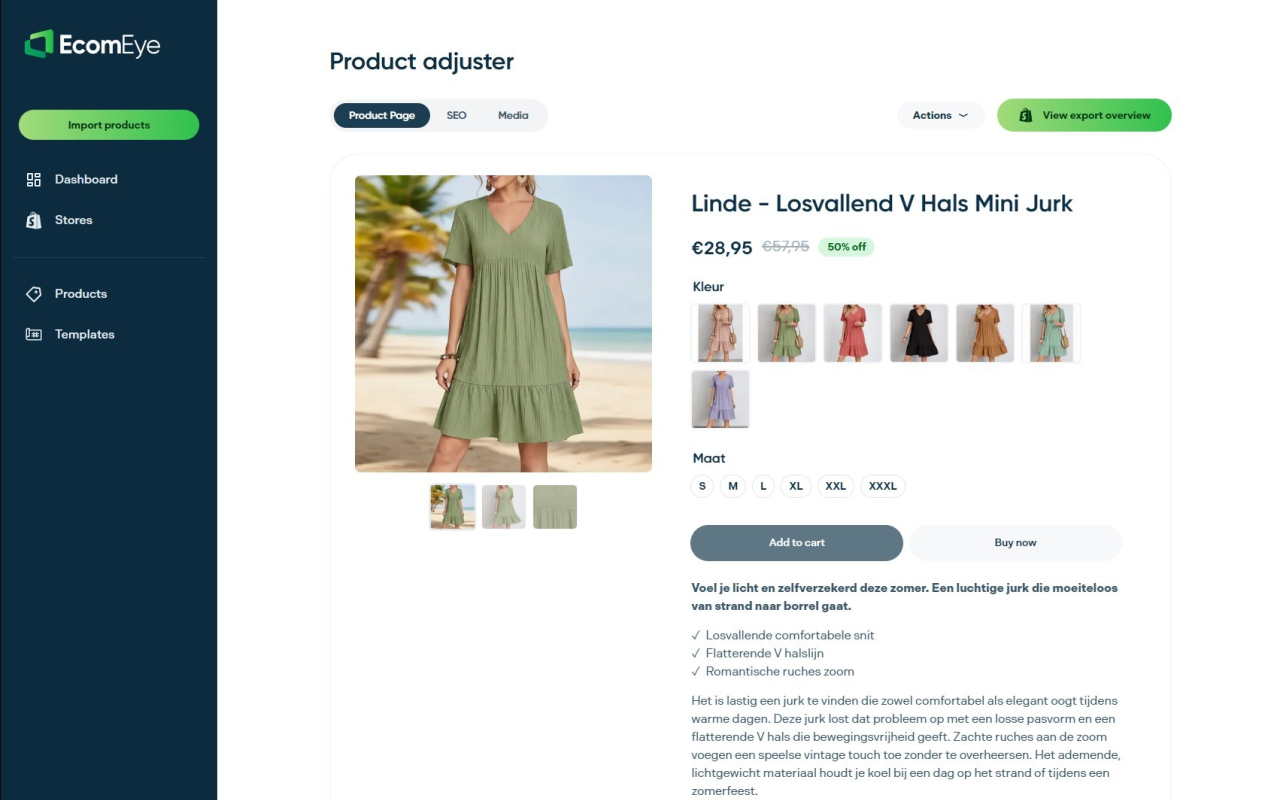
EcomEye’s automation handles product imports from AliExpress and competitor links, creating unique titles, descriptions, and high-quality images that avoid duplicate content penalties. This supports compliance by ensuring your store presents original content that respects intellectual property rights whilst meeting Google Merchant Centre requirements. Flexible pricing plans accommodate businesses at every growth stage, from new sellers to established stores scaling internationally.
Export completed product pages directly to Shopify with one click, streamlining operations whilst maintaining the compliance foundation you’ve established. Efficient product management through EcomEye lets you apply compliance knowledge effectively without drowning in repetitive tasks that distract from strategic business growth.
FAQ
Is dropshipping legal without a business licence in 2026?
Shopify does not require a business licence to create a store, but compliance with local, state, and federal laws remains mandatory regardless. Operating legally requires meeting licensing requirements based on your physical location, where customers reside, and what products you sell. Consult local authorities to identify specific licence obligations before launching your dropshipping business.
How do I handle VAT compliance for dropshipping in the EU?
Register for VAT in countries where you exceed registration thresholds, typically €10,000 in cross-border sales annually. Dropshippers face complex VAT obligations due to OSS and FBA across multiple countries, requiring careful separation of local VAT and OSS filings. Use the One Stop Shop system where applicable to simplify returns, but maintain detailed records for each transaction to support proper reporting.
What website policies are essential for ecommerce compliance?
Website policies, including privacy policies, terms of service, and return or refund policies are essential for compliance. Privacy policies must explain data collection, usage, and customer rights under GDPR and CCPA. Terms of service outline seller and buyer responsibilities whilst limiting liability appropriately. Clear refund policies prevent disputes by establishing expectations before purchases occur.
How do economic nexus thresholds affect my Shopify store?
Economic nexus creates tax obligations in jurisdictions where your sales exceed specific thresholds, typically $100,000 in sales or 200 transactions annually in US states. Crossing thresholds requires immediate registration and tax collection, even without physical presence. Monitor sales by jurisdiction monthly to identify approaching thresholds, allowing proactive registration before violations occur. Consider tax automation software when operating in multiple jurisdictions simultaneously.
Ready to boost your product pages?
Generate high-converting, SEO-optimized product pages in bulk using AI automation used by e-commerce experts.
No credit card required