What is ecommerce localisation: boost SEO and global sales
Discover what ecommerce localisation truly means beyond translation. Learn how proper localisation boosts SEO rankings by 60%, prevents Google Merchant disapprovals, and drives international sales for Shopify dropshippers.

Many dropshippers believe translating product pages guarantees international success. Unfortunately, translation alone fails to capture cultural nuances, local search intent, or regulatory requirements. True ecommerce localisation adapts every element of your product pages to resonate with target markets, driving superior SEO rankings and avoiding costly Google Merchant disapprovals that damage visibility.
Table of Contents
- Introduction To Ecommerce Localisation: Definition And Scope
- SEO Impact Of Ecommerce Localisation
- Common Misconceptions And Pitfalls In Ecommerce Localisation
- Step-By-Step Framework For Ecommerce Localisation
- Tools And Automation For Ecommerce Localisation
- Technical And Regulatory Considerations
- Case Studies And Real-World Applications
- Boost Your Ecommerce Localisation With EcomEye
- Frequently Asked Questions
Key takeaways
| Point | Details |
|---|---|
| Localisation scope | Goes beyond translation to include cultural adaptation, SEO optimisation, and regulatory compliance for each target market. |
| SEO performance lift | Localised content can rank 60% higher in international searches compared to simple translations. |
| Duplicate content risk | Copying competitors causes Google Merchant disapprovals, reducing store traffic by up to 40%. |
| Automation advantage | Tools like EcomEye reduce localisation time by over 90% whilst ensuring copyright safety and SEO readiness. |
| Continuous optimisation | Post-launch monitoring and refinement are essential for sustained international growth and compliance. |
Introduction to ecommerce localisation: definition and scope
Ecommerce localisation represents a holistic approach to adapting your online store for international markets. It encompasses language translation, cultural customisation, regulatory compliance, and SEO adaptation tailored to each target region. This process transforms product pages into culturally relevant, legally compliant assets that speak directly to local customers.
The scope extends far beyond swapping words from one language to another. You must adapt product titles, descriptions, imagery, keywords, pricing formats, measurement units, and legal disclaimers. Each element requires careful consideration of local preferences and search behaviours.
Shopify dropshippers targeting multiple international markets gain significant competitive advantages through proper localisation. Your product pages must reflect local customer expectations, from colour preferences in images to colloquial expressions in descriptions. Regulatory requirements vary dramatically across borders, affecting product claims, safety information, and advertising language.
Unlike simple translation services, localisation aligns every aspect of your product pages with local customer preferences and compliance needs. Consider these essential components:
- Language adaptation that captures local idioms and search intent
- Cultural customisation of images, colours, and messaging
- Regulatory compliance with local advertising and product standards
- SEO keyword research specific to each market’s search behaviours
- Currency, measurement, and date format localisation
This comprehensive approach ensures your international product pages feel native rather than foreign, building trust and driving conversions.
SEO impact of ecommerce localisation
Proper ecommerce localisation delivers measurable SEO benefits that directly impact your store’s visibility and revenue. Localised product pages rank 60% higher in international Google search results compared to merely translated versions. This dramatic difference stems from matching local search intent, cultural keywords, and user behaviour patterns.

Cultural keyword adaptation accounts for over 50% of SEO success in target markets. Search terms that work brilliantly in the UK may fall flat in Australia, Canada, or other English-speaking regions. Local expressions, product terminology, and search habits vary significantly, requiring dedicated keyword research for each market.
Duplicate content poses a severe threat to dropshipping stores. When you copy product descriptions from competitors or AliExpress, Google identifies the duplication and penalises your rankings. Google Merchant disapprovals from duplicate content reduce ad visibility and traffic by up to 40%, crippling your international expansion efforts.
Maximising SEO benefits requires simultaneous attention to language, culture, and keyword intent. You achieve optimal results when:
- Product titles incorporate locally searched terms and phrases
- Descriptions use natural language patterns familiar to target audiences
- Meta descriptions match local query structures and expectations
- Image alt text includes region-specific keywords
- URL structures follow local naming conventions
SEO Performance Comparison
| Metric | Non-localised Pages | Localised Pages | Improvement |
|---|---|---|---|
| Average search ranking position | 35-50 | 10-20 | 60% higher |
| Organic traffic growth | 5-10% | 45-70% | 400-600% increase |
| Bounce rate | 65-75% | 35-45% | 40% reduction |
| Conversion rate | 1-2% | 3-5% | 150-250% increase |
These improvements compound over time as Google recognises your localised content as authoritative for specific markets. Consider how to boost SEO with AI product pages for strategies that combine localisation with automated optimisation at scale.

Common misconceptions and pitfalls in ecommerce localisation
The biggest misconception plaguing ecommerce entrepreneurs is that translation equals localisation. This costly error leads over 70% of stores to fail in their international SEO efforts. Translation merely converts words between languages, missing cultural context, local search patterns, and regulatory requirements entirely.
Copying competitors’ or AliExpress product pages creates immediate duplicate content problems. Google’s algorithms quickly identify identical or near-identical content across multiple sites. The consequences hit hard: duplicate content causes Google Merchant disapprovals that reduce store traffic by 40% through lost ad visibility and organic ranking penalties.
Many dropshippers assume machine translation tools provide adequate localisation. These tools fail to capture:
- Regional product terminology and colloquialisms
- Cultural sensitivities around colours, symbols, and imagery
- Local SEO keyword intent and search behaviours
- Legal compliance requirements for product claims
- Measurement units, currency formats, and date conventions
The pitfall of ignoring cultural nuances extends beyond language. Product images that resonate in one market may confuse or offend customers in another. Colour symbolism varies dramatically across cultures, affecting purchasing decisions in ways many entrepreneurs overlook.
“Successful international ecommerce requires treating each market as unique, with dedicated research, content creation, and compliance verification. Shortcuts through copying or basic translation guarantee mediocre results at best, penalties at worst.”
Pro Tip: Create original, SEO-optimised local content for each target market rather than copying existing pages. Invest time in understanding local search intent and cultural preferences to build authentic connections with international customers whilst avoiding duplicate content penalties that damage your entire store’s visibility.
Step-by-step framework for ecommerce localisation
Implementing effective ecommerce localisation requires a systematic approach that balances efficiency with cultural authenticity. Follow this six-phase framework to transform your product pages for international success:
-
Market research and analysis: Identify target markets based on demand, competition, and regulatory complexity. Research local language variations, cultural preferences, shopping behaviours, and legal requirements. Document measurement systems, currency formats, and payment preferences specific to each region.
-
Content adaptation and translation: Translate product titles, descriptions, and marketing copy using native speakers familiar with ecommerce terminology. Adapt images to reflect local cultural preferences, ensuring colours, symbols, and lifestyle representations resonate authentically. Modify product specifications to local measurement units and standards.
-
Local SEO keyword research and integration: Conduct keyword research specific to each target market, identifying high-volume search terms that match local intent. Integrate keywords naturally into titles, descriptions, headings, and meta tags. Avoid direct keyword translation, instead focusing on terms locals actually search.
-
Compliance testing and platform validation: Review localised pages against regional advertising regulations and product claim requirements. Verify that descriptions, images, and specifications meet local consumer protection laws. Test pages for technical compatibility with regional Shopify settings and payment gateways.
-
Launch, monitoring, and feedback collection: Deploy localised pages and monitor initial performance through Google Analytics and Search Console. Track rankings for target keywords, conversion rates, and bounce rates. Gather customer feedback through reviews and support enquiries to identify improvement opportunities.
-
Continuous optimisation and updates: Regularly update content based on performance data, algorithm changes, and evolving customer preferences. Adjust keywords as search trends shift. Stay current with regulatory changes that affect product claims or advertising language. Refine images and descriptions based on conversion data.
Pro Tip: Use automation tools to handle bulk translation and optimisation efficiently, then layer in manual cultural review for critical markets. This hybrid approach balances speed with authenticity, allowing you to scale internationally without sacrificing quality.
Explore Shopify page automation strategies and bulk AI product page creation methods to implement this framework at scale across your product catalogue.
Tools and automation for ecommerce localisation
Automation tools revolutionise ecommerce localisation by reducing manual effort whilst maintaining quality and consistency. Modern platforms can cut localisation time by over 90% compared to manual methods, allowing you to scale internationally without proportionally scaling your workload.
These tools support bulk import of product data from sources like AliExpress or competitor sites, then generate localised versions automatically. The best platforms create SEO-friendly titles, culturally adapted descriptions, and AI-generated product images that avoid copyright issues entirely.
Key capabilities that distinguish effective localisation automation include:
- Multi-language content generation that adapts to regional keyword preferences
- AI-powered image creation that eliminates copyright concerns
- Bulk processing that handles hundreds of products simultaneously
- SEO optimisation built into every generated title and description
- Direct integration with Shopify for seamless deployment
- Customisation options that allow brand voice consistency across markets
Non-experts can now achieve professional localisation results without hiring translators, copywriters, or designers for each market. The technology handles technical SEO requirements, keyword placement, and content structure automatically.
Pro Tip: Combine automation with manual review for optimal results. Let tools handle the heavy lifting of content generation and keyword integration, then apply human judgement to verify cultural appropriateness and brand alignment. This approach delivers speed without sacrificing authenticity.
Consider EcomEye’s bulk AI product lister as a solution specifically designed for Shopify dropshippers requiring copyright-safe, multilingual product pages at scale. The platform addresses the exact duplicate content issues that cause Google Merchant disapprovals whilst accelerating your international expansion.
Technical and regulatory considerations
Navigating technical and regulatory requirements forms a critical yet often overlooked aspect of ecommerce localisation. Each market imposes unique legal standards for product claims, advertising language, and consumer protection that directly affect your product pages.
Local regulations govern what you can claim about product benefits, ingredients, safety features, and performance characteristics. Failure to comply results in product page or advertising disapprovals that block your market entry. Beyond immediate disapprovals, non-compliance increases store liability by 15-20%, exposing you to potential fines or legal action.
Essential regulatory considerations include:
- Product safety standards and certification requirements for specific categories
- Advertising claim restrictions that vary by country and product type
- Consumer protection laws mandating specific return policy language
- Data privacy regulations affecting customer information collection
- Accessibility standards for website functionality and content
- Age restriction disclosures for certain product categories
Incorporate local regulatory review as a standard step in your localisation process. Designate time to verify that product descriptions, images, and specifications meet regional requirements before launch. Use region-specific disclaimers that address local legal expectations without cluttering your global brand message.
Accurate ingredient lists, safety information, and warranty terms must reflect local language and legal terminology precisely. Vague or mistranslated legal text creates compliance gaps that regulators exploit. Partner with local legal advisors or compliance services for high-risk categories like health products, electronics, or children’s items.
Technical considerations extend to payment processing, shipping integrations, and tax calculations. Ensure your Shopify setup properly handles regional VAT rates, customs declarations, and local payment preferences. These backend technical elements support the localised frontend experience, creating seamless transactions that build customer trust.
Case studies and real-world applications
Real Shopify dropshipping stores demonstrate the transformative impact of proper ecommerce localisation on traffic, conversions, and overall business growth. These examples illustrate practical benefits beyond theoretical improvements.
One UK-based Shopify store selling home décor expanded into European markets through systematic localisation. Within six months, international traffic increased by 120% compared to the previous period. The store adapted product descriptions to reflect regional design preferences, localised colour terminology, and incorporated market-specific keywords.
Conversion rates consistently improve by 10-25% following localised product content launches. Customers respond positively to content that feels native rather than translated. Natural language patterns, familiar product terminology, and culturally appropriate imagery build trust that translates directly into purchases.
Key success factors across multiple case studies include:
- Customised product images showing relevant lifestyle contexts for each market
- Keywords based on actual local search behaviour rather than direct translation
- Compliance with regional advertising standards preventing disapprovals
- Currency and measurement unit localisation removing purchase friction
- Mobile optimisation tailored to regional device and connection preferences
Before and after localisation metrics
| Performance Indicator | Before Localisation | After Localisation | Change |
|---|---|---|---|
| Monthly organic traffic | 3,500 visits | 7,700 visits | +120% |
| Average session duration | 1:15 | 2:45 | +120% |
| Bounce rate | 68% | 42% | -38% |
| Conversion rate | 1.8% | 3.2% | +78% |
| Google Merchant approvals | 65% | 95% | +46% |
| Customer satisfaction score | 3.7/5 | 4.5/5 | +22% |
These improvements compound as Google recognises your localised content as authoritative for specific geographic queries. Search visibility increases progressively, creating sustainable competitive advantages in target markets.
Practical insights from successful implementations emphasise the importance of ongoing refinement. Initial localisation establishes your presence, but continuous optimisation based on performance data drives long-term success. Review essential delivery considerations for UK ecommerce to complement localised content with appropriate fulfilment strategies.
Browse examples like Tonewood’s international e-shop and their localised shipping information to see professional localisation in practice across product catalogues and support pages.
Boost your ecommerce localisation with EcomEye
Scaling your international Shopify store requires tools that match your ambition without overwhelming your resources. EcomEye automates bulk product page localisation through AI-generated SEO titles, descriptions, and copyright-safe images that eliminate manual bottlenecks.
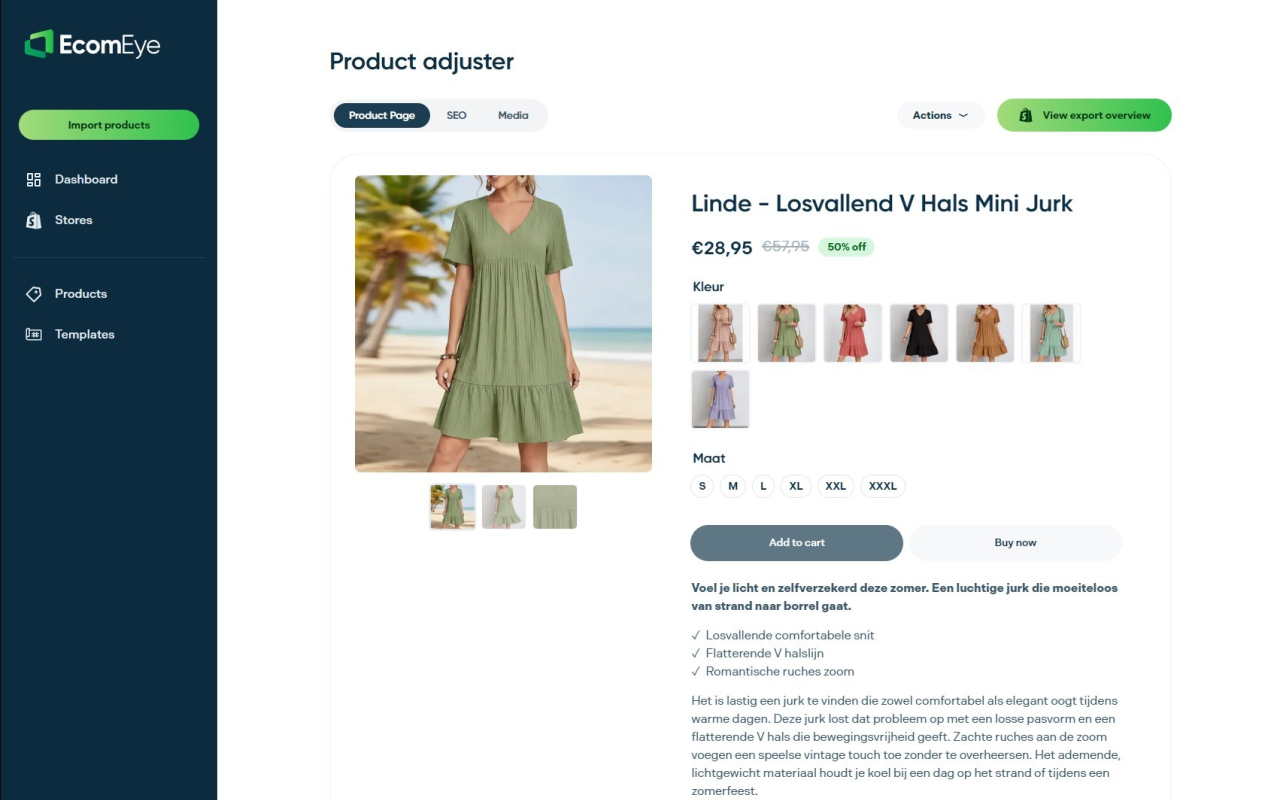
The platform addresses the core challenges dropshippers face: duplicate content penalties, Google Merchant disapprovals, and time-consuming manual localisation. Import products in bulk, generate multi-language pages optimised for local search intent, and export directly to Shopify in minutes rather than weeks.
Flexible pricing plans suit businesses at every stage, from new dropshippers testing international markets to established stores scaling across dozens of countries. Start streamlining your global expansion today with EcomEye’s proven automation technology designed specifically for Shopify ecommerce success.
Frequently asked questions
What is ecommerce localisation?
Ecommerce localisation adapts product content including language, cultural elements, SEO keywords, and regulatory compliance to suit specific local markets beyond simple translation. It ensures product pages resonate authentically with local customers whilst meeting legal requirements and search engine expectations for each target region.
Why is simple translation not enough for ecommerce SEO?
Simple translation misses local keyword intent, cultural nuances, and legal compliance requirements that search engines evaluate. Over 70% of translation-only efforts fail to improve SEO because they ignore how locals actually search, the terms they use, and the cultural context that builds trust and drives conversions.
How can automation tools help with ecommerce localisation?
Automation speeds up localisation by bulk generating SEO-ready titles, descriptions, and images that eliminate manual effort. Tools reduce copyright risks through AI-generated content whilst scaling international product pages efficiently. EcomEye automation specifically addresses Shopify dropshipping needs for multi-language, copyright-safe product catalogues.
What are common mistakes to avoid in ecommerce localisation?
Avoid copying competitors’ content, which causes duplicate penalties and Google Merchant disapprovals that reduce traffic by 40%. Don’t rely solely on translation; fully adapt cultural elements, SEO keywords, imagery, and legal compliance. Ignoring local search intent and regulatory requirements guarantees poor performance regardless of translation quality.
Ready to boost your product pages?
Generate high-converting, SEO-optimized product pages in bulk using AI automation used by e-commerce experts.
No credit card required