SEO content generation for Shopify dropshippers
Discover what is SEO content generation for Shopify dropshippers. Create unique, search-optimized product pages that boost rankings and sales.

SEO content generation for Shopify dropshippers

TL;DR:
- Automated SEO content generation helps Shopify dropshippers produce unique, structured product pages that improve search rankings. Human oversight ensures the accuracy, brand voice, and compliance of AI-created copy, reducing risks like duplicate content and misleading claims. Using tools like Ecom-eye streamlines bulk import, prompt-based generation, and direct Shopify export, leading to measurable SEO improvements over time.
SEO content generation is the process of producing search-optimised product copy, structured headings, and factual snippets through a combination of automated tools, prompt templates, and human editorial oversight. For Shopify dropshippers, it solves one specific problem: you cannot rank, get indexed cleanly by Google AI Overviews, or pass Google Merchant Centre review when your product pages are copied from a supplier or a competitor.
The three things that make automated generation work for dropshipping:
- Uniqueness at scale — each product page gets original copy, not recycled supplier text
- Structured output — titles, meta descriptions, spec tables, and FAQs formatted for E-E-A-T signals
- Human oversight — a QA layer that catches hallucinated specs before they cause returns or Merchant disapprovals
Tools like Ecom-eye are built specifically around this workflow, handling bulk import, generation, and one-click Shopify export so you are not rewriting 500 listings by hand.
Table of Contents
- Why does SEO content generation matter for your Shopify store?
- How does SEO content generation actually work?
- Step-by-step bulk workflow for Shopify product pages
- What separates high-performing pages from junk output?
- When will you see results, and what should you measure?
- Common pitfalls and UK compliance considerations
- How Ecom-eye covers this workflow for Shopify
- Key takeaways
- The part most guides skip
- Ecom-eye puts this workflow within reach
- Useful sources
- FAQ
Why does SEO content generation matter for your Shopify store?
Duplicate product descriptions are the single most common reason dropshipping stores stagnate in search. Google does not penalise you for copying a supplier description in a manual sense, but it will consistently rank the original source above you, and Google Merchant Centre will flag identical copy as a policy issue.
The practical benefits of generating unique SEO content at scale:
- Better indexing — original pages get crawled and indexed faster than near-duplicate ones
- Higher click-through rates — benefit-led titles and compelling meta descriptions outperform generic supplier copy
- Fewer Merchant disapprovals — clean, factual descriptions reduce the risk of Shopping feed suspensions
- AI Overview visibility — structured summaries and spec tables are the elements Google’s generative layer is most likely to surface
A store that replaces many copied supplier descriptions with unique, structured pages typically sees a measurable improvement in impressions within the first several weeks, before organic rankings fully stabilise. The gains compound: topical authority builds as more pages earn consistent signals, which lifts the whole domain over time.
How does SEO content generation actually work?
The core process is a data pipeline: raw product information goes in, structured SEO copy comes out, and a human checks it before it goes live.

The data flow
Product feed → field mapping → prompt or template → AI draft → human edit → publish to Shopify.
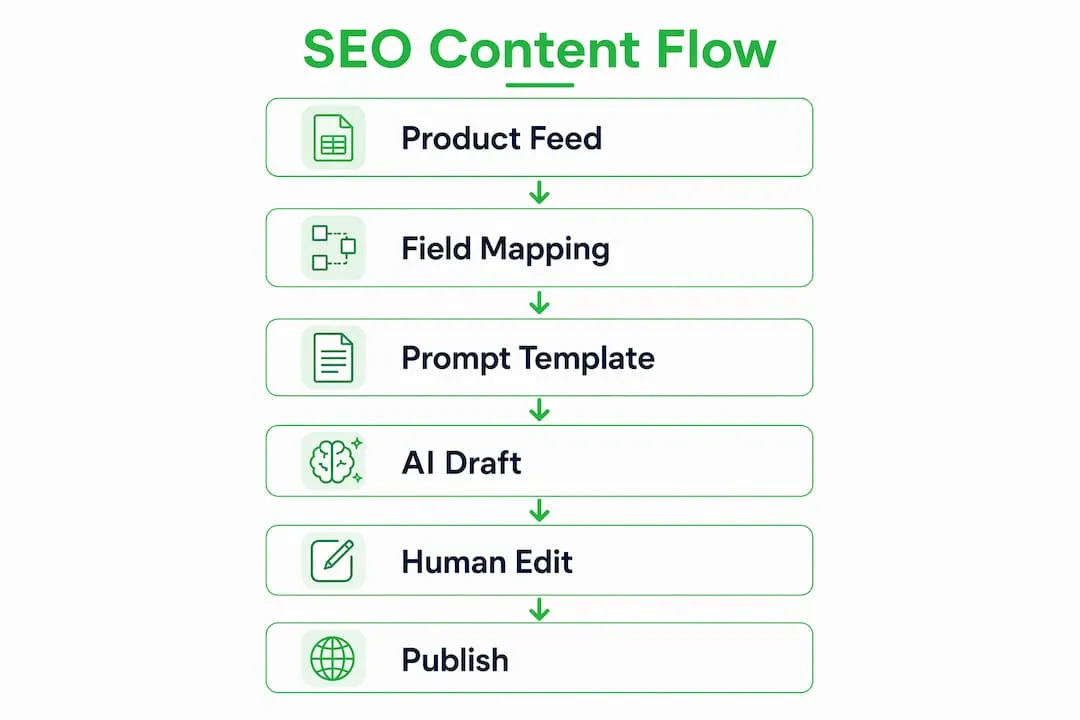
Each stage depends on the quality of what you feed it. Garbage inputs produce boilerplate outputs. Specific inputs — dimensions, materials, use cases, SKU-level USPs — produce pages that are genuinely distinct.
Field mapping for Shopify
| Shopify field | Typical source | Notes |
|---|---|---|
| Product title | Supplier title + keyword research | Rewrite for search intent |
| Short description | Supplier bullet points + USPs | Unique, benefit-led |
| Long description | Spec sheet + use-case prompts | — |
| Meta title | Generated from product title | — |
| Meta description | Summary of key benefit + CTA | — |
| Spec table | Raw supplier data | Structured for AI citation |
| FAQ | Common buyer questions | 3–5 Q&As per product |
Shopify metafields for structured data are worth populating alongside the standard fields — they feed Google’s rich results and improve AI Overview eligibility.
Pro Tip: Feed at least three SKU-unique details into every prompt: a precise dimension, a specific material or certification, and one use-case that differentiates this product from similar listings. Without these, AI drafts default to generic phrasing that looks identical across your catalogue.
Step-by-step bulk workflow for Shopify product pages
- Audit your existing pages. Identify which SKUs have duplicate or thin descriptions. Prioritise your top 20% by revenue or traffic.
- Import your product feed. Pull from AliExpress, a supplier CSV, or existing Shopify exports. Include all available spec data.
- Map fields to prompt variables. Assign each data field (title, material, dimensions, category) to the corresponding template placeholder.
- Select or build templates. Use separate templates for product titles, short descriptions, long descriptions, and FAQs. Each template should specify tone, prohibited phrases, and required structure.
- Run a small test batch first. Generate 10–20 pages before scaling. Review for hallucinations, brand-voice fit, and factual accuracy.
- QA-sample the full batch. Check at least 10% of generated pages manually. Run uniqueness checks, verify key specs against supplier data, and confirm images are correctly attributed.
- Export to Shopify. Push approved pages in one batch. Use bulk product page generation tools that map directly to Shopify’s product schema.
- Monitor for 8 weeks. Track impressions, average position, and Merchant approval rate. Flag any pages with high bounce rates or zero impressions for re-generation.
What separates high-performing pages from junk output?
The difference is almost always in the prompt and the QA step, not the AI model itself.
Prompt rules that consistently improve output quality:
- State the target keyword and search intent explicitly in the prompt
- Prohibit vague filler phrases (“high quality”, “perfect for”, “great product”)
- Require a spec table and at least one FAQ per product
- Specify word count ranges for each field
- Include a brand-voice reference sentence the model can match
Quality checklist before publishing:
- Uniqueness check against your existing catalogue and supplier pages
- Factual verification of all dimensions, materials, and certifications
- Brand-voice review — does it sound like your store, not a generic listing?
- Google Merchant Centre policy check — no prohibited claims, no misleading pricing language
- Image alt-text review — descriptive, keyword-relevant, not keyword-stuffed
AI-generated content carries real ranking risk when it is generic or factually wrong. Baking SEO intent into prompts and running a human review layer removes most of that risk before it reaches your live store.
Pro Tip: Build a one-page correction rules document: a list of 10–15 phrases your AI consistently gets wrong or overuses. Share it with anyone doing micro-edits. This scales human QA without requiring deep SEO knowledge from every reviewer.
When will you see results, and what should you measure?
SEO content is a long-term asset. The realistic timeline involves initial indexing with volatility during the first couple of months, followed by steady traffic growth over several months, and compounding authority gains that continue over the longer term
KPIs to track from day one:
- Organic impressions and average position (Google Search Console)
- Click-through rate per product page
- Organic sessions and engaged time
- Google Merchant Centre approval rate
- Conversion rate on regenerated pages vs. original pages
Use the 8-week mark to decide which pages need a second pass. Pages with impressions but low CTR usually need a better title or meta description. Pages with zero impressions after 8 weeks may have indexing issues worth investigating via product page indexing checks.
Common pitfalls and UK compliance considerations
The most common failure modes are predictable and avoidable.
Pitfalls to watch for:
- Boilerplate duplication — identical sentence structures across hundreds of pages, even when the product names differ
- Hallucinated specs — AI inventing dimensions, certifications, or compatibility claims that are factually wrong
- Misleading claims — superlatives or health/safety claims that trigger Merchant disapprovals or consumer complaints
UK-specific compliance checks:
- Advertising Standards Authority (ASA) rules apply to online product descriptions. Comparative claims and absolute superlatives (“the best”, “the only”) require substantiation.
- The Consumer Rights Act 2015 and the Consumer Contracts Regulations 2013 govern distance selling. Product descriptions must accurately reflect what is delivered.
- Product safety labelling requirements apply to certain categories (electrical goods, toys, cosmetics). AI-generated copy must not omit mandatory safety information.
- Copyright in product images and descriptions belongs to the original creator. AI-generated product images sidestep supplier copyright issues; repurposed supplier photos do not.
- Google Merchant Centre expectations include accurate pricing, clear product identifiers (GTIN, MPN), and descriptions free from promotional language.
This article is general information, not legal advice. Confirm current rules with the relevant authority or a qualified professional for your specific situation.
How Ecom-eye covers this workflow for Shopify
Ecom-eye is built around the exact pipeline described above, with Shopify dropshipping as the primary use case.
Feature-to-workflow mapping:
- Bulk import from AliExpress or competitor URLs → covers the feed import step
- Field mapping and prompt templates → covers template selection and variable assignment
- AI description generator → produces titles, short descriptions, long descriptions, and FAQs
- AI product image generator → creates copyright-safe images alongside the copy
- Multi-language export → generates pages in multiple languages in the same batch
- One-click Shopify export → pushes approved pages directly to your store
Before your first bulk run, prepare three things: a spec sheet for your product range, a short brand-voice guide (tone, prohibited phrases, preferred terminology), and 5–10 sample products to use as a test batch. That preparation takes an hour and prevents most of the QA issues that slow down larger runs.
Key takeaways
SEO content generation works for Shopify dropshipping when automated drafting is paired with structured inputs and a human QA layer before publishing.
| Point | Details |
|---|---|
| Uniqueness prevents penalties | Original descriptions avoid duplicate-content suppression and Google Merchant disapprovals. |
| Structured inputs drive quality | Feeding SKU-specific specs, dimensions, and USPs into prompts prevents boilerplate output. |
| QA sampling is non-negotiable | Check at least 10% of generated pages for factual accuracy, uniqueness, and brand voice. |
| Results take time | Expect initial indexing within a couple of months, steady traffic growth after several months, and compounding gains over an extended period. |
| Ecom-eye covers the full pipeline | Bulk import, AI generation, image creation, and one-click Shopify export in a single workflow. |
The part most guides skip
The honest conversation about automated SEO content is not about which AI model writes the best product descriptions. It is about what happens after the generation step.
Human oversight remains essential not because AI is unreliable in some abstract sense, but because the consequences of a wrong spec, a misleading claim, or a duplicated sentence structure fall entirely on the store owner. A hallucinated certification on an electrical product is not just an SEO problem; it is a consumer protection issue. Most guides treat QA as a footnote. It is the actual work.
The stores that get the most from automated content generation are the ones that invest in their inputs and their correction rules, not the ones chasing the newest model. Feed the system better data, build a short list of what it consistently gets wrong, and fix those patterns once rather than correcting them page by page. That is where the time saving actually lives.
Optimising for AI search follows the same logic: structured, factual, human-verified content performs better in both classic SERPs and AI Overviews than content that was generated and published without review.
Ecom-eye puts this workflow within reach
Replacing copied supplier descriptions with unique, structured product pages is the single highest-leverage SEO move available to a Shopify dropshipper. Ecom-eye does it in bulk, without the manual rewriting, the copyright exposure, or the Merchant disapprovals that come from recycled content.
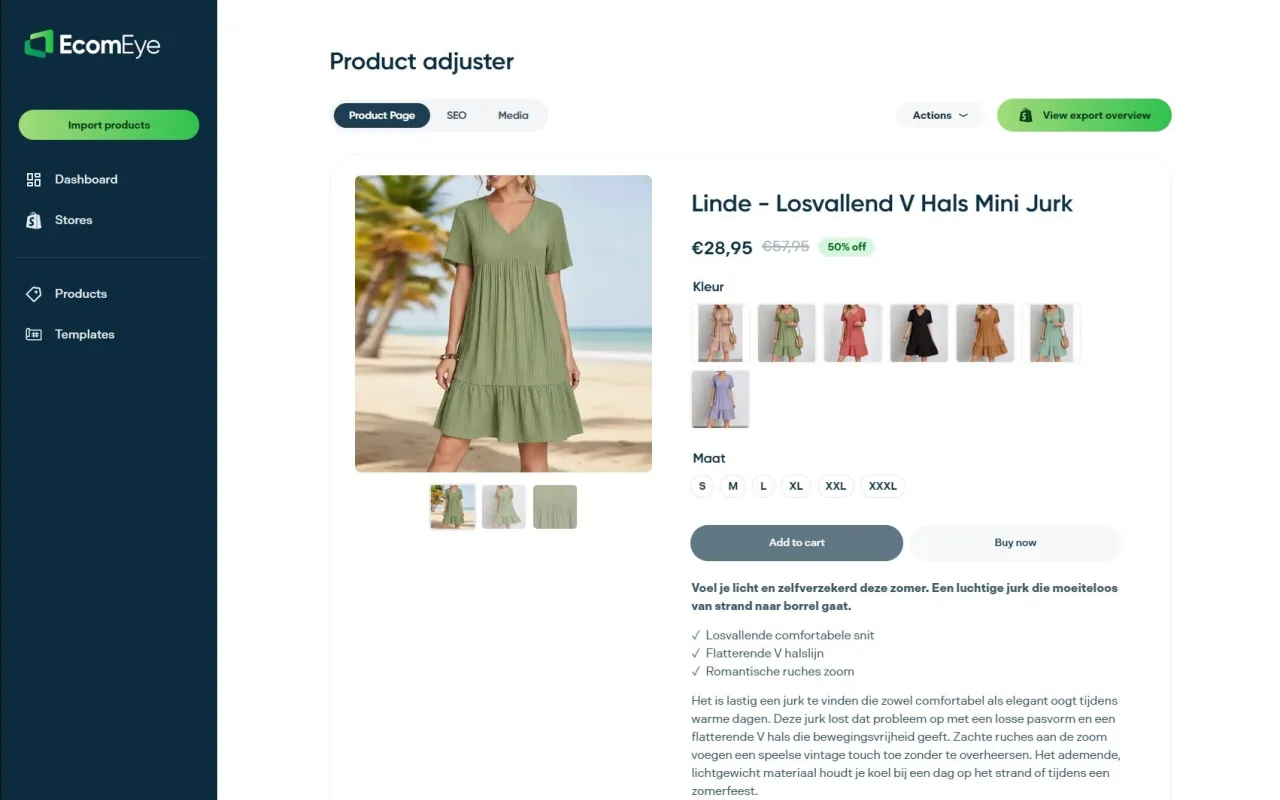
Import your products, generate SEO-ready titles, descriptions, spec tables, FAQs, and AI product images, then push everything to Shopify in one click. You can start with your top 20 SKUs and see the difference in your Search Console impressions within weeks. Try the AI product description generator or go straight to the bulk product lister to run your first batch.
Useful sources
- Search Engine Land: Create content for search generative engines — structured snippets and AI indexing guidance
- Neil Patel: Can AI create content? — human oversight, E-E-A-T, and quality responsibility
- Search Engine Land: AI-generated content — benefits, risks and SEO best practices — prompt engineering and risk mitigation
- Powered By Search: SEO automated content generation — hybrid AI and editorial workflows
- SEOAuthori: How SEO content writing drives measurable business growth — timeline and KPI benchmarks
- KeyGrow: Does content marketing benefit SEO? — topical authority and compounding returns
- BabyLoveGrowth: Structured data SEO — 30+ rich results you can win — schema types for ecommerce rich results
FAQ
What is SEO content generation in plain terms?
It is the process of using automated tools and prompt templates to produce search-optimised product copy, titles, meta descriptions, and structured snippets, combined with human review before publishing.
Does AI-generated content hurt your Google rankings?
Generic or duplicated AI content can suppress rankings, but well-structured, factually verified AI content that passes a human QA step performs as well as manually written copy.
How many product pages should you QA manually?
Check at least 10% of any generated batch manually, verifying specs against supplier data, running a uniqueness check, and confirming no prohibited claims are present.
How long before SEO content generation shows results?
Expect initial indexing within 0–8 weeks, consistent traffic growth at 3–6 months, and compounding domain-level gains from 9–18 months onwards.
Can Ecom-eye handle bulk generation and Shopify export?
Yes. Ecom-eye imports products in bulk from AliExpress or competitor URLs, generates titles, descriptions, FAQs, and AI product images, then exports directly to Shopify in one click.
Ready to boost your product pages?
Generate high-converting, SEO-optimized product pages in bulk using AI automation used by e-commerce experts.
No credit card required