Brand differentiation in dropshipping: stand out and boost sales
Discover what brand differentiation in dropshipping means. Learn how to stand out, boost sales, and create lasting customer loyalty today!
TL;DR:
- Effective brand differentiation in dropshipping creates emotional connections and trust, setting stores apart from lookalike competitors. It relies on controlling storytelling, trust signals, creative merchandising, and SEO content rather than just product choices or packaging. This strategic focus drives higher prices, better customer loyalty, and sustainable growth over purely price-based competition.
Most dropshipping stores look identical. Same products, same supplier photos, same copy-pasted descriptions. When everything looks the same, the only competition left is price, and that is a race nobody wins. The stores that break out of this cycle are not the ones with the lowest prices or the fastest shipping. They are the ones that make customers feel something, remember something, and come back. This article shows you exactly what brand differentiation means for dropshipping stores, what you can actually control, and how to turn it into a genuine competitive advantage that improves your SEO and builds lasting loyalty.
Table of Contents
- What does brand differentiation mean in dropshipping?
- Key levers of differentiation for dropshippers
- Branded packaging and white-label fulfilment
- Differentiation and competitive advantage: price versus value
- Brand differentiation, SEO, and customer loyalty
- The most overlooked truth about brand differentiation in dropshipping
- Tools to help you differentiate and thrive
- Frequently asked questions
Key Takeaways
| Point | Details |
|---|---|
| Differentiation is not just design | True brand differentiation means offering a unique value, not just a prettier logo or product selection. |
| Leverage all controllable levers | Brand identity, storytelling, trust signals, and content all shape customer perception and loyalty. |
| Branded fulfilment isn’t the only path | If you can’t control packaging, double down on digital trust, merchandising, and unique store experiences. |
| SEO supports differentiation | Align your SEO strategy with your brand story and value proposition to attract and retain the right customers. |
What does brand differentiation mean in dropshipping?
Brand differentiation is not about having a clever logo or a catchy store name. It is about giving your customers a specific, compelling reason to choose you over every other shop selling the same items. In plain terms, brand differentiation means making your store and your product presentation meaningfully distinct from other sellers offering the same underlying supplier items.
The challenge in dropshipping is structural. When you and fifty other stores source from the same AliExpress suppliers, the product itself offers zero differentiation. The goods arrive in the same boxes, photographed against the same white backgrounds, described with the same supplier copy. What you are left with is a sea of lookalike stores competing on price alone, which drags margins down for everyone.
Here is what smart store owners understand: the product is a commodity, but the brand is yours. Customers do not buy because you have the cheapest yoga mat. They buy because your store feels trustworthy, your story resonates, and your content answers their questions better than anyone else’s.
Brand differentiation also gives you a clear value proposition, which is the specific claim you make about why you are the right choice. A strong value proposition allows you to justify premium pricing, attract the right customers, and reduce the churn that plagues price-focused stores.
Key reasons differentiation matters more than ever:
- Search engines penalise duplicate content, so copied supplier descriptions hurt your rankings directly
- Customers are more sceptical than before and rely on trust signals before purchasing
- Social media advertising costs have risen sharply, making repeat customers far more valuable
- Google Merchant Centre disapprovals are increasingly tied to thin, duplicated product content
Key levers of differentiation for dropshippers
Because dropshipping storefronts often sell similar items, differentiation typically comes from what you control beyond the commodity product: brand identity, storytelling, trust signals, and customer experience. The good news is that these levers are entirely within your reach, regardless of your supplier.

The five main levers you can activate right now are: branding elements, storytelling, customer trust and experience, creative merchandising, and content strategy. Each one independently adds value, but together they create a compounding effect where your store becomes genuinely hard to copy.

| Lever | What it means | Why it matters | Example in action |
|---|---|---|---|
| Branding elements | Visual identity: colours, fonts, tone of voice | Creates instant recognition and sets expectations | A fitness store using bold typography and an energetic colour palette |
| Storytelling | Your brand’s origin, mission, and personality | Connects emotionally and builds trust | A pet accessories store founded by a dog rescue volunteer |
| Trust signals | Reviews, guarantees, certifications, return policies | Reduces purchase anxiety | Displaying verified Trustpilot ratings prominently on product pages |
| Creative merchandising | How you present, group, and describe products | Makes browsing intuitive and persuasive | Curated bundles with benefit-led copy rather than spec lists |
| Content strategy | Blogs, guides, landing pages, and SEO content | Attracts the right traffic and establishes authority | A skincare store publishing ingredient explainers tied to each product |
Shopify notes that differentiation should be visible and consistently delivered across touchpoints. Simply having visual assets without a coherent value proposition risks being perceived as interchangeable. In other words, you can have a beautiful logo and still fail if your messaging is vague.
Consistency is the multiplier. A customer who sees the same voice and values on your store, your emails, and your Instagram is far more likely to form a genuine connection with your brand. Small, consistent differences accumulate into real advantages over time.
Pro Tip: Audit every customer-facing touchpoint this week. Does your email confirmation match the tone of your store? Does your social media feel like the same brand? Inconsistencies signal to customers that you are just another generic shop. Coherent optimised product content is one of the most overlooked differentiators available.
Avoiding the common dropshipping pitfalls often comes down to recognising this: most store owners invest heavily in advertising but almost nothing in brand coherence. Flip that ratio.
Branded packaging and white-label fulfilment
Beyond digital signals, your physical presentation can become your differentiator when you have the means and the know-how. A common dropshipping-specific approach to differentiation is branded or white-label style fulfilment: selling under your own brand with branded packaging and labels, so the customer experience reflects your brand rather than the supplier’s generic presentation.
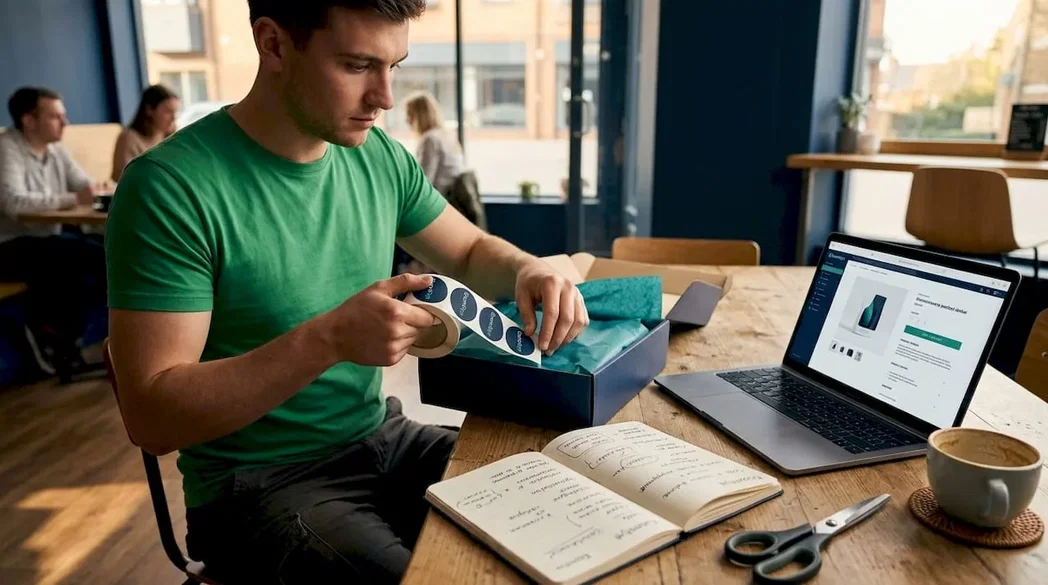
The unboxing moment is frequently underrated. When a customer receives a parcel that feels curated, labelled professionally, and wrapped thoughtfully, it changes how they perceive the product’s quality. Even a modest branded sticker on a plain box lifts perceived value noticeably.
Here is a step-by-step process for negotiating branded packaging with your supplier:
- Identify your top-selling products first. Branded packaging has upfront costs, so focus on items with the highest repeat purchase potential.
- Contact the supplier directly and ask explicitly whether they offer custom inserts, stickers, or branded outer packaging. Many AliExpress suppliers do this for a small fee per order.
- Request samples before rolling out to all orders. Check that the branding is applied consistently and looks professional.
- Negotiate a minimum order volume that makes branded fulfilment economically viable for both parties.
- Document the arrangement clearly in writing to avoid disputes further down the line.
| Feature | Branded fulfilment | Generic fulfilment |
|---|---|---|
| Customer impact | Creates memorable, premium experience | Forgettable, feels like buying from a warehouse |
| Perceived value | Higher, supports premium pricing | Lower, invites price comparisons |
| Repeat sales likelihood | Significantly higher | Depends entirely on product quality |
| Setup effort | Moderate, requires supplier negotiation | None required |
If your suppliers ship generic packaging and you cannot control branding elements, differentiation shifts to non-physical levers: creative merchandising, store narrative, customer experience, and trust signals. That is not a compromise. Some of the most successful stores in the market have built fierce loyalty purely through digital brand expression.
Staying current on Shopify dropshipping trends will help you spot when branded fulfilment becomes more accessible in your niche as supplier competition increases.
Pro Tip: If you cannot access branded packaging, invest in post-purchase email sequences. A personalised thank-you email with care instructions, a handwritten-style note, and a loyalty discount can replicate much of the emotional impact of branded packaging.
Differentiation and competitive advantage: price versus value
To make differentiation work for you, it must become the driving force of your competitive strategy, not merely an afterthought you consider when sales dip.
“Differentiation is tied to competitive strategy: you choose to win via differentiation, offering something customers value enough to pay more for, rather than price competition.” Competitive Advantage
The race to the bottom is real and it is brutal. When you compete purely on price, you attract customers who are loyal only to whoever is cheapest today. The moment a competitor undercuts you by 50 pence, that customer disappears. There is no loyalty, no word of mouth, and no margin left to invest in growth.
Signs you are stuck competing on price:
- You check competitor prices daily and adjust yours reactively
- Customers frequently abandon at checkout asking for a discount code
- Your repeat purchase rate is below 10 per cent
- Your average order value has declined despite traffic staying flat
Signs you are winning with value:
- Customers leave reviews mentioning the brand experience, not just the product
- Your conversion rate is higher than the category average even at a higher price
- Email subscribers engage with your content, not just promotional offers
- Referrals and word of mouth contribute meaningfully to new customer acquisition
The methodology that underpins successful differentiation is competitive positioning: define who you serve and what makes you meaningfully different, because customers must be able to articulate why they chose you. If they cannot, price becomes your only lever by default.
Creating unique content for SEO is one of the clearest and most actionable ways to communicate that difference at scale. Generic product descriptions written for everyone speak to no one.
Brand differentiation, SEO, and customer loyalty
Having understood the strategy, consider how differentiation ties directly to more visible and profitable stores. The connection between brand clarity and search performance is stronger than most store owners realise.
Google does not just index your products. It evaluates the overall quality, relevance, and trustworthiness of your store. A differentiated store with consistent brand messaging and trust-building content helps turn store traffic into repeat customers. Omnisend’s dropshipping success data explicitly links branding with differentiation, trust, loyalty, and converting one-time buyers into repeat purchasers.
Content types that reinforce differentiation and help SEO simultaneously:
- Unique product descriptions written for your specific audience, not copied from suppliers
- Brand story and about pages that give Google a clear picture of who you are and who you serve
- Blog posts and buying guides that answer questions your target customers are actively searching
- Authentic customer reviews with detailed text that adds keyword-rich, trust-building content naturally
- Niche-specific landing pages that map to differentiated value propositions rather than generic category listings
Building SEO content that maps to your differentiated value proposition is what separates stores that rank from stores that remain invisible. Publishing generic product descriptions means competing with thousands of identical pages. Publishing content that explains why your offering is different and who it is for gives search engines a clear reason to surface your store above the rest.
Loyalty is the long-term dividend of differentiation. When your store communicates a coherent identity, serves a specific audience well, and consistently delivers on its promises, customers return without needing to be retargeted. That reduces advertising spend and increases lifetime customer value in a way that no price promotion can replicate.
Prioritise SEO-friendly dropshipping content from day one. Retrofitting SEO into a store built on duplicate content is far more costly and time-consuming than building correctly from the start.
The most overlooked truth about brand differentiation in dropshipping
Here is a perspective you will not find in most differentiation checklists: copying visible brand assets is not differentiation. It is decoration.
Many dropshippers look at successful stores and attempt to replicate the surface layer. They adopt a similar colour palette, write a comparable mission statement, and source matching product photography. But what they are actually doing is creating a better-looking version of a commodity store. The visible elements of a brand are the output of a story, not the story itself.
True differentiation is built through repeated, authentic engagement with a specific audience over time. It is the store that consistently answers its customers’ questions before they are asked. It is the email sequence that feels like it was written by someone who genuinely understands the customer’s life. It is the product curation that shows real taste, not just what the algorithm recommends.
Most stores treat differentiation as a one-time project. They rebrand, redesign, and then return to the same behaviour: copying competitor listings, pushing ads without content strategy, and ignoring the customer beyond the transaction. Differentiation without the discipline to maintain it dissolves quickly.
The real moat is built by continually aligning your offer with your customer’s evolving needs. That requires listening, experimenting, and being willing to update your positioning as the market changes. No checklist can replace that ongoing commitment.
Marketing strategies for dropshipping that leverage AI and automation can help you stay consistent at scale, but the strategic direction always has to come from a genuine understanding of your audience.
Tools to help you differentiate and thrive
Transitioning from principle to practice, here is how you can put brand differentiation into action faster and smarter.
One of the most immediate ways to differentiate is through your product content. If your pages use copied supplier descriptions, you face duplicate content penalties, low SEO rankings, and Google Merchant disapprovals before a single customer even arrives.

EcomEye makes this fixable in minutes. With EcomEye’s automation tools, you can import products in bulk from AliExpress or competitor links and automatically generate optimised titles, clean descriptions, SEO-ready content, high-quality AI product images, and multi-language pages. Everything exports directly to Shopify in one click, with no rewriting, no copyright risk, and no manual work. Pair that with thoughtful shop page layout tips to ensure your store’s structure supports both user experience and search visibility. Differentiation starts with content, and EcomEye gives you the foundation to build it at scale.
Frequently asked questions
What is the biggest mistake to avoid with dropshipping brand differentiation?
The biggest mistake is relying only on logos or product selection. True differentiation requires a clear value proposition that is consistently delivered across every customer touchpoint, not just visible brand assets.
How do I differentiate my dropshipping store if my supplier won’t let me use branded packaging?
Focus on trust signals, creative merchandising, unique stories, and customer experience to stand out digitally. If physical branding is unavailable, non-physical levers like store narrative and customer experience become your primary differentiators.
What specific content helps with both differentiation and SEO in dropshipping?
Brand-aligned landing pages, unique product copy, and authentic customer reviews all differentiate your store and improve search visibility. Consistent brand messaging tied to trust-building content is what converts traffic into repeat customers over time.
Does effective differentiation really allow for higher prices in dropshipping?
Yes. Customers pay more for brands that show clear unique value. Differentiation-led strategy allows you to compete on value rather than price, supporting healthier margins and stronger customer retention.
Ready to boost your product pages?
Generate high-converting, SEO-optimized product pages in bulk using AI automation used by e-commerce experts.
No credit card required