Dropshipping advantages in 2026: what you need to know
Discover the dropshipping advantages in 2026. Learn how supply chain shifts and AI are reshaping success in online retail. Dive in now!

Dropshipping advantages in 2026: what you need to know

TL;DR:
- Dropshipping in 2026 thrives through diversified near-shore sourcing, advanced product data management, and strategic branding. Success requires active supplier relationships, disciplined investment, and high-ticket niche focus to sustain margins and compete effectively. Proper execution and automation tools are essential for building a profitable, scalable dropshipping business.
Dropshipping is a retail fulfilment model where sellers list and sell products without holding stock, with suppliers shipping directly to customers. The model is thriving in 2026. The global market sits between $401 billion and $476 billion, and 27% of online retailers use it as their primary fulfilment method. The dropshipping advantages in 2026 are real, but they belong to operators who treat the model as a proper business, not a passive income shortcut. Supply chain shifts, AI-driven discovery, and near-shore sourcing have reshaped what success looks like.
1. Supply chain diversification is now a core dropshipping advantage in 2026

The biggest structural change in dropshipping this year is where products come from. Tariff friction on Chinese goods has pushed effective duties above 35% in many categories, making the old model of sourcing everything from a single Chinese supplier economically unworkable.
Mexican and Vietnamese supplier onboarding grew 74% year-over-year through Q2 2026. U.S.-based supplier searches increased by 61% over the same period. These are not marginal shifts. They represent a fundamental reorientation of where dropshippers source their goods.
The practical benefits are significant:
- Faster delivery: Domestic U.S. warehouse fulfilment now handles 34% of all orders to U.S. consumers, up from 19% in Q1 2025. Shipping times of 3–7 days replace the 2–3 week delays that plagued Chinese-origin fulfilment.
- Better margins: Near-shore suppliers in Mexico and Vietnam offer consistent quality with lower damage-related return rates, protecting gross margins.
- Tariff resilience: Products sourced domestically or from near-shore partners avoid the duty exposure that erodes profitability on Chinese-origin goods.
- Supplier vetting as a skill: Leading operators now manage supplier contracts actively, monitor performance rigorously, and build hybrid supply chains for regional order routing.
Categories benefiting most from this shift include furniture, home goods, and fitness equipment, where near-shore suppliers can match quality expectations at competitive price points.
Pro Tip: Build relationships with at least two suppliers per product category. Single-supplier dependence is the fastest route to stockouts and fulfilment failures.
2. Low startup costs and fast product testing remain unmatched
Dropshipping still offers one of the lowest barriers to entry in e-commerce. Entrepreneurs can start with around €2,500 and scale by reinvesting profits rather than raising external capital. That figure covers initial advertising spend, platform fees, and basic tooling.
The model’s cost structure is fundamentally different from traditional retail. You do not pay for stock until a customer pays you. You do not rent warehouse space. You do not hire fulfilment staff. Those savings compound quickly when you are testing multiple product ideas simultaneously.
Here is what makes the operational model work at scale:
- Rapid product testing: You can list a new product, run a small paid traffic test, and know within days whether demand exists. Traditional retailers commit to bulk orders before seeing a single sale.
- No warehousing overhead: Supplier-managed fulfilment means your cost base does not grow proportionally with order volume.
- Location independence: Your business runs from anywhere with an internet connection, which opens access to global talent and diverse markets.
- Flexible scaling: Successful operators run multiple Shopify stores with over $2 million in combined monthly revenue, scaling through marketing investment rather than infrastructure build-out.
- Lower ongoing overhead: Without physical stock, your fixed costs stay low even as revenue grows.
Pro Tip: Use fast product listing as a competitive weapon. The operator who tests ten products a week learns faster than the one who spends a month perfecting a single listing.
3. TikTok Shop and AI discovery have transformed customer acquisition
Marketing is where the benefits of dropshipping in 2026 have shifted most dramatically. Two forces are reshaping how customers find and buy products: TikTok Shop and AI-powered commerce protocols.
TikTok Shop now delivers customer acquisition costs 40–60% lower than traditional paid social advertising. The platform grew from roughly 4,450 shops in mid-2023 to approximately 475,000 shops in 2026 in the U.S. alone. That growth reflects genuine commercial activity, not just content consumption.
The second force is structural. Google introduced the Universal Commerce Protocol in 2026, enabling AI agents including Gemini and ChatGPT to discover and transact with stores via product feed data. This changes the rules of visibility entirely.
Key implications for dropshippers:
- Feed hygiene is now non-negotiable: Stores without a clean presence in Google Merchant Center risk invisibility to customers using AI shopping assistants. Product feed optimisation is as critical as SEO once was.
- Structured product data wins: AI agents parse attributes, not prose. Accurate titles, clean descriptions, and correct product attributes determine whether your store appears in AI-driven results.
- Multi-channel presence compounds: Organic TikTok content, paid social, and AI commerce visibility work together. Relying on a single channel creates fragility.
- The zero-friction myth is dead: Success now demands capital investment of £1,200–£2,400 and disciplined operational execution, not a quick product listing and hope.
Ecom-eye addresses the feed hygiene challenge directly. It generates copyright-safe, SEO-ready product pages in bulk, with structured data built in, so your store is visible to both search engines and AI shopping agents.
4. High-ticket niches deliver the strongest margins
Not all product categories carry equal profit potential. The dropshipping trends in 2026 point clearly toward higher average order values as the path to sustainable margins.
High-ticket dropshipping in furniture and home furnishings with near-shore suppliers offers 35–55% gross margins on products retailing between $400 and $1,800. That margin profile changes the economics of customer acquisition entirely. You can afford to spend more to acquire each customer when the order value is high.
Successful operators in 2026 target net margins of 15–30% through brand building, diversified supply, and multi-channel marketing. Pure arbitrage on cheap commodity goods no longer delivers those numbers.
| Category | Why it works in 2026 | Margin profile |
|---|---|---|
| Furniture and home furnishings | Near-shore suppliers, high AOV, low return rates | 35–55% gross |
| Fitness equipment | Domestic suppliers, strong demand, repeat buyers | 25–40% gross |
| Home office supplies | Remote work demand, B2B and B2C crossover | 20–35% gross |
| Pet accessories | TikTok-driven trends, loyal buyer base | 20–30% gross |
| Skincare and beauty | High repeat purchase rate, brand-building potential | 15–30% gross |
Categories to avoid are low-margin commodity goods with heavy Chinese-origin exposure. Tariffs and rising ad costs make those products unprofitable before you account for returns.
The designer and luxury fashion segment illustrates a broader principle: niche markets with high average order values and brand-conscious buyers reward operators who invest in quality presentation and supplier relationships.
Pro Tip: Match your average order value to your customer acquisition cost model before committing to a niche. A £30 product cannot sustain a £25 cost per acquisition.
5. Branding and content create durable competitive advantages
The dropshipping operators who built durable businesses in 2026 share one characteristic: they stopped competing on price and started competing on brand. Price arbitrage is a race to the bottom. Brand equity compounds over time.
Building a brand in dropshipping does not require a private label product. It requires consistent visual identity, a clear customer promise, and product pages that communicate quality. Customers cannot touch your products before buying. Your content does the selling. Brand differentiation is the mechanism that converts browsers into buyers and buyers into repeat customers.
Ecom-eye generates AI product images alongside optimised titles and descriptions, giving every listing a professional presentation without manual design work. That consistency across a catalogue of hundreds of products is what separates a credible store from a generic one.
6. Automation platforms extend operational capacity
Automation is not optional for dropshippers running at scale. Operators using automation platforms for order routing see better fulfilment resilience and fewer manual errors. These platforms now integrate beyond AliExpress to include U.S. and near-shore suppliers, reflecting the supply chain shift described earlier.
The practical value of automation is time. Every hour saved on manual order processing is an hour available for marketing, supplier development, or product research. At scale, that difference determines whether a business grows or stagnates.
Ecom-eye fits into this automation layer at the product page level. Bulk import from AliExpress or competitor links, automatic generation of optimised content, and one-click export to Shopify removes the most time-consuming part of launching new products.
7. Why choose dropshipping in 2026 over traditional e-commerce
The comparison between dropshipping and traditional inventory-based e-commerce comes down to capital efficiency and speed. Traditional e-commerce requires significant upfront stock investment, warehousing, and fulfilment infrastructure before a single sale is made. Dropshipping inverts that model entirely.
The Shopify dropshipping trends for 2026 show that the model’s advantages are strongest for entrepreneurs who want to test markets quickly, operate with low fixed costs, and scale through marketing rather than logistics. Those are structural advantages that do not disappear as the market matures.
The risks are real too. Thin margins on the wrong products, single-supplier dependence, and poor product page quality all destroy profitability. But those are execution failures, not model failures. The common mistakes that cost operators sales in 2026 are avoidable with the right systems in place.
Key takeaways
Dropshipping in 2026 is profitable for operators who combine near-shore sourcing, clean product data, and disciplined brand building to achieve net margins of 15–30%.
| Point | Details |
|---|---|
| Market scale confirms viability | The dropshipping market sits between $401 billion and $476 billion, with 27% of online retailers using the model. |
| Near-shore sourcing is the new edge | Mexican and Vietnamese supplier onboarding grew 74% year-over-year, delivering faster shipping and better margins. |
| AI feed hygiene drives visibility | Google’s Universal Commerce Protocol means clean product data now determines AI shopping discoverability. |
| High-ticket niches outperform | Furniture and home goods with near-shore suppliers deliver 35–55% gross margins on orders between $400 and $1,800. |
| Capital and discipline are required | Success demands an initial investment of £1,200–£2,400 and active supplier management, not passive arbitrage. |
Koen’s take: the operators who will win in 2026
The biggest mistake I see entrepreneurs make is treating dropshipping as a passive income model. It never was, and in 2026 it absolutely is not. The operators building real businesses are the ones who treat supplier relationships like partnerships, not plug-and-play connections.
What I have found actually works is reinvesting early profits into two things: paid advertising skills and supplier diversification. Most people spend their first profits on lifestyle. The ones who reinvest build a moat. Near-shore sourcing is not just a tariff workaround. It is a genuine quality and speed advantage that customers notice and reward with repeat purchases.
The branding piece is where I see the most untapped opportunity. Dropshipping stores that look and feel like real brands convert at dramatically higher rates than generic storefronts. You do not need a private label to build a brand. You need consistent imagery, clear copy, and a product range that tells a coherent story. That is entirely achievable with the right tools and the right mindset.
— Koen
How Ecom-eye helps you capture these advantages
The dropshipping advantages in 2026 are real, but they require execution. The biggest operational bottleneck for most Shopify dropshippers is product page quality at scale. Copying competitor listings creates duplicate content, Google Merchant disapprovals, and poor SEO rankings.
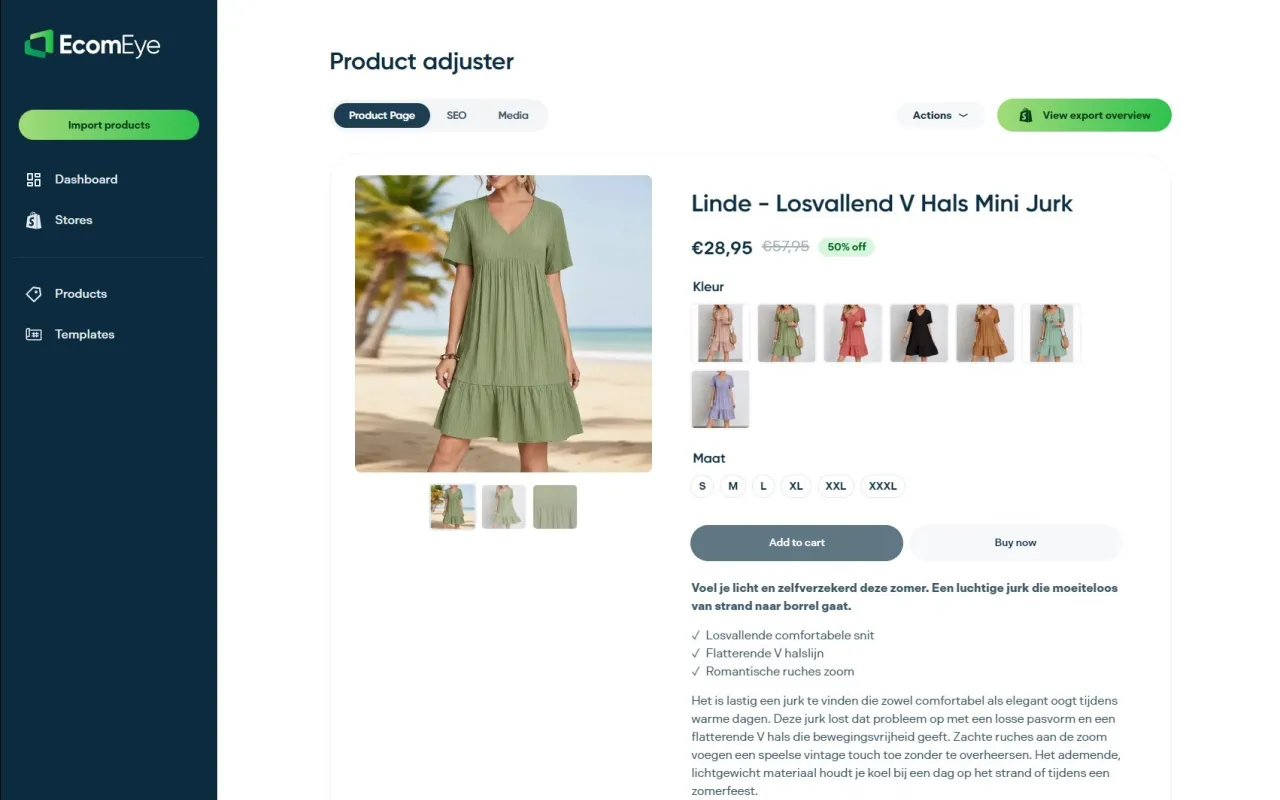
Ecom-eye solves that problem directly. Import products in bulk from AliExpress or competitor links, and the platform automatically generates optimised titles, clean descriptions, SEO-ready content, AI product images, and multi-language pages. Export everything to Shopify in one click. No rewriting, no copyright risk, and no manual work. If you are serious about building a dropshipping business that captures the benefits available in 2026, Ecom-eye gives you the product page infrastructure to compete.
FAQ
What is the dropshipping market worth in 2026?
The dropshipping market is valued between $401 billion and $476 billion in 2026. Around 27% of online retailers use dropshipping as their primary fulfilment model.
Is dropshipping profitable in 2026?
Dropshipping is profitable in 2026 for operators targeting net margins of 15–30% through brand building, near-shore sourcing, and multi-channel marketing. Pure arbitrage on commodity goods is no longer sustainable due to tariffs and rising advertising costs.
Which product categories work best for dropshipping in 2026?
High-ticket categories including furniture, fitness equipment, and home office supplies deliver the strongest margins, with near-shore suppliers offering 35–55% gross margins on products retailing between $400 and $1,800.
How has AI changed dropshipping in 2026?
Google’s Universal Commerce Protocol now enables AI agents like Gemini and ChatGPT to discover products via feed data. Stores with clean, structured product data in Google Merchant Center gain visibility in AI-driven shopping results.
How much does it cost to start dropshipping in 2026?
Starting a dropshipping business requires around €2,500 in initial capital to cover advertising, platform fees, and tooling. The zero-cost launch model is no longer viable; disciplined investment from the outset is what separates successful operators from those who fail quickly.
Ready to boost your product pages?
Generate high-converting, SEO-optimized product pages in bulk using AI automation used by e-commerce experts.
No credit card required