Creative product listing ideas that actually convert
Discover creative product listing ideas that convert browsers into buyers. Learn effective techniques to engage shoppers and boost sales.

Creative product listing ideas that actually convert

TL;DR:
- Effective product listings tell a story that resonates emotionally and clearly shows benefits.
- They focus on a single primary differentiator and use structured, AI-friendly content for discoverability.
Creative product listing ideas are the methods e-commerce sellers use to make products stand out, engage shoppers emotionally, and turn browsers into buyers. The standard approach of copying competitor pages fails on every front: duplicate content tanks your SEO rankings, Google Merchant rejects your ads, and shoppers see nothing worth choosing you over anyone else. 70% of online shoppers report that product content alone decides their purchase. That single figure tells you where the battle for conversion is won or lost. This article gives you the specific techniques that work, backed by research and built for e-commerce owners who need results, not theory.

1. Creative product listing ideas: lead with storytelling
The most effective product listings shift from listing specifications to telling a story the buyer can place themselves inside. Specs tell shoppers what a product is. Stories tell them what their life looks like after buying it.
Matching your copy tone to the emotional experience of the purchase is the first step. Copy tone should reflect the emotional state of the buyer, not the brand’s internal voice. A hangover supplement should sound like a sympathetic friend, not a clinical pharmacist. A luxury candle should feel like a quiet Saturday morning, not a warehouse catalogue entry.
Storytelling in listings works through three layers:
- Lifestyle context: Open with a scene the buyer recognises. “You’ve just finished a 10-hour shift” beats “This product is suitable for tired workers.”
- Specific outcome: Name the exact result. “Wakes you up in under 20 minutes” beats “promotes alertness.”
- Social proof: Weave in a customer voice or a concrete result. A single quoted sentence from a real buyer outperforms a five-star rating badge.
87% of consumers rate detailed product content as extremely important at the final buying stage. Shoppers are not looking for more specs at that point. They want confirmation that this product fits their life.
Pro Tip: Write your listing copy as if you are texting a friend who asked “should I buy this?” That constraint kills corporate filler immediately.
Before-and-after visuals and short video clips build trust before a shopper reads a single word of copy. Interactive and visual storytelling elements like these do the emotional heavy lifting so your text can focus on specifics.
2. Images, layout, and interactive features that reduce friction
Product display design is not decoration. Every element on a listing page either moves a shopper toward purchase or creates doubt that sends them elsewhere.
Overloading product displays with excess information increases cognitive load and reduces conversion. The fix is a clean visual hierarchy: hero image first, key benefit second, supporting detail third. Shoppers scan before they read, so the scan must do most of the selling.
High-impact display techniques that reduce friction include:
- Hero images with context: Show the product in use, not floating on a white background. A backpack worn on a mountain trail communicates capacity, comfort, and aspiration in one frame.
- 360° views and smooth zoom: Shoppers who cannot physically handle a product need the next best thing. 360° rotation and high-resolution zoom remove the “I can’t tell what this feels like” objection.
- Colour and variant swatches: Clicking a swatch to see the product change colour keeps the shopper on the page. Sending them to a new URL for each variant loses them.
- Collapsible information sections: Accordion-style tabs for sizing, materials, and shipping let detail-seekers find what they need without burying casual browsers in text.
Smart display design drove a 17.05% increase in conversions in a controlled desktop experiment. That figure comes from aligning each display element with a specific revenue goal, not from adding more content.
The principle behind AI and augmented reality in e-commerce extends this logic further. Visual previews and interactive try-on features remove the final objection most shoppers carry: “I’m not sure it will work for me.”
3. Seven types of product listing differentiation
Differentiation is the discipline of making your product the obvious choice in a crowded category. There are seven distinct types, and the most effective listings lead with one primary differentiator rather than trying to claim all seven at once.
| Differentiator type | What it communicates | Where to lead with it |
|---|---|---|
| Feature | A capability competitors lack | Title and hero image |
| Quality | Materials, durability, or craftsmanship | Primary bullet points |
| Design | Aesthetic or ergonomic advantage | Lifestyle photography |
| Price | Best value at this specification level | Subtitle or badge |
| Service | Warranty, returns, or support | Trust section near add-to-cart |
| Story | Brand origin or mission | Brand content section |
| Audience | Made specifically for a defined group | Opening copy line |
Titles structured as ‘[Brand] [Differentiator] [Category] – [Benefit]’ outperform generic listings consistently. The structure forces you to commit to one differentiator before you write anything else.
Supporting differentiators belong in bullet points and the description body. Leading with three differentiators simultaneously dilutes all three. Shoppers remember one clear reason to buy, not a list of competing claims.
Pro Tip: Pick your primary differentiator before you write a single word of copy. If you cannot name it in five words, your listing will not communicate it either.
Enhanced brand content, known as A+ Content on Amazon, gives you additional space to tell the brand story and demonstrate quality through comparison charts and lifestyle modules. Use it to support your primary differentiator with evidence, not to repeat the same claims in a different format.
Focus on what the product difference means for the buyer, not just what the product does. A waterproof jacket’s differentiator is not “20,000mm hydrostatic head rating.” It is “stays dry in a Scottish downpour.”
4. Listing engineering: the AI-era approach to discoverability
Listing engineering is a distinct discipline from copywriting. Listing engineering converts product truth into AI-readable, structured content that maximises both discoverability and conversion. The difference matters because AI-powered discovery systems do not work like keyword-match search engines.
Amazon’s discovery AI, known as COSMO, uses structured semantic relationships within listings to match products to shopper intent. Qualitative descriptors and lifestyle context have moved from optional colour copy to searchable data points. A description that says “perfect for solo travellers who prefer lightweight gear” gives COSMO a semantic relationship to work with. “Lightweight backpack” gives it a keyword.
The listing engineering framework runs in four stages:
- Brand input ingestion: Gather every product truth: materials, origin, test results, customer feedback, and intended use cases.
- Competitive niche research: Map your product’s strengths against the strongest competitors in the category before writing anything.
- Semantic mapping: Identify the qualitative relationships between your product and the buyer’s context, goals, and lifestyle.
- AI-optimised copy engineering: Write copy that satisfies both human readers and AI discovery systems simultaneously.
Effective listing engineering requires deep niche research and mapping product strengths against the strongest competitors before writing any copy. The goal is not to describe the product. The goal is to position it as the answer to a specific buyer’s specific situation.
Generative AI for e-commerce accelerates this process significantly. AI tools can generate semantically rich descriptions at scale, but the competitive niche research and semantic mapping must come first. AI without strategy produces generic copy at speed.
Pro Tip: Write one “semantic anchor sentence” per listing: a single sentence that names the buyer, the situation, and the outcome. Every other sentence in the listing should support that anchor.
5. Common mistakes that kill conversion
The most damaging listing mistakes are not obvious errors. They are structural choices that feel reasonable but quietly destroy conversion rates.
Burying your differentiator is the most common. Sellers write a strong unique selling point in paragraph three of a description that most shoppers never reach. 20% of failed online purchases result from unclear or incomplete product descriptions. The fix is to move your strongest claim to the first sentence of your first bullet point.
Other conversion-killing patterns include:
- Neglecting revenue intent in design: Every listing element must serve a specific goal. An image that looks beautiful but does not answer a shopper’s objection is wasted space.
- Generic corporate voice: “High-quality product designed for modern consumers” communicates nothing. Name the specific quality and the specific consumer.
- Overloading with information: A listing with twelve bullet points, three videos, and four comparison tables creates decision paralysis. Prioritise ruthlessly.
- Missing cross-sell opportunities: “Complete the look” bundles and personalised recommendations increase average order value without requiring additional traffic.
- Ignoring mobile layout: A listing that reads well on desktop often collapses on mobile. Your hero image, first bullet, and add-to-cart button must all be visible without scrolling on a phone screen.
Every listing element must serve a clear revenue goal such as increasing average order value or building trust. If you cannot name the goal an element serves, remove it.
Pro Tip: Audit your listings by reading only the first sentence of each bullet point. If those sentences alone do not make a compelling case to buy, rewrite them before touching anything else.
Explore the most frequent listing obstacles and fixes that e-commerce sellers face in 2026 to build a systematic approach to these corrections.
Key takeaways
The most effective product listings combine a single clear differentiator, emotionally resonant copy, and structured AI-readable content to convert browsers into buyers.
| Point | Details |
|---|---|
| Lead with one differentiator | Pick the strongest unique selling point and place it in your title, hero image, and first bullet. |
| Match tone to the buyer’s emotional state | Write copy that reflects how the buyer feels during purchase, not how the brand wants to sound. |
| Design for revenue intent | Every image, section, and interactive element must serve a specific conversion or trust goal. |
| Use listing engineering, not just copywriting | Structure listings with semantic mapping so AI discovery systems can match your product to buyer intent. |
| Fix the most common mistake first | Move your strongest claim to the first sentence of your first bullet point, not paragraph three. |
What I’ve learnt after years of watching listings succeed and fail
The listings that consistently outperform are not the ones with the most content. They are the ones with the clearest point of view. Every time I see a seller add another bullet point to a listing that is already not converting, I know they are solving the wrong problem.
The uncomfortable truth about creative product listing ideas is that creativity without data is decoration. You need to know which differentiator your buyers actually care about before you decide how to present it. That requires reading your own reviews, reading competitor reviews, and doing the competitive niche research before you write a word.
I have also watched sellers invest heavily in beautiful photography while ignoring copy tone entirely. A stunning hero image with clinical, lifeless copy creates a jarring disconnect. Shoppers feel it even when they cannot name it. The image sets an emotional expectation that the copy must meet.
The AI-era shift is real and it is accelerating. Qualitative, narrative descriptions are now a technical necessity, not a nice-to-have. Sellers who treat their listing copy as searchable data, not just persuasive text, will have a structural advantage that compounds over time. Start treating every descriptive sentence as a semantic signal, and your discoverability will improve alongside your conversion rate.
The sellers who win in 2026 will be the ones who combine emotional truth with structured data. Neither alone is enough.
— Koen
How Ecom-eye handles this at scale
Writing differentiated, AI-readable listings for every product in your catalogue is genuinely time-consuming. Most e-commerce owners know what good looks like but cannot produce it consistently across hundreds of SKUs.
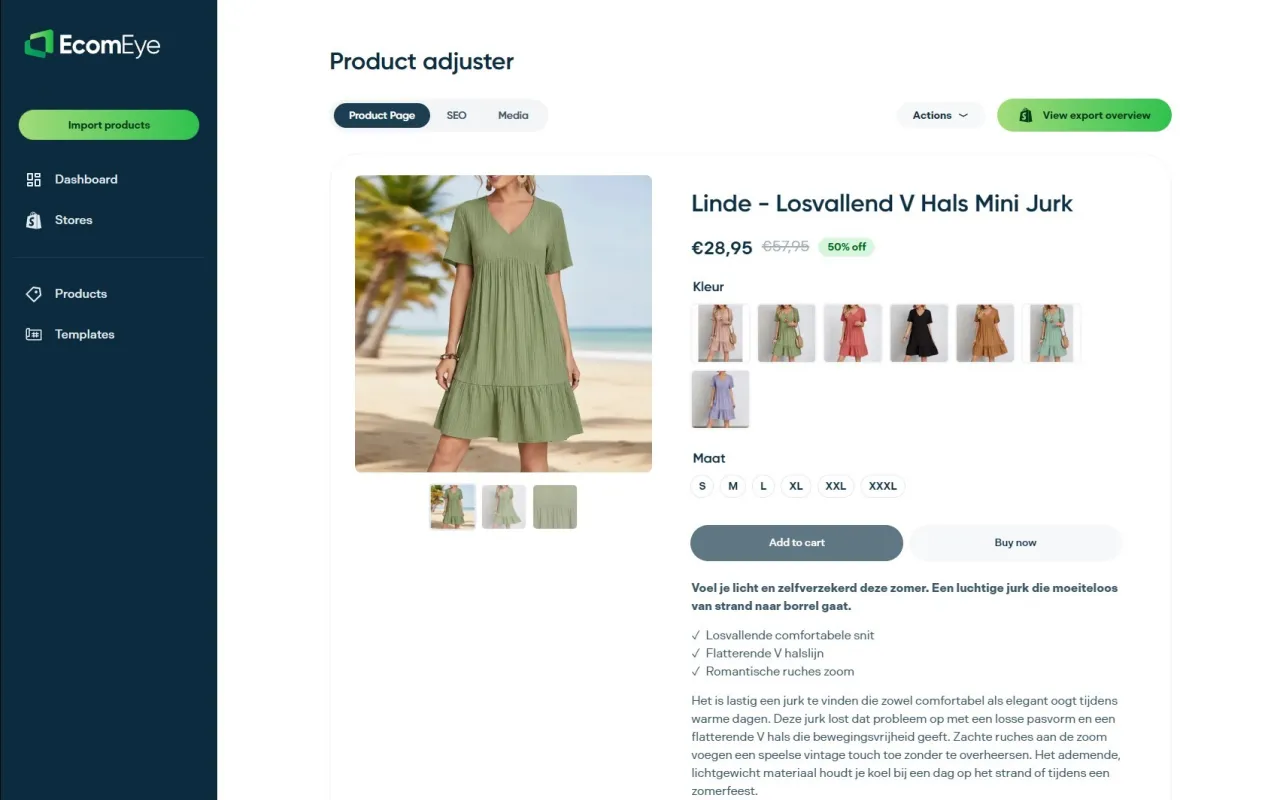
Ecom-eye is built specifically for this problem. It imports products in bulk from AliExpress or competitor links, then generates SEO-ready titles, clean descriptions, and high-quality AI product images automatically. Every page it produces is copyright-safe and built to pass Google Merchant review. You export directly to Shopify in one click, with no rewriting and no manual work. For sellers who need high-converting product descriptions at volume, Ecom-eye removes the bottleneck between knowing what works and actually publishing it.
FAQ
What makes a product listing creative and effective?
A creative listing combines a single clear differentiator, emotionally resonant copy, and a clean visual hierarchy that guides shoppers toward purchase. High-converting descriptions achieve conversion rates between 3.5% and 8% by combining customer identity, specific outcomes, and social proof.
How long should a product description be?
The recommended length for product descriptions is 150–300 words. Descriptions in this range reduce cart abandonment by keeping copy concise and scannable without omitting critical detail.
What is listing engineering?
Listing engineering is the process of converting product information into structured, AI-readable content that maximises discoverability and conversion. It differs from standard copywriting by including competitive niche research and semantic mapping before any copy is written.
How do I differentiate my product listing from competitors?
Lead with your single strongest differentiator in the title, hero image, and first bullet point. Supporting claims belong in the description body, not competing for attention at the top of the listing.
Why do shoppers abandon listings without buying?
20% of failed purchases result from unclear or incomplete product descriptions. The most common cause is burying the key selling point in body copy that most shoppers never reach.
Ready to boost your product pages?
Generate high-converting, SEO-optimized product pages in bulk using AI automation used by e-commerce experts.
No credit card required