High-converting product descriptions: 2026 guide
Unlock the secrets of high-converting product descriptions! Boost sales and SEO with our expert guide for e-commerce success in 2026.

High-converting product descriptions: 2026 guide

TL;DR:
- Effective product descriptions are benefit-driven, mobile-optimized, and structured as persuasive landing pages. Unique, outcome-focused copy improves conversions by 78%, with clear benefits, social proof, and objection handling essential for success. Optimizing length, SEO, and mobile layout ensures higher search rankings and increased sales.
High-converting product descriptions are benefit-led, mobile-optimised content blocks that directly influence buying decisions and improve search rankings. Products with unique, benefit-focused descriptions convert 78% better than generic manufacturer copy. That single figure explains why your product page text is not a formality. It is your most powerful sales tool. This guide covers the exact structure, frameworks, and writing techniques that e-commerce marketers use to turn browsers into buyers, with practical advice on why product descriptions matter for both revenue and SEO in 2026.
1. what are high-converting product descriptions?
High-converting product descriptions are persuasive copy blocks that combine clear benefits, emotional relevance, and search-optimised language to move a shopper from consideration to purchase. The industry term for this discipline is conversion copywriting, and it sits at the intersection of SEO and consumer psychology. A description that simply lists specifications is not conversion copy. It is a data sheet. The difference matters enormously for your bottom line.

20% of all purchase abandonments stem from insufficient or unclear product information. That means one in five lost sales is recoverable with better copy alone. Sites using generic or poor descriptions can improve conversion rates by an average of 35.26% by rewriting them with a benefit-led approach.
2. key elements of effective product descriptions
Strong product copy follows a consistent structure regardless of category. Each element below serves a specific role in moving the reader towards purchase.
- Keyword-rich headline: Include your primary search term and a key product feature or brand name. This anchors both SEO and first impressions.
- Benefit-led opening sentence: State the single most important outcome the buyer gets. Not what the product is. What it does for them.
- Scannable bullet points: Cover the top three to five benefits and differentiators. Keep each bullet under 12 words.
- Narrative paragraph: Explain the product story, the ideal user, and the emotional payoff. This is where you build connection.
- Specifications block: Present technical data clearly, in a table or labelled list, so buyers can verify compatibility without hunting.
- Mobile-first layout: Place the most critical information above the fold. Mobile commerce accounts for nearly 68% of e-commerce sessions, so anything buried below a long scroll is effectively invisible to the majority of your shoppers.
Most shoppers scan product pages in 3–5 seconds. That means your hero paragraph and bullets must work independently of the full description. 80% of visitors read the short copy and bullets. Only 20% read extended copy. Write both layers, but never assume the long version gets read first.
The optimal word count is 150–300 words for standard products and 300–500 words for high-value items. Descriptions under 100 words lack sufficient SEO content. Descriptions over 500 words add friction and reduce conversions for most product categories.
Pro Tip: Write your bullet points before your narrative paragraph. The bullets force you to identify the real benefits. The narrative then gives those benefits emotional context.
3. which copywriting frameworks drive the most conversions?
The Feature-Benefit-Emotion chain is the most widely validated framework for product copy. It works by connecting a product feature to a concrete benefit, then anchoring that benefit to an emotional outcome. “Waterproof membrane” becomes “stays dry in heavy rain” becomes “you arrive confident, not soaked.” That progression transforms a commodity into a solution.
A more advanced model is the four-layer persuasion sequence:
- Identity Statement: Open by reflecting the buyer’s self-image. “Built for runners who train through winter.”
- Outcome Scene: Paint a vivid picture of life after purchase. Specific, sensory, and aspirational.
- Evidence Stack: Provide verifiable claims, ratings, materials, or certifications that back the outcome.
- Friction Killer: Address the single biggest objection directly. Sizing, returns, compatibility, or price justification.
“Product descriptions should be considered a persuasion sequence rather than a mere list of facts for maximum sales impact.” — WebMedic
This sequencing matches the actual buyer decision journey. Shoppers do not evaluate features first. They ask “is this for someone like me?” before they ask “what does it do?” Frameworks that open with identity outperform those that open with specifications, particularly for fashion, lifestyle, and premium goods.
For high-ticket items, descriptions should extend to 500 words and incorporate deeper identity and emotional outcome scenes. A £1,200 espresso machine needs a different depth of copy than a £12 phone case.
4. how to optimise product descriptions for SEO without hurting conversion
SEO and conversion rate optimisation share the same enemy: duplicate content. Duplicate manufacturer descriptions have zero SEO value and can actively harm your rankings. Every product page on your Shopify store should carry unique copy. This is non-negotiable for both Google visibility and buyer trust.
Here is how to balance keyword relevance with persuasive prose:
- Place your primary keyword in the page title, the opening sentence, and at least one bullet point. Do not force it elsewhere.
- Use semantic variants naturally throughout the body. Google understands synonyms. Keyword stuffing reads as spam to both algorithms and humans.
- Write meta descriptions as standalone benefit statements, not keyword dumps. 155 characters. One clear outcome.
- Add structured data markup (Schema.org Product type) to qualify for rich snippets showing price, availability, and ratings in search results.
- Keep paragraphs short for mobile rendering. Long blocks collapse poorly on small screens and increase bounce rates.
| Approach | SEO Impact | Conversion Impact |
|---|---|---|
| Copied manufacturer copy | Harmful (duplicate penalty) | Low (generic, no differentiation) |
| Keyword-stuffed copy | Neutral to negative | Low (unreadable) |
| Unique, benefit-led copy | Strong (original content signal) | High (addresses buyer needs) |
| Benefit copy with structured data | Strongest (rich snippet eligible) | Highest (trust signals visible in SERP) |
For a deeper look at Shopify SEO best practices in 2026, including title tag structures and internal linking, the Ecom-eye blog covers the full technical picture.
Pro Tip: Use Google Search Console to identify which product pages already rank on page two. Rewriting their descriptions with the Feature-Benefit-Emotion chain is the fastest route to a first-page ranking without building new links.
5. common mistakes that kill product description conversion rates
Most underperforming product pages share the same handful of errors. Recognising them is the first step to fixing them.
- Features without benefits: “6,000mAh battery” tells a buyer nothing. “Lasts three full days without charging” tells them everything. Always translate specifications into outcomes.
- Vague quality claims: Phrases like “premium quality” or “best in class” carry no weight. Specific, verifiable claims build trust. “Stitched with 400-denier nylon, rated to 15kg” is credible. “High quality” is not.
- Missing social proof: Pages with 11–30 customer reviews paired with strong descriptions see approximately 68% higher conversions than those without. A description without any social proof signal is leaving significant revenue on the table.
- No objection handling: Common product description mistakes include missing size or fit information and lack of compatibility details. These omissions create doubt. Doubt kills conversions.
- Poor mobile layout: Text that renders as a wall of copy on mobile causes immediate drop-off. Use short paragraphs, white space, and bullets to keep mobile readers engaged.
- Wrong word count: Descriptions under 100 words lack SEO substance. Descriptions over 500 words add friction. Stay within the 150–300 word range for standard products unless the price point justifies more depth.
For a full breakdown of Shopify product page mistakes that hurt conversion rates, Oxedent’s analysis covers nine common errors with practical fixes.
6. practical tips for writing high-impact product copy
Writing persuasive product copy is a skill, but it follows repeatable patterns. Apply these directly to your next product page.
- Lead with the outcome, not the product. Your opening sentence should describe what the buyer’s life looks like after purchase, not what the product is made of.
- Use sensory language. Words like “smooth,” “crisp,” “lightweight,” and “silent” activate imagination. Buyers who can picture using a product are more likely to buy it.
- Name the ideal customer. “Designed for home bakers who want professional results” immediately qualifies the buyer and makes the copy feel personal.
- Address the top objection in the copy. If your returns data shows that sizing is the most common reason for refunds, address sizing in the description. Do not wait for a customer service query.
- Structure for scanners first. Hero paragraph, then bullets, then expandable technical detail. This mirrors how shoppers actually read product pages.
- Keep your tone consistent. A style guide for your store should define reading level, sentence length, and whether you use “you” or the customer’s identity label. Consistency builds brand trust across hundreds of product pages.
Scaling this process manually across a large catalogue is where most e-commerce marketers hit a wall. Tools like Ecom-eye automate bulk description creation while maintaining uniqueness and SEO structure, which removes the bottleneck without sacrificing quality.
Pro Tip: Write three versions of your hero paragraph for each product: one focused on outcome, one on identity, one on social proof. A/B test them over 30 days. The winner tells you what your specific audience responds to most.
Key takeaways
High-converting product descriptions require unique, benefit-led copy structured for scanners, optimised for mobile, and built around a persuasion sequence that addresses buyer identity, outcomes, and objections.
| Point | Details |
|---|---|
| Unique copy converts significantly better | Benefit-focused, original descriptions convert 78% better than copied manufacturer text. |
| Structure matters as much as content | Use a hero paragraph plus bullets; 80% of shoppers read only the short-form copy. |
| Word count affects both SEO and conversion | Aim for 150–300 words for standard products and 300–500 words for high-ticket items. |
| Frameworks outperform feature lists | The Feature-Benefit-Emotion chain and four-layer persuasion sequence drive stronger sales lift. |
| Social proof amplifies copy quality | Pairing strong descriptions with 11–30 reviews increases conversions by approximately 68%. |
The uncomfortable truth about product copy in 2026
I have reviewed hundreds of Shopify stores over the years, and the pattern is always the same. The store owner has spent weeks on their logo, their theme, their ad creative. Then they paste in the AliExpress description and call it done. That single decision undoes everything else.
The uncomfortable truth is that most e-commerce marketers still treat product descriptions as a formality rather than a conversion asset. They know the copy is weak. They plan to fix it later. Later never comes, and the store underperforms indefinitely.
What I have found actually works is treating every product page as a standalone landing page. Not a catalogue entry. A landing page. That mental shift changes how you approach word count, structure, objection handling, and mobile layout all at once.
The rise of AI writing tools has made this easier, but it has also created a new risk. Stores that use AI to generate copy from the same source data end up with different words but identical structure and tone. That is still a form of duplication, and Google is getting better at detecting it. The stores that win are those using AI to generate unique, brand-consistent copy at scale, not to clone what competitors already have.
Voice search is also reshaping description style faster than most people realise. Queries like “best lightweight running jacket for cold weather” are now common. Descriptions written in natural, outcome-focused language match these queries better than specification-heavy copy. Write for the human first. The algorithm follows.
— Koen
Scale your product pages with Ecom-eye
Writing one great product description takes time. Writing five hundred takes a system.
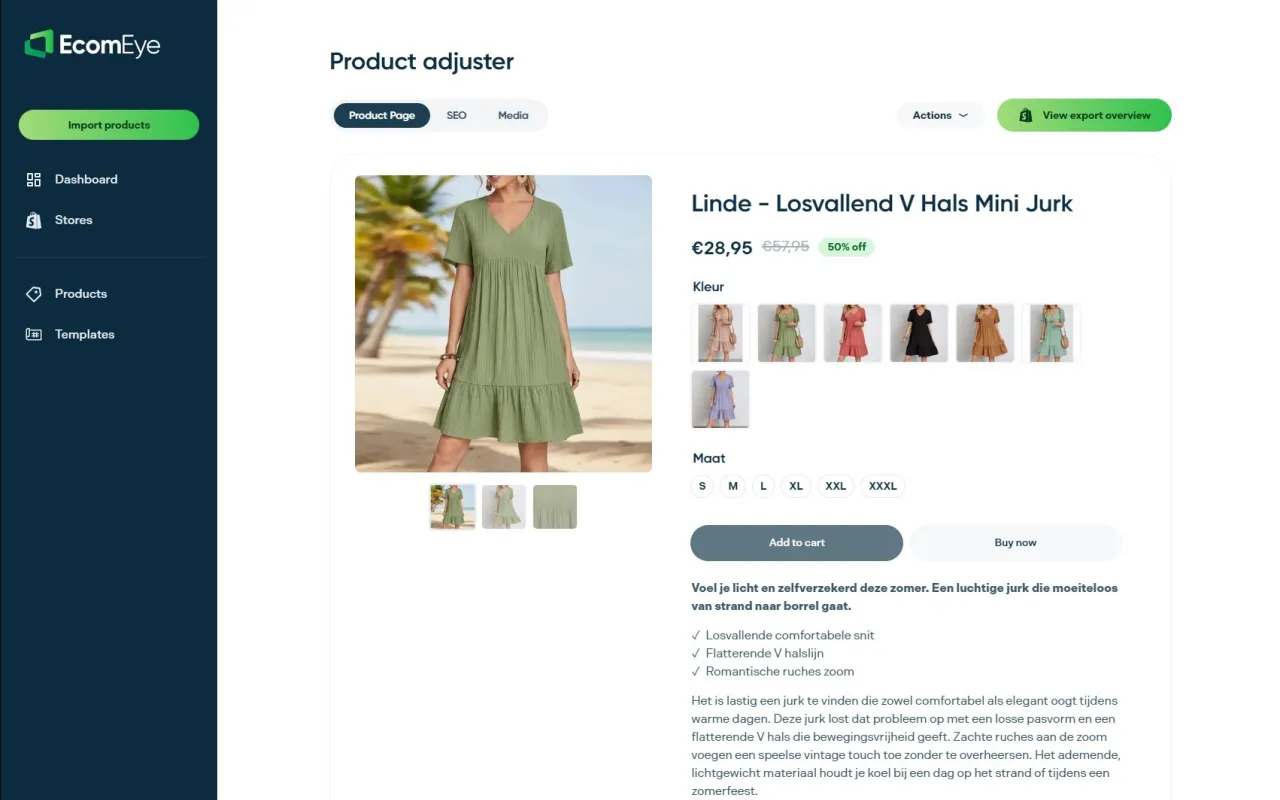
Ecom-eye is an AI-powered bulk product lister built specifically for Shopify dropshipping stores. Import products directly from AliExpress or competitor links, and Ecom-eye automatically generates unique titles, benefit-led descriptions, SEO-ready content, and high-quality AI product images. Every page is copyright-safe and export-ready in one click. No rewriting. No duplicate content risk. No Google Merchant disapprovals. If you are serious about scaling your Shopify store with product pages that actually rank and convert, Ecom-eye removes the manual bottleneck entirely.
FAQ
What makes a product description high-converting?
A high-converting description combines a benefit-led opening, scannable bullet points, social proof, and objection handling in a structure built for mobile. Products with unique, benefit-focused copy convert 78% better than generic manufacturer descriptions.
How long should a product description be?
The optimal length is 150–300 words for standard products and 300–500 words for high-value items. Descriptions under 100 words lack SEO substance, while those over 500 words add friction and reduce conversions.
Does copying manufacturer descriptions hurt SEO?
Yes. Duplicate manufacturer descriptions carry zero SEO value and can actively harm your search rankings. Unique, keyword-rich descriptions serve both SEO and conversion goals simultaneously.
How does mobile optimisation affect product description performance?
Mobile commerce accounts for nearly 68% of e-commerce sessions. Descriptions that render as long blocks of text on small screens cause immediate drop-off. Short paragraphs, bullets, and above-the-fold clarity are non-negotiable for mobile product pages.
Should i include customer reviews in my product descriptions?
Social proof belongs on the product page alongside the description. Pages with 11–30 reviews paired with strong copy see approximately 68% higher conversions than those without any social proof signal.
Ready to boost your product pages?
Generate high-converting, SEO-optimized product pages in bulk using AI automation used by e-commerce experts.
No credit card required