Shopify pricing for UK dropshippers: the full cost stack
Discover the full cost stack of Shopify com pricing for UK dropshippers. Learn about fees, processing costs, and budgeting tips.

Shopify pricing for UK dropshippers: the full cost stack

TL;DR:
- For UK dropshippers, most costs quickly surpass the Shopify plan fee, especially after three months. Payment processing, apps, and AI credits form the largest recurring expenses, with processing fees scaling with revenue. Batching AI content generation and conducting quarterly app audits help merchants control overall costs effectively.
A UK Shopify merchant running a lean dropshipping store typically pays modest monthly subscription fees, but the realistic monthly total once you add Shopify Payments processing, a basic app stack, and pay-as-you-go AI credits for bulk product pages can vary widely depending on order volume. The single biggest surprise for most merchants is not the plan fee at all — it is payment processing, which scales directly with revenue and quietly becomes the dominant line item by month three. Two other costs routinely catch people out: apps (which agency data puts at £80–£150 per month for a growing store) and AI content credits, which you can estimate at roughly £20–£60 per month for bulk SEO product-page generation at typical dropshipping volumes.
Three numbers to start your budget:
- Subscription: Basic to Advanced plans currently run from ~£19 (Basic, annual) to ~£194 (Advanced, annual) per month as of July 2026 (see the Shopify UK pricing page for latest rates).- Processing fees: Shopify Payments card rates vary by plan tier and apply to every transaction — this is your largest variable cost once monthly revenue exceeds £5,000.
- AI credits: Pay-as-you-go models for bulk SEO product pages typically cost £0.05–£0.30 per page depending on complexity, images, and language variants — budget £20–£60 per month for a store generating 100–300 new SKUs monthly.
Table of Contents
- What does Shopify pricing actually include at each plan tier?
- What is the true total cost of ownership for a Shopify store?
- How do pay-as-you-go AI services charge for bulk product pages?
- How does Ecom-eye help UK merchants generate bulk SEO pages?
- When does upgrading your Shopify plan actually pay off?
- Three UK sample scenarios you can copy and adapt
- Tactical ways to cut your Shopify and AI overhead
- Key takeaways
- The cost most merchants get wrong
- Ready to generate bulk product pages without the manual work?
- Sources and further reading
- FAQ
What does Shopify pricing actually include at each plan tier?
Most dropshippers start on Basic and stay there longer than they should. The plan tiers matter less for their headline features and more for what they do to your per-transaction cost and your automation ceiling.
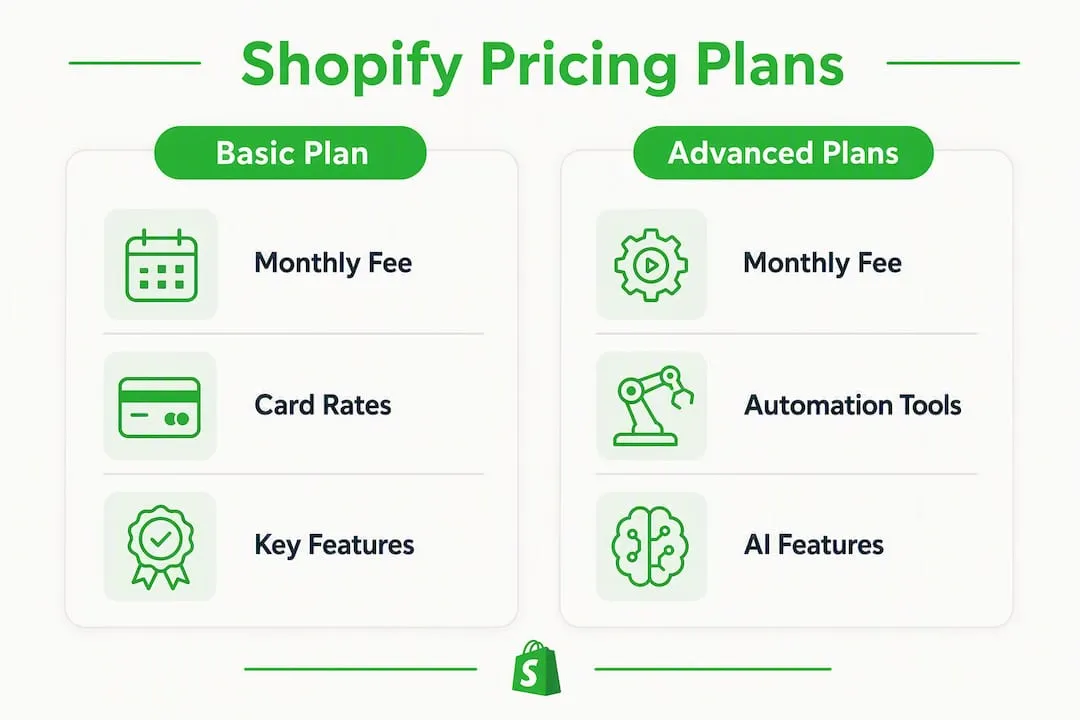
Shopify’s UK pricing page lists four main plans: Basic, Grow, Advanced, and Plus. Annual billing cuts the effective monthly cost by around 25% on Basic through Advanced. The table below uses USD figures as published by Shopify (UK GBP prices follow the same tier structure — verify live GBP rates before publishing):
| Plan | Pay monthly (GBP) | Pay yearly (GBP/mo) | Online standard card rate | Third-party surcharge | Notable feature |
|---|---|---|---|---|---|
| Basic | £25 | ~£19 | 1.7% blended UK rate | 2% | 2 staff accounts |
| Grow | £65 | ~£49 | 1.7% blended UK rate | 1% | 5 staff accounts |
| Advanced | £259 | ~£194 | 1.5% blended UK rate | 0.6% | Custom reports, 15 staff |
| Plus | Custom pricing | Custom pricing | Most competitive | 0.2% | Unlimited staff, agentic commerce |
Higher tiers include native automation and AI features — Shopify’s agentic commerce tools sit in Plus and Advanced. For merchants using AI workflows like bulk product-page generation, those native features can reduce reliance on third-party apps, which directly lowers your monthly app spend.
What is the true total cost of ownership for a Shopify store?
The subscription is rarely the largest recurring cost. As Echovyn Labs notes, merchants routinely mistake the plan fee for the total cost of ownership, then hit cash-flow problems when the app stack and processing fees compound at scale.
The full TCO formula:
Monthly TCO = Subscription + Processing fees + Third-party transaction fees + Apps + Theme (amortised) + Domain/email + Shipping labels + Chargebacks + VAT/taxes + AI credits + Dev costs (amortised)
A worked example for a store doing £10,000 revenue per month at £40 average order value (250 orders):
- Subscription (Basic, annual): ~£19/mo
- Processing fees (Shopify Payments, ~1.7% blended UK rate): ~£170/mo
- Third-party surcharge: £0 (using Shopify Payments)
- Apps cost varies significantly depending on the app stack
- Domain + email: ~£5/mo
- Shipping labels: ~£15/mo
- AI credit spend depends on SKU volume and batching
- Dev amortised: ~£20/mo
Total: ~£374/mo — of which the subscription is about 5%.
That ratio shifts further as revenue grows. Payment processing is the dominant cost for stores doing tens of thousands per month, not the plan fee.
Note on UK VAT: HMRC requires you to charge 20% VAT on digital services sold to UK customers. Shopify’s subscription and most app fees carry VAT on UK invoices — factor this into your budget. AI credit purchases from UK-registered providers will also carry VAT.
How do pay-as-you-go AI services charge for bulk product pages?
Pay-as-you-go AI typically bills by credits: one credit per page of content generated, plus separate credits per image. The two biggest cost drivers are content complexity (number of fields, metafields, and description length) and total SKU count per run.
Common pricing models you will encounter:
| Model | How it works | Best for |
|---|---|---|
| Per-page credit | Fixed credit per product page (title + description + SEO fields) | Predictable per-SKU budgeting |
| Per-image credit | Separate credit per AI-generated product image | Stores needing custom visuals |
| Blended bundle | Page + image in one credit | Simplicity; often slightly cheaper per unit |
| Subscription with credits | Monthly fee includes a credit allowance | High-volume stores with consistent output |
| Volume discount | Lower per-credit rate above thresholds | Batching large catalogue runs |
Non-obvious cost drivers include multi-language page generation (each language variant typically consumes a credit), the number of metafields generated per product, and re-run credits when you edit a template and regenerate. AI-generated metafields add SEO value but do add to per-page credit consumption — worth knowing before you set up your template.
Pro Tip: Batch your SKU imports into runs of 50–100 products at a time. Most pay-as-you-go platforms apply volume discounts at specific thresholds, so splitting a 200-SKU catalogue into four runs of 50 often costs more than one run of 200.
How does Ecom-eye help UK merchants generate bulk SEO pages?
Ecom-eye generates bulk, copyright-safe, SEO-optimised product pages and AI product images with one-click export to Shopify — purpose-built for dropshippers who need to publish at scale without duplicating competitor content.
Key features relevant to cost and scale:
- Bulk import from AliExpress, Amazon, Temu, or competitor Shopify links
- Auto-generated SEO titles, clean descriptions, and SEO-ready content fields
- AI product image generation per SKU
- Multi-language page exports (each language variant generated in the same workflow)
- Metafield generation for structured data and richer search snippets
- Built-in template reuse to reduce per-page credit consumption on repeat product types
- One-click export directly to your Shopify store
Internal data shows that EcomEye workflows achieve 40% better SEO compared to manually copied or duplicated product pages — a meaningful difference when Google Merchant Centre disapprovals are costing you traffic. The pay-as-you-go model means you only spend credits when you generate pages, with no minimum monthly commitment required to get started.
Pro Tip: Use Ecom-eye’s template reuse feature for product categories you list repeatedly (e.g., phone cases, clothing basics). A saved template cuts the fields you need to generate per SKU, which reduces credit consumption per page.
When does upgrading your Shopify plan actually pay off?
Upgrade when the processing-fee savings from the lower card rate exceed the extra subscription cost. The break-even formula:
Break-even orders/month = Monthly subscription delta ÷ Per-order processing-fee delta

Example: moving from Basic ($29/mo annual) to Grow ($79/mo annual) saves 0.2 percentage points on card rates. At £40 AOV, that saving is £0.08 per order. The subscription delta is $50/mo (roughly £40). Break-even: £40 ÷ £0.08 = 500 orders per month (£20,000 revenue at £40 AOV).
| Upgrade | Monthly sub delta (approx.) | Rate saving per order (£40 AOV) | Break-even orders/mo | Break-even revenue/mo |
|---|---|---|---|---|
| Basic → Grow | ~£30 | ~£0.08 | ~375 | ~£15,000 |
| Grow → Advanced | ~£145 | ~£0.20 | ~725 | ~£29,000 |
Beyond the maths, upgrade signals include: hitting staff account limits, needing custom reports for multi-channel tracking, or wanting native automation workflows that reduce your app spend. If you are using Shopify Payments, the third-party surcharge drops to zero — which alone can justify staying on a lower plan.
Three UK sample scenarios you can copy and adapt
The monthly totals below use the TCO formula from the earlier section. App costs use the £80–£150 range from WebMedic’s agency data; processing fees are estimated at Shopify Payments blended rates.
| Scenario | Revenue/mo | Plan | Subscription | Processing fees | Apps | AI credits | Total/mo |
|---|---|---|---|---|---|---|---|
| Starter | £3,000 | Basic (annual) | ~£25 | ~£51 | ~£80 | ~£20 | ~£176 |
| Scaling | £10,000 | Grow (annual) | ~£49 | ~£165 | ~£120 | ~£40 | ~£374 |
| High-volume | £30,000 | Advanced (annual) | ~£194 | ~£450 | ~£150 | ~£60 | ~£854 |
Increases in AI credit usage due to additional variants or regenerations can add modest incremental costs, which are worth monitoring as your catalogue grows.
Tactical ways to cut your Shopify and AI overhead
Three actions that typically reduce monthly costs significantly include switching to Shopify Payments to avoid third-party surcharges, moving to annual billing on your core subscription, and conducting regular app audits to cancel unused tools.
Pro Tip: Set a calendar reminder every 90 days to review your active Shopify apps. App billing cycles rarely align with your Shopify subscription date, so charges accumulate invisibly. A single audit session typically surfaces £20–£50 in unused subscriptions.
A 30-day cost-reduction checklist:
- Enable Shopify Payments to remove the third-party transaction surcharge
- Switch your Shopify plan to annual billing (saves ~25% on the subscription line)
- Audit every active app; cancel any with no usage in the past 30 days
- Batch AI product-page generation into large runs to hit volume discount thresholds
- Create and save templates in Ecom-eye for repeat product categories to cut per-page credit use
- Consolidate domain, email, and shipping label tools where possible to reduce vendor count
- Review your AI-driven SEO workflows quarterly to check credit efficiency
Key takeaways
Running a Shopify store in the UK costs far more than the subscription alone — payment processing and apps typically exceed the plan fee by month three, and AI credits add a predictable but manageable line once you batch efficiently.
| Point | Details |
|---|---|
| Subscription is not the main cost | Processing fees and apps routinely exceed the plan fee for stores above £3,000/month revenue. |
| Annual billing saves ~25% | Switching from monthly to annual billing on Basic through Advanced cuts the subscription line by around 25%. |
| Break-even for Basic → Grow | At a typical average order value, you need a moderate volume of orders per month before the Grow plan’s lower card rate offsets the higher subscription. |
| AI credits are predictable | At typical dropshipping volumes (100–300 new SKUs/month), AI credit spend runs £20–£60/month — batch runs to hit volume discounts. |
| Ecom-eye for bulk pages | Ecom-eye’s pay-as-you-go credit model generates copyright-safe, SEO-optimised product pages with 40% better SEO, with no minimum monthly commitment. |
The cost most merchants get wrong
The plan fee is the price of entry, not the cost of running a store. Every merchant I see underestimating their Shopify overhead makes the same three mistakes: they budget the subscription, ignore the processing-fee curve, and treat AI content generation as a one-off rather than a recurring line.
The processing-fee curve is the one that stings. At £3,000 revenue it looks trivial. At £30,000 it is your single largest cost. The merchants who catch this early are the ones who run the break-even calculation before they need to, not after.
The second mistake is app sprawl. Apps get installed during a problem-solving sprint and never removed. A quarterly audit is not optional admin — it is the cheapest cost-reduction lever available.
Third: not batching AI generation. Generating 20 pages at a time instead of 200 can double your effective per-page cost. Template reuse and batching are the two levers that keep AI credit spend flat even as your catalogue grows.
Pro Tip: Treat your Shopify stack like a subscription audit, not a set-and-forget setup. One hour per quarter reviewing apps, billing cycles, and AI credit usage will save more than any plan upgrade.
Ready to generate bulk product pages without the manual work?
Scaling a Shopify dropshipping store means publishing unique, Google-compliant product pages faster than your competitors copy them. Ecom-eye gives you that speed without the copyright risk or the rewriting.
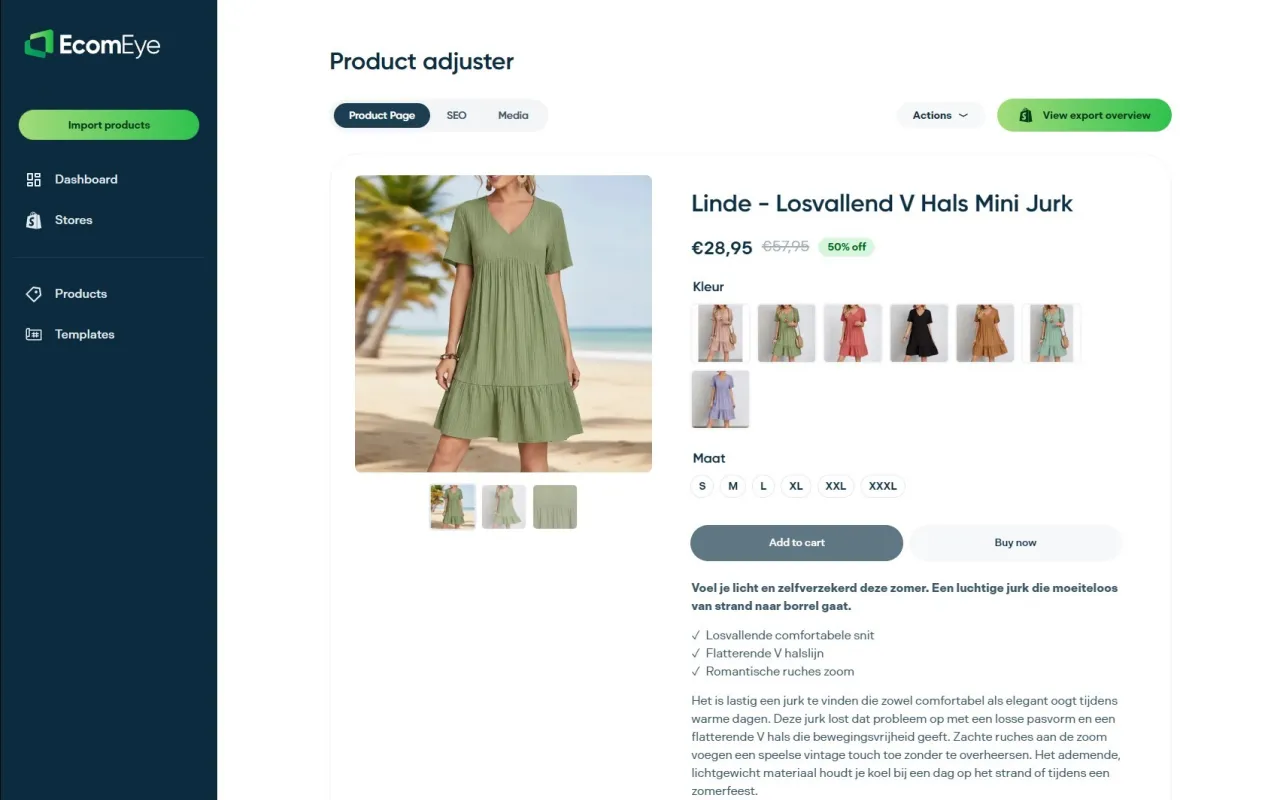
Import products in bulk from AliExpress, Amazon, Temu, or competitor Shopify links. Ecom-eye automatically generates SEO-ready titles, clean descriptions, AI product images, and multi-language variants, then exports everything to your Shopify store in one click. No agency, no freelancer, no duplicate content. Internal data puts the SEO uplift at 40% better performance versus manually copied pages.
The pay-as-you-go model means you pay only for what you generate. There is no minimum monthly commitment to get started. UK merchants: note that VAT at 20% applies to credit purchases from UK-registered providers — your invoice will reflect this, and it is reclaimable if you are VAT-registered.
Start with a free trial on the AI product description generator, import a sample batch of SKUs, and see the output before you commit to a credit purchase.
Sources and further reading
Live pricing figures change. Before publishing or making budget decisions, verify current GBP rates directly from primary sources:
- Shopify UK pricing page — live GBP plan rates, card rates, and annual billing discounts
- Shopify Help Centre: pricing plans and billing overview — third-party transaction fees, billing cycles, and plan comparison
- Shopify Help Centre: pricing plans — plan features and upgrade guidance
- Echovyn Labs: agency cost breakdown — practitioner analysis of app and integration under-budgeting
- WebMedic: Shopify fees explained — app cost ranges and processing-fee analysis
- Ecom-eye: Shopify page layouts and SEO bulk management — first-party data on the 40% SEO improvement claim
FAQ
What is the cheapest Shopify plan for UK dropshippers?
Basic on annual billing is the lowest-cost entry point, but the true monthly cost depends on your order volume — processing fees will exceed the subscription fee once revenue passes roughly £3,000 per month.
How do Shopify Payments card rates affect my monthly costs?
Shopify Payments eliminates the third-party transaction surcharge (up to 2% on Basic) and applies plan-dependent card rates; at higher volumes, the rate difference between Basic and Advanced can save hundreds of pounds per month.
How much should I budget for AI product-page credits on Shopify?
At typical dropshipping volumes of 100–300 new SKUs per month, expect to spend roughly £20–£60 per month on pay-as-you-go AI credits — less if you batch large runs and reuse templates.
When should I upgrade from Basic to Grow?
At £40 average order value, the Grow plan’s lower card rate breaks even at approximately 500 orders per month (roughly £20,000 monthly revenue) — below that threshold, Basic on annual billing is usually cheaper overall.
Does UK VAT apply to Shopify and AI service subscriptions?
Yes. Shopify’s subscription and most app fees carry 20% VAT on UK invoices, as do AI credit purchases from UK-registered providers. VAT-registered merchants can reclaim this as input tax via their HMRC VAT return.
Ready to boost your product pages?
Generate high-converting, SEO-optimized product pages in bulk using AI automation used by e-commerce experts.
No credit card required