Must-have Shopify store features for SEO and conversions in 2026
Discover essential Shopify features for 2026 that boost SEO rankings and conversions. Learn to choose AI product pages, mobile optimisation, and checkout upgrades.

Choosing the right Shopify features in 2026 can make or break your store’s success. With thousands of apps and options available, the wrong choices lead to duplicate content penalties, slow load times, and abandoned carts. This guide provides a structured framework to evaluate essential features that boost SEO rankings and drive conversions, focusing on unique product pages, mobile performance, streamlined apps, checkout optimisation, and multilingual support.
Table of Contents
- How To Choose The Right Shopify Store Features In 2026
- Bulk Ai-Generated Unique Product Pages
- Performance And Mobile Optimisation
- Essential Shopify Apps For 2026
- Checkout Experience Optimisation
- Multilingual Support For Global Reach
- Summary Comparison And Situational Recommendations
- Discover Ecomeye For Smarter Shopify Automation
Key takeaways
| Point | Details |
|---|---|
| Unique SEO-friendly product pages are essential | AI-generated content avoids duplicate penalties and improves rankings. |
| Fast mobile performance boosts conversions | Stores loading under four seconds see significantly better conversion rates. |
| Streamlined apps improve store speed and functionality | Limit apps to 8-12 optimised tools to maintain performance. |
| Checkout optimisations reduce abandonment | Shopify’s 2026 upgrades increase conversions by 36% through faster flows. |
| Multilingual features expand global sales reach | Multi-language pages drive 30% higher international sales. |
How to choose the right Shopify store features in 2026
Selecting Shopify features requires evaluating criteria that directly impact your bottom line. Focus on load speed, checkout flow, and content uniqueness. Stores that reduce apps whilst maintaining functionality see better performance metrics.
SEO benefits come from copyright-safe, unique product content. Duplicate descriptions copied from competitors trigger Google Merchant disapprovals and tank rankings. AI automation scales content creation without sacrificing quality or compliance.
Mobile-first design matters more than ever. With mobile devices generating the majority of e-commerce traffic, responsive themes and compressed images become non-negotiable. Balancing app functionality with site performance means choosing fewer, better-optimised tools.
Consider these priorities when evaluating features:
- Load speed under four seconds to prevent bounce
- Unique, SEO-optimised product descriptions
- Minimal app count to maintain performance
- Mobile-responsive design and fast image loading
- Multilingual support for international markets
Pro Tip: Test each new app’s impact on load time using Google PageSpeed Insights before committing. Remove any tool that adds more than 0.5 seconds to your page load.
Understanding Shopify hosting basics helps you optimise infrastructure alongside feature selection. The right foundation supports faster performance and better scalability.
Bulk ai-generated unique product pages
Duplicate content remains the primary reason dropshippers fail Google Merchant compliance. Copying product pages from AliExpress or competitors creates identical descriptions across thousands of stores. Google penalises this heavily.
AI-powered tools solve this by generating complete stores in minutes with unique titles, descriptions, and SEO-ready content. Bulk generation transforms what used to take hours per product into a single-click operation.

Time and cost savings compound quickly. Manual rewriting costs £15-30 per product page. For a 500-product catalogue, that’s £7,500-15,000 in outsourcing fees. AI automation reduces this to a fraction whilst maintaining quality and compliance.
The process works seamlessly:
- Import products from AliExpress or competitor links
- AI generates unique titles and descriptions
- System creates SEO-optimised content automatically
- High-quality product images generated via AI
- Export directly to Shopify in one click
EcomEye’s approach eliminates copyright risk entirely. Each product page receives original content that passes plagiarism checks and satisfies Google’s quality guidelines. Rankings improve because search engines reward unique, valuable content.
Pro Tip: Prioritise products with highest traffic potential first. Generate unique pages for your top 20% of products, then scale to your full catalogue.
Learn more about boosting SEO with bulk AI to implement this strategy effectively. The combination of automation and compliance creates sustainable competitive advantage.
Performance and mobile optimisation
Stores loading under four seconds convert significantly better, with nearly 70% of shoppers citing speed as a purchase factor. Every additional second of load time costs conversions.
Mobile devices generate 79% of Shopify traffic, making mobile-first design essential. Shoppers on smartphones have zero patience for slow, unresponsive pages. They simply leave and buy elsewhere.
Optimising themes and compressing images delivers immediate improvements. Choose lightweight, mobile-responsive themes built for speed. Use WebP format for images and compress to 80-100KB per file.
App bloat kills performance. Each additional app adds JavaScript, CSS, and server requests. The trade-off between functionality and speed requires careful evaluation.
Implement these mobile-first strategies:
- Compress all product images to under 100KB
- Use lazy loading for images below the fold
- Minimise JavaScript and CSS file sizes
- Enable browser caching for repeat visitors
- Test on actual mobile devices, not just desktop simulators
Key stat: Stores with sub-4-second load times see conversion rates 2-3x higher than slower competitors. Mobile optimisation directly impacts revenue.
Essential Shopify apps for 2026
Shopify offers over 8,000 apps, but stores running 8-12 optimised apps perform best. More apps mean slower load times and increased costs.
Selecting apps requires balancing utility against performance impact. Atlas AI Store Builder and USAdrop lead the essential category by combining multiple functions into single tools. This consolidation reduces app count whilst maintaining capabilities.
Compare top apps by key criteria:
| App | Primary Function | Speed Impact | Monthly Cost | Best For |
|---|---|---|---|---|
| Atlas AI Store Builder | Complete store generation | Low | £29-99 | New stores |
| USAdrop | US-based dropshipping | Low | £29+ | Fast shipping |
| Loox | Photo reviews | Medium | £9.99-299 | Social proof |
| Judge.me | Review collection | Low | Free-£15 | Budget-conscious |
| PageFly | Page builder | Medium | Free-£99 | Custom design |
Prioritise apps that serve multiple purposes. Photo review apps that also handle product Q&A eliminate the need for separate tools. Page builders with built-in SEO features replace standalone optimisation apps.
Streamlined integration aids conversion by maintaining fast load times whilst adding functionality. Choose apps with clean code and regular updates.
Key selection criteria:
- Combines multiple functions when possible
- Regular updates and security patches
- Minimal impact on page load speed
- Clear ROI through increased conversions
- Strong support and documentation
Pro Tip: Audit your current apps monthly. Remove any tool you haven’t actively used in 30 days. Even inactive apps slow your store.
Checkout experience optimisation
Shopify’s 2026 checkout upgrades boost conversion by 36% through streamlined payment flows and reduced friction. Fast, user-friendly checkout directly reduces cart abandonment.
Personalised AI-driven upsells during checkout increase average order value without annoying customers. The key is relevance. Show complementary products based on cart contents, not random items.
Simplified payment and shipping options matter enormously. Offer Apple Pay, Google Pay, and Shop Pay for one-click checkout. Display all shipping options with clear delivery estimates upfront.
Reducing cart abandonment drives revenue gains that compound over time. A 10% reduction in abandonment on a store with £100,000 monthly revenue adds £10,000 annually.
Clear, concise product pages set up checkout success. When customers understand exactly what they’re buying, they complete purchases faster with fewer questions.
Implement these checkout optimisations:
- Enable express payment methods (Apple Pay, Google Pay)
- Show trust badges and security indicators
- Display shipping costs before checkout begins
- Offer guest checkout without forced account creation
- Use progress indicators for multi-step checkouts
Learn about Shopify page automation to streamline product pages that feed into your checkout flow. Review Shopify’s 2026 updates for the latest checkout features.
Multilingual support for global reach
Multilingual product pages increase international sales by making your store accessible to non-English speakers. Stores offering content in local languages see 30% higher sales from those markets.
AI tools enable bulk multi-language page generation without manual translation costs. Traditional translation services charge £0.10-0.20 per word. For a 500-product catalogue, that’s £15,000-30,000 per language. AI automation reduces this to pennies.
Addressing compliance and local legal requirements becomes easier with native-language content. Product disclaimers, shipping policies, and return terms must meet local regulations.
SEO benefits compound when you create unique, optimised content in each language. Google ranks multilingual pages higher in regional searches when content is genuinely translated, not machine-copied.
Advantages for dropshippers targeting global markets:
- Access to untapped markets with less competition
- Higher conversion rates from local-language shoppers
- Improved international SEO rankings
- Better customer service through native-language support
Explore multi-region hosting for e-commerce to optimise infrastructure for international audiences. Regional hosting reduces latency and improves performance for global customers.
Summary comparison and situational recommendations
Compare key features to align your choices with store goals:
| Feature | SEO Impact | Speed Impact | Conversion Uplift | Best For |
|---|---|---|---|---|
| Bulk AI product pages | Very High | None | 15-25% | Dropshippers, large catalogues |
| Mobile optimisation | High | Positive | 20-30% | All stores |
| Streamlined apps | Medium | Very Positive | 10-15% | Growth-focused stores |
| Checkout upgrades | Low | Neutral | 30-40% | All stores |
| Multilingual support | High | Low | 25-35% | International sellers |
For dropshippers, prioritise bulk AI-generated unique pages to avoid penalties and scale quickly. Combine this with mobile optimisation and minimal app count.
Growth-focused stores should emphasise checkout upgrades and performance optimisation. Every percentage point of conversion improvement compounds as traffic increases.
International sellers gain most from multilingual support combined with regional SEO optimisation. Target markets with less English-language competition first.
Trade-offs exist between feature richness and performance. Apps that add valuable functionality but slow your store require careful cost-benefit analysis. Calculate the revenue impact of both the feature and the speed reduction.
Edge case considerations include stores with highly technical products requiring detailed specifications. These benefit from custom page builders despite the performance cost. Stores with simple, visual products should minimise customisation and maximise speed.
Strategic guidance centres on testing and iteration. Implement one feature category at a time, measure impact, then optimise before adding more. This prevents overwhelming your site and isolates what actually drives results.
Discover ecomeye for smarter Shopify automation
EcomEye automates everything discussed in this guide. Import products in bulk, generate unique SEO-optimised pages, create multi-language content, and export directly to Shopify.
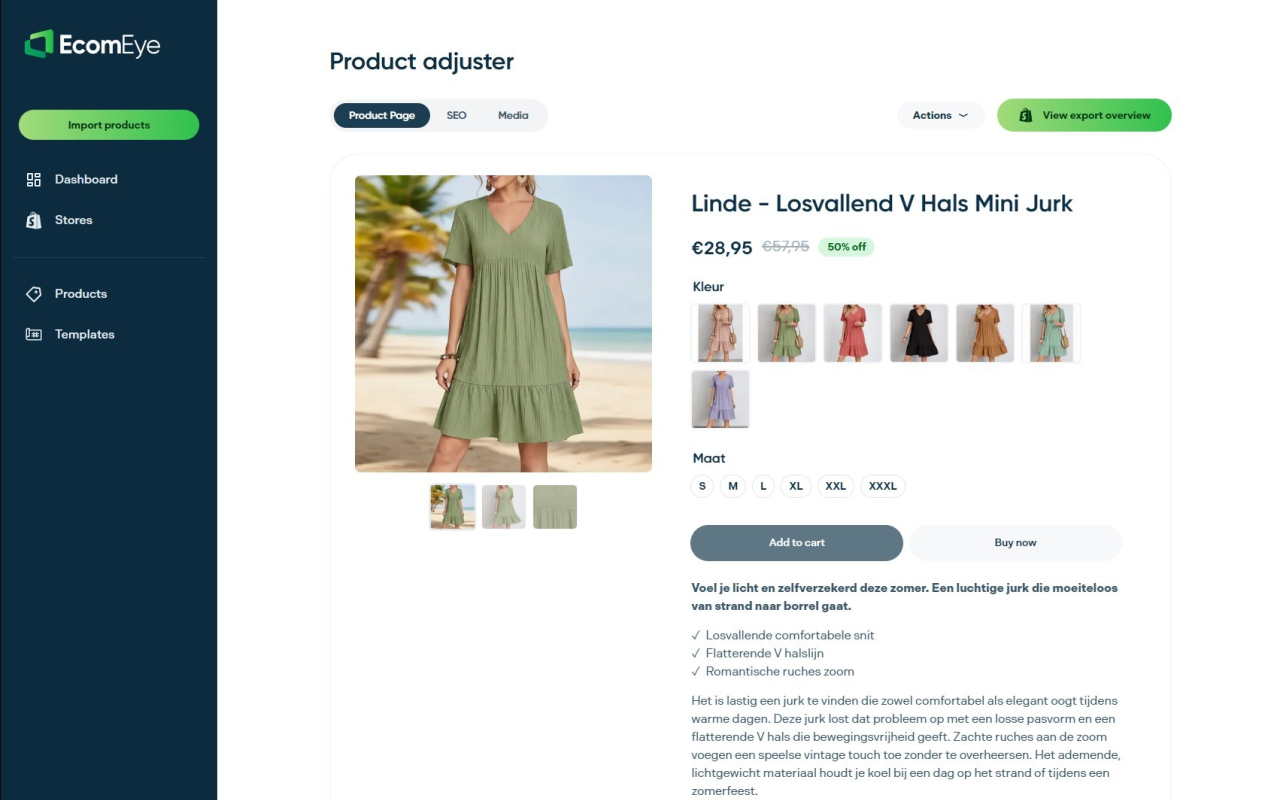
The EcomEye bulk AI product lister eliminates duplicate content risk whilst scaling your catalogue. Pricing plans suit stores from startup to enterprise, with features tailored to your growth stage.
Seamless Shopify integration means no technical setup. Connect your store, import products, and publish optimised pages in minutes. Ideal for dropshippers and growing stores aiming for 2026 compliance and performance standards.
Explore EcomEye pricing plans to find the right fit for your store size and needs.
Frequently asked questions
What are the top Shopify features to improve SEO in 2026?
Use bulk AI-generated unique product pages to avoid duplicate content penalties and improve rankings. This eliminates Google Merchant disapprovals whilst scaling your catalogue quickly. Leverage AI tools to automate and scale SEO-friendly page creation without manual rewriting costs. Learn more about boosting SEO with bulk AI.
How can I speed up my Shopify store on mobile?
Optimise images and use lightweight, mobile-first themes built for performance. Compress all images to under 100KB and enable lazy loading. Limit apps to essentials to prevent slowing load times, aiming for 8-12 optimised tools maximum. Stores loading under four seconds see significantly better conversions. Review 2026 Shopify mobile trends for detailed strategies.
What checkout features reduce cart abandonment on Shopify?
Use Shopify’s 2026 checkout upgrades for streamlined payment and shipping options. Enable express payment methods like Apple Pay and Google Pay for one-click purchases. Incorporate AI-driven personalisation and upsells in checkout to increase average order value. Clear product pages combined with fast checkout flow reduce abandonment by up to 36%. Explore Shopify page automation to optimise the full customer journey.
Why do I need multilingual product pages?
Multilingual pages expand your addressable market to non-English speakers who prefer shopping in their native language. Stores with multi-language content see 30% higher international sales. AI translation tools make bulk generation affordable, eliminating the £15,000-30,000 cost of traditional translation services per language.
How many Shopify apps should I install?
The optimal range is 8-12 carefully selected apps that combine multiple functions. Each additional app adds load time and potential conflicts. Prioritise apps with proven ROI and minimal speed impact. Audit monthly and remove any tool you haven’t actively used in 30 days.
Ready to boost your product pages?
Generate high-converting, SEO-optimized product pages in bulk using AI automation used by e-commerce experts.
No credit card required