Common product listing challenges: 2026 fix guide
Struggling with common product listing challenges? Discover our 2026 fix guide to boost visibility, reduce errors, and drive sales!

Common product listing challenges: 2026 fix guide

TL;DR:
- Many common product listing challenges stem from poor data quality, incorrect images, and weak content strategies that hinder visibility and conversion. Continuous operational discipline, including regular audits of inventory, pricing, and channel-specific requirements, is essential for maintaining optimized listings. Regularly updating and validating listings ensure compliance, improve rankings, and boost sales across multiple marketplaces.
Common product listing challenges are recurring issues that prevent products from appearing in search results, passing marketplace validation, or converting browsers into buyers. Every seller on Amazon, Google Shopping, Walmart, or Shopify faces them. The difference between stores that scale and stores that stall is whether they treat listing quality as an ongoing operational discipline rather than a one-time setup task. This guide covers the most frequent mistakes, why they happen, and what to do about them.
1. Common product listing challenges start with bad data
Data errors are the single most destructive category of listing problems because they cause outright rejection before a shopper ever sees your product. Missing or invalid GTINs account for 30 to 40% of product listing rejections across top marketplaces. That figure means roughly one in three submitted products never goes live, not because the product is wrong, but because the identifier attached to it is.

GTINs (Global Trade Item Numbers), which include UPC and EAN codes, must be purchased directly from GS1 and verified using GS1 validation tools before submission. Buying codes from resellers on eBay or third-party sites is a common product listing mistake that leads to duplicate ASIN creation on Amazon, error flags on Walmart, and disapprovals on Google Merchant Centre.
Beyond identifiers, missing required attributes cause a second wave of rejections. Price, shipping weight, product category, and brand name are mandatory fields on most channels. Leaving any of them blank or formatted incorrectly triggers suppression. The fix is a centralised master feed where every required field is populated and validated before the data reaches any channel.
- Obtain GTINs exclusively from GS1 and validate before upload
- Populate all mandatory attributes: price, category, shipping weight, brand
- Use a centralised product feed to maintain consistency across channels
- Run pre-upload validation checks to catch format errors early
Pro Tip: Build a required-field checklist specific to each marketplace you sell on. Amazon, Walmart, and Google Shopping each have different mandatory fields, and a single master list will not cover all three.
2. Image errors that kill visibility before the click
Visual asset problems are the second most common category of listing optimisation challenges, and they operate at two levels. The first is technical rejection: images that fail resolution requirements, contain watermarks, use non-white backgrounds where required, or exceed file size limits are refused outright. The second is softer but equally damaging: images that are technically accepted but generic, blurry, or uninspiring reduce click-through rates and shopper trust.
Thin descriptions and low-quality images are leading causes of listing suppression and reduced conversion rates. Search engines treat visual quality as a proxy for content quality, which means a poor hero image does not just hurt aesthetics. It actively signals low relevance to the algorithm.
The table below compares what marketplace algorithms accept versus what actually converts:
| Image type | Algorithm acceptance | Conversion impact |
|---|---|---|
| White background, 1000px+ hero | Required on Amazon, Walmart | Meets minimum; not differentiating |
| Multiple angles (3 to 5 shots) | Accepted on all major platforms | Increases buyer confidence significantly |
| Lifestyle or in-use photography | Accepted; rewarded on Google Shopping | Strongest driver of emotional engagement |
| Supplier stock photos (shared) | Accepted but flagged for duplication | Reduces trust; no differentiation |
| AI-generated original images | Accepted; copyright-safe | Matches lifestyle quality at scale |
The practical implication is clear: meeting the technical floor is not enough. Sellers who rely on supplier stock photos share identical images with dozens of competitors, which fragments trust and reduces the perceived uniqueness of the product. Original photography or AI-generated product images are the 2026 standard for stores that want to stand out. For a full breakdown of image types and their use cases, the types of ecommerce product images guide covers every format in detail.
3. Content and SEO pitfalls that suppress your listings
Poor copywriting is one of the most overlooked product description problems, partly because bad copy does not always trigger an outright rejection. Instead, it quietly suppresses rankings and reduces conversion over time. Keyword stuffing, where sellers pack titles and bullet points with search terms at the expense of readability, is penalised by 2026 marketplace algorithms on Amazon and Google Shopping alike.
Duplicate titles across product variants are a specific and underappreciated problem. When a red, blue, and green version of the same product all share an identical title, they compete against each other for the same search query rather than each capturing a distinct segment of demand. This fragments traffic and signals low content quality to the algorithm.
- Write titles that include the primary keyword, key attribute, and variant differentiator
- Keep descriptions above 100 words with natural language and customer-benefit framing
- Use bullet points to translate features into outcomes the buyer actually cares about
- Avoid repeating the same phrase more than twice in any single listing
- Match character limits per platform: Amazon titles allow up to 200 characters; Google Shopping titles cap at 150
Pro Tip: Frame every bullet point as a benefit, not a specification. “Waterproof to 50 metres” is a feature. “Stays protected during swimming, surfing, and heavy rain” is a benefit. Buyers respond to outcomes. For deeper guidance on title structure and its SEO impact, descriptive product titles and the penalties for getting them wrong are worth reviewing before you publish.
Missing social proof compounds content weakness. Listings with zero reviews rank lower on Amazon and convert at a fraction of the rate of listings with even five to ten verified reviews. Building a post-purchase review request into your fulfilment workflow is not optional if you want competitive listings.
4. Price and inventory inconsistencies that cause rejections
Operational data errors are a category of common e-commerce issues that many sellers underestimate until they start losing sales at scale. Price mismatches between product feed and website cause listing rejections on Google Shopping specifically, because Google cross-references the price in the submitted feed against the price displayed on the landing page. A £1 discrepancy is enough to trigger a disapproval.
The consequences extend beyond rejection. Out-of-stock items left live on a marketplace waste crawl budget, frustrate shoppers who click through to find nothing available, and damage your seller metrics. On Amazon, a high out-of-stock rate directly reduces Buy Box eligibility, which is the single most important placement for driving sales volume.
- Synchronise pricing between your product feed and your website in real time, not on a daily batch schedule
- Set automated alerts for any product that drops below a minimum stock threshold before it goes live as unavailable
- Remove or pause listings immediately when stock hits zero rather than leaving them active
- Audit your feed for price rounding errors, currency formatting issues, and VAT inclusion inconsistencies before submission
Marketplace SEO relies heavily on operational signals including inventory availability and price competitiveness, not just content quality. A perfectly written listing with a stale price or zero stock will rank below a mediocre listing that is consistently in stock and competitively priced. Operational discipline is ranking strategy.
5. Marketplace-specific rules that create compliance complexity
One of the most persistent listing optimisation challenges is the false assumption that a “complete” product feed works everywhere. Generic feeds often fail due to taxonomy mismatches, format rules, and invalid fields, causing rejections and suppressed listings even when the seller believes the data is correct.
Each marketplace operates its own taxonomy, its own required attribute set, and its own title formatting rules. The table below illustrates key differences:
| Platform | Title character limit | GTIN requirement | Key unique rule |
|---|---|---|---|
| Amazon | 200 characters | Mandatory (manufacturer-assigned) | ASIN duplication if GTIN mismatched |
| Walmart | 75 characters | Mandatory; mismatches flagged as errors | Strict category taxonomy enforcement |
| Google Shopping | 150 characters | Required; exemptions for custom goods | Price must match landing page exactly |
| Etsy | 140 characters | Exempt for handmade/custom products | Handmade policy compliance required |
GTIN errors cause different consequences per marketplace, ranging from disapproval to duplicate ASIN creation. Amazon requires manufacturer-assigned GTINs; Walmart flags mismatches as errors; eBay offers some exemptions for certain categories. Treating these platforms as interchangeable is a product listing mistake that costs time and ranking.
Dedicated pre-upload validations and approval gates reduce rejection cycles and improve time to market. Building channel-specific data profiles, where each marketplace gets a tailored version of your feed formatted to its exact requirements, is the only reliable way to maintain compliance at scale.
Key takeaways
Fixing common product listing challenges requires addressing data quality, image standards, content depth, operational accuracy, and channel-specific compliance as five separate disciplines, not one.
| Point | Details |
|---|---|
| Validate identifiers first | Buy GTINs from GS1 and verify them before submitting to any marketplace. |
| Original images outperform stock | Supplier photos shared across sellers reduce trust; original or AI-generated images differentiate. |
| Operational signals affect ranking | Inventory availability and price accuracy are ranking factors, not just content quality. |
| Channel-specific feeds prevent rejection | A single generic feed fails taxonomy and format rules across Amazon, Walmart, and Google Shopping. |
| Content quality requires ongoing audit | Thin descriptions and duplicate titles suppress rankings silently over time without triggering alerts. |
Why listing quality is never a one-time job
I have seen sellers spend weeks perfecting their initial product uploads, then ignore their listings for six months while rankings quietly erode. The uncomfortable truth about listing optimisation is that it is an operational function, not a launch task. Marketplaces update their algorithms, change required fields, and shift ranking weights continuously. A listing that was compliant in January may be suppressed by March for reasons that have nothing to do with the seller’s actions.
The diagnostic framework that actually works separates two distinct failure modes. High impressions but low clicks indicate a problem with the hero image or price. High clicks but low orders point to a content or trust failure. Most sellers conflate these two problems and apply the wrong fix, rewriting descriptions when the real issue is a weak main image, or changing the price when the real issue is a thin product page.
Tools like Brand Analytics on Amazon let you attribute poor performance to specific variables through A/B testing. Running split tests on titles, images, and bullet points separately is the only way to know with confidence what is actually causing underperformance. Guessing is expensive. Experienced sellers treat listing quality the way a finance team treats a P&L: reviewed regularly, with clear ownership and clear metrics.
The operational signals matter more than most sellers realise. Marketplace SEO differs fundamentally from traditional SEO by integrating inventory, pricing, and fulfilment metrics as ranking factors. Ignoring stock levels and price competitiveness while obsessing over keyword density is a category error that costs real revenue.
— Koen
Fix your listings faster with Ecom-eye
If the challenges above feel familiar, the issue is usually not knowledge. It is the volume of manual work required to fix listings across multiple products and channels simultaneously.
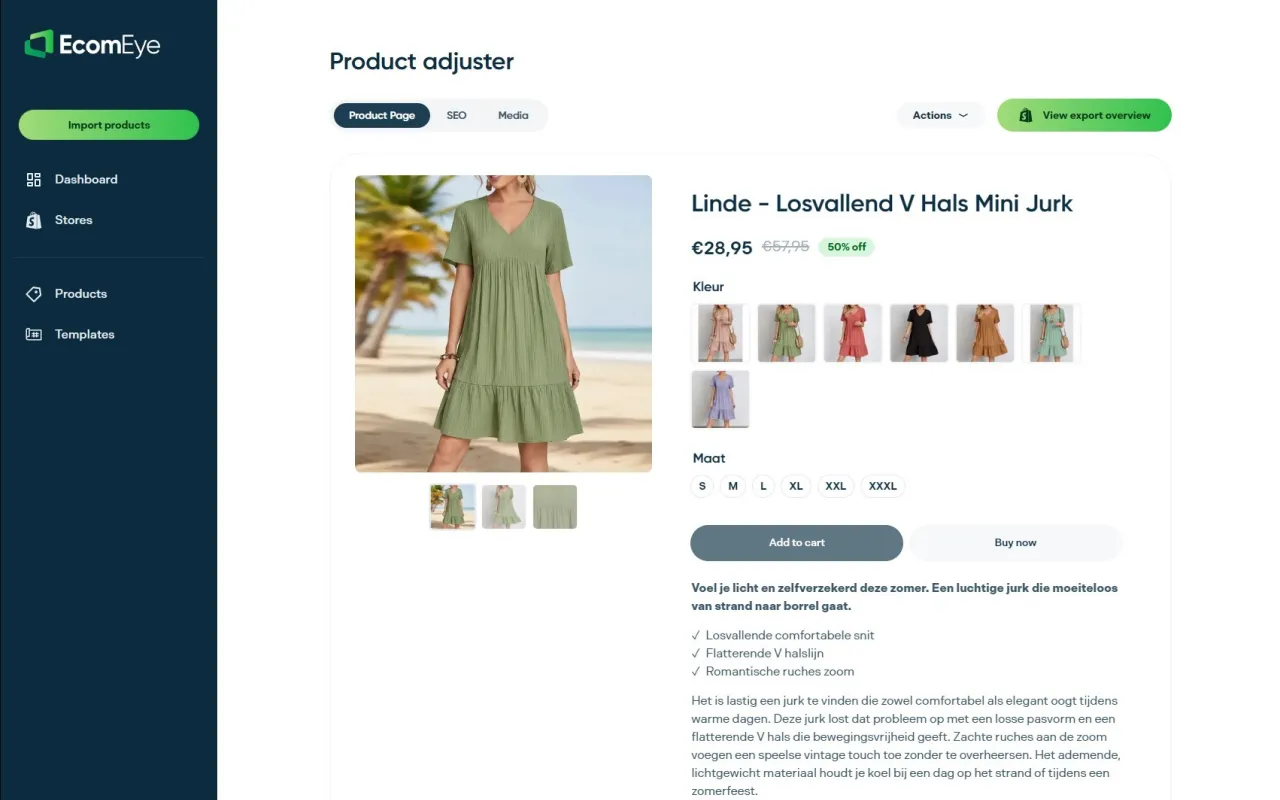
Ecom-eye is built specifically for Shopify dropshippers who need to fix and scale product listings without rewriting every page by hand. Import products in bulk from AliExpress or competitor URLs, and Ecom-eye automatically generates SEO-optimised titles, clean original descriptions, and high-quality AI product images. Every page is copyright-safe and formatted to avoid Google Merchant disapprovals. You can export directly to Shopify in one click, with no manual rewriting and no duplicate content risk. If you are managing more than a handful of products, the bulk AI product lister removes the bottleneck entirely.
FAQ
What are the most common product listing challenges?
The most frequent issues are missing or invalid GTINs, low-quality images, thin descriptions, price mismatches between feed and website, and failure to meet channel-specific formatting rules. Each of these causes either outright rejection or suppressed rankings.
Why do my listings get rejected on Google Shopping?
Google Shopping disapprovals are most commonly caused by price mismatches between the submitted feed and the live landing page, missing GTINs, or images that violate background and resolution requirements. Synchronising your feed with your website in real time resolves the majority of price-related rejections.
How do I improve product listings for better SEO?
Write titles that include the primary keyword, a key attribute, and a variant differentiator. Keep descriptions above 100 words, frame bullet points as customer benefits, and avoid keyword stuffing. Use original images rather than shared supplier stock photos.
Do I need a different product feed for each marketplace?
Yes. Amazon, Walmart, Google Shopping, and Etsy each have distinct taxonomy structures, required fields, and title formatting rules. A single generic feed will fail on at least one channel due to taxonomy mismatches or invalid field formats.
How often should I audit my product listings?
Listings should be reviewed at minimum monthly, with automated alerts set for out-of-stock events and price discrepancies. Marketplace algorithm updates and policy changes mean that compliant listings can become non-compliant without any action on your part.
Ready to boost your product pages?
Generate high-converting, SEO-optimized product pages in bulk using AI automation used by e-commerce experts.
No credit card required