Scalable product uploads: your 2026 ecommerce guide
Unlock growth with our 2026 guide to scalable product uploads. Learn the essential strategies for efficient, error-free product management.

Scalable product uploads: your 2026 ecommerce guide

TL;DR:
- Scaling product uploads is fundamentally an infrastructure, automation, and data quality challenge rather than just data entry.
- A reliable process depends on distributed cloud architecture, asynchronous processing, AI-assisted enrichment, rigorous validation, and layered security.
What scalable product uploads actually require
Scaling product uploads is not a data entry problem. It is an infrastructure, automation, and data quality problem. The moment your catalogue grows past a few hundred SKUs, manual processes break down, site performance suffers, and errors compound faster than any team can fix them by hand.
A genuinely scalable upload process rests on five foundations:
- Distributed cloud architecture separating application servers, database servers, and content delivery networks, so that catalogue growth does not slow checkout or search
- Asynchronous processing with defined lifecycle states (created, uploading, processing, ready, failed) so uploads can be tracked, retried, and recovered without full resubmission
- AI-assisted catalogue enrichment with human review to generate compliant, SEO-ready titles, descriptions, and attributes at speed
- Rigorous data validation before any file reaches your platform, covering attribute structure, SKU matching, and file integrity
- Security layered across every stage, from filename sanitisation to server-side content checks
Site performance is directly tied to how uploads are architected. Poorly structured bulk imports create database bottlenecks that slow product pages and search results for real shoppers. Getting the foundations right protects both your catalogue and your conversion rate.
How to implement scalable product uploads step by step
1. Prepare and clean your data first
Bad data in means bad listings out. Before any bulk import, structure your attributes consistently, assign clean SKUs to every product, and validate that each record is complete. SKU-based image matching is the single biggest time-saver at scale: name every image file with its product SKU and a bulk tool can match thousands of images to the right listings automatically, cutting hours of manual work to minutes.

Pro Tip: Run an image audit before uploading. You may find only a fraction of your catalogue actually needs new images, which shrinks the job considerably.
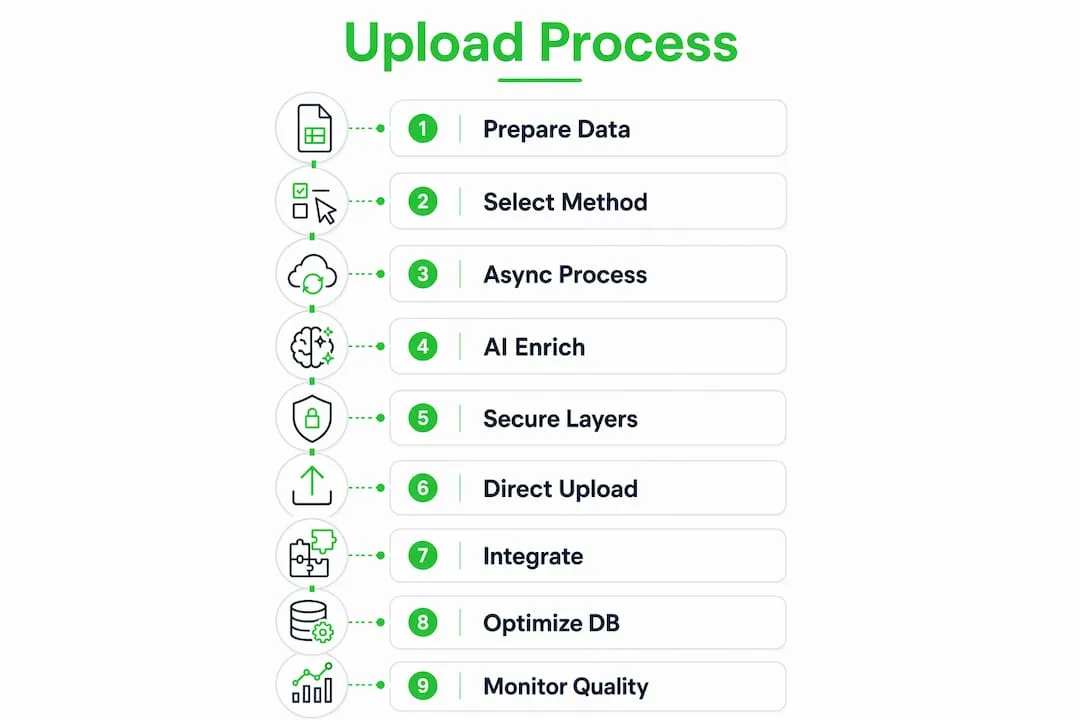
2. Choose the right upload method for your volume
Three methods cover the full range of catalogue sizes:
- CSV or XML bulk import works for mid-sized catalogues and one-off migrations, but requires careful formatting. One misplaced column silently drops data.
- API-based upload suits ongoing, automated pipelines and gives you programmatic control over batching and error handling.
- Chunked, resumable uploads via protocols like tus 1.0.x are the right choice for large files or unreliable networks. If a chunk fails, only that chunk retries, not the entire transfer.
For mobile or variable connections, chunk sizes of 5–10 MiB balance recovery cost against network overhead.
3. Use asynchronous processing and track lifecycle states

Treating uploads as synchronous operations is the most common architectural mistake. A file can arrive successfully and still fail validation minutes later. Model uploads as resources with explicit states: created, uploading, uploaded, validating, processing, ready, and failed. This gives your team reliable progress feedback and lets the system retry failed stages without restarting from scratch.
Webhooks notify downstream systems when state changes occur. The upload resource endpoint stays authoritative even when webhook delivery is delayed.
4. Automate catalogue enrichment with AI and human review
AI-powered catalogue tools can reduce product launch times from days to minutes by automating title generation, attribute population, compliance auditing, and multi-channel publishing. The catch is that AI outputs require human review to preserve brand voice and catch edge cases. Automation handles volume; people handle quality. That combination is what makes the process sustainable at scale.
Ecom-eye’s AI product description generator applies this principle directly for Shopify dropshippers, producing SEO-ready, copyright-safe descriptions in bulk without manual rewriting.
5. Secure every layer of your upload pipeline
File upload security requires depth, not a single check. The OWASP File Upload Cheat Sheet sets the standard: whitelist allowed extensions, validate actual file content using magic bytes checks rather than trusting Content-Type headers, sanitise filenames by generating server-side identifiers, restrict upload access to authorised users, and store files outside the webroot. Never rely on client-supplied metadata alone.
6. Use direct-to-storage uploads to reduce server load
Routing large files through your API server wastes bandwidth and creates bottlenecks. Presigned URLs let clients upload directly to object storage, with your server issuing a short-lived credential and then recording the completed transfer. This approach keeps your API responsive regardless of upload volume.
7. Integrate with Shopify and multi-platform feeds via middleware
Shopify’s native CSV import handles basic catalogue migrations but struggles with multi-image products and large batches. Dedicated bulk tools with SKU-based matching and Google Drive integration handle the volume Shopify’s admin cannot. For multi-platform selling, middleware layers normalise your product data into each channel’s required format, pushing a single source of truth to Shopify, Amazon, and other marketplaces simultaneously. Explore automated ecommerce workflows to see how asynchronous pipelines support this at scale.
8. Optimise your database and search architecture
At high SKU volumes, default database queries become the bottleneck. Partitioning large tables into smaller logical segments reduces query load significantly. Dedicated search engines handle faceted filtering far better than standard database queries. Caching frequently accessed product data at the CDN layer keeps page load times stable even as catalogue size grows.
9. Monitor upload success and data quality continuously
Monitoring systems that track upload progress, success rates, content completeness, and compliance give you early warning of problems before they affect shoppers. Audit across dimensions like SEO completeness, attribute consistency, and conversion readiness. Without this visibility, errors accumulate silently across thousands of listings.
| Area | What to track |
|---|---|
| Upload pipeline | Success rate, failure states, retry counts |
| Data quality | Attribute completeness, SKU accuracy, image match rate |
| Site performance | Page load times, search response times post-import |
| Compliance | Policy violations, flagged content, audit trail |
Ecom-eye handles the hardest part for Shopify dropshippers
Bulk uploading is one problem. Generating product content that actually ranks and converts is another. Most dropshippers copy competitor pages and end up with duplicate content, Google Merchant disapprovals, and poor SEO rankings.
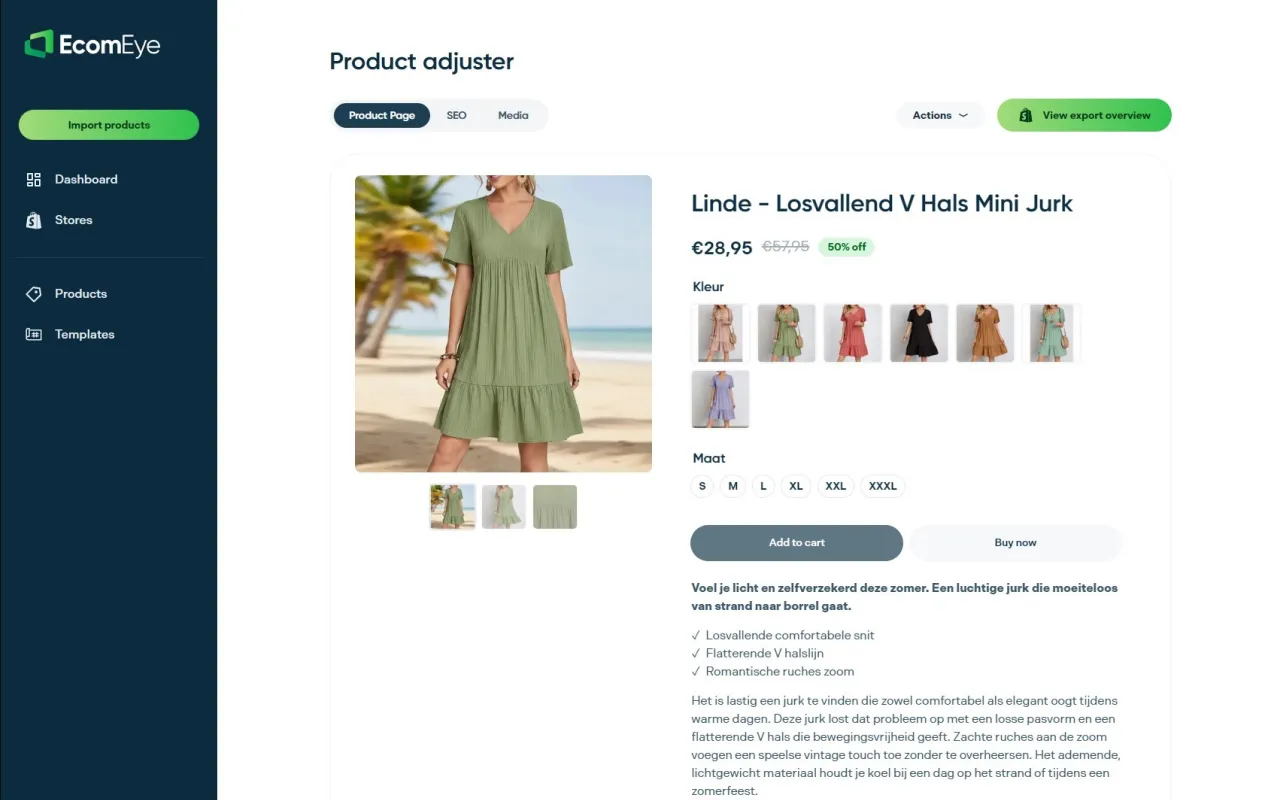
Ecom-eye skips that entirely. Import products in bulk from AliExpress or competitor links, and Ecom-eye automatically generates original, SEO-ready titles, clean descriptions, and high-quality AI product images, then exports directly to Shopify in one click. No rewriting, no copyright risk, no manual work. It also supports multi-language pages, so scaling into new markets does not require a separate content process. Try the AI product description generator to see how fast a clean, compliant catalogue comes together.
Key takeaways
Scalable product uploads require distributed infrastructure, asynchronous processing, AI-assisted enrichment with human review, and layered security to handle large catalogues without degrading site performance.
| Point | Details |
|---|---|
| Architecture first | Separate application, database, and CDN layers to prevent bottlenecks as catalogue volume grows. |
| Lifecycle states matter | Model uploads with explicit states (created, processing, ready, failed) to enable reliable retries and progress tracking. |
| SKU-based image matching | Naming image files with SKUs enables automated bulk matching, removing hours of manual work. |
| Security in depth | Validate file content via magic bytes, sanitise filenames server-side, and store files outside the webroot. |
| Ecom-eye for Shopify | Ecom-eye generates copyright-safe, SEO-ready product pages in bulk and exports directly to Shopify in one click. |
FAQ
What is product uploading in ecommerce?
Product uploading is the process of adding product data, including titles, descriptions, images, and attributes, to an ecommerce platform so items become available for sale. At scale, this requires bulk import tools, API integrations, and automated data pipelines rather than manual entry.
How do you make a product upload process scalable?
Scalable uploads rely on distributed cloud infrastructure, asynchronous processing with lifecycle state tracking, chunked file transfers for large datasets, and automated catalogue enrichment. Separating application, database, and storage layers prevents any single component from becoming a bottleneck.
What is a scalable product in ecommerce terms?
A scalable product is one whose listing, inventory, and content management can be automated and replicated across channels without proportional increases in manual effort. Clean attribute structures, SKU-based matching, and API-ready data formats are what make a product truly scalable.
How does Ecom-eye help with bulk product uploads to Shopify?
Ecom-eye imports products in bulk from AliExpress or competitor links, generates original SEO-ready titles, descriptions, and AI product images, and exports the completed listings directly to Shopify in one click, removing duplicate content risk and manual rewriting entirely.
Ready to boost your product pages?
Generate high-converting, SEO-optimized product pages in bulk using AI automation used by e-commerce experts.
No credit card required