Role of schema markup for ecommerce: 2026 guide
Discover the role of schema markup for ecommerce in 2026. Enhance your product listings with rich results to boost clicks and sales.

Role of schema markup for ecommerce: 2026 guide

TL;DR:
- Schema markup enhances ecommerce listings by enabling rich results with star ratings and prices, boosting click-through rates. Complete schema stacks, including Product, Offer, and AggregateRating, are essential for eligibility, and regular audits prevent errors that hinder visibility. As AI shopping systems rely heavily on structured data, maintaining accurate, comprehensive schema is critical for AI-driven commerce success in 2026.
Schema markup is defined as structured code added to a webpage that tells search engines exactly what your content means, not just what it says. For ecommerce professionals, the role of schema markup for ecommerce is to transform standard product listings into rich results packed with star ratings, price badges, and stock availability. These visual enhancements increase click-through rates by 20–35% without changing your organic ranking position. Governed by schema.org standards and Google Search Central guidelines, structured data has evolved from a useful SEO tactic into a foundational requirement for AI-driven search and agentic commerce in 2026.
What schema types does every ecommerce site need?
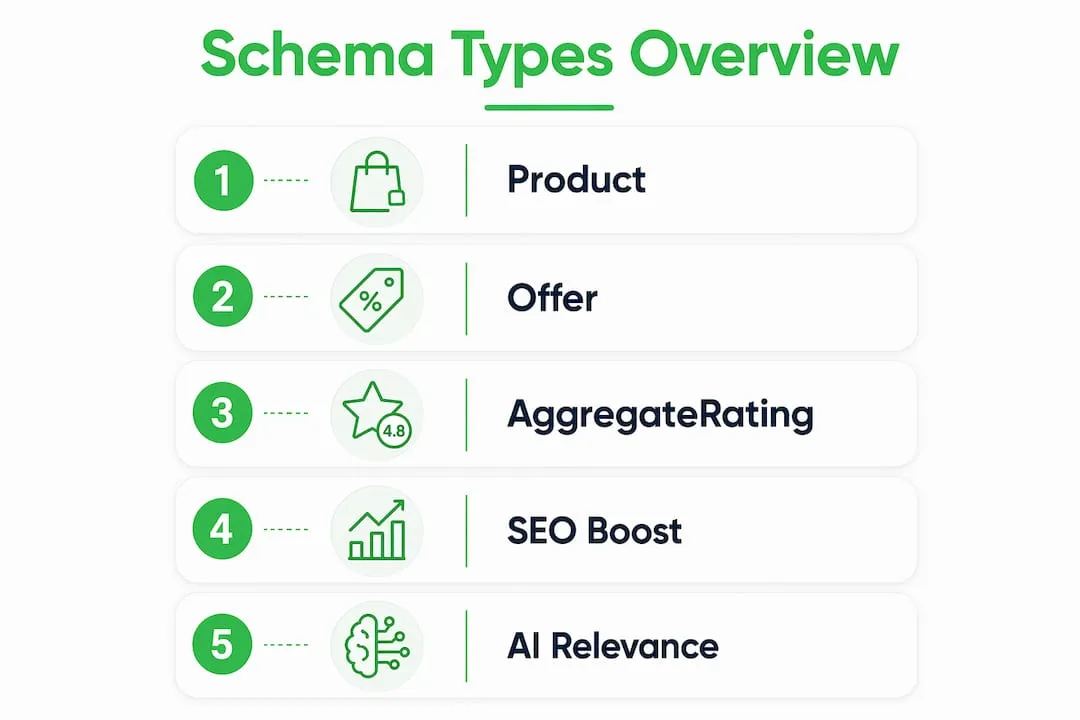
Product schema is the non-negotiable starting point for any ecommerce site. On its own, however, it does very little. Full rich snippet eligibility requires a three-layer stack: Product, Offer, and AggregateRating working together in a single JSON-LD block. Miss any one of these layers and Google will not display rich results, regardless of how well the page ranks.
JSON-LD is Google’s preferred format for structured data. It sits inside a <script> tag in your page’s <head> or <body> and does not interfere with visible HTML. Microdata and RDFa are older alternatives, but they are harder to maintain and more prone to errors. Every new implementation should use JSON-LD.
Beyond the core Product stack, three additional schema types deliver measurable gains for online stores:
- BreadcrumbList schema replaces raw URLs in search results with clear navigation paths such as “Home > Clothing > Jackets.” BreadcrumbList schema improves listing trust and makes results look more organised to shoppers scanning the page.
- FAQPage schema adds expandable question-and-answer pairs directly beneath your listing. FAQ schema increases the vertical space your result occupies, which pushes competitors further down the screen.
- ItemList and CollectionPage schemas apply to category pages and curated product collections. They signal to search engines that a page contains a structured set of products, which supports better indexing of your catalogue.
The table below summarises which schema type applies to which page and what it unlocks.
| Schema type | Best applied to | What it unlocks |
|---|---|---|
| Product + Offer + AggregateRating | Individual product pages | Star ratings, price, stock status in results |
| BreadcrumbList | All pages with navigation hierarchy | Navigation path replacing URL in results |
| FAQPage | Product and landing pages | Expandable Q&A pairs in search results |
| ItemList / CollectionPage | Category and collection pages | Structured product set signals for indexing |
How does schema markup boost ecommerce SEO and sales?
Schema markup is not a direct ranking factor. Google has confirmed this repeatedly. What it does instead is make your listing look significantly more attractive than unformatted competitors. Star ratings alone can pull clicks away from higher-ranking pages that show no visual enhancements. A shopper choosing between a plain blue link and a result showing 4.7 stars, a £29.99 price, and “In Stock” will almost always click the enriched result.

The downstream effect on rankings is real, even if indirect. Higher click-through rates send positive engagement signals to Google. Over time, pages that consistently earn more clicks than their ranking position predicts tend to move upward. Treating schema as a conversion tool, rather than a pure ranking lever, is the correct mental model.
Common pitfalls that block rich results include:
- Incomplete schema stacks. Adding Product schema without Offer or AggregateRating prevents rich results from appearing at all.
- Mismatched data. Schema showing a price of £19.99 when the page displays £24.99 violates Google’s policies and triggers manual review.
- Stale review counts. AggregateRating values that do not update when new reviews arrive cause eligibility issues over time.
- Microdata from default themes. Platform default themes often output partial Microdata rather than complete JSON-LD, leaving critical fields like SKU and availability missing.
Pro Tip: Run Google’s Rich Results Test on your top ten revenue-generating product pages before anything else. Fix those first. The revenue impact of correcting schema on high-traffic pages far outweighs fixing low-traffic pages.
A site generating 10,000 organic clicks per month can realistically gain 2,000–3,500 additional clicks monthly after a thorough schema fix. That scale of traffic growth from a one-time technical change is difficult to match with content or link-building alone.
Why does schema matter for AI and agentic commerce?
The stakes for structured data have risen sharply in 2026. AI systems, including large language models powering Google’s AI Overviews and third-party shopping agents, do not browse pages the way humans do. They extract structured signals. LLMs use schema to pull product details, verify pricing, and compare options across multiple sites simultaneously. A product page with incomplete or absent schema is effectively invisible to these systems.
Schema now functions as a secondary verification layer alongside Google Merchant Center feeds. When an AI shopping agent checks whether a product is in stock and correctly priced, it cross-references the on-page schema against the merchant feed. Mismatches between the two reduce trust scores and lower the likelihood of the product appearing in AI-generated recommendations. Sites with well-maintained schema act as trusted sources in the agentic web, gaining preference in AI shopping results.
Scaling schema across a large catalogue requires a systematic approach. The steps below reflect what practitioners are doing in 2026 to stay ahead.
- Audit your current schema output. Use Google’s Rich Results Test on a representative sample of product, category, and landing pages. Note every missing property.
- Prioritise by revenue. Fix schema on your highest-earning product pages first. A complete Product, Offer, and AggregateRating stack on twenty key pages delivers more return than partial schema across two hundred pages.
- Align schema with your Merchant Center feed. Price, availability, and GTIN values must match exactly. Discrepancies cause AI agents to distrust your data.
- Automate schema generation for new products. Manual schema entry does not scale. Build schema generation into your product upload workflow so every new listing arrives with complete structured data.
- Schedule quarterly audits. Schema breaks when pages are redesigned, prices change, or reviews accumulate. A quarterly check catches drift before it costs you rich snippet eligibility.
The voice search in ecommerce context adds another dimension. Voice assistants and AI agents both rely on structured data to surface specific product answers. A store without complete schema is simply not part of that conversation.
Best practices for implementing ecommerce schema effectively
Start with your top revenue-generating product pages and build outward. Every product page needs a complete JSON-LD block covering Product, Offer, and AggregateRating. Missing any of these three properties means no rich results, full stop.
Default platform schema from Shopify and WooCommerce themes is frequently incomplete. Default themes often output Microdata rather than JSON-LD, and they routinely omit SKU, review data, and availability fields. Do not assume your platform handles this correctly. Check it manually.
Key rules for implementation:
- Keep schema consistent with visible page content. If your page shows “In Stock,” your schema must say the same. Google penalises schema that misrepresents what users see.
- Embed JSON-LD in the page source, not via JavaScript injection. Dynamically injected schema can be missed by crawlers if the page is not fully rendered.
- Add BreadcrumbList to every page with a navigation hierarchy. This applies to product pages, category pages, and blog posts alike.
- Use FAQPage schema on product pages where you answer common buyer questions. This is particularly effective for products with complex specifications or multiple variants.
- Validate after every site update. Redesigns, theme changes, and CMS updates frequently break schema output without any visible warning.
Pro Tip: Do not rely solely on automated schema plugins. Cross-check their output with Google’s Rich Results Test after installation. Plugins frequently generate schema that passes their own validation but fails Google’s stricter requirements.
Ecommerce SEO best practices for Shopify consistently place schema implementation in the top tier of technical priorities. The reason is simple: the effort is low, the validation is free, and the upside in clicks and AI visibility is substantial.
Key takeaways
Schema markup is the single highest-return technical SEO task available to ecommerce professionals, delivering measurable click-through gains and AI visibility from a one-time implementation effort.
| Point | Details |
|---|---|
| Three-layer schema stack | Product, Offer, and AggregateRating must all be present for rich results to appear. |
| CTR uplift is real | Complete schema drives 20–35% higher click-through rates, which indirectly supports rankings. |
| AI agents rely on schema | LLMs and shopping agents use structured data to verify and recommend products in 2026. |
| Platform defaults are insufficient | Shopify and WooCommerce default themes often output incomplete Microdata, not full JSON-LD. |
| Audit and maintain regularly | Schema breaks silently after site updates; quarterly checks protect rich snippet eligibility. |
Schema in 2026: what I’ve learned from watching stores get it wrong
Most ecommerce professionals I speak with believe they have schema covered. They installed a plugin, ticked a box, and moved on. The reality is that the gap between “having schema” and “having complete, valid schema” is where most stores lose their rich results.
The stores that genuinely benefit from structured data are the ones that treat it as a living part of their technical stack, not a one-time setup task. I have seen product pages ranking in position three with no rich results, losing clicks to position-seven pages showing star ratings and price. That is a fixable problem, and it costs nothing beyond time and attention.
What concerns me more in 2026 is the AI visibility gap. Stores with incomplete schema are not just missing rich snippets. They are being filtered out of AI shopping recommendations entirely. As agentic commerce grows, that gap will widen. The stores that audit their schema now, align it with their Merchant Center feeds, and automate it for new products will compound that advantage month after month.
My practical advice: stop thinking about schema breadth and start thinking about schema completeness. Twenty perfectly implemented product pages outperform two hundred partially implemented ones every time. Audit your top pages this week. Fix what is broken. Then build the process so every new product arrives with complete structured data from day one.
— Koen
How Ecom-eye helps you get schema and SEO right
Getting schema right is one piece of a larger puzzle. Ecom-eye builds that puzzle for Shopify dropshippers automatically. Every product page generated by Ecom-eye arrives with SEO-ready content built for search visibility, not copied from competitors. That means no duplicate content penalties, no Google Merchant disapprovals, and no manual rewriting.
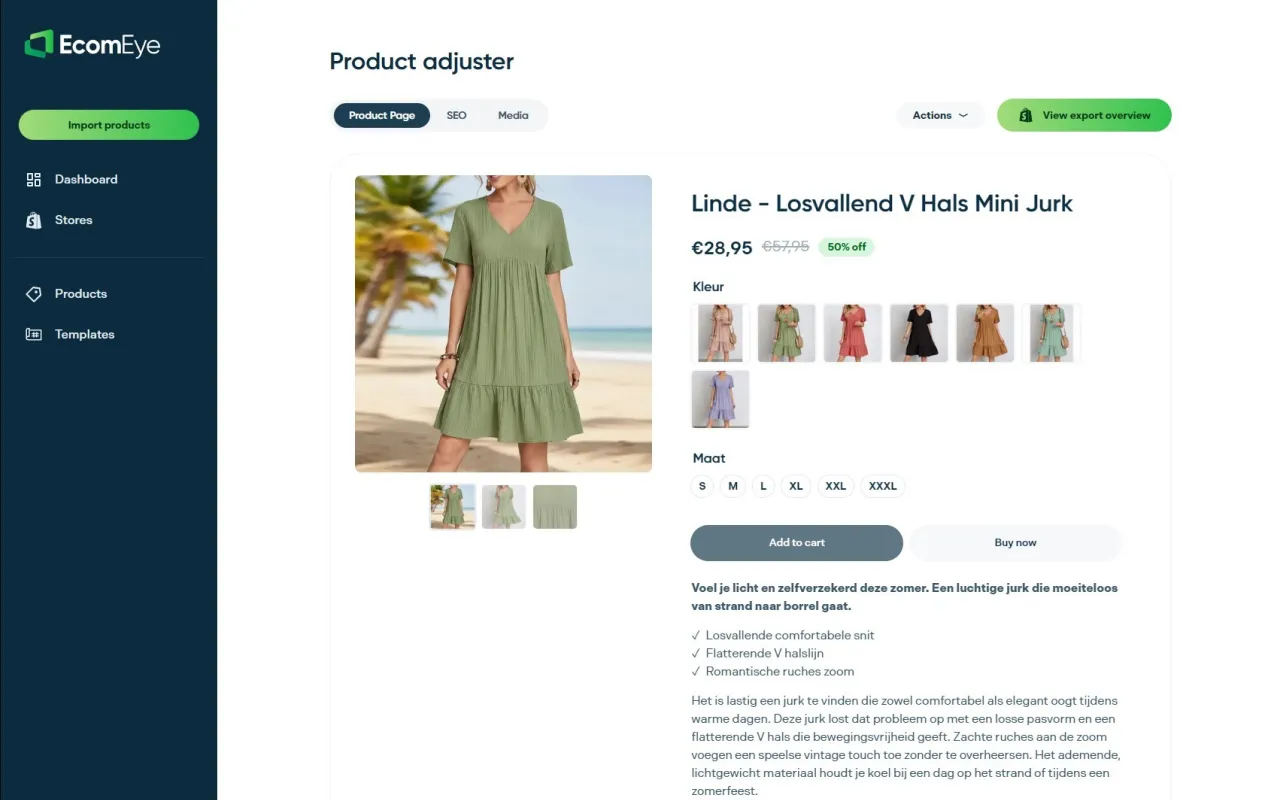
Ecom-eye imports products in bulk from AliExpress or competitor links and generates clean titles, descriptions, and AI product images ready for Shopify export in one click. For Shopify store owners who want to compete on SEO without spending hours on technical fixes, Ecom-eye is the direct path from product import to search-ready listing.
FAQ
What is the role of schema markup for ecommerce?
Schema markup tells search engines the precise meaning of your product data, enabling rich results with star ratings, pricing, and stock status. These visual enhancements increase click-through rates by 20–35% compared to standard listings.
Does schema markup directly improve Google rankings?
Schema is not a direct ranking factor. It improves click-through rates, and the resulting positive engagement signals can indirectly support rankings over time.
Which schema type is most important for product pages?
The Product schema combined with Offer and AggregateRating is the most critical combination. All three must be present in JSON-LD format for rich results to appear.
How do I check if my schema is working correctly?
Use Google’s Rich Results Test to validate your schema. It identifies missing properties and errors that prevent rich snippets from displaying in search results.
Why does schema matter for AI shopping agents?
LLMs and AI shopping agents use schema to extract and verify product details for recommendations. Sites with complete, consistent schema are treated as trusted sources and gain preference in AI-generated shopping results.
Ready to boost your product pages?
Generate high-converting, SEO-optimized product pages in bulk using AI automation used by e-commerce experts.
No credit card required