The role of voice search in ecommerce: 2026 guide
Discover the role of voice search in ecommerce by 2026. Learn how to leverage voice commerce for increased sales and visibility today!
The role of voice search in ecommerce: 2026 guide
TL;DR:
- Voice search in ecommerce is transforming the customer journey by serving as a discovery and reorder channel driven by conversational AI and structured data. It offers higher loyalty and order values, especially through repeat purchases, while presenting challenges like optimizing for natural speech and local intent. Businesses should focus on content architecture, seamless reorder flows, and AI-ready product data to capitalize on this growing trend.
Voice search in ecommerce is the practice of using spoken, natural language commands to discover, evaluate, and purchase products through AI-powered assistants such as Amazon Alexa, Google Assistant, and Apple Siri. Voice commerce reached $23.4 billion in Q1 2026, marking a 47% year-over-year increase that no serious retailer can afford to ignore. The industry term for this channel is voice commerce, and it sits at the intersection of conversational AI, mobile-first behaviour, and SEO architecture. For Shopify store owners and dropshippers, understanding how voice commerce works is no longer optional. It is the difference between appearing in front of buyers at the moment of intent and being invisible to them entirely.
How does voice search influence the ecommerce funnel?
Voice search reshapes the ecommerce funnel at every stage, from discovery through to repeat purchase, and the data makes the impact concrete. 49.6% of US consumers use voice search for shopping-related tasks, and 54% of retail searches now occur via voice. That scale means voice is no longer a niche behaviour. It is the default for a significant portion of your potential customers.

The conversion picture is more nuanced than the headline numbers suggest. Only 2.8% of voice sessions convert when the purchase remains voice-only, but that figure rises to 14.2% when the session transitions to a screen for checkout. Voice commerce works best as a discovery and intent layer, not a standalone checkout mechanism. Think of it as the top of your funnel doing the heavy lifting, handing off to your product page to close the sale.
Where voice genuinely dominates is in repeat purchasing. Reorder completion rates between 78% and 84% make subscription and replenishment categories the strongest use case for voice commerce today. A customer saying “Alexa, reorder my protein powder” requires zero friction and zero screen time. For DTC brands selling consumables, this is a retention channel as much as a sales channel.
- Voice search acts as a discovery layer, surfacing products through conversational queries before the buyer reaches a screen.
- Conversion rates are five times higher when voice initiates and screen completes the purchase.
- Repeat purchases and subscriptions are where voice commerce delivers its highest return on investment.
- Local and transactional queries, such as “where can I buy X near me,” are growing at pace, connecting online intent to offline or same-day fulfilment.
Pro Tip: Set up a dedicated landing page for your top reorder products, optimised for conversational queries. Pair it with a simple reorder flow and you capture the 78%+ completion rate that voice-driven repeat purchases consistently achieve.
What technology trends are shaping voice commerce in retail?
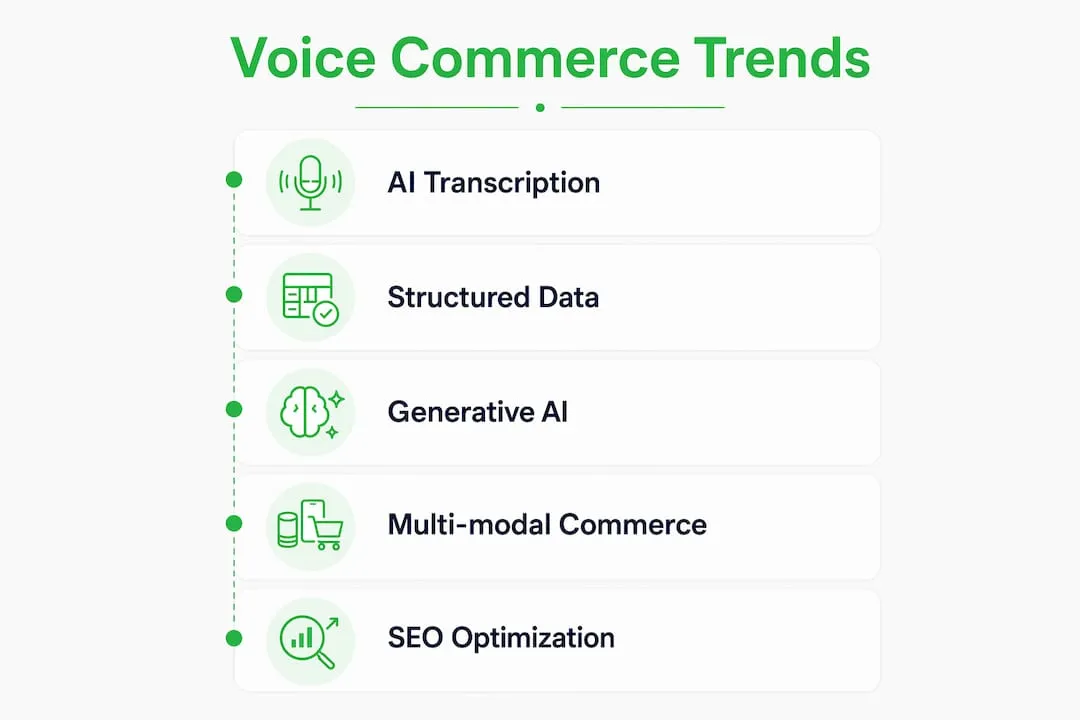
The technology underpinning voice search in retail has matured significantly since the early days of simple command-and-response assistants. Three converging developments define the current state of the art.
1. AI transcription for voice-friendly SEO content
AI transcription converts spoken audio from support calls, product videos, and customer reviews into natural language text that mirrors how real people ask questions. This matters because voice queries use full sentences and colloquial phrasing that traditional keyword research rarely captures. Transcribing your customer service recordings gives you a direct window into the exact language your buyers use, which you can then embed in product descriptions, FAQs, and category pages.
2. Structured data, FAQ schema, and conversational SEO
Structured data and FAQ schema are the technical foundation for appearing as the “position zero” answer that voice assistants read aloud. When Google Assistant or Alexa answers a shopping query, it pulls from featured snippets. If your product pages lack schema markup, you are not in contention for that answer. Conversational keyword targeting, built around question phrases like “what is the best X for Y,” replaces the short-tail keyword approach that traditional SEO relies on.
3. Generative AI and multi-modal commerce
Voice and generative AI are converging into a single discovery channel, and this is the most consequential shift for ecommerce businesses planning beyond 2026. Amazon’s Alexa now integrates large language model capabilities, allowing it to handle complex, multi-turn shopping conversations. The Walmart and Google partnership embeds voice search directly into Google Shopping, meaning a spoken query can surface a Walmart product listing without the customer ever visiting Walmart’s website. Shopify’s Voice Commerce API allows merchants to connect their product catalogues directly to voice assistant ecosystems.
| Technology | Primary benefit | Best use case |
|---|---|---|
| AI transcription | Natural language content generation | Product descriptions, FAQs |
| FAQ schema markup | Featured snippet eligibility | Category and product pages |
| Generative AI assistants | Multi-turn conversational shopping | Discovery and product comparison |
| Voice Commerce API | Direct catalogue integration | Reordering and subscription management |
Pro Tip: Use AI infrastructure for retail platforms that support multi-modal commerce. A voice query that starts on a smart speaker and ends on a mobile checkout page requires your product data to be consistent across every touchpoint.
What challenges come with optimising for voice search?
The most significant obstacle for most ecommerce businesses is the “voice gap.” This is the mismatch between the formal, keyword-dense language in most product listings and the casual, conversational phrasing that shoppers use when speaking. A product page optimised for “men’s waterproof running shoes size 10” will not surface for “what are the best running shoes I can wear in the rain.” Closing this voice gap requires a deliberate content strategy built around natural speech patterns, not search volume alone.
Several other challenges compound this core problem:
- Local intent mismatch: ‘Near me’ shopping queries have grown over 500% in two years, yet many ecommerce stores have no local SEO presence at all. If you offer same-day delivery or click-and-collect, your store needs geo-optimised content to capture this intent.
- Voice-only purchase limitations: Complex or high-consideration purchases rarely convert through voice alone. Customers buying a laptop or a piece of furniture want to see images, read specifications, and compare options on screen. Voice is the entry point, not the closing mechanism, for these categories.
- Security and trust concerns: Shoppers remain cautious about completing payments through voice assistants, particularly for new purchases. Stored payment methods and one-click reorder flows reduce this friction, but first-time voice purchases still face a trust barrier that screen-based checkout does not.
- Attribution gaps: Most analytics platforms do not yet distinguish voice-initiated sessions from standard organic or direct traffic. Without dedicated voice search analytics for ecommerce, measuring the true impact of your voice optimisation efforts is genuinely difficult.
The businesses that navigate these challenges most effectively treat voice as one layer of a multi-channel strategy rather than a standalone channel. Understanding how content drives ecommerce SEO is the foundation on which voice optimisation sits.
How can ecommerce businesses leverage voice search effectively?
Practical voice commerce strategy comes down to five areas, each of which builds on the last.
Audit your existing audio assets. Customer service call recordings, product explainer videos, and unboxing content all contain the natural language your buyers use. Transcribe these assets using tools such as Otter.ai or Descript, then extract the question-and-answer patterns that appear repeatedly. These become the raw material for your FAQ pages and conversational product descriptions.
Re-architect your product catalogue for conversational intent. A product titled “Blue Ceramic Coffee Mug 350ml” answers a keyword query. A product titled “What is the best ceramic coffee mug for everyday use?” answers a voice query. You do not need to rename every product, but your page copy, meta descriptions, and FAQ sections should address the spoken questions buyers ask at each stage of the purchase journey. The role of language in global ecommerce extends directly into voice, where phrasing and register matter as much as keyword presence.
Implement structured data across your catalogue. Product schema, FAQ schema, and review schema each increase your eligibility for featured snippets. Voice assistants pull answers from position zero results. Without schema, your pages are structurally invisible to the algorithms that power voice responses.
Build frictionless reorder flows. Given that voice commerce drives completion rates up to 84% for repeat transactions, your highest-priority voice investment is a one-click reorder or subscription management system. Integrate this with Alexa for Shopping or Google Assistant through their respective merchant APIs.
Measure voice-specific KPIs. Track featured snippet appearances, conversational keyword rankings, and reorder rates separately from your standard ecommerce metrics. Google Search Console now surfaces question-based query data that approximates voice search behaviour, even without a dedicated voice analytics dashboard.
| Strategy | Traditional SEO approach | Voice-optimised approach |
|---|---|---|
| Keyword targeting | Short-tail, high-volume terms | Full-sentence, question-based phrases |
| Content format | Product specifications | Conversational FAQs and answers |
| Schema markup | Basic product schema | FAQ, HowTo, and review schema |
| Purchase flow | Standard checkout | One-click reorder and subscription |
| Analytics | Session and conversion tracking | Featured snippet and query-type tracking |
Brands that have made this shift report 31% higher order values and 43% higher brand loyalty compared to traditional ecommerce. The loyalty figure is particularly telling. Voice interactions create habitual purchasing patterns that are far harder for competitors to disrupt than a standard search ranking.
Pro Tip: Connect your ecommerce automation workflows to your voice commerce strategy. Bulk-generating conversational product descriptions at scale is the only practical way to re-architect a large catalogue without months of manual rewriting.
Key takeaways
Voice commerce succeeds when it functions as a discovery and reorder layer feeding into screen-based checkout, supported by conversational SEO, structured data, and frictionless repeat-purchase flows.
| Point | Details |
|---|---|
| Voice as a discovery layer | Voice initiates purchase intent; screen-based checkout closes the sale at five times the conversion rate. |
| Reorder flows deliver the highest ROI | Completion rates of 78% to 84% make subscriptions and repeat purchases the strongest voice commerce use case. |
| Close the voice gap | Transcribe audio assets and rewrite product copy using natural, question-based language to match spoken queries. |
| Structured data is non-negotiable | FAQ schema and product schema are the technical requirements for appearing in the featured snippets that voice assistants read aloud. |
| Measure what matters | Track featured snippet rankings, conversational keyword positions, and reorder rates as your core voice commerce KPIs. |
Voice commerce in 2026: what I actually think is happening
I have watched voice search go from a novelty to a genuine revenue channel over the past two years, and the shift that surprises most store owners is how habitual it becomes for customers once they use it once. The first reorder via Alexa is a novelty. The tenth is just how they shop. That behavioural lock-in is something no paid ad campaign can replicate.
What I think most businesses get wrong is treating voice as a separate technology project. They assign it to the SEO team, run a schema audit, and consider the job done. The real opportunity is in the content architecture. Your product descriptions, FAQs, and category pages need to read the way people speak, not the way copywriters write. That is a content strategy problem, not a technical one.
The convergence of voice with generative AI is the development I am watching most closely. When a customer can have a multi-turn conversation with an AI assistant that knows their order history, their preferences, and their budget, the traditional product discovery funnel becomes almost irrelevant. The assistant becomes the funnel. Businesses that have already built conversational content and clean product data will be positioned to feed those AI systems. Businesses that have not will be filtered out before the customer ever sees their products.
My honest recommendation: start with your top 20 reorder products and build a proper voice-optimised FAQ and reorder flow for each one. The investment is small. The compounding loyalty effect is not.
— Koen
How Ecom-eye helps you build voice-ready product listings at scale
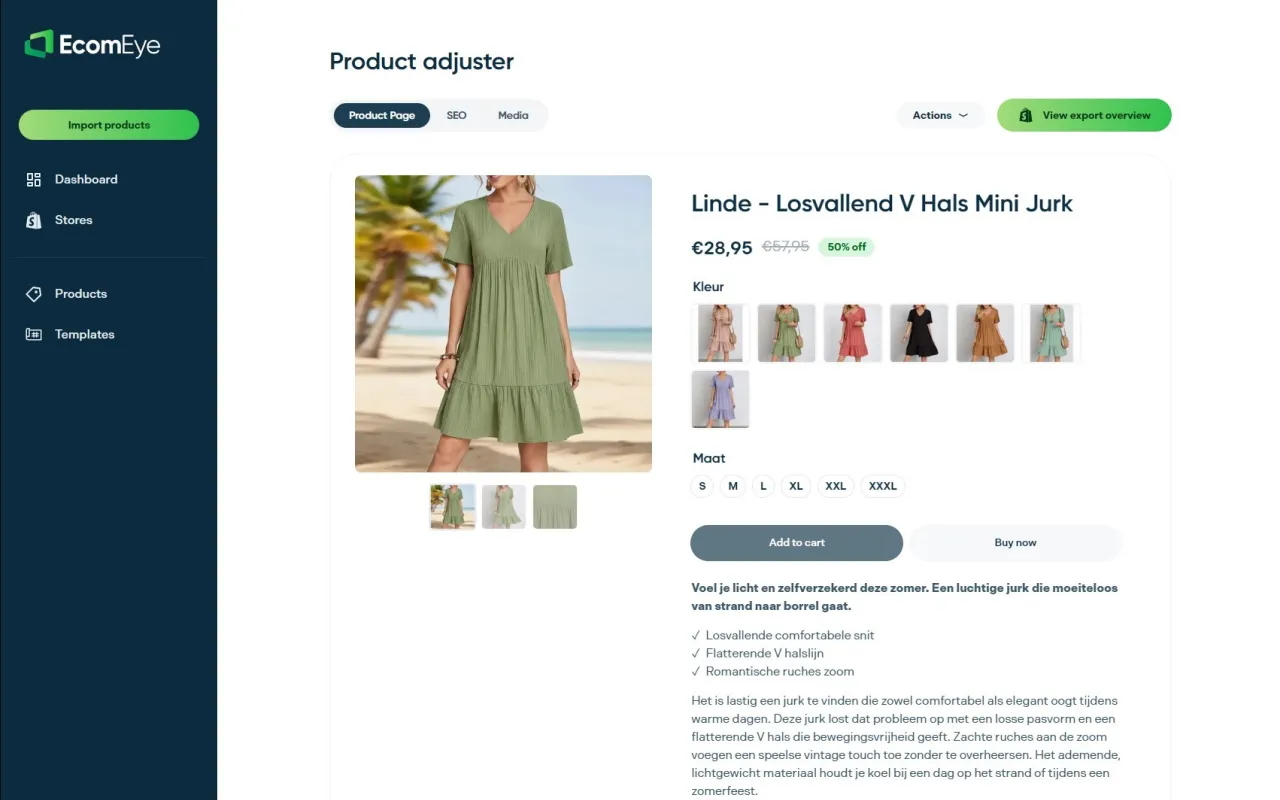
Rewriting an entire product catalogue to match conversational search intent is the kind of task that sounds straightforward and takes months when done manually. Ecom-eye removes that bottleneck entirely. The platform imports products in bulk from AliExpress or competitor links and automatically generates SEO-ready titles, clean descriptions, and FAQ-structured content that aligns with how buyers actually speak. Every listing is copyright-safe, multi-language ready, and exportable to Shopify in one click. For dropshippers who need to re-architect their catalogues for voice and conversational SEO without hiring a content team, the bulk AI product lister is the practical starting point.
FAQ
What is the role of voice search in ecommerce?
Voice search in ecommerce enables customers to discover and purchase products using natural spoken language through assistants such as Amazon Alexa and Google Assistant. It functions primarily as a discovery and reorder channel, with the highest conversion rates occurring when voice initiates and a screen completes the purchase.
How does voice search affect online shopping conversion rates?
Voice-only sessions convert at 2.8%, but that rate rises to 14.2% when the session moves to a screen for checkout. The most reliable conversion use case is repeat purchasing, where voice-driven reorder flows achieve completion rates of 78% to 84%.
What are the benefits of voice commerce for retailers?
Brands using voice commerce report 31% higher order values and 43% higher brand loyalty compared to standard ecommerce. The habitual nature of voice reordering creates purchasing patterns that are difficult for competitors to disrupt through conventional advertising.
How do I optimise my ecommerce store for voice search?
Implement FAQ schema and product structured data across your catalogue, rewrite product copy using full-sentence, question-based language, and build a frictionless one-click reorder flow for your top repeat-purchase products. AI transcription of customer service calls is the fastest way to identify the natural language your buyers actually use.
What is the future of voice search in shopping?
Voice and generative AI are converging into a single conversational discovery channel, with multi-turn AI assistants increasingly acting as the primary interface between buyers and product catalogues. Businesses that build clean, conversational product data now will be best positioned to feed these AI-driven shopping systems as they mature through 2026 and beyond.
Ready to boost your product pages?
Generate high-converting, SEO-optimized product pages in bulk using AI automation used by e-commerce experts.
No credit card required