Why dropshippers fail Google checks: 2026 guide
Discover why dropshippers fail Google checks and how to avoid common pitfalls. Learn to build a compliant store for success in 2026!

Why dropshippers fail Google checks: 2026 guide

TL;DR:
- Dropshippers often fail Google Merchant Center checks due to accumulated inconsistencies in business identity, unoriginal supplier content, and misleading shipping claims that trigger Google’s misrepresentation policies. Ensuring exact identity, original product content, and synchronized policies across all platforms is essential for compliance and long-term store stability. Building automated systems for ongoing consistency and proper documentation boosts confidence and improves chances of reinstatement after suspensions.
Dropshippers fail Google Merchant Center checks primarily because their stores present inconsistent business identity, copied supplier content, and misleading operational claims, all of which trigger Google’s misrepresentation policy. Google’s misrepresentation policy is designed to protect shoppers by eliminating hidden or inconsistent store information, and it catches far more stores than most new sellers expect. In April 2026, Google introduced an advanced AI verification layer that cross-checks supplier-of-origin signals against declared business identity, making the old shortcut of copying AliExpress listings directly into a Shopify store a near-guaranteed route to suspension. Understanding why dropshippers fail Google checks is the first step to building a store that actually survives scrutiny.
What specific Google checks cause dropshippers to fail
Google Merchant Center suspensions for dropshippers rarely come from a single catastrophic error. Accumulated weak signals cause most misrepresentation suspensions, meaning a slightly inconsistent address here, a vague refund policy there, and a stock supplier photo combine into a risk score that crosses Google’s threshold. This is the most misunderstood aspect of dropshipper compliance issues: you can do nine things right and still fail.
Google’s automated verification system runs several distinct checks simultaneously:
- Business identity cross-check. Google’s AI compares the business name, address, and contact details across your Merchant Center profile, your domain WHOIS record, your Google payments profile, and your website footer. Any mismatch, even a different company suffix like “Ltd” versus “Limited”, raises a flag.
- Image fingerprinting. Google’s AI fingerprints product images and compares them against listings on AliExpress, Temu, and other major dropshipping marketplaces. Unmodified supplier photos are one of the highest-weighted suspension triggers in 2026.
- Shipping time verification. If your product feed claims three-day delivery but your AliExpress supplier ships from Shenzhen with a 15-day transit time, Google’s system detects the discrepancy through historical shipping data and flags it as a misleading claim.
- Feed-to-site consistency. Product titles, prices, images, and availability in your Google Shopping feed must exactly match what appears on your website. Dynamic pricing tools that update your site but lag your feed are a common and avoidable cause of suspension.
- Policy and contact completeness. Vague or template-copied return policies, missing physical contact addresses, and generic “contact us” forms without a real email address all lower your trust score.
Pro Tip: Use exactly the same business name format everywhere: Merchant Center, your website footer, your domain registration, and your Google Ads account. Even a missing comma or abbreviated word can trigger an identity mismatch in Google’s automated review.
How discrepancies in business identity lead to Google suspensions
Google checks five key surfaces when verifying your business identity: your Merchant Center profile, your website footer, your domain WHOIS record, your Google payments profile, and your Google Ads account. Professionals call this NAP consistency, which stands for Name, Address, and Phone. When these five surfaces tell slightly different stories, Google’s risk score climbs.
The most common identity mistakes dropshippers make follow a predictable pattern:
- Privacy-protected WHOIS records. Many domain registrars offer WHOIS privacy by default. Google cannot verify your business identity against a hidden WHOIS record, and this alone can trigger a review hold of 7 to 30 days.
- Virtual office addresses. Using a virtual office or a PO box as your registered business address, then listing a different address on your website, creates an immediate mismatch. Google cross-references these and flags the inconsistency.
- Inconsistent company suffixes. Registering as “Bright Goods Limited” in Merchant Center but displaying “Bright Goods Ltd” on your website footer seems trivial. Google’s AI does not treat it as trivial.
- Different phone number formats. Listing “+44 20 7946 0958” in one place and “020 7946 0958” in another is enough to contribute to a failed identity check.
- Mismatched payment profile names. Your Google payments profile must reflect the exact legal trading name you use everywhere else. Many dropshippers set this up hastily and never revisit it.
To prepare identity documents for a Merchant Center appeal, gather your certificate of incorporation, a recent utility bill or bank statement showing your registered address, and a screenshot of your WHOIS record with privacy disabled. Submit all three together, not piecemeal.
Pro Tip: Temporarily disable WHOIS privacy protection before submitting a reconsideration request. Google’s reviewers need to see a live, verifiable WHOIS record that matches your declared business identity. Re-enable privacy after reinstatement if you prefer.
Why unoriginal product content and feed inconsistencies cause failure
Copied content is the single most common reason why Google bans dropshippers at scale. When you import a product directly from AliExpress into Shopify without modifying the title, description, or images, you are presenting Google with content it has already indexed thousands of times across competing stores. Google’s systems recognise this pattern immediately.

Feed-to-site consistency across product title, pricing, images, and availability is non-negotiable. Discrepancies trigger suspension. Professional dropshippers enforce this programmatically, using scripts or Shopify apps to synchronise every variable between their product feed and their live website, because human error in manual updates is one of the most common root causes of suspensions.
The content-related triggers worth understanding in detail:
- Stock supplier images. Using unmodified AliExpress or Temu photos links your listing directly to known supplier sources through image fingerprinting. Original photography or commissioned mockups drastically lower your fingerprint match score and reduce suspension risk.
- Copied product titles. Titles like “2024 New Arrival Waterproof LED Watch Men Women Fashion Sport” are indexed across thousands of stores. Google treats them as a signal of a low-effort, potentially misleading listing.
- Duplicated descriptions. Supplier descriptions are written for wholesale buyers, not retail shoppers, and they are rarely unique. Rewriting them in your own voice serves both SEO and compliance.
- Dynamic pricing mismatches. If you use a currency conversion tool or a repricing app, your Shopify storefront price can differ from your Google Shopping feed price by the time Google crawls it. Even a one-penny discrepancy is a feed violation.
- Variant inconsistencies. Listing a product in three colours on your website but only one colour in your feed is a common oversight that flags your account for misrepresentation.
| Content issue | Compliance risk |
|---|---|
| Unmodified supplier images | High: triggers image fingerprint match |
| Copied product titles | Medium: signals low-effort, duplicate listing |
| Feed price differs from site price | High: direct misrepresentation violation |
| Missing variants in feed | Medium: inconsistency between feed and site |
| Duplicated supplier descriptions | Medium: low trust score, SEO penalty |
How shipping, return policies, and customer service affect compliance
Inaccurate shipping claims are one of the fastest routes to a Google Merchant Center suspension for dropshippers. If your store promises delivery in five to seven days but your supplier ships from overseas with a 20-day transit time, Google’s system flags this as a misleading operational claim. The fix is not to hide the real shipping time. The fix is to state it accurately and build customer expectations around it.
Return and refund policies require the same specificity. Vague language like “we accept returns within a reasonable timeframe” fails Google’s transparency requirements. Your policy must state the exact return window in days, who pays return shipping, how refunds are processed, and how long they take. Template policies copied from other websites are recognisable to Google’s reviewers and contribute to a lower trust score.
Here is a practical sequence for aligning your policies with Google’s requirements:
- Contact your supplier and get their actual shipping times in writing for each destination country you sell to. Use these figures, not optimistic estimates, in your Merchant Center shipping settings.
- Write a return policy that mirrors what your supplier actually allows. If your supplier does not accept returns on certain product categories, state this clearly rather than promising returns you cannot honour.
- Add a real business email address and a physical contact address to your website footer, your Merchant Center profile, and your Google Ads account. A contact form alone is insufficient.
- Set up automated shipping notifications at day one and day three post-purchase. Automated shipping notifications reduce customer support tickets by 30% to 45%, which matters because high dispute and chargeback rates are a negative trust signal for Google.
Pro Tip: Cross-check your return policy wording against your Merchant Center return settings. If your website says 30 days but your Merchant Center is set to 14 days, Google reads this as a direct inconsistency and it contributes to your misrepresentation risk score.
How to fix and avoid Google checks failures as a dropshipper
Fixing a Google Merchant Center suspension requires a full compliance audit, not a quick patch. Most reinstatements take 7 to 14 days after submitting corrected documents and comprehensive fixes. Submitting a partial fix and appealing immediately triggers longer cool-down periods, sometimes extending to 30 days or more.
Work through this audit sequence before submitting any reconsideration request:
- Identity audit. Verify that your business name, address, phone number, and company suffix are identical across Merchant Center, your website footer, WHOIS, your payments profile, and Google Ads. Disable WHOIS privacy before appealing.
- Feed audit. Use a feed management tool to compare every product’s title, price, image URL, availability, and variants between your Google Shopping feed and your live website. Fix every discrepancy before appealing.
- Content audit. Replace all unmodified supplier images with original photography or AI-generated mockups. Rewrite every product title and description in your own voice. Tools like Ecom-eye generate copyright-safe product pages in bulk, removing the manual rewriting bottleneck entirely.
- Policy audit. Rewrite your shipping, return, and refund policies with specific figures and clear language. Remove all template language.
- Appeal documentation. Write a detailed reconsideration request that lists every specific change you made, with before-and-after examples where possible. Vague appeals like “we have fixed the issues” are rejected far more often than specific, documented ones.
Automated fix engines resolve approximately 80% of feed disapprovals within 24 hours, which cleans your account before you submit a formal appeal. Do not appeal with outstanding feed errors. Google’s reviewers see them and it undermines your credibility.
One critical mistake to avoid: do not create a new Merchant Center account or switch to a new domain after a suspension. Google links accounts by IP address, payment profile, and business identity. A new account with the same underlying signals will be suspended faster than the original.
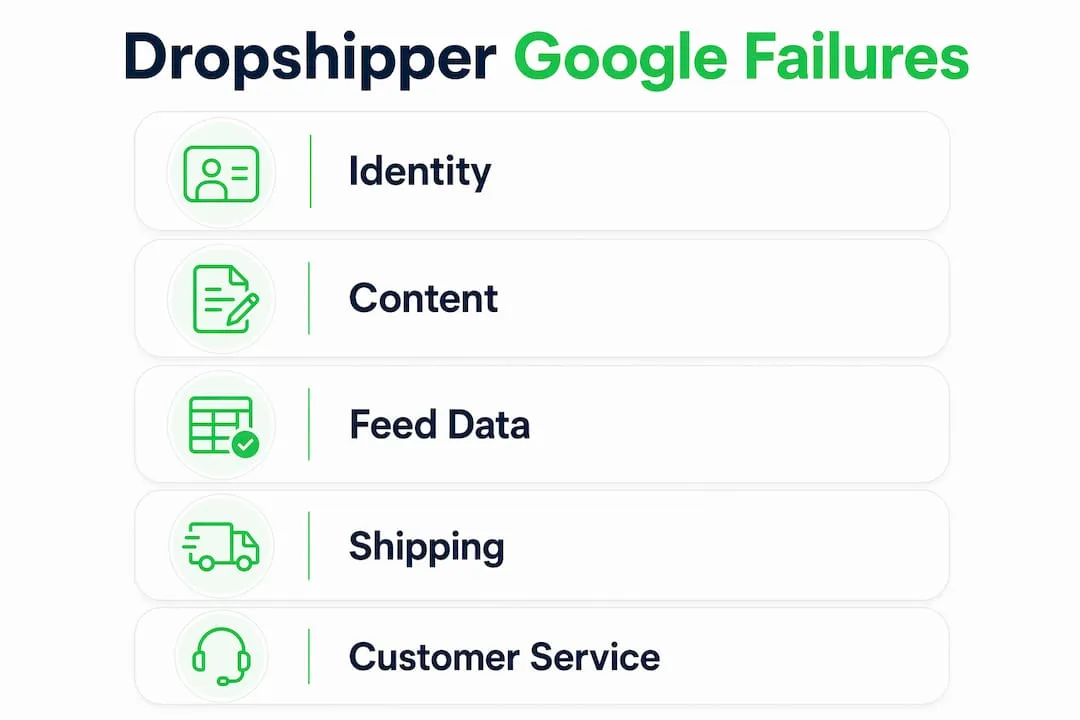
For a broader view of common dropshipping mistakes that affect both sales and compliance, the pattern is consistent: shortcuts that save time upfront create compounding problems later.
Key takeaways
Dropshippers fail Google Merchant Center checks because of accumulated inconsistencies across identity, content, feed data, and policies, not a single critical error.
| Point | Details |
|---|---|
| Identity consistency is non-negotiable | Business name, address, and phone must match exactly across all five surfaces Google checks. |
| Image fingerprinting is a top trigger | Replace all unmodified supplier photos with original or AI-generated images before launching. |
| Feed-to-site harmony prevents suspensions | Synchronise titles, prices, variants, and availability programmatically to eliminate human error. |
| Policy specificity is required | State exact return windows, shipping times, and refund processes. Vague language lowers your trust score. |
| Fix everything before appealing | Partial fixes extend cool-down periods. A full audit before submission is the fastest route to reinstatement. |
Why most dropshippers are solving the wrong problem
I have reviewed a lot of suspended Merchant Center accounts, and the pattern is almost always the same. The store owner focuses entirely on the appeal letter and spends almost no time on the underlying store. They write a polished reconsideration request, submit it with one or two fixes, and then wait two weeks for a rejection. Then they repeat the cycle.
The uncomfortable truth is that only 10% to 20% of dropshipping stores achieve durable profit, and the failure rate is not primarily about product selection or ad spend. It is about treating the business as an experiment rather than a professional operation with consistent standards. Google’s checks are not designed to catch fraudsters. They are designed to surface stores that look like they were set up in an afternoon with no intention of serving customers properly.
The details that get overlooked most often are not the dramatic ones. They are the boring ones: a company suffix that does not match, a return policy that was copied from a template and never updated, a feed that drifts out of sync because no one set up an automated sync. Profitable dropshipping businesses typically require 6 to 12 months to reach stable profitability. That timeline assumes you are not losing weeks to suspension cycles.
My recommendation is to treat your first compliance audit as a permanent investment, not a one-time fix. Build the systems that keep your identity, feed, and policies consistent automatically. Then, if you do face a suspension, you can appeal with genuine confidence because you know your store is clean. That confidence comes through in the quality of your documentation, and Google’s reviewers notice it.
— Koen
How Ecom-eye helps dropshippers pass Google checks
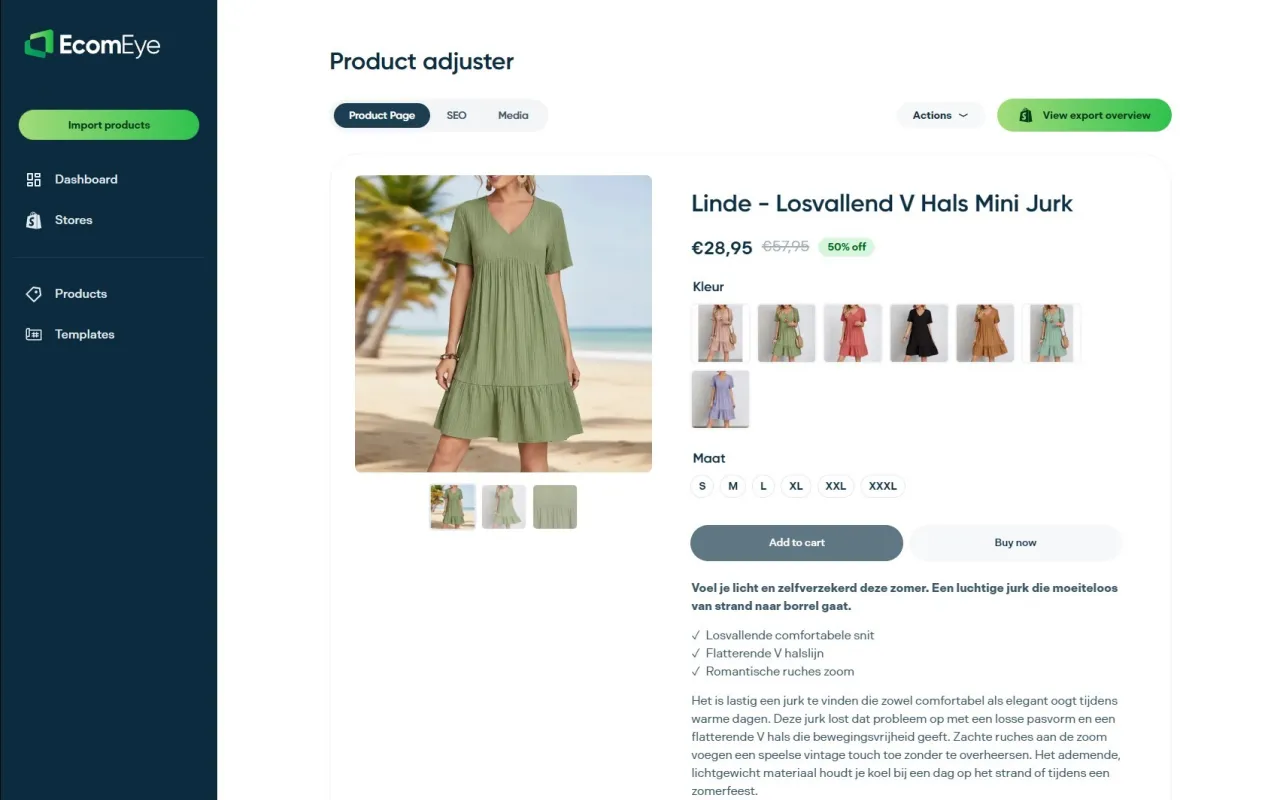
Ecom-eye is built specifically for the problem this article describes. Most dropshippers fail Google checks because they copy product pages directly from suppliers, creating duplicate content, copyright risk, and feed inconsistencies that Google’s AI detects immediately. Ecom-eye fixes this at the source. Import products in bulk from AliExpress or competitor links, and Ecom-eye automatically generates original titles, clean descriptions, SEO-ready content, and high-quality AI product images that pass image fingerprinting checks. Every page exports directly to Shopify in one click, with no manual rewriting and no copyright risk. If you are serious about building a compliant dropshipping store that survives Google’s 2026 verification standards, Ecom-eye removes the most common failure points before they become suspensions.
FAQ
What is the most common reason dropshippers fail Google checks?
The most common cause is misrepresentation, specifically inconsistent business identity, unoriginal supplier content, and inaccurate shipping claims that accumulate into a risk score above Google’s threshold. Suspension rarely results from one critical error but from several minor inconsistencies across identity, feed, and policy data.
How long does a Google Merchant Center suspension last for dropshippers?
Most reinstatements take 7 to 14 days after submitting a comprehensive set of fixes and supporting documents. Submitting partial fixes and appealing repeatedly triggers extended cool-down periods that can stretch to 30 days or longer.
Does using AliExpress photos get your Google Merchant account suspended?
Yes. Google’s image fingerprinting system identifies unmodified supplier photos from AliExpress, Temu, and similar marketplaces and treats them as a high-risk signal for misrepresentation. Replacing supplier images with original photography or AI-generated mockups significantly reduces suspension risk.
Can I open a new Merchant Center account after a suspension?
Creating a new account after a suspension is one of the most common dropshipping mistakes and almost always results in a faster second suspension. Google links accounts through IP addresses, payment profiles, and business identity signals. Fix the original account and appeal with a full compliance audit instead.
How do I fix feed inconsistencies to pass Google’s checks?
Use a feed management tool or Shopify app to programmatically synchronise your product titles, prices, images, variants, and availability between your Google Shopping feed and your live website. Automated fix engines resolve approximately 80% of feed disapprovals within 24 hours, clearing your account before you submit a formal reconsideration request.
Ready to boost your product pages?
Generate high-converting, SEO-optimized product pages in bulk using AI automation used by e-commerce experts.
No credit card required