Copyright-safe ecommerce tips for online sellers in 2026
Discover essential copyright-safe ecommerce tips for 2026 that protect your online store from violations and boost your revenue. Learn more now!

Copyright-safe ecommerce tips for online sellers in 2026

TL;DR:
- Copyright-safe ecommerce relies on generating original content, using verified licenses, and maintaining organized documentation. Sellers must respond thoughtfully to DMCA notices and regularly audit their listings to stay compliant. Investing in original images and content enhances legal protection, SEO, and long-term growth.
Copyright-safe ecommerce is the practice of building and running an online store using only original content, properly licensed assets, and verified permissions. Copyright violations cause the most marketplace suspensions in 2026, and platforms like Etsy and Shopify offer zero reimbursement when a takedown hits your store. That means every listing you publish carries financial risk if the content behind it is not clean. These copyright-safe ecommerce tips exist to close that gap before it costs you revenue.
1. What are the top copyright-safe ecommerce tips for sellers?
Intellectual property compliance is not a legal luxury. It is a core operating requirement for any ecommerce business that wants to scale without interruption.
Create all product content from scratch. Original product titles, descriptions, and images are the cleanest form of copyright protection available. When you write your own copy and shoot your own photos, there is no licence to expire and no third party who can file a claim. This is the foundation every other tip builds on.
Obtain explicit commercial licences for every third-party asset. Standard licences often exclude resale rights, which makes them unsuitable for product listings. When you purchase a font, a graphic, or a stock photo, confirm the licence specifically permits commercial use and resale before publishing.
Keep a centralised licence registry. Store every licence document, receipt, and creation timestamp in one accessible folder or spreadsheet. Centralised asset registries serve as vital evidence when a DMCA notice arrives unexpectedly. Without this documentation, even a legitimate defence becomes difficult to mount.
Use official brand licensing programmes. If you sell branded merchandise, apply directly through the brand’s official licensing portal. This is the only route that gives you a defensible, documented right to use logos, characters, or trade dress in your listings.
Treat fan art and parody as high-risk categories. Fan art usage in ecommerce is rarely defensible without an explicit licence from the rights holder. Character likenesses and logos are protected regardless of how transformative your design appears.
Audit your listings quarterly. Licences change. Platforms update their policies. A quarterly review of every active listing against its corresponding licence keeps you ahead of compliance gaps before a platform flags them.
Understand DMCA takedown procedures. Every seller on a US-based platform operates under the Digital Millennium Copyright Act framework. Knowing how notices work, and what your counter-notification rights are, is not optional knowledge for a serious ecommerce business.
Pro Tip: Set a recurring calendar reminder every three months labelled “IP audit.” Review five to ten listings per session rather than attempting a full store review at once. Small, consistent checks catch problems before they escalate.
2. How can ecommerce sellers legally source product images?
Sourcing images is where most copyright violations begin. Sellers copy product photos from AliExpress listings, competitor pages, or manufacturer websites without realising those images carry their own copyright protections.

The cleanest solution is original photography. Shooting your own product images gives you full ownership and eliminates any third-party claim. For dropshippers who never handle physical stock, this is not always practical, which makes the next options critical.
Authorised manufacturer or distributor assets are the preferred alternative. Many suppliers provide digital asset management feeds or media kits that grant explicit commercial use rights. Manufacturer-provided DAM systems help avoid SEO penalties and legal risk while scaling a large catalogue. Always request written confirmation that the assets cover commercial resale before using them.
Reputable stock photo providers with extended commercial licences are a reliable option for lifestyle and contextual imagery. Providers like Getty Images, Shutterstock, and Adobe Stock each offer extended licence tiers that cover resale and print-on-demand use. Read the licence tier carefully. A standard subscription licence and an extended commercial licence are not the same product.
User-generated content requires written permission from the creator before you republish it in a listing. A customer tagging your product on Instagram does not constitute a content licence. Get explicit written consent, ideally through a signed release or a clear opt-in process.
Avoid scraping images from third-party websites entirely. Copy-pasting or scraping product images risks infringement and can trigger both legal claims and search engine penalties. The short-term convenience is not worth the exposure.
| Source type | Commercial use permitted? | Recommended action |
|---|---|---|
| Original photography | Yes, full ownership | Always preferred |
| Manufacturer DAM feed | Yes, with written confirmation | Request licence documentation |
| Stock photo (extended licence) | Yes, within licence terms | Verify resale rights before use |
| Stock photo (standard licence) | No resale rights | Upgrade or avoid |
| Scraped from competitor site | No | Do not use |
| User-generated content | Only with written consent | Obtain signed release |
Pro Tip: When requesting assets from a supplier, ask specifically: “Does this media kit grant commercial resale rights for online retail listings?” A vague “yes you can use our images” in a chat message is not a licence.
3. What should sellers do when they receive a DMCA takedown notice?
A DMCA notice is not an automatic admission of guilt. It is a formal claim that requires a structured response, not a panic reaction.
The first step is to read the notice carefully. Identify exactly which listing is named, which asset is claimed, and who the claimant is. Responding to DMCA notices requires review and evidence gathering, not immediate deletion. Removing a listing before assessing the claim can actually weaken your position in a dispute.
- Verify the claim. Check whether the named asset is genuinely yours, licensed, or in the public domain. Cross-reference your licence registry against the specific file or content cited in the notice.
- Gather your evidence. Pull the licence document, receipt, creation timestamp, or any written permission that supports your right to use the content.
- Respond professionally and promptly. Contact the platform’s IP team with your evidence. Keep the tone factual and calm. Emotional responses do not help and can create additional problems.
- File a counter-notification if the claim lacks merit. A counter-notification is a formal legal document stating that the takedown was made in error. Use it only when your evidence is solid. Filing a counter-notification without supporting documentation is risky.
- Communicate with customers if necessary. If a listing is temporarily removed, a brief, professional message to affected customers maintains trust without oversharing legal details.
Pro Tip: Keep a dedicated folder labelled “DMCA responses” with a template response letter and a checklist of the evidence you need. When a notice arrives, you will respond in hours rather than days.
4. What ongoing practices keep ecommerce stores copyright-compliant?
Compliance is not a one-time task. It is a set of habits that protect your store as your catalogue grows and platform policies evolve.
Set quarterly compliance audits as a fixed calendar event. Review active listings, verify that licences are still valid, and check whether any assets have been flagged by your platform. Quarterly licence reviews are now standard practice given the pace of change in AI content rules and trademark policy in 2026.
Track platform policy updates actively. Etsy, Shopify, and Amazon each publish policy change notices. Subscribe to their seller newsletters and check their policy pages at least once per quarter. A rule that did not apply to your store last year may apply now.
Centralise all asset management. Every licence, receipt, and proof of creation belongs in one system, whether that is a shared Google Drive folder, a project management tool like Notion, or a dedicated digital asset management platform. Scattered documentation is as dangerous as no documentation.
Use infringement scanning tools before listing new products. Tools like Copyscape check whether text content matches existing published material. Running a scan before publishing a new description costs minutes and can prevent a takedown that costs days of lost revenue.
Educate every team member who touches listings. A virtual assistant who copies a product description from a competitor’s page can trigger a copyright claim just as easily as the store owner. IP policy training is not optional for anyone who creates or uploads content.
Register your original intellectual property. If you create original designs, photography, or written content, registering that IP with the relevant authority gives you a stronger legal position if someone else copies your work. In the UK, copyright is automatic, but registration with the Intellectual Property Office provides additional evidence of ownership. You can find more detail on ecommerce compliance requirements for Shopify sellers in 2026.
Integrate human creativity into AI-generated content. AI-generated imagery cannot be copyrighted without human authorship. Adding human edits, creative direction, or original elements to AI-assisted visuals creates a partial basis for IP ownership. Fully automated AI images with no human input have no copyright protection under current rules.
Key takeaways
Copyright-safe ecommerce requires original content, verified licences, centralised documentation, and a structured process for handling DMCA claims before they disrupt your store.
| Point | Details |
|---|---|
| Original content is the safest asset | Create your own product images, descriptions, and designs to eliminate third-party claims entirely. |
| Licences must explicitly cover resale | Standard stock licences rarely permit commercial resale; always verify before publishing. |
| Documentation is your legal defence | A centralised registry of licences and creation timestamps is your primary evidence in any dispute. |
| DMCA notices require a structured response | Read the notice, gather evidence, and respond professionally before removing any listing. |
| Compliance is a recurring operational task | Quarterly audits and platform policy checks prevent small gaps from becoming costly suspensions. |
The uncomfortable truth about copyright and ecommerce
Most sellers treat copyright compliance as something to deal with after a problem appears. That is the wrong order of operations entirely.
I have seen stores with strong products and solid traffic lose weeks of revenue because a supplier image or a copied description triggered a platform takedown. The listing was gone, the ranking dropped, and the recovery took far longer than the original compliance work would have. The cost of a takedown is never just the lost sale. It is the ranking damage, the customer confusion, and the time spent on dispute correspondence instead of growing the business.
The sellers who scale without these interruptions share one habit: they treat IP compliance the same way they treat accounting. It is a non-negotiable operational cost, budgeted in time and money, not an afterthought. They keep their licence files organised, they audit regularly, and they never assume that a supplier’s verbal permission is a legal licence.
The other thing worth saying plainly is this: shortcuts in content sourcing are a false economy. Switching from scraped content to official manufacturer assets is not just a legal improvement. It is an SEO improvement. Original, clean content ranks better and stays live longer. The stores that invest in protecting their online content from the start are the ones that compound their growth without interruption.
— Koen
How Ecom-eye helps sellers stay copyright-safe at scale
Manually rewriting product pages for hundreds of listings is where most sellers either cut corners or burn out.
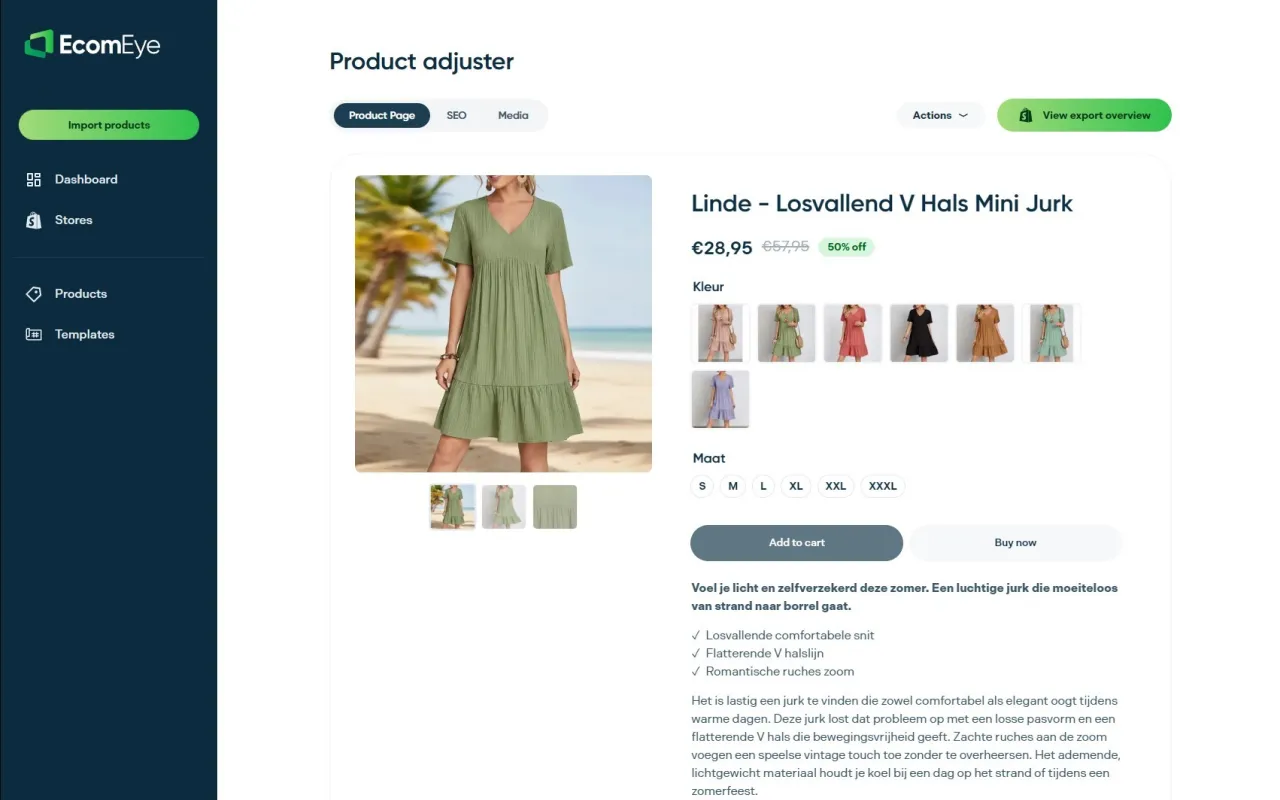
Ecom-eye is a bulk AI product lister built specifically for Shopify dropshipping stores. It imports products from AliExpress or competitor links and automatically generates original titles, clean descriptions, and SEO-ready content, along with high-quality AI product images that include human-directed creative input. Every output is fresh, original content with no copied text and no scraped images. The result is a store that passes Google Merchant review, avoids duplicate content penalties, and carries no copyright risk from its product pages. Sellers who want to scale their catalogue without the legal exposure of copied content can explore the bulk AI product lister and see how it fits their workflow.
FAQ
What does copyright-safe ecommerce mean?
Copyright-safe ecommerce means every product listing, image, and piece of written content in your store is either original, properly licensed, or in the public domain. It protects your store from DMCA takedowns and platform suspensions.
Can I use manufacturer product images in my listings?
You can use manufacturer images only if the supplier has granted explicit commercial resale rights in writing. A verbal agreement or informal permission does not constitute a licence.
Is fan art legal to sell on Etsy or Shopify?
Fan art is generally not legal to sell without an explicit licence from the rights holder. Most fan art usage in ecommerce is high risk and rarely defensible under copyright law.
What should I do first when I receive a DMCA notice?
Read the notice carefully to identify the specific claim, then check your licence records before removing anything. Verify the claim and gather evidence before deciding whether to comply or file a counter-notification.
Are AI-generated product images copyright-protected?
Fully AI-generated images with no human authorship have no copyright protection under current rules. Adding human edits creates a partial basis for IP ownership, so always incorporate human creative input into AI-assisted visuals.
Ready to boost your product pages?
Generate high-converting, SEO-optimized product pages in bulk using AI automation used by e-commerce experts.
No credit card required