Steps for international dropshipping success in 2026
Unlock the steps for international dropshipping success in 2026. Learn essential strategies for product validation and supplier vetting.

Steps for international dropshipping success in 2026

TL;DR:
- Successful international dropshipping depends on thorough product validation, reliable supplier vetting, and localized customer experiences. Scaling too early causes failures, so operators must validate demand, regional logistics, and store localization before expanding. Pre-positioned inventory with regional fulfillment improves delivery times, customer reviews, and long-term profitability.
International dropshipping success is the result of disciplined, repeatable steps: rigorous product validation, reliable supplier vetting, and localised customer experiences that convert across borders. Most aspiring dropshippers skip at least one of these steps and pay for it. 90% of beginners fail due to poor niche choice and a lack of structured testing. The steps for international dropshipping success covered here are built around real margin requirements, regional fulfilment logic, and the kind of patient, data-driven approach that separates profitable operators from those who quit after three months. Tools like Shopify, Spocket, and third-party logistics partners make execution faster, but the discipline behind each step is what actually drives results.
1. How to research and validate products for global markets
Product research is the single highest-leverage activity in international dropshipping. A poor product choice wastes every pound you spend on ads, logistics, and store setup.

Target products with gross margins above 20%, shipping costs below the product price, and delivery times ideally under 14 days. 15.8% of products carry shipping costs that exceed the product price, and 11.3% have margins below 20%. Both scenarios destroy profitability before a single ad runs.
Calculate your unit economics before you commit. Factor in cost of goods, shipping, platform fees, and your target cost per acquisition. If the numbers do not work on paper, they will not work in practice.
Pro Tip: Avoid chasing viral or trending products without verified, sustained demand. Trend-driven products spike and collapse. Products that solve a specific, ongoing problem hold margins and repeat purchase rates far longer.
- Prioritise products with a clear, articulable benefit over decorative or novelty items
- Confirm that your supplier can ship to your target countries without excessive customs friction
- Check that the product is not restricted or regulated in your target markets (electronics, cosmetics, and supplements carry the highest risk)
- Validate demand using Google Trends, AliExpress order volumes, and competitor store traffic estimates
2. Steps for vetting and selecting reliable international suppliers
Supplier quality is the operational backbone of any successful dropshipping business. A single unreliable supplier can generate a wave of refund requests that kills your store’s reputation overnight.
Run communication stress-tests during your supplier’s local business hours. Send a query and measure response time and quality. Suppliers who take more than 24 hours to reply during their working day will take far longer when a fulfilment crisis hits.
Order product samples before listing anything. Assess packaging integrity, actual shipping times, and product quality against the listing photos. What arrives in your hands is what your customers will receive.
Verify real-time inventory data. Suppliers with more than 20% catalogue stock-outs generate costly service tickets and damage customer trust. Request API or CSV stock feeds and check consistency over two to three weeks before committing.
Supplier vetting checklist
- Request merchant references and verify business registration
- Test communication responsiveness across at least five working days
- Order samples to assess quality, packaging, and actual delivery time
- Confirm API or CSV inventory feeds are accurate and updated in real time
- Review return and refund policies in writing before signing any agreement
- Segment suppliers by geography so EU customers are served by EU-based stock
Pro Tip: Pre-position inventory for your best-selling SKUs with a 3PL partner like ShipBob or Flexport. This enables 2–3 day delivery speeds that standard international dropshipping cannot match, and it is the single fastest way to improve your review scores.
Supplier comparison: standard dropshipping vs regional 3PL fulfilment
| Factor | Standard dropshipping | Regional 3PL fulfilment |
|---|---|---|
| Delivery time | 7–14 days | 2–3 days |
| Stock visibility | Variable | Real-time via API |
| Return handling | Supplier-managed | Warehouse-managed |
| Upfront cost | Low | Moderate |
| Customer satisfaction | Lower | Higher |
3. How to localise the customer experience for international markets
Localisation is not just translation. It is the process of making every part of your store feel native to the customer’s country, from the currency displayed at checkout to the returns policy written in their language.
Scaling internationally requires localisation by country and supplier segmentation by geography. Ignoring import tariffs and HS codes erodes thin profit margins fast. Communicate duties and taxes transparently in your product pages and checkout flow.
Good ecommerce localisation covers several practical areas:
- Display prices in local currency and accept regional payment methods (iDEAL for the Netherlands, Klarna for Germany and Sweden, PayPal everywhere)
- Write country-specific shipping expectations directly into product descriptions and order confirmation emails
- Set up separate return policies for each major market, reflecting local consumer protection laws
- Translate customer support materials, not just product descriptions
- Setting honest delivery windows in product descriptions and email notifications improves customer reviews and reduces refund rates
The practical payoff is measurable. Customers who see accurate delivery estimates and familiar payment options convert at higher rates and leave fewer negative reviews.
4. Testing, launching, and scaling international campaigns
The most common mistake in scaling is moving too fast. Sustainable international growth follows a specific sequence: test one product, on one channel, with one clear decision rule, before spending more.
A typical dropshipping launch roadmap spans 2–3 months, covering product research, store setup, ad testing, and optimisation before sustainable profit appears. Organic-only strategies extend that timeline to 4–6 months. Budget accordingly.
A disciplined scaling sequence
- Launch a narrow traffic test with a controlled daily spend (£20–£50 per day on Meta or TikTok Ads)
- Track clicks, add-to-cart rates, purchase conversion rates, and profit margin by region
- Run each test for at least seven days before drawing conclusions
- If a product does not convert, stop the test and diagnose before spending more
- Scale winning products gradually, increasing budget by no more than 20–30% per week
- Add new markets only after demand and fulfilment processes are stable in your first market
- Expand in phases, starting with one or two countries and validating demand before going global
Pro Tip: Automate your fulfilment workflows before increasing your ad budget. If your order processing relies on manual steps, scaling volume will create errors, delays, and refunds that cancel out your ad returns.
Testing one product at a time with a budget of £500–£2,000 gives you enough data to diagnose what is working without burning capital on inconclusive results. Testing multiple products simultaneously makes it impossible to know which variable caused a failure.
5. Common pitfalls in international dropshipping and how to avoid them
The most frequent reason international dropshipping fails is not bad luck. It is predictable, avoidable errors that experienced operators have already learned to sidestep.
Underfunding is the most common. Running paid ads with a budget below £100 produces no statistically meaningful data. You cannot diagnose a product, an audience, or a creative with three days of low-spend testing. Commit to a proper test budget or do not run paid traffic at all.
Treating dropshipping as a quick flip rather than a brand-building exercise keeps operators in the bottom 90%. The top operators build recognisable stores with clear value propositions, consistent branding, and customer retention strategies from day one. Read more about brand differentiation in dropshipping to understand what separates short-term sellers from sustainable businesses.
Watch out for these specific traps:
- Testing multiple products simultaneously without the budget to diagnose individual failures
- Ignoring local tariffs, HS codes, and import restrictions in target markets
- Listing products without checking whether your supplier ships to those countries reliably
- Setting unrealistic delivery expectations that generate refund requests and chargebacks
- Copying competitor product pages verbatim, which creates duplicate content penalties on Google and disapprovals on Google Merchant Centre
The last point is particularly damaging for international stores. Duplicate content across multiple country-specific pages compounds the SEO problem. Review the most common dropshipping mistakes before you launch to avoid the errors that cost most new operators their first three months of budget.
Key takeaways
Successful international dropshipping requires disciplined product validation, geography-based supplier segmentation, and localised customer experiences built before scaling ad spend.
| Point | Details |
|---|---|
| Validate margins first | Target products with gross margins above 20% and shipping costs below the product price. |
| Vet suppliers rigorously | Test communication, order samples, and verify real-time stock feeds over 2–3 weeks. |
| Localise every market | Adapt currency, payment methods, delivery windows, and return policies by country. |
| Test one product at a time | Use a £500–£2,000 budget per test to generate clean, actionable data. |
| Scale in phases | Stabilise fulfilment in one or two markets before expanding to new countries. |
Why I think most dropshippers scale too early
The biggest mistake I see aspiring dropshippers make is treating the scaling phase as a reward for surviving the testing phase. It is not. Scaling is its own discipline, and it requires a completely different set of processes.
Most operators who fail internationally do so because they expanded before their fulfilment was reliable. They had a winning product in one market, increased ad spend, and opened three new countries simultaneously. Then supplier stock-outs, customs delays, and currency conversion errors hit at the same time. The store collapsed under its own growth.
The operators who succeed treat each new country as a fresh test. They validate demand, confirm supplier reliability for that specific region, and localise the store before spending a pound on ads. It takes longer. It is far less exciting. And it is the only approach that actually works.
Regional fulfilment is the differentiator that most guides underplay. Pre-positioning inventory with a 3PL in your target region is not a luxury for large operators. It is the move that takes your delivery time from 14 days to 3 days and your review score from average to excellent. That gap in customer experience is where sustainable businesses are built.
— Koen
Ecom-eye: bulk AI product listing for international stores
Scaling a dropshipping store across multiple countries means creating product pages in multiple languages, with unique descriptions, SEO-ready titles, and original images for every market. Doing that manually is the fastest way to burn out before you reach profitability.
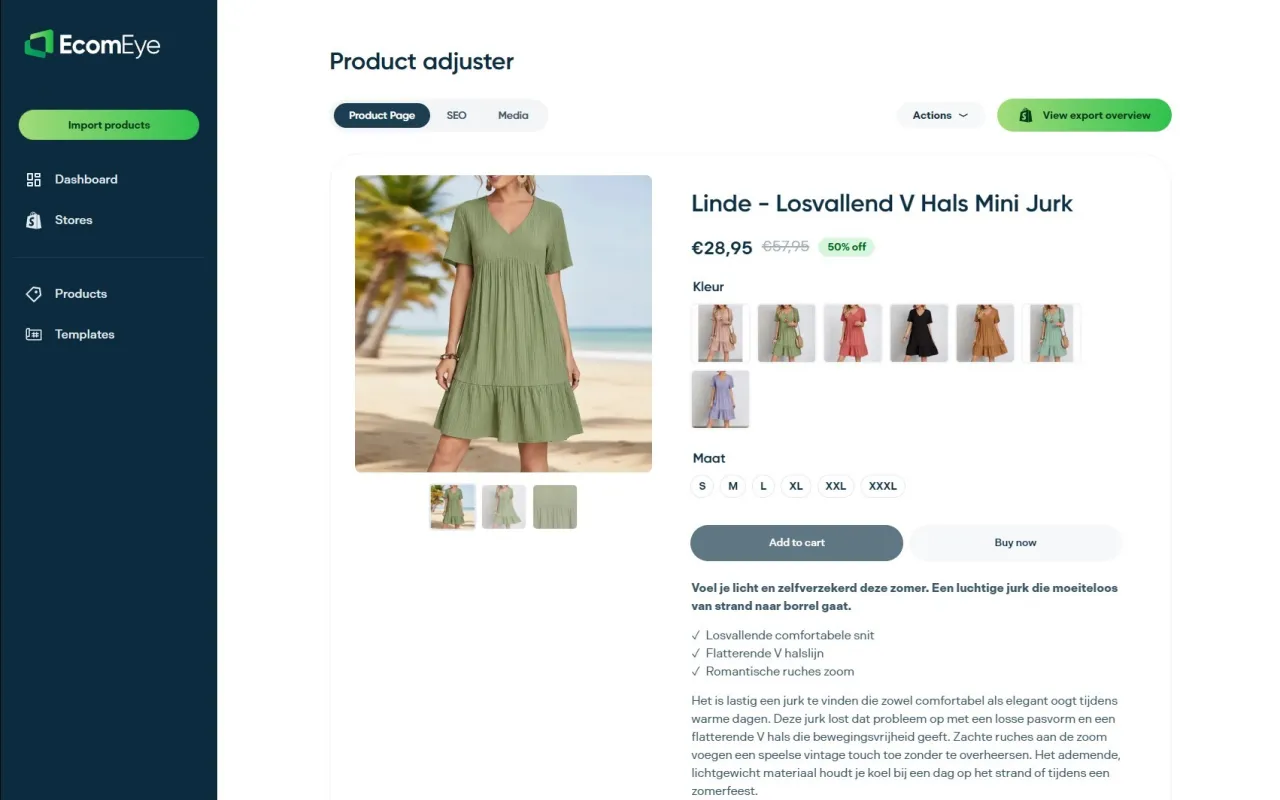
Ecom-eye is built specifically for this problem. Import products in bulk from AliExpress or competitor links, and Ecom-eye automatically generates unique titles, clean descriptions, SEO-ready content, high-quality AI product images, and multi-language product pages ready for export to Shopify in one click. No rewriting, no copyright risk, and no duplicate content penalties on Google Merchant Centre. For dropshippers building across multiple international markets, it removes the most time-consuming bottleneck in the entire operation.
FAQ
What budget do I need to start international dropshipping?
A realistic test budget sits between £500 and £2,000 per product. Budgets below £100 for paid ads produce no meaningful data and cannot diagnose product or audience issues.
How long does it take to see profit from international dropshipping?
A typical launch roadmap spans 2–3 months before sustainable profit appears. Organic-only strategies extend that timeline to 4–6 months.
How do I choose suppliers for international markets?
Segment suppliers by geography so regional customers are served by nearby stock. Vet each supplier by testing communication, ordering samples, and verifying real-time inventory feeds over two to three weeks.
What is the biggest mistake in international dropshipping?
Scaling to multiple countries before fulfilment is reliable in the first market. Expand in phases, validating demand and logistics in one or two countries before adding more.
Do I need to localise my store for each country?
Yes. Localisation covers currency, payment methods, delivery windows, return policies, and translated product descriptions. Customers who see accurate, familiar information convert at higher rates and leave fewer refund requests.
Ready to boost your product pages?
Generate high-converting, SEO-optimized product pages in bulk using AI automation used by e-commerce experts.
No credit card required