The role of guide articles in ecommerce: 2026 guide
Discover the role of guide articles in ecommerce and learn how they boost consumer confidence, improve SEO, and drive sales in 2026.
The role of guide articles in ecommerce: 2026 guide
TL;DR:
- Guide articles in ecommerce help consumers identify the best products for specific use cases by offering criteria and comparisons, thus improving decision-making and trust. They enhance SEO and AI visibility through structured content, direct answers in the first 60 words, and schema implementation, leading to higher citations and rankings. Properly crafted guides significantly increase conversions, reduce return rates, and build topical authority in a competitive digital landscape.
Guide articles in ecommerce are structured content pieces designed to answer one specific question: “Which product is right for me?” Unlike product pages, which describe a single item, buying guides resolve decision-level queries by offering criteria, comparisons, and use-case recommendations. They are the highest-citation content format in ecommerce AI search, outperforming standard product listings in both SEO visibility and consumer trust. For ecommerce marketers and business owners in 2026, understanding the role of guide articles in ecommerce is no longer optional. It is the difference between ranking and being invisible.
How do guide articles improve consumer decision-making?
Guide articles, also called buying guides in the industry, are built differently from product pages at a structural level. A product page tells a shopper what something is. A guide tells them what to buy and why. That distinction drives every measurable advantage guides hold over standard listings.

When a shopper types “best wireless earbuds for running” into Google or Perplexity, they are not looking for a spec sheet. They want someone to weigh the options and give a clear recommendation. Buying guides answer this by using explicit criteria such as battery life, water resistance, and fit security, then mapping each product to a specific use case. This structure mirrors how buyers actually think, which is why guides convert at a higher rate than product pages for mid-funnel queries.
The format matters as much as the content. Comparison tables with named attributes give shoppers a side-by-side view that product pages cannot replicate. A table comparing three running headphones across six criteria resolves uncertainty in seconds. Prose alone cannot do that. The table below illustrates how a well-structured guide differs from a typical product page:
| Feature | Product page | Buying guide |
|---|---|---|
| Scope | Single product | Multiple options |
| Query match | “Buy X” | “Best X for Y” |
| Decision support | Low | High |
| AI citation rate | Lower | Significantly higher |
| Trust signal | Moderate | Strong |
Guides also reduce what psychologists call choice overload. When a shopper faces 47 wireless earbuds on a category page, they often abandon the purchase entirely. A guide that narrows the field to three options with clear reasoning removes that friction. The result is a shorter path from discovery to checkout.
Pro Tip: Structure every guide around a single, specific use case rather than a broad product category. “Best laptops for graphic designers under £1,000” will outperform “Best laptops” every time, both in AI citation and in conversion.
In what ways do guide articles improve ecommerce SEO and AI visibility?
The SEO advantage of buying guides is structural, not accidental. AI search engines like ChatGPT, Perplexity, and Google’s AI Overviews extract answers from content that is formatted to be extracted. Guide articles, when built correctly, are that format.
The most critical structural rule is the lead answer. Guide content with a direct answer in the first 60 words achieves dramatically higher AI citation rates than content that buries the key claim. This aligns directly with how AI engines parse pages: they prioritise the opening paragraph when generating responses. If your guide opens with background history or brand storytelling, you have already lost the citation window.
FAQPage schema is the second major lever. Pages with FAQPage schema are 3.2 times more likely to appear in Google AI Overviews than those without it. That is not a marginal gain. It is the difference between appearing in a featured position and not appearing at all. The schema signals to AI engines that your content contains structured, question-and-answer pairs worth extracting.
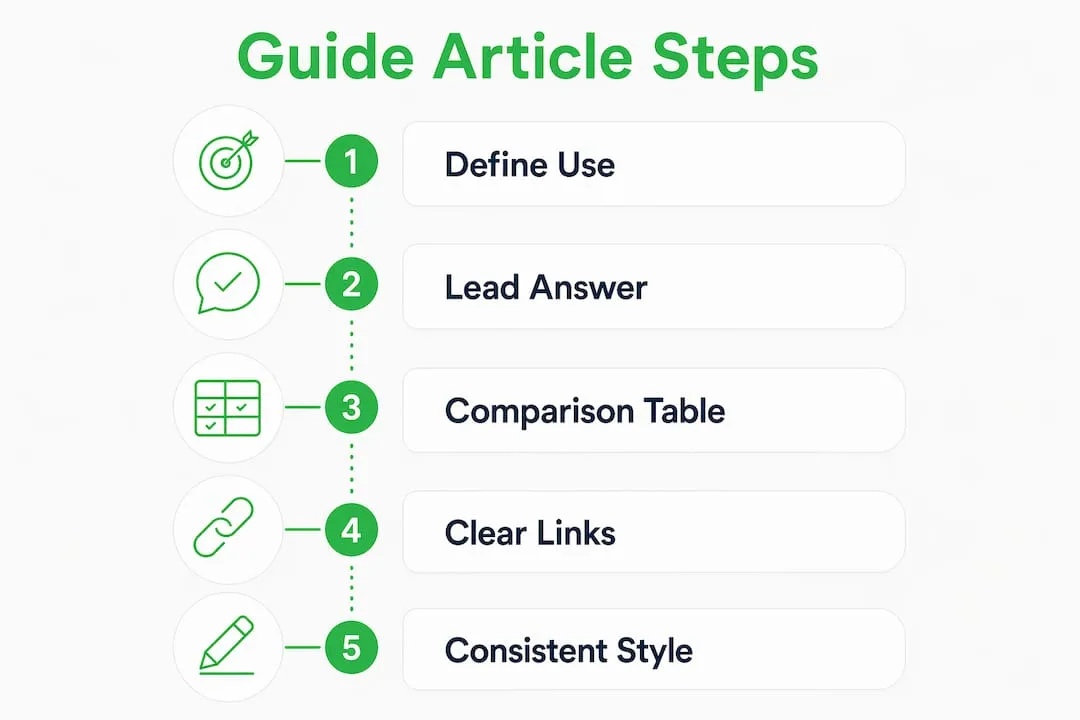
Here is a practical sequence for building a guide that ranks and gets cited:
- Open with a direct answer to the guide’s core question within the first 60 words.
- Use question-based H2 headings that mirror how shoppers phrase queries.
- Include a comparison table with specific, named attributes for each product.
- Add an FAQ section at the end with three to five questions, each answered in two sentences or fewer.
- Implement FAQPage schema in JSON-LD that matches the visible text exactly.
- Link internally from the guide to each product page you recommend.
That last point connects to topical authority. Isolated product pages are far less likely to be cited by AI without surrounding content that establishes domain credibility. A guide that links to five product pages, supported by related FAQs and category content, signals to both Google and AI engines that your domain understands the topic deeply. This is the foundation of ecommerce SEO growth through content clustering.
Pro Tip: When implementing FAQPage schema, copy the visible question and answer text directly into your JSON-LD. Any mismatch between what users see and what the schema contains risks citation failure even when the schema validates without errors.
What is the measurable impact of guide articles on conversion and sales?
The conversion case for buying guides is well documented. One retailer’s gift guide quiz, a form of interactive guided selling, delivered a 50% year-over-year conversion increase and over 35,000 completed interactions in under two months. That figure is not an outlier. It reflects a consistent pattern: when you remove decision friction, buyers complete purchases.
The mechanism is trust. Value-first web content nurtures buyer relationships before any sales conversation takes place. A shopper who reads your guide, finds it genuinely useful, and clicks through to a product page arrives with a level of confidence that a cold category-page visitor simply does not have. That pre-sale trust shortens the sales cycle and reduces cart abandonment.
Several specific impacts are worth noting for ecommerce operators:
- Guides reduce return rates by setting accurate expectations before purchase.
- They increase average order value when they recommend complementary products within the same content.
- They generate backlinks organically because other sites reference useful, structured guides.
- They capture mid-funnel traffic that product pages and category pages miss entirely.
“Value-first content engages prospects long before sales conversations begin, making the eventual conversion feel like a natural next step rather than a push.” — Salesforce
The Salesforce insight above captures why guides outperform promotional content in long-term conversion metrics. Shoppers do not want to be sold to. They want to be helped. A guide that genuinely helps a buyer choose the right product earns the sale without asking for it directly.
How should ecommerce marketers structure guide articles for maximum impact?
Effective guide articles follow a repeatable structure. The topic formula that consistently performs best is “Best Product Category] for [Specific Use Case].” [Specific, focused guides outperform vague or generic content even when they are shorter. “Best running shoes for flat feet” will rank above “Best running shoes” because it matches a more precise query with higher buyer intent.
Follow this structure for every guide you publish:
- Opening claim (60 words maximum): State the core recommendation or key finding immediately. Do not open with history, context, or brand narrative.
- Criteria section: Explain the two to four factors that matter most for this buying decision. Use H3 subheadings for each criterion.
- Comparison table: List four to six products with named attributes in columns. Every attribute should map to a criterion from the previous section.
- Use-case recommendations: Match specific products to specific buyer profiles. “Best for beginners,” “Best for professionals,” “Best under £50.”
- FAQ section: Answer three to five questions that buyers commonly ask. Implement FAQPage schema on these.
- Internal links: Link each recommended product name to its product page. This creates the retrieval-and-routing layer that AI engines follow.
The structured content approach also demands consistency across your content cluster. One excellent guide surrounded by thin product pages will not build the topical authority that AI engines require. Publish supporting content: category FAQs, comparison articles, and product education pieces that reinforce the guide’s topic from multiple angles.
Pro Tip: Treat your guide as a routing layer, not just an article. Every product you mention should link to its product page. Every criterion you discuss should link to a supporting article. This internal link structure is what transforms a good guide into a Shopify content asset that compounds in value over time.
Avoid two common structural errors. The first is vague claims: “This product is great for most users” tells neither the shopper nor the AI engine anything useful. Replace every vague claim with a specific attribute and a named product. The second is schema-only FAQ content. FAQ schema must mirror the visible text on the page exactly. If your JSON-LD contains answers that do not appear in the visible HTML, AI engines will ignore the schema or flag it as misleading.
Key takeaways
Guide articles drive ecommerce performance by resolving buyer decisions, building topical authority, and aligning content structure with how AI search engines extract and cite information.
| Point | Details |
|---|---|
| Guides outperform product pages | Buying guides answer “which product” queries with criteria and comparisons that product pages cannot provide. |
| FAQPage schema multiplies visibility | Pages with FAQPage schema are 3.2x more likely to appear in Google AI Overviews than unstructured pages. |
| Lead answers capture AI citations | Placing a direct answer in the first 60 words is the single highest-impact structural change for AI citation. |
| Guides measurably lift conversion | Interactive and written guides have demonstrated up to 50% conversion increases by reducing decision friction. |
| Topical clusters amplify individual guides | A single guide without supporting content earns less authority than a guide embedded in a well-built content cluster. |
Why most ecommerce stores are still getting this wrong
Most ecommerce operators I speak with treat content as decoration. They publish a buying guide once, link to it from nowhere, and wonder why it does not rank. The structural discipline required to make guides work, direct-answer openings, matched schema, internal routing links, is not complicated. But it requires consistency that most stores simply do not apply.
The shift towards AI-centric search has made this gap more expensive. When ChatGPT or Perplexity answers a shopping query, it cites one or two sources. If your guide is not structured for extraction, you do not appear. A competitor who followed the schema rules and placed their answer in the first paragraph takes the citation instead. That is not a ranking loss. It is a visibility loss at the point of purchase intent.
The mistake I see most often is treating guides as long product descriptions. A guide that spends 400 words explaining how a product category works before making a single recommendation has already lost the AI citation window and the impatient shopper. Get to the recommendation fast. Explain the reasoning after.
Interactive formats, such as quizzes and decision trees, extend the guide concept further. The 50% conversion lift from guided selling tools is not surprising once you understand the mechanism. Personalised recommendations reduce uncertainty more effectively than static text. If your store has the development resource, a quiz layered on top of a well-structured guide is the highest-converting combination available to ecommerce marketers right now.
The stores that will dominate AI search in the next two years are the ones building content clusters today. Not one guide. A system of guides, FAQs, and product education that signals deep topical authority to every AI engine that crawls the domain.
— Koen
Scale your ecommerce content with Ecom-eye
Writing effective guide articles takes time, and scaling that output across hundreds of products is where most Shopify stores stall. Ecom-eye is built specifically for this problem.
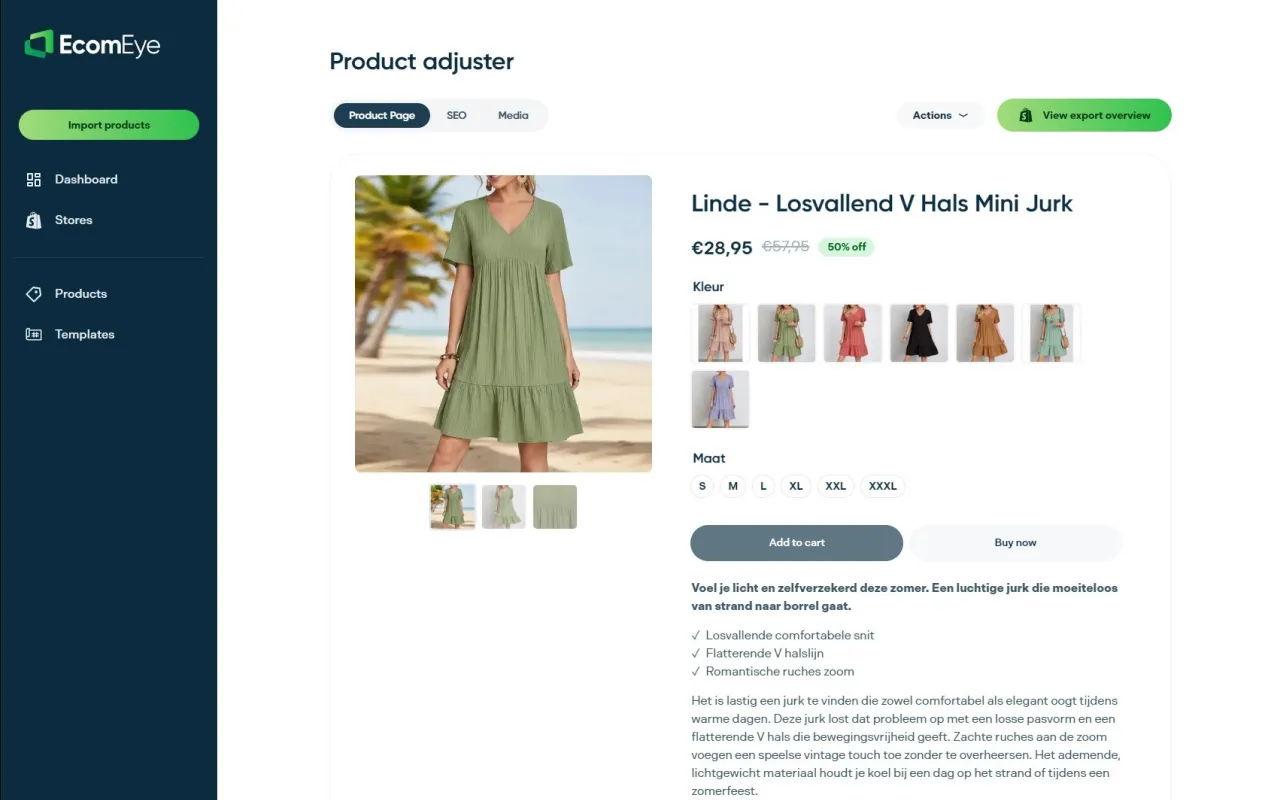
Ecom-eye’s bulk AI product lister generates SEO-optimised product pages, titles, and descriptions in bulk from AliExpress imports or competitor links, with no duplicate content and no copyright risk. Every page is built for Google compliance and AI citation readiness from the start. If you are serious about implementing the guide article strategy covered in this article at scale, Ecom-eye removes the manual bottleneck entirely. Import, generate, and export to Shopify in one click.
FAQ
What is the role of guide articles in ecommerce?
Guide articles resolve mid-funnel buyer queries by comparing products against specific criteria and use cases. They outperform product pages for AI citation and conversion because they answer “which product is right for me” rather than simply describing one item.
How do guide articles boost sales for online stores?
By reducing decision friction and building pre-sale trust, guide articles shorten the path from discovery to purchase. Interactive guided selling tools have demonstrated 50% conversion increases by simplifying complex buying decisions.
Does FAQPage schema really improve AI visibility?
Yes. Pages with FAQPage schema are 3.2 times more likely to appear in Google AI Overviews. The schema must match visible text exactly to avoid extraction failures.
How long should an ecommerce buying guide be?
Length matters less than specificity. A focused guide on “Best X for Y” with a direct-answer opening, a comparison table, and a matched FAQ section will outperform a longer but vague guide on the same topic.
What is the best topic formula for ecommerce guide articles?
The formula “Best [Product Category] for [Specific Use Case]” consistently produces the highest citation and conversion rates. It aligns with how buyers phrase queries to AI engines and signals clear relevance to both Google and shoppers.
Ready to boost your product pages?
Generate high-converting, SEO-optimized product pages in bulk using AI automation used by e-commerce experts.
No credit card required