Explain product categorization for your online store
Learn how to explain product categorization for your online store. Improve navigation, boost sales, and enhance the shopping experience today!

Explain product categorization for your online store

TL;DR:
- Product categorization organizes products into logical groups that enhance navigation and boost sales. Combining taxonomic and thematic approaches creates a flexible, shopper-friendly store structure, with validation from real customers ensuring effectiveness. Attaching attributes to categories improves filtering, SEO, and the overall shopping experience.
Product categorization is the process of organising products into well-defined groups that improve navigation and help shoppers find what they need faster. Done well, it directly influences conversion rates, search rankings, and the overall shopping experience on your store. The industry term for this structured system is product taxonomy. Whether you run a Shopify dropshipping store or a multi-category retail site, understanding product grouping is the difference between a store shoppers browse with confidence and one they abandon in frustration.
What are the main types of product categorization?
Product categorization splits into two core methods: taxonomic and thematic. Each serves a different purpose, and the strongest stores use both.

Taxonomic categorization groups products by objective attributes such as product type, function, or material. A clothing store using taxonomic logic would group items as Tops, Bottoms, Footwear, and Accessories. This method supports inventory management, filtering, and backend search because the rules are consistent and attribute-driven.
Thematic categorization groups products by shopper context rather than product properties. Examples include “Summer Essentials,” “Back to School,” or “Gifts Under £30.” These categories reflect how shoppers think during specific moments. They work well for campaigns, homepages, and seasonal promotions.
The most effective product classification methods combine both approaches. Taxonomic categories form the permanent backbone of your store. Thematic categories sit on top as flexible, campaign-driven overlays. Neither replaces the other.
The main categorization types at a glance:
- Taxonomic: Attribute-based, rules-driven, permanent. Best for navigation menus and filtering.
- Thematic: Context-based, campaign-driven, temporary. Best for promotions and seasonal collections.
- Hierarchical: Products nested within parent and child categories. Supports multi-level navigation.
- Flat: All categories at one level. Simple but limited for large catalogues.
- Industry standards: Classification systems such as eCl@ss and ETIM provide standardised attribute definitions. eCl@ss covers over 45,000 product classes. ETIM operates across more than 20 countries. These standards matter most for retailers selling technical or industrial products where data consistency across suppliers is critical.
How to design an optimal product category hierarchy
The structure of your category hierarchy determines how easily shoppers navigate your store and how well search engines index your pages. Getting the depth and breadth right is not guesswork.
Optimal hierarchies have a depth of 3–5 levels and 5–12 top-level categories. That range balances navigability with complexity. Fewer than five top-level categories forces shoppers into overly broad buckets. More than twelve creates decision paralysis at the very first click.
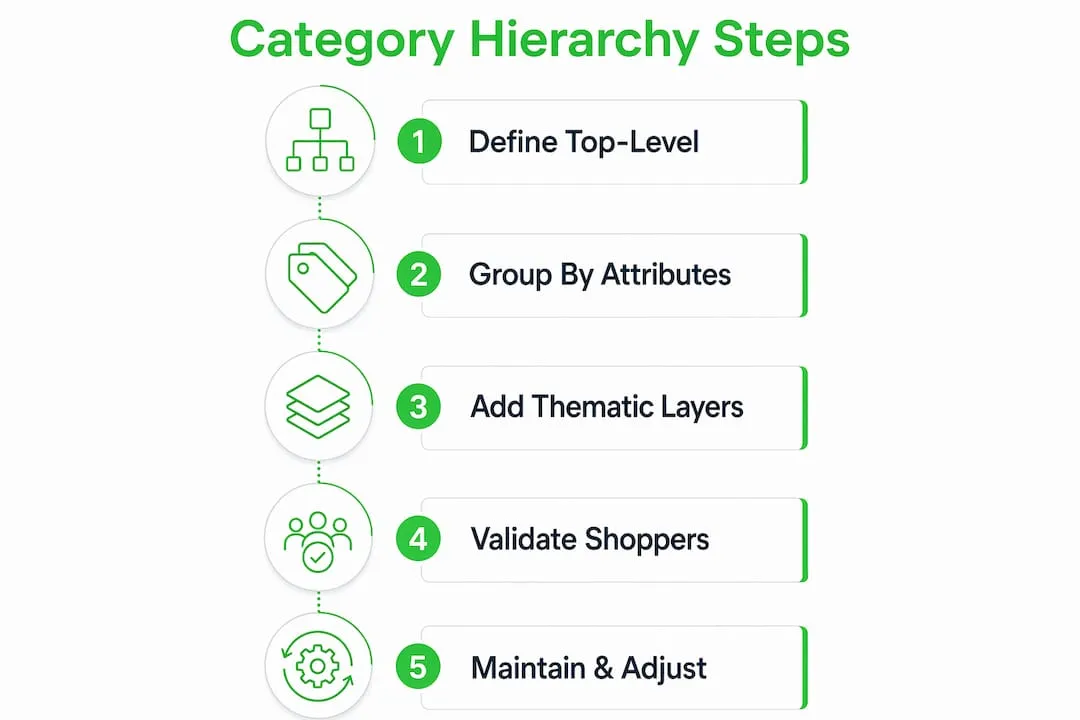
The recommended steps for building your hierarchy
- List your full product range. Group every product by its primary function or type before you touch any software or spreadsheet.
- Define your top-level categories. Aim for 5–12 broad labels that cover your entire catalogue without overlapping.
- Build subcategories beneath each. Add one or two levels of specificity. A top-level category of “Lighting” might branch into “Ceiling Lights,” then “Pendant Lights.”
- Assign attributes at the leaf level. Leaf categories are the lowest level in your hierarchy. Attributes such as colour, size, wattage, or material live here and power your filters.
- Assign stable unique IDs to every category node. Display names change for SEO or marketing reasons. Stable category IDs prevent those changes from breaking your backend systems or inventory rules.
Pro Tip: Never name a category after your supplier or warehouse location. Shoppers do not think in warehouse logic. Name categories after the words your customers actually search for.
The table below shows how hierarchy depth affects the shopper experience and maintenance burden.
| Hierarchy depth | Shopper experience | Maintenance burden |
|---|---|---|
| 1–2 levels | Broad, hard to filter | Very low |
| 3–4 levels | Clear navigation, good filtering | Moderate |
| 5 levels | Detailed, suits large catalogues | Higher but manageable |
| 6+ levels | Confusing, cognitive overload | High, often counterproductive |
A well-sized hierarchy prevents category bloating, which is the single most common structural error in e-commerce taxonomy design. Category bloating occurs when retailers add new categories for every product variation instead of using attributes. The result is a navigation menu no shopper can parse. For a deeper look at how taxonomy design affects product page performance, the Ecom-eye blog covers this in detail.
Why should you validate categories with real shoppers?
Most merchandising teams build categories using supplier logic or warehouse organisation. That internal logic frequently misaligns with how shoppers actually think, which leads to poor navigation and lost sales. Validation with real customers fixes this before it costs you conversions.
The standard two-stage validation process uses card sorting followed by tree testing.
Card sorting asks shoppers to group product names written on cards (physical or digital) into categories that feel natural to them. Run this with 15–20 target shoppers and look for 60% agreement on groupings to confirm a reliable category. This stage reveals how your customers mentally organise your products, which is often different from how your team does it.
Tree testing comes second. You present shoppers with your proposed category tree and ask them to locate specific products within it. A success rate of 80% for your most popular categories is the target. Anything below that signals a structural problem worth fixing before launch.
- Card sorting uncovers natural grouping preferences
- Tree testing verifies that shoppers can actually find products in your structure
- Both stages together take 1–2 weeks to complete
- Free and low-cost tools exist for running both studies remotely with your own customer base
Pro Tip: Recruit participants from your actual customer list, not from general survey panels. A shopper who has bought from you before has a mental model that reflects your real audience far better than a generic respondent.
The insight here is straightforward. Shopper validation is not a luxury for large retailers. It is the fastest way to find out whether your category structure makes sense to the people who actually use it.
How do attributes and taxonomy standards improve SEO?
Categories tell shoppers where to find a product. Attributes tell shoppers what a product is. These two concepts work together, but they are not the same thing.
Attributes linked to leaf categories enable detailed filtering and comparison. A shopper browsing “Pendant Lights” can filter by bulb type, cable length, and finish. Without attributes at the leaf level, your category is just a list. With them, it becomes a filtering engine that keeps shoppers engaged and reduces bounce rates.
The table below clarifies the distinction between categories and attributes.
| Concept | Purpose | Example |
|---|---|---|
| Category | Where to find the product | Lighting > Ceiling Lights > Pendant Lights |
| Attribute | What the product is | Colour: Brass; Bulb type: E27; Cable length: 1.5m |
| Taxonomy standard | Consistent attribute definitions | eCl@ss, ETIM |
Structured product data built on a clear taxonomy also improves SEO. Search engines read category paths as signals of relevance. A product sitting in a well-defined category with rich attributes ranks more accurately for long-tail searches than a product in a flat, unstructured list. Structured content built on a sound taxonomy is one of the most durable SEO advantages an e-commerce store can build. For Shopify retailers specifically, aligning your Shopify page structure with your taxonomy hierarchy compounds these gains.
Best practices and common pitfalls in product categorization
Good product categorization strategies share a few consistent traits. The pitfalls are equally consistent, and most are avoidable.
Best practices to follow:
- Use shopper language, not internal jargon. “Men’s Running Shoes” beats “Athletic Footwear M.”
- Assign each product to one primary category. Cross-listing the same product in multiple categories creates duplicate content risks and confuses analytics.
- Keep category names short and scannable. Three words or fewer is the target for top-level labels.
- Review your taxonomy every six months. New product lines, seasonal shifts, and shopper feedback all require adjustments.
- Balance taxonomic and thematic categories. Permanent taxonomic categories handle navigation. Thematic categories handle campaigns. Do not let campaign categories become permanent fixtures.
Common pitfalls to avoid:
- Category bloating. Adding a new category for every product variation instead of using attributes inflates your navigation and confuses shoppers.
- Mirroring supplier catalogues. Suppliers organise products for logistics. Shoppers organise products by need. These two systems rarely match.
- Ignoring cognitive overload. More than twelve top-level categories forces shoppers to read and evaluate too many options before they even begin browsing.
- Skipping validation. Building a taxonomy based on internal consensus alone is the most common and most costly mistake in e-commerce category design.
The importance of product categorization compounds over time. A well-maintained taxonomy scales with your catalogue. A poorly structured one becomes harder to fix with every new product you add.
Key takeaways
Effective product categorization combines a validated taxonomy structure with shopper-tested category names, attribute-rich leaf nodes, and stable category IDs to support both navigation and SEO.
| Point | Details |
|---|---|
| Use both categorization types | Combine taxonomic (attribute-based) and thematic (contextual) categories for full coverage. |
| Limit hierarchy depth | Keep category trees to 3–5 levels to prevent cognitive overload and maintenance problems. |
| Validate with real shoppers | Run card sorting with 15–20 participants and tree testing before launching your taxonomy. |
| Attach attributes to leaf categories | Attributes power filtering and comparison, which keeps shoppers engaged and improves SEO. |
| Use stable category IDs | Stable IDs let you rename categories for SEO without breaking backend systems or inventory rules. |
The mistake I see most often in e-commerce taxonomy work
Every retailer I have spoken to about category structure eventually admits the same thing: they built their first taxonomy in an afternoon, based on how their supplier sent them the data. That is the single most expensive shortcut in e-commerce.
The problem is not laziness. It is that supplier logic feels logical. Products arrive grouped by brand, SKU range, or warehouse location. Those groupings make perfect sense for procurement. They make almost no sense for a shopper who types “waterproof jacket under £100” into your search bar.
What I have found is that the retailers who invest one or two weeks in card sorting and tree testing before launch recover that time within the first month. Their bounce rates drop. Their filter usage goes up. Their average session depth increases. None of that happens by accident.
The other thing worth saying plainly: taxonomy is not a one-time project. Your product range grows. Shopper language evolves. A category name that worked in 2023 may no longer match how people search in 2026. The retailers who treat taxonomy as a living system, not a completed task, consistently outperform those who do not.
If you are building a Shopify store and you are still copying product structures from your competitors or suppliers, you are inheriting someone else’s mistakes. Build your own taxonomy, validate it with your own shoppers, and you will have a structural advantage that is genuinely hard to replicate.
— Koen
How Ecom-eye handles product listing at scale
Building a sound taxonomy is only half the work. Populating it with unique, SEO-ready product pages is where most Shopify dropshippers lose time and rankings.
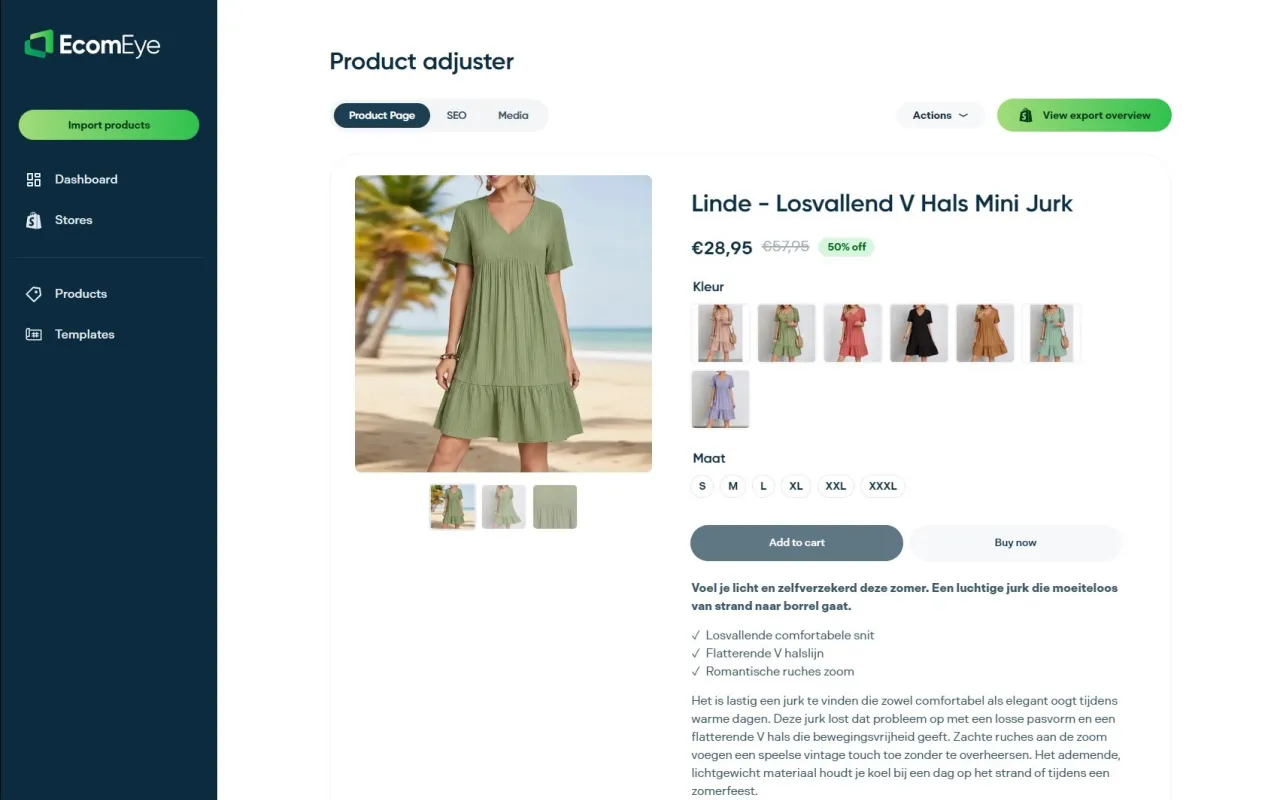
Ecom-eye is an AI tool built specifically for Shopify dropshipping stores. You import products in bulk from AliExpress or competitor links, and Ecom-eye automatically generates original titles, clean descriptions, SEO-ready content, and high-quality AI product images. Every page is copyright-safe and ready to export to Shopify in one click. No rewriting, no duplicate content risk, and no manual work. For retailers who want to build at scale, Ecom-eye removes the bottleneck between a well-designed taxonomy and a fully populated store.
FAQ
What is product categorization in e-commerce?
Product categorization is the process of organising products into logical groups within a structured taxonomy to improve navigation, search, and conversion. It directly affects how easily shoppers find products and how search engines index your store.
How many top-level categories should an online store have?
The optimal range is 5–12 top-level categories. Fewer than five is too broad for useful navigation; more than twelve creates decision overload at the first click.
What is the difference between taxonomic and thematic categorization?
Taxonomic categorization groups products by objective attributes such as type or function. Thematic categorization groups products by shopper context, such as seasonal collections or gift guides. Effective stores use both.
How do you validate a product category structure?
Run card sorting with 15–20 target shoppers to identify natural groupings, then follow up with tree testing to confirm shoppers can locate products in your proposed structure. The full process takes 1–2 weeks.
Why do attributes matter in product categorization?
Attributes attached to leaf categories power filtering and product comparison. Without them, a category is just a list. With them, shoppers can narrow results by colour, size, material, or any other relevant property, which improves both experience and conversion.
Ready to boost your product pages?
Generate high-converting, SEO-optimized product pages in bulk using AI automation used by e-commerce experts.
No credit card required