Why taxonomy design in product pages matters
Discover why taxonomy design in product pages is crucial for boosting conversions. Learn to enhance user experience and drive sales today!
Why taxonomy design in product pages matters
TL;DR:
- Ecommerce sites with poor taxonomy design experience higher abandonment rates and lower conversions, emphasizing the need for structured categories. Effective taxonomy, built around customer data and maintained through governance, boosts search, SEO, and user experience, ensuring sustainable growth. Continuous refinement and strategic management of taxonomy are vital to prevent performance issues and maximize online store success.
Eighty-eight per cent of ecommerce sites suffer from poor taxonomy UX, leading to higher abandonment rates and lower conversions. That single number should make any serious e-commerce professional stop and think. Understanding why taxonomy design in product pages drives or destroys your store’s performance is not a theoretical exercise. It is the difference between a shopper finding what they want in three clicks and leaving in frustration after ten. This article breaks down what product taxonomy actually is, where most stores go wrong, and how to build a structure that works for both customers and search engines in 2026.
Table of Contents
- Key takeaways
- Why taxonomy design in product pages is foundational
- Common taxonomy mistakes that hurt ecommerce performance
- Best practices for effective product taxonomy
- SEO and AI advantages of optimised taxonomy
- Practical steps to implement a taxonomy system
- My take: taxonomy gets neglected until it breaks everything
- How Ecom-eye automates taxonomy-consistent product pages
- FAQ
Key takeaways
| Point | Details |
|---|---|
| Taxonomy affects conversions directly | Well-structured taxonomy can boost conversion rates by up to 20% compared to poorly organised stores. |
| User behaviour drives good taxonomy | Category structures built around customer search data outperform those built around internal business logic. |
| Governance is not optional | Dedicated stewards, naming conventions, and regular audits prevent costly data quality issues at scale. |
| SEO and AI both depend on structure | Optimised taxonomy improves crawlability, prevents duplicate pages, and enhances AI-driven product discovery. |
| Taxonomy is a living system | Product taxonomy must be continuously refined through search analytics, click paths, and conversion data. |
Why taxonomy design in product pages is foundational
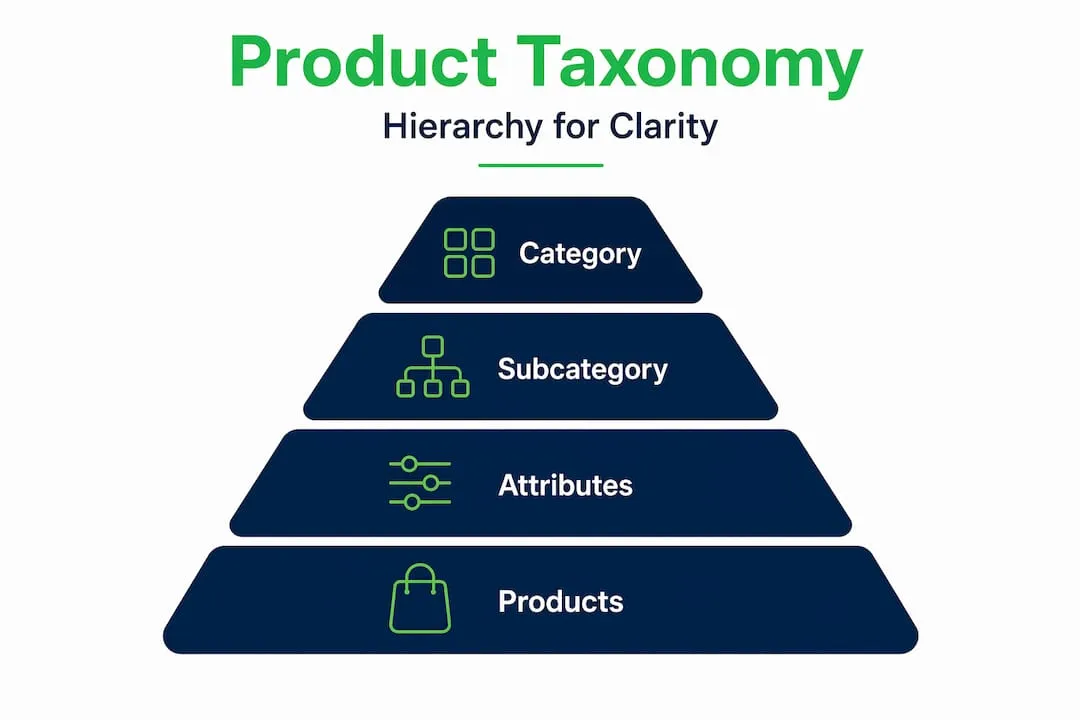
Product taxonomy is the structured system of categories, subcategories, attributes, and relationships that organises your entire product catalogue. Think of it as the skeleton of your store. Without a solid skeleton, everything else, your descriptions, your images, your pricing, sits in a heap rather than standing upright.
At its core, taxonomy has two distinct layers that most teams blur together. The first is the operational or internal classification. This is how your warehouse, buying team, or ERP system organises products behind the scenes. The second is the customer-facing navigation taxonomy. This is what shoppers see when they click through category pages and filters. Conflating operational taxonomy with navigation taxonomy creates rigid systems that break under the pressure of growth, and it is one of the most common structural errors in ecommerce today.
Good taxonomy supports three critical functions at once. It powers your site search so shoppers find relevant results. It structures your navigation so browsing feels intuitive. And it signals to Google exactly what each page is about, which directly affects your rankings.
- Categories: Top-level groupings like “Footwear” or “Electronics”
- Subcategories: Mid-level groupings like “Running Shoes” or “Wireless Headphones”
- Attributes: Product-specific descriptors like colour, size, material, or compatibility
- Leaf categories: The most granular level, where individual products sit and attribute templates are applied
Pro Tip: Map your customer-facing navigation categories to your internal operational taxonomy separately. Keeping these two systems distinct allows you to update internal processes without breaking the shopping experience, and vice versa.
The importance of taxonomy in ecommerce cannot be overstated. A shopper who cannot find a product within two to three clicks will not keep searching. They will leave and buy from a competitor who made it easier.

Common taxonomy mistakes that hurt ecommerce performance
Most taxonomy problems are not random. They follow predictable patterns, and recognising them is the first step to fixing them.
-
Building for internal convenience, not customer behaviour. The most common taxonomy mistake is structuring categories around how your company organises itself rather than how customers actually search. A buying team might split “Outdoor Furniture” into “Garden Seating” and “Patio Collections” based on supplier relationships, when shoppers simply search for “garden chairs.”
-
Hierarchies that are too deep or too shallow. More than three levels of categories creates decision fatigue. Fewer than two collapses distinct product types into broad buckets that return irrelevant results. Both extremes push shoppers towards your competitors.
-
Misclassification at the leaf category level. When products land in the wrong leaf category, they inherit the wrong attribute templates. A “Bluetooth Speaker” classified under “Home Décor” will not surface attributes like battery life or connectivity range. This breaks faceted navigation and frustrates shoppers who rely on filters.
-
No separation between channel taxonomies. Your Shopify store, your Google Shopping feed, and any marketplace listing you run may each require different category structures. Treating them as one system creates mapping conflicts and Google Merchant disapprovals.
-
Zero governance. Without formal naming conventions, ownership, and change processes, taxonomy grows organically in the worst way. Different team members create overlapping categories, inconsistent attribute labels, and orphaned products that never appear in search.
Pro Tip: Run a zero-result query analysis on your site search monthly. The search terms returning no results are a direct map of where your taxonomy is failing your customers.
Best practices for effective product taxonomy
The difference between a taxonomy that scales and one that collapses under its own weight usually comes down to a handful of deliberate design choices made early on.
Start with customer data, not spreadsheets. Before you draw a single category, pull your site search logs, Google Search Console queries, and on-site behaviour data. Your customers are already telling you how they think about your products. Build your categories around their language, not your internal shorthand.
Keep hierarchies broad and shallow. The optimal structure for most ecommerce stores sits at two to three levels. Broad at the top, specific at the leaf. This keeps navigation fast and prevents the “rabbit hole” problem where shoppers click deeper and deeper without finding what they came for.
Separate your taxonomies by purpose. As noted above, conflating these two taxonomy types is a structural error with long-term consequences. Maintain your internal operational classification and your customer navigation taxonomy as distinct systems with a documented mapping between them.
Use attribute templates at the leaf level. Every leaf category should have a defined attribute template. This enforces consistency across products, enables faceted filtering, and supports regulatory compliance when required. Layered attributes also empower faceted navigation, which significantly improves the filtering experience on category pages.
Implement formal governance. Taxonomy governance with dedicated stewards and formal change processes prevents the slow drift that eventually renders your catalogue unusable. This means role assignments, naming convention documents, approval workflows, and scheduled audits, at minimum quarterly.
Here is a quick comparison of taxonomy approaches and their typical outcomes:
| Approach | Customer impact | SEO impact | Maintenance burden |
|---|---|---|---|
| User-centric, shallow hierarchy | High findability, low abandonment | Strong keyword alignment | Moderate |
| Internal-logic, deep hierarchy | High confusion, high abandonment | Weak, diluted signals | High |
| No governance, ad hoc growth | Inconsistent, broken filters | Duplicate and thin pages | Very high |
| PIM-managed, mapped taxonomy | Consistent across channels | Structured, crawlable | Low to moderate |
Pro Tip: Manage taxonomy as a living model in a PIM system rather than a static spreadsheet. PIM tools allow you to handle attribute inheritance, channel mappings, and versioning without the risk of manual errors at scale.
SEO and AI advantages of optimised taxonomy
There is a direct and measurable connection between good taxonomy and organic search performance. Google processes over 3.5 billion daily searches with nearly half product-related. A well-structured taxonomy means Google can crawl your site efficiently, understand your category hierarchy through URL structure and internal links, and attribute authority correctly across pages.
Poor taxonomy creates two specific SEO problems that are expensive to fix. First, thin category pages that contain too few products produce low-quality, near-empty pages that Google deprioritises. Second, duplicate content arises when the same product appears under multiple ambiguous categories with near-identical descriptions. Both problems suppress rankings and waste crawl budget.
Beyond traditional SEO, AI-driven search models depend on structured entity data and schema markup to interpret product pages correctly. If you want your products to appear in AI-generated shopping responses or featured snippets, the underlying taxonomy must give those models something structured to read. This means implementing:
- Product schema on every product page with complete attribute data
- BreadcrumbList schema that reflects your taxonomy hierarchy
- FAQPage schema on category pages to target question-based queries
- Review schema to add credibility signals to leaf-level pages
A well-structured product page layout that reflects your taxonomy hierarchy also improves internal linking, which distributes page authority more effectively across your catalogue. This is often the fastest SEO win available to stores that have neglected taxonomy structure.
Practical steps to implement a taxonomy system
Getting taxonomy right requires both upfront design work and ongoing maintenance. Here is a process that works in practice, not just in theory.
-
Start with a representative sample. Begin with 20 to 30 representative products from across your catalogue before designing the full structure. This surfaces edge cases and prevents expensive restructuring once you scale to thousands of SKUs.
-
Establish mapping rules. Document the rules that determine which product goes into which category. This removes ambiguity for team members classifying products and keeps your taxonomy consistent as your catalogue grows.
-
Create an unmapped holding category. New products that do not clearly fit any existing category should land in a temporary holding area rather than being forced into the wrong category. Review this holding area weekly.
-
Analyse and refine continuously. Design taxonomy as a dynamic model refined through real-world data. Monitor site search logs for zero-result queries, analyse click paths to identify where shoppers abandon navigation, and track conversion rates by category.
-
Assign ownership. Every part of your taxonomy should have a named owner responsible for its accuracy and maintenance. Without ownership, nobody audits anything.
-
Plan channel mappings separately. Your Google Shopping feed, Amazon catalogue, and Shopify navigation may all use different taxonomy standards. Map each channel separately and build a schedule to update these mappings whenever external taxonomy standards change.
-
Schedule formal audits. Quarterly audits catch problems before they compound. Annual reviews should evaluate whether the top-level category structure still reflects your product range and customer behaviour.
My take: taxonomy gets neglected until it breaks everything
I have seen this pattern repeat across dozens of stores. A team launches fast, builds categories quickly to get products live, and taxonomy becomes a problem for future-them to solve. Then future-them inherits a catalogue where the same product lives in three categories, none of the filters work correctly, and SEO performance is inexplicably flat despite strong content.
The honest truth is that taxonomy feels abstract until the consequences are impossible to ignore. Most teams only discover how badly they need a proper structure when site search starts returning irrelevant results, when a new product line does not fit anywhere cleanly, or when a Google Merchant review flags duplicate content at scale. By that point, fixing it means touching thousands of product records. It is a project that takes months instead of days.
What I have found is that the teams who invest in taxonomy design before they need it share one belief: that taxonomy is a strategic asset, not a filing system. They treat it like a product in itself, with ownership, governance, and iteration cycles. The payoff is faster time-to-market for new products, cleaner SEO performance, and a site that converts because shoppers can actually find things.
The biggest myth worth dismantling is that taxonomy is a one-time project. It is not. Every time your product range shifts, every time a new channel opens, every time customer search behaviour evolves, your taxonomy needs to respond. The stores that build governance into their process from day one are the ones still growing five years later.
— Koen
How Ecom-eye automates taxonomy-consistent product pages
If the gap between knowing what good taxonomy looks like and actually implementing it across hundreds or thousands of products feels wide, that is exactly the problem Ecom-eye was built to solve.
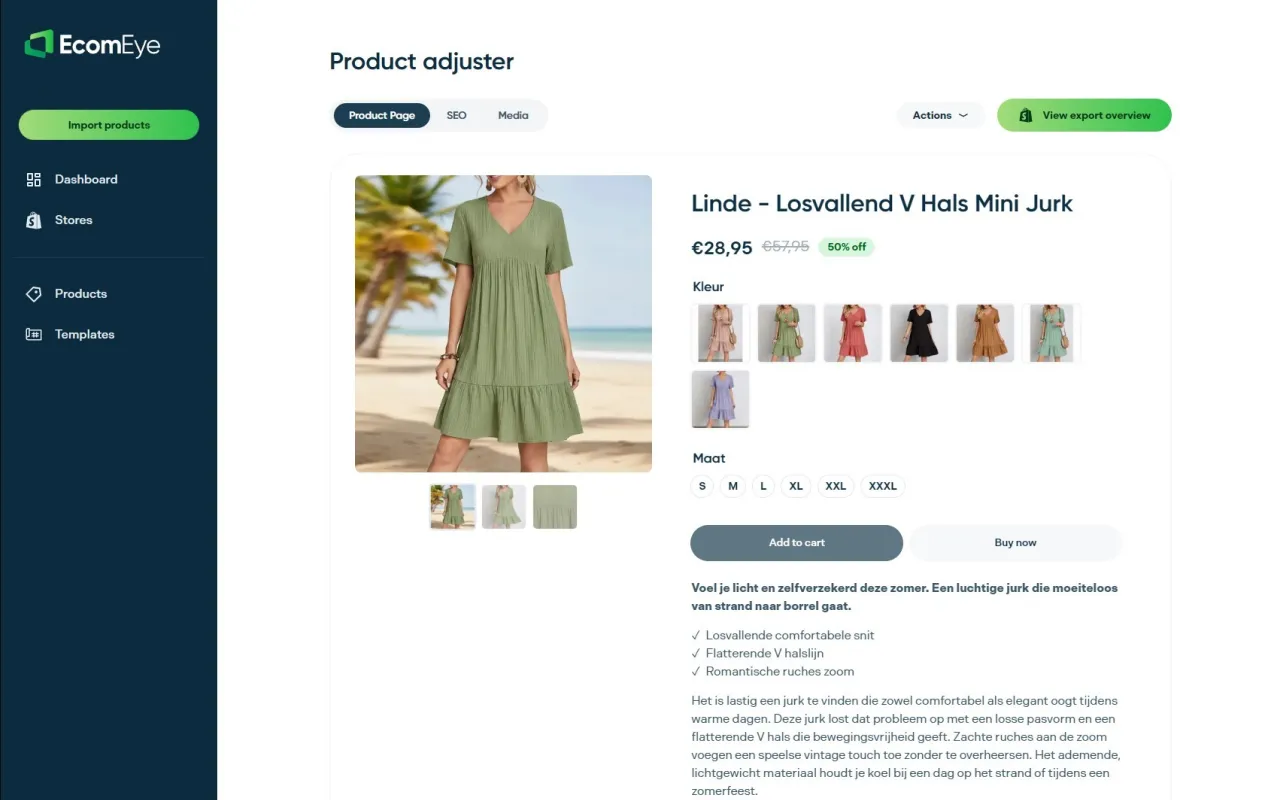
Ecom-eye’s bulk AI product lister generates SEO-optimised product pages at scale directly from AliExpress imports or competitor links, without the duplicate content risk that tanks most dropshipping stores on Google. Every page Ecom-eye creates includes clean, structured descriptions, optimised titles, and AI-generated images, all exported directly to Shopify in a single click. This means your product data stays consistent across your catalogue from the start, which is the foundation every good taxonomy system needs. No manual rewriting, no copyright risk, and no misclassified products landing in the wrong category because someone was working through a backlog at midnight. You can also explore ecommerce SEO best practices to see how product structure and content work together to drive organic visibility.
FAQ
What is product taxonomy in ecommerce?
Product taxonomy is the hierarchical system of categories, subcategories, and attributes used to organise products in an online store. It governs how products are classified internally and how shoppers navigate and discover them.
Why does taxonomy design affect conversion rates?
Poor taxonomy forces shoppers to search harder for products, increasing frustration and abandonment. Well-structured taxonomy can boost conversions by up to 20% by making products faster and easier to find.
How many levels should a product taxonomy have?
Most ecommerce stores perform best with two to three levels of category depth. Deeper hierarchies create decision fatigue, while overly shallow structures return too many irrelevant results for broad queries.
How does taxonomy impact SEO?
Taxonomy shapes URL structure, internal linking, and crawl efficiency. Optimised taxonomy distributes page authority effectively, prevents duplicate content issues, and aligns category pages with the keyword intent of shoppers and search engines.
How often should product taxonomy be reviewed?
Taxonomy should be monitored continuously through search analytics and click-path data, with formal audits conducted at least quarterly and a full structural review annually to align with changes in your product range and customer behaviour.
Ready to boost your product pages?
Generate high-converting, SEO-optimized product pages in bulk using AI automation used by e-commerce experts.
No credit card required