Optimise Shopify product page structure for SEO 2026
Learn how to optimise Shopify product page structure for better SEO rankings and conversion rates. Discover essential elements that can double your click-through rates and boost sales by up to 50%.

Most Shopify dropshipping stores lose 40% of potential organic traffic because they rely on default product page structures that prioritise quick setup over search performance. Shopify’s out-of-the-box configurations waste precious meta title space, omit critical schema markup, and present layouts that fail to convert visitors into buyers. This guide reveals exactly which structural elements to optimise on your product pages, why they matter for both SEO rankings and conversion rates, and how to implement changes that can double your click-through rates whilst boosting sales by up to 50%.
Table of Contents
- Why Default Shopify Product Pages Limit Your Store’s Success
- Essential Components Of An Optimised Shopify Product Page Structure
- Designing A High-Converting Product Page Layout For Shopify Dropshipping
- Applying Product Page Structure Optimisations Effectively In Your Shopify Dropshipping Store
- Unlock Your Store’s Growth With EcomEye Automation Tools
- Frequently Asked Questions
Key takeaways
| Point | Details |
|---|---|
| Default Shopify pages waste SEO potential | Out-of-the-box meta titles and missing schema markup cost stores up to 40% of organic traffic |
| Proper structure boosts search visibility | Optimised meta titles, product schema, and image formatting can double click-through rates from search results |
| Modular layouts increase conversions dramatically | Strategic page design with trust signals and social proof placement improves sales by 20 to 50% |
| Internal linking enhances engagement | Connecting related products extends session duration by 18% and strengthens site architecture |
| Speed and accessibility drive rankings | WebP images with descriptive alt text improve page speed by 30% and mobile SEO scores |
Why default Shopify product pages limit your store’s success
Shopify’s default product page structure prioritises ease of initial setup over long-term SEO effectiveness. This design choice creates immediate problems for dropshipping entrepreneurs who depend on organic search traffic. The platform automatically appends your store name to every meta title, consuming up to 30 characters of the crucial 60-character display limit. This forces your primary product keywords beyond the visible portion of search results, directly reducing click-through rates.
Default themes rarely include SEO-friendly URL structures or product schema markup, two foundational elements that search engines use to understand and rank your pages. Without schema markup, your products miss the opportunity to appear with rich snippets showing ratings, pricing, and availability directly in search results. Shopify default meta titles waste up to 30 characters, pushing critical keywords past the 60-character display limit where potential customers never see them.
The cumulative impact of these structural flaws is severe. Competitive product categories can cost stores 40% or more of potential organic traffic when relying on Shopify defaults. Consider these common default limitations:
- Meta titles that prioritise branding over product keywords
- Missing or poorly implemented product schema markup
- Generic URL structures that fail to incorporate target keywords
- Image handling that ignores modern formats and alt text optimisation
- Lack of strategic internal linking between related products
Pro Tip: Before making any structural changes, audit your current product pages using Google Search Console to identify which pages already receive impressions but have low click-through rates. These pages offer the quickest wins when you optimise their meta titles and add schema markup.
Understanding Shopify page layouts for dropshipping helps you recognise where defaults fall short and what alternatives exist. The good news is that fixing these structural issues requires no coding expertise, just systematic application of proven SEO principles.
Essential components of an optimised Shopify product page structure
Optimising product page structure begins with five core elements that directly influence both search rankings and user experience. Each component serves a specific purpose in helping search engines understand your products whilst making pages more appealing to potential customers.
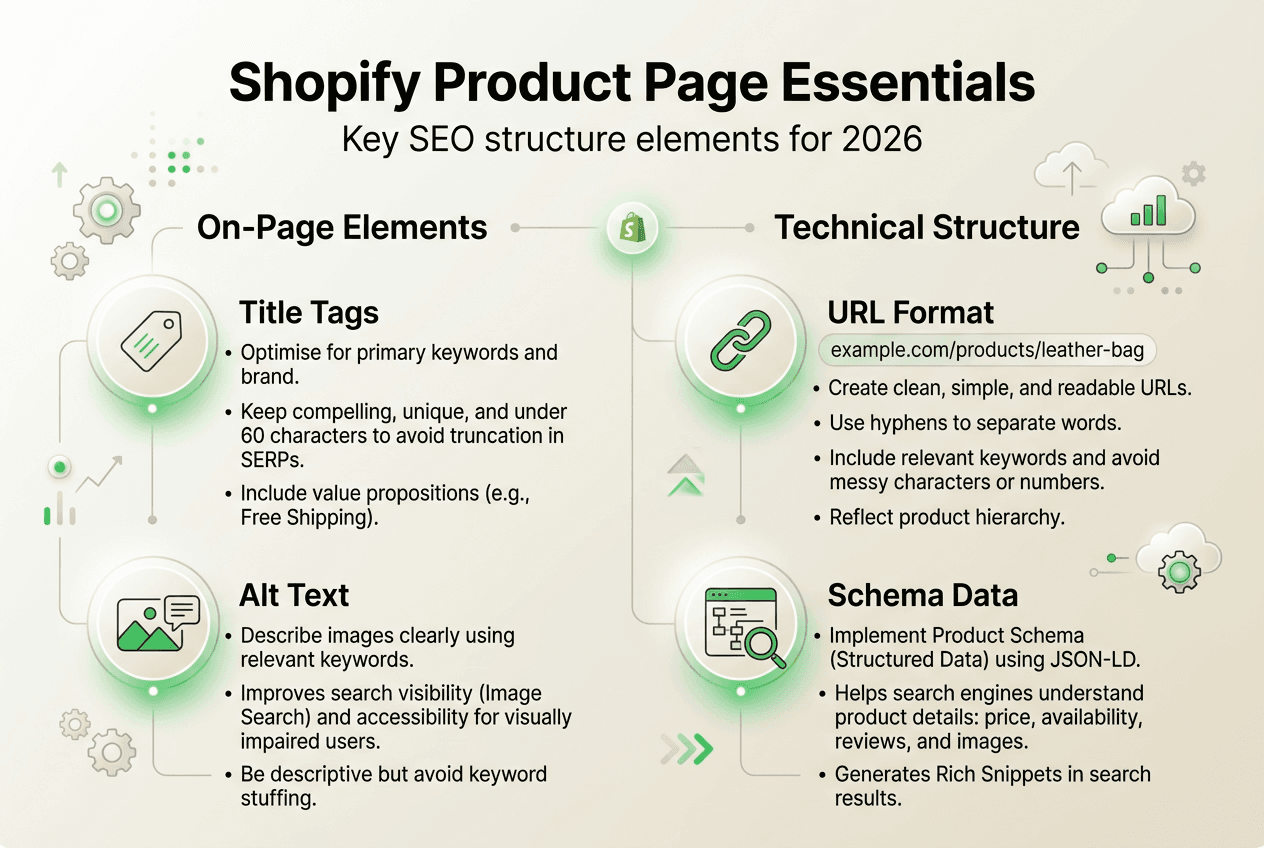
Product page optimisation focuses on titles, URLs, descriptions, images, and alt text to drive free, consistent traffic. Start by restructuring meta titles to lead with your product name and primary keyword, removing the automatic store name appendage. This simple change recovers valuable character space and ensures your most important keywords appear in the visible portion of search results.
URL structure matters more than many store owners realise. Replace Shopify’s default numeric or random URLs with descriptive paths that match your product keywords. A URL like yourstore.com/products/wireless-bluetooth-headphones-noise-cancelling performs far better than yourstore.com/products/12345 because it provides context to both users and search engines about page content.

Image optimisation delivers a dual benefit for page speed and accessibility. WebP format and descriptive alt text improves page speed by 30% compared to traditional JPEG or PNG formats. Alt text serves visually impaired users whilst giving search engines textual context about your product images, creating additional ranking opportunities in image search results.
Product schema markup represents the highest-impact structural change you can make. Schema markup doubles organic click-through rate by enabling rich snippets that display star ratings, pricing, and stock status directly in search results. These enhanced listings stand out visually and provide shoppers with key information before they even click through to your site.
Implement these essential optimisations systematically:
- Rewrite meta titles to lead with product keywords and stay within 50 to 60 characters
- Customise product URLs to include descriptive keywords matching search intent
- Convert all product images to WebP format and add specific, keyword-rich alt text
- Install and configure product schema markup for all product pages
- Create strategic internal links between complementary and related products
Internal linking between related products extends average session duration by 18% whilst helping search engines understand the topical relationships within your store. Link from higher-priced items to accessories, from popular products to newer inventory, and between items that customers frequently purchase together.
Pro Tip: Use Shopify’s bulk editor to update meta titles and alt text across multiple products simultaneously. This saves hours compared to editing each product individually and ensures consistency in your optimisation approach.
Mastering creating product pages with AI bulk tools accelerates implementation of these structural improvements across your entire catalogue. Understanding Shopify store features for SEO and conversions ensures you leverage platform capabilities effectively whilst avoiding common configuration mistakes.
Designing a high-converting product page layout for Shopify dropshipping
Product page layout directly influences conversion rates by controlling how information flows to visitors and where trust signals appear in the user journey. Modular section design offers the most effective approach for dropshipping stores because it provides complete layout customisation without the code bloat and rigidity of expensive premium themes.
Modular product page templates offer a fully custom look without code bloat compared to rigid expensive themes. This approach lets you build pages from individual components, arranging them strategically to guide visitors towards purchase decisions. The flexibility matters because different product categories require different layouts to convert effectively.
Every high-converting product page should include these core template components:
- Hero block with primary product image and key selling proposition
- Social proof grid displaying customer reviews and ratings prominently
- Specifications accordion organising technical details without cluttering the page
- Why section explaining unique benefits and solving customer objections
- Trust bar featuring security badges, guarantees, and shipping information
Placement of these elements determines their effectiveness.
Layout choices also influence pricing perception and average order value. Displaying related products or bundles near the main product encourages customers to consider higher-value purchases. Comparison tables help justify premium pricing by clearly articulating value differences between product tiers.
| Layout Element | Default Theme | Modular Custom Template |
|---|---|---|
| Customisation flexibility | Limited to theme settings | Complete control over every section |
| Page load speed | Often bloated with unused features | Lightweight, only includes needed components |
| Development cost | £150 to £300 for premium themes | Free base theme plus targeted sections |
| Conversion optimisation | Generic layouts for all products | Tailored layouts per product category |
| Update complexity | Theme updates may break customisations | Modular sections update independently |
Optimised Shopify product page templates can increase conversions by 20 to 50% compared to default layouts. This dramatic improvement comes from strategically positioning persuasion elements where they have maximum impact on purchase decisions.
Pro Tip: Create separate page templates for your highest-margin products versus high-volume items. Premium products benefit from extensive storytelling and detailed specifications, whilst fast-moving commodities convert better with minimal friction and prominent trust signals.
Implementing Shopify page automation for SEO boost ensures your layout optimisations scale efficiently across growing product catalogues without manual repetition.
Applying product page structure optimisations effectively in your Shopify dropshipping store
Systematic implementation of product page optimisations requires a methodical approach that balances immediate wins with long-term improvements. Begin with foundational elements that affect all products, then refine individual pages based on performance data.
Start with a fast, free theme and upgrade specific sections to maintain speed and avoid code bloat. This strategy delivers better performance than purchasing expensive premium themes that include hundreds of features you’ll never use. Choose a lightweight base theme with clean code, then add only the modular sections your specific products require.
Follow this implementation sequence for maximum efficiency:
- Audit existing product pages to identify SEO gaps and conversion bottlenecks
- Create custom meta title templates emphasising product keywords first
- Compress and convert all product images to WebP format with descriptive alt text
- Install and configure product schema markup across your entire catalogue
- Design modular page sections for different product categories
- Implement strategic internal linking between related products and collections
- Test layout variations focusing on trust element placement and pricing presentation
Image optimisation delivers immediate performance improvements. Compressed images and lightweight themes lead to mobile scores of 90 plus, boosting SEO rankings whilst reducing bounce rates from slow-loading pages. Use automated tools to batch-process images before uploading them to Shopify, ensuring consistent quality and file sizes.
Schema markup implementation requires careful attention to detail. Validate your structured data using Google’s Rich Results Test to confirm search engines can parse your product information correctly. Include all relevant schema properties such as price, availability, ratings, and product identifiers to maximise rich snippet eligibility.
Internal linking strategy should connect products logically based on customer behaviour patterns. Link complementary items that shoppers frequently purchase together, create pathways from entry-level products to premium alternatives, and guide visitors from popular items to newer inventory that needs visibility.
Pro Tip: Prioritise optimisation efforts based on traffic potential. Start with products that already rank on page two or three of search results, where structural improvements can push them onto page one and dramatically increase visibility.
Continuous testing reveals which structural changes produce the best results for your specific audience. Run A/B tests on trust badge placement, review section formatting, and product description length. Track metrics including bounce rate, time on page, add-to-cart rate, and completed purchases to measure the impact of each optimisation.
Understanding common dropshipping pitfalls 2026 helps you avoid structural mistakes that undermine SEO performance and conversion rates. Many failed stores neglect product page optimisation entirely, focusing instead on paid advertising that becomes unsustainable without organic traffic supporting it.
Unlock your store’s growth with EcomEye automation tools
Manually optimising product page structure across hundreds or thousands of products creates an impossible workload for most dropshipping entrepreneurs. EcomEye’s bulk AI product lister automates the creation of SEO-optimised product pages at scale, generating unique meta titles, descriptions, and image alt text that follow best practices without copying competitor content.
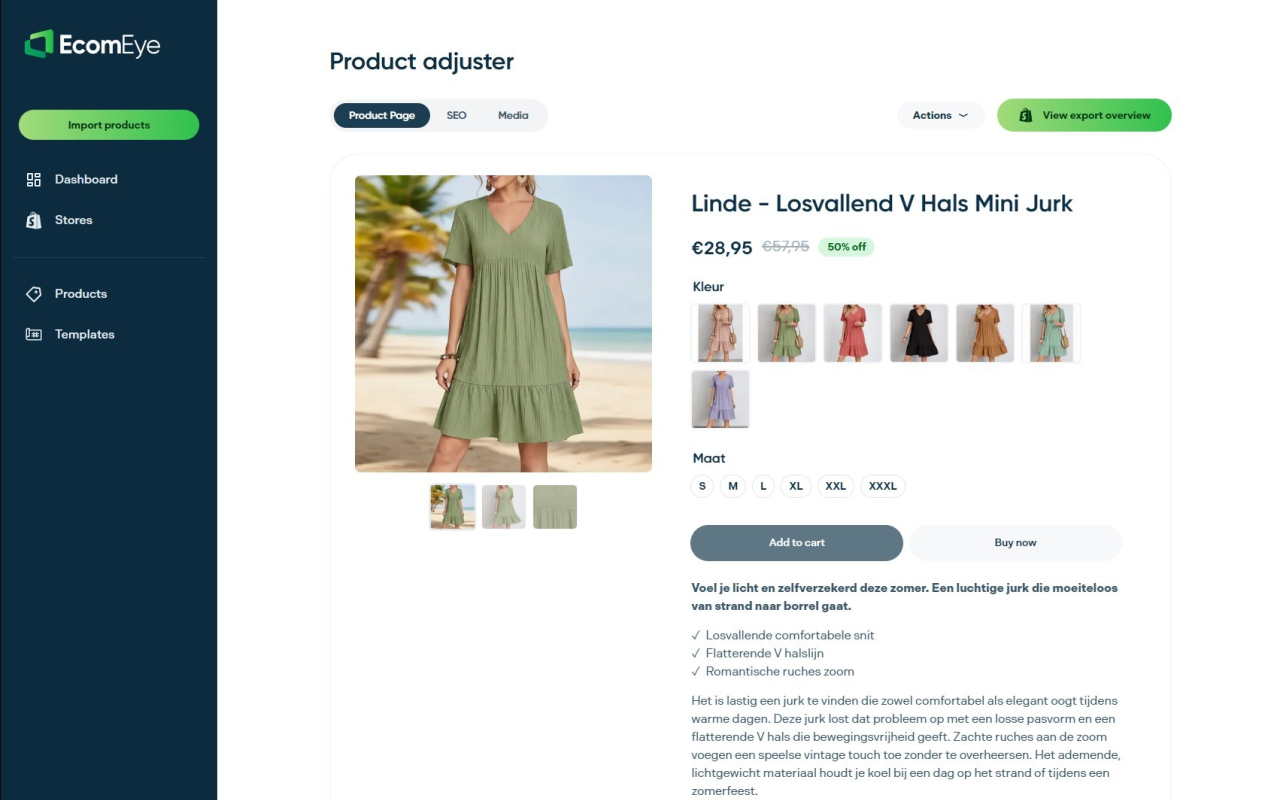
The platform imports products directly from AliExpress or competitor links, then automatically generates copyright-safe content in multiple languages. You maintain complete control over modular page templates whilst EcomEye handles the repetitive optimisation tasks that consume hours when done manually. Export completed products directly to Shopify in one click, with all structural elements properly configured for maximum SEO impact and conversion potential. Explore EcomEye pricing plans to find the solution that matches your store size and growth goals, or try the EcomEye bulk AI product lister to experience automated product page creation firsthand.
Frequently asked questions
What is the role of product page structure in SEO and conversions?
Effective product page structure organises content and metadata to improve search engine rankings whilst persuading shoppers to buy. It controls how information is presented for maximum clarity, trust, and engagement, directly influencing both organic visibility and purchase decisions.
How do meta titles and schema markup affect my Shopify store’s visibility?
Meta titles with main keywords increase search relevance and ranking potential by clearly communicating page content to search engines. Schema markup enables rich snippets that can double click-through rates from search results by displaying ratings, pricing, and availability directly in listings.
Can modular product page templates increase my store’s conversion rate?
Yes, modular templates allow precise user experience customisation that can boost conversions by up to 50% compared to default layouts. They keep pages fast and flexible without excess code bloat, enabling you to optimise each product category with the most effective layout for that specific audience.
Should I optimise all product pages simultaneously or prioritise certain products?
Prioritise products that already receive search impressions but have low click-through rates, as these offer the quickest wins. Focus next on high-margin items and best-sellers where conversion improvements deliver maximum revenue impact, then systematically optimise remaining inventory.
Ready to boost your product pages?
Generate high-converting, SEO-optimized product pages in bulk using AI automation used by e-commerce experts.
No credit card required