What is plagiarism in ecommerce: a seller's guide
Discover what is plagiarism in ecommerce and learn how it impacts SEO. Protect your brand with expert tips on avoiding content theft. Click to read!
What is plagiarism in ecommerce: a seller’s guide
TL;DR:
- Plagiarism in ecommerce involves copying product descriptions, images, or content without proper attribution, risking SEO penalties and customer distrust. Differentiating between unethical plagiarism and legal copyright infringement is crucial, with original writing and technical safeguards being the best prevention methods. When content is copied by others, prompt documentation, direct contact, and DMCA notices help protect your brand and rankings.
Plagiarism in ecommerce is defined as copying someone else’s product descriptions, images, or branded content and presenting it as your own without permission or proper attribution. This practice is widespread across online retail, from dropshippers pasting supplier text verbatim to retailers lifting competitor category copy wholesale. The consequences reach well beyond ethics. Google penalises copied content through ranking suppression and de-indexing, while customers who notice recycled descriptions lose trust in your brand. Tools like Grammarly, Copyscape, and Semrush’s content audit features can detect plagiarism before it costs you rankings. Understanding what counts as plagiarism in online business, and where it shades into copyright infringement, is the first step to protecting your store.
What is plagiarism in ecommerce and why does it matter for SEO?
Plagiarism in ecommerce covers any instance where you use another party’s words, images, or ideas without meaningful transformation or credit. Google’s Quality Rater Guidelines rate pages at the lowest quality level when almost all main content is copied or AI-generated with little effort or added value. That rating directly influences how Googlebot treats your pages in rankings. Attribution alone does not save you. If your product description is 95% manufacturer copy with a small “source” note at the bottom, Google still classifies it as low-effort rehashed content.
The SEO damage from duplicate content operates through several mechanisms:
- Ranking dilution. When the same description appears across dozens of URLs, Google struggles to determine which page deserves to rank. Duplicate content splits ranking signals across multiple URLs, reducing visibility for all of them.
- De-indexing risk. Pages Google considers thin or copied may be removed from the index entirely, making them invisible in search results.
- Poor Trust and Quality Score. Repeated low-quality signals across your catalogue drag down your domain’s overall authority.
- Higher bounce rates. Shoppers who read identical descriptions on three different sites recognise the copy-paste pattern and leave, which signals poor user experience to Google.
- Google Merchant Centre disapprovals. For dropshippers running Shopping campaigns, duplicate product content frequently triggers disapprovals that pause your ads.
Pro Tip: Use canonical tags on every product variant URL, filtered page, and parameter-driven URL in your Shopify store. Parameter URLs and faceted navigation create duplication at scale, and without precise, self-referencing canonical tags, your ranking signals fragment across hundreds of near-identical pages.
How is plagiarism different from copyright infringement?
These two concepts are related but legally and ethically distinct. Plagiarism is an ethical issue involving presenting another’s work as your own. Copyright infringement is a legal violation of the exclusive rights granted to a content creator under intellectual property law. You can commit one without the other, and ecommerce retailers regularly do both simultaneously without realising it.
Here is how the distinction plays out in practice:
- Copying a manufacturer’s description without credit is plagiarism. If that description is not protected by copyright (for example, it is a purely factual specification list), it may not be copyright infringement.
- Using a competitor’s product photograph without permission is almost certainly copyright infringement, because photographs attract automatic copyright protection. It is also plagiarism if you present the image as your own.
- Paraphrasing a competitor’s category text without attribution is plagiarism. Whether it constitutes infringement depends on how closely the paraphrase tracks the original expression.
- Receiving a DMCA takedown notice is a legal event tied to copyright infringement, not plagiarism. DMCA notices in the US require specific legal elements and compel platforms to remove infringing content.
The practical implication for ecommerce sellers is that ethics and legal compliance are separate but complementary concerns. You need to address both to protect your brand and avoid disputes. Ignoring the ethical dimension because something is technically legal still damages your SEO and customer trust.
A particular caution applies to AI-generated content. AI-generated drafts require human review, rewriting, and added value to avoid being classified as low-effort plagiarism by search engines. Generating a product description with an AI tool and publishing it unchanged is not a legal workaround. Google treats it the same as copied manufacturer copy.
What are the most common plagiarism examples in ecommerce?
Most plagiarism in online business is not deliberate theft. It is the product of speed, scale, and a lack of content strategy. Mass syndication of supplier copy, amplified by AI paraphrasing tools, is now the dominant form of ecommerce plagiarism. Sellers import 500 products from AliExpress, publish the supplier descriptions unchanged, and wonder why their store never ranks.
The most frequently plagiarised content types in ecommerce include:
- Product descriptions copied directly from manufacturer data sheets or supplier listings
- Category page text lifted from competitor stores or industry directories
- FAQ sections scraped from brand websites and republished without modification
- Product images taken from supplier catalogues or competitor listings without licence clearance
- Customer reviews reproduced from third-party platforms without permission
- Meta titles and descriptions cloned from ranking competitors to mimic their SEO structure
The underlying cause is almost always a rushed launch or an absence of a content workflow. Sellers prioritise getting products live over getting them right. The result is a catalogue that Google treats as low-value, regardless of how good the actual products are. Effective differentiation requires changing content structure, adding custom testing notes, original photography, and customer Q&A. Synonym swaps and light paraphrasing do not constitute original content in Google’s assessment.
How to avoid plagiarism in ecommerce product listings
Preventing plagiarism in ecommerce requires a combination of original writing practices, technical SEO discipline, and the right tools. The goal is not just to avoid penalties. It is to build a catalogue that genuinely serves your customers better than your competitors’ catalogues do.

Here is a practical comparison of approaches:
| Approach | What it involves | SEO outcome |
|---|---|---|
| Copy-paste supplier text | No modification of manufacturer copy | Ranking suppression, de-indexing risk |
| Light paraphrasing | Synonym replacement, minor restructuring | Still classified as low-effort by Google |
| AI-generated without editing | Published AI draft with no human input | Treated as copied content, quality penalty |
| Original description with evidence | Custom testing notes, use cases, customer insights | Strong quality signals, ranking potential |
| Canonical URL strategy | Self-referencing tags on all variant and parameter URLs | Consolidates ranking signals, prevents dilution |
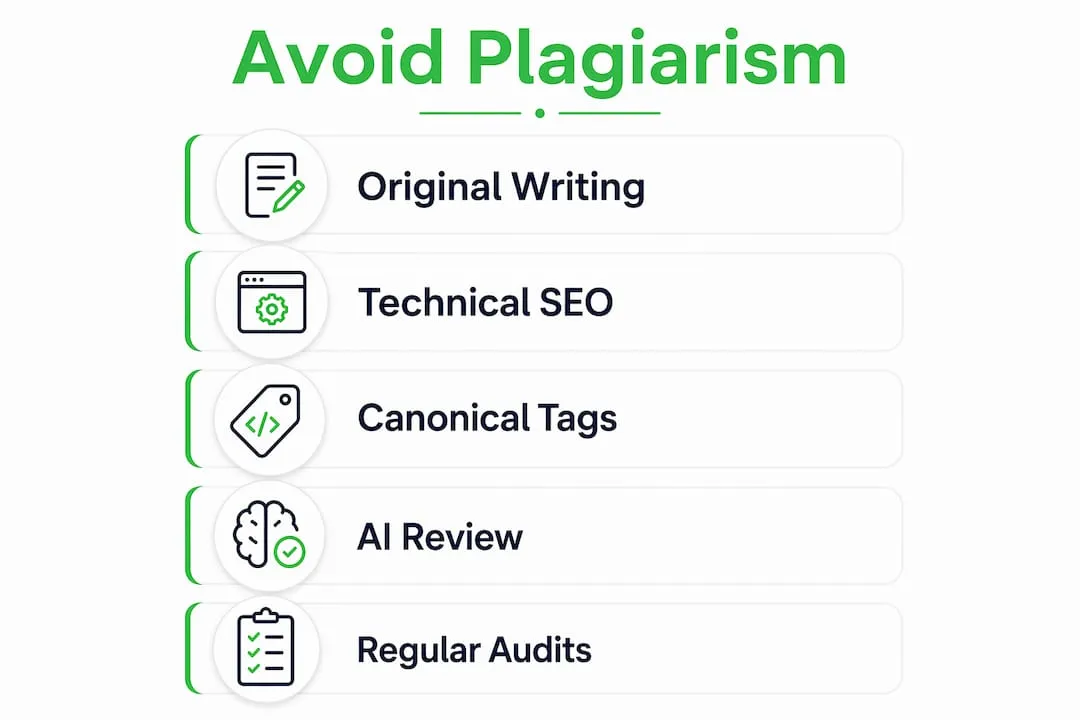
The most effective prevention combines original writing with technical safeguards. Write descriptions that reference your own experience with the product, specific use cases your customers have raised, and compatibility details that go beyond the manufacturer sheet. Run every batch of new listings through a plagiarism checker such as Copyscape or Semrush’s content audit before publishing. Use reverse image search via Google Images or TinEye to verify that any product photos you use are either your own or properly licenced.
For product page uniqueness on Shopify specifically, the canonical tag implementation matters as much as the writing. Every colour variant, size option, and filtered URL needs a canonical pointing to the primary product page.
Pro Tip: Use AI writing tools as a structural assistant, not a content generator. Feed the AI your own notes, customer questions, and product observations, then use its output as a draft to edit heavily. AI-generated content that includes verifiable sources and personal expertise avoids quality penalties. AI content published unchanged does not.
What should you do if your content is plagiarised by others?
Discovering that a competitor has copied your product descriptions or images is frustrating, but there is a clear process for addressing it. Acting quickly matters because the longer copied content remains indexed, the more it dilutes your own rankings.
- Document the infringement. Take timestamped screenshots of both your original content and the copied version. Note the URLs, dates, and the extent of copying. This documentation is your proof of ownership.
- Run a content monitoring check. Tools like Copyscape, Google Alerts set to your unique phrases, or Semrush’s brand monitoring feature will surface copies you may not have found manually.
- Contact the infringing site directly. Send a polite but firm written request to remove the content. Many smaller sellers comply immediately when contacted, avoiding the need for formal action.
- File a DMCA takedown notice. If the site is hosted on a US-based platform or uses a US-based hosting provider, a valid DMCA notice requires your contact details, identification of the original work, identification of the infringing material, and a statement of good faith belief that the use is unauthorised.
- Consult a solicitor if the infringement is significant. For high-value original photography, branded content, or large-scale copying that is damaging your rankings, legal advice is worth the cost.
One important limitation: plagiarism enforcement outside copyright law has no formal legal mechanism. If someone copies your factual product specifications (which may not attract copyright protection), your remedies are reputational and SEO-based rather than legal.
Key takeaways
Plagiarism in ecommerce destroys SEO rankings, triggers Google quality penalties, and exposes sellers to legal risk through copyright infringement, making original content the only sustainable content strategy.
| Point | Details |
|---|---|
| Plagiarism defined | Copying text, images, or ideas without permission or attribution, including supplier copy and competitor content. |
| SEO impact | Duplicate content splits ranking signals and risks de-indexing; canonical tags are the technical fix. |
| Legal distinction | Plagiarism is ethical; copyright infringement is legal. Both require separate responses from ecommerce sellers. |
| Prevention method | Write original descriptions with product-specific evidence; run Copyscape checks before publishing. |
| If you are copied | Document, contact the infringer, then file a DMCA notice if the platform is US-based. |
The uncomfortable truth about content shortcuts in ecommerce
I have reviewed hundreds of Shopify stores over the years, and the pattern is always the same. The seller who copied 800 product descriptions from their supplier in a weekend wonders why their store sits on page six after six months. The seller who wrote 50 genuinely original listings, with real use-case notes and honest product observations, ranks on page one for half of them within three months.
The temptation to copy is understandable. Writing original content for a large catalogue feels like an impossible task when you are also managing fulfilment, customer service, and paid advertising. But the maths do not work in favour of shortcuts. Google’s quality assessment has become precise enough that even well-paraphrased supplier copy fails the originality test. The algorithm is not looking for identical text. It is looking for evidence that a human with genuine product knowledge wrote the page.
What actually moves the needle is integrating customer feedback directly into your listings. If five customers have asked whether a product fits a specific use case, answer that question in the description. That single addition makes your page more useful than any competitor who copied the same manufacturer text. Search engines reward usefulness, not volume.
The relationship between content quality and ecommerce SEO is not going to weaken as AI tools become more prevalent. If anything, the bar for what counts as original and valuable will rise as AI-generated content floods the web. The sellers who invest in genuine originality now will have a structural advantage that compounds over time.
— Koen
Generate original product listings at scale with Ecom-eye
If writing unique descriptions for every product in your catalogue sounds like a full-time job, Ecom-eye was built to solve exactly that problem.
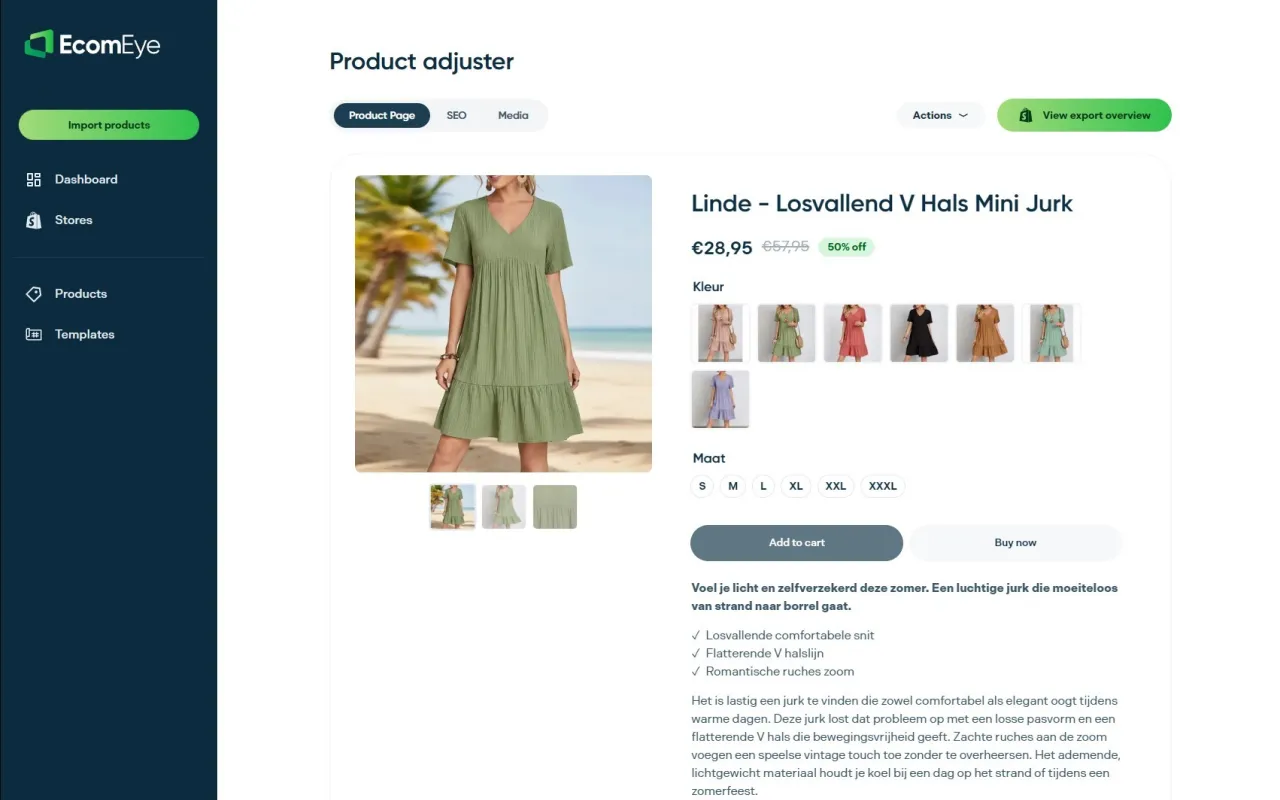
Ecom-eye is an AI product listing tool designed for Shopify dropshippers who need copyright-safe product pages generated in bulk, without the plagiarism risk that comes from copying supplier or competitor content. Import products directly from AliExpress or competitor URLs, and Ecom-eye automatically generates original titles, clean descriptions, SEO-ready content, and high-quality AI product images. Every page is built to pass Google’s quality assessment, not trigger it. Export your entire catalogue to Shopify in one click, with no manual rewriting and no duplicate content penalties. For sellers managing hundreds or thousands of SKUs, that is the difference between a store that ranks and one that does not.
FAQ
What counts as plagiarism in an ecommerce product listing?
Plagiarism in a product listing includes copying supplier descriptions, competitor text, or any other content without meaningful transformation or attribution. Even heavily paraphrased content can be classified as plagiarised if it adds no original value.
Does using manufacturer copy count as plagiarism?
Yes. Publishing manufacturer or supplier descriptions unchanged is a form of plagiarism in online business, and Google treats it as low-effort duplicate content regardless of how many other sellers use the same text.
How does plagiarism affect my Google rankings?
Copied content splits ranking signals across multiple URLs and signals low quality to Google’s algorithms, resulting in lower rankings, reduced indexing, and potential removal from search results entirely.
Is AI-generated product content safe to publish?
Not without editing. AI-generated content requires human review and added original value before publishing. Unedited AI output is treated by Google as low-effort content and carries the same quality penalties as copied text.
What is the fastest way to detect plagiarism in my ecommerce store?
Run your existing product descriptions through Copyscape or Semrush’s content audit tool. Both identify duplicate content across the web and flag pages that share significant text with other indexed URLs.
Ready to boost your product pages?
Generate high-converting, SEO-optimized product pages in bulk using AI automation used by e-commerce experts.
No credit card required