Why clarity in ecommerce descriptions drives more sales
Discover why clarity in ecommerce descriptions boosts sales. Learn effective strategies to enhance product descriptions and reduce cart abandonment.
Why clarity in ecommerce descriptions drives more sales
TL;DR:
- Clarity in ecommerce product descriptions significantly reduces cart abandonment and enhances SEO performance by answering customer questions effectively.
- Implementing a three-layer structure—a benefit-led introduction, scannable feature bullets, and a micro-FAQ—improves conversion rates and search engine rankings.
- Using original, benefit-driven, and structured descriptions tailored to customer objections is essential for sustained organic growth and avoiding duplicate content penalties.
Clarity in ecommerce product descriptions is defined as concise, benefit-driven copy that eliminates shopper doubt and directly supports the purchase decision. 87% of online shoppers rate product descriptions as extremely or very important when deciding to buy. That figure, from Salsify’s 2024 consumer research, means your product copy is doing as much selling as your price or your images. Effective ecommerce copywriting sits at the intersection of customer psychology and search engine optimisation, and getting it right pays off in fewer abandoned carts, higher Google Shopping rankings, and measurable revenue growth. Tools like Grammarly help with readability, but the strategic framework behind clear descriptions matters far more than grammar alone.
Why clarity in ecommerce descriptions reduces cart abandonment
The average cart abandonment rate sits at 69.99%, according to Baymard Institute data. That means roughly seven out of every ten shoppers who add a product to their basket leave without buying. A significant share of those exits trace back to unclear product information that increases cognitive load. When a shopper cannot quickly answer “Will this fit?”, “Is this compatible with my device?”, or “What exactly does this do?”, the easiest decision is to leave.

Clarity resolves doubt before it forms. A description that states “fits UK standard 13-amp sockets” removes a question that would otherwise send a shopper to a competitor’s page or a Google search. Reducing uncertainty through clear copy also lowers the volume of support tickets, which is a direct operational saving on top of the conversion benefit.
The contrast between clear and vague messaging is stark in practice. Compare “high-quality material” with “420gsm brushed cotton, pre-shrunk, rated for 60°C machine wash.” The second version answers the questions a buyer actually has. Structured content, including short paragraphs, bullet points for specifications, and bold text for key attributes, reinforces the written clarity by making information scannable rather than buried.
“Most product pages lose sales because of unclear or insufficient product descriptions, rather than price or distractions.” — Baymard Institute, 2026 checkout usability study
Pro Tip: Before rewriting a description, list the three questions a first-time buyer would ask about the product. Answer all three in the first 80 words of the copy.
How does description clarity affect SEO rankings?
Search engines, including Google’s AI-powered systems, rank product pages partly on the consistency and structure of the information they find. AI search engines prioritise stable, structured, factually consistent data across visible copy, product feeds, and schema markup. When your written description says “midnight blue” but your Google Merchant Centre feed says “navy,” that inconsistency creates what SEO specialists call clarity friction, and it suppresses visibility.
The SEO advantages of clear descriptions compound across three areas:
- Duplicate content avoidance. Manufacturer copy pasted directly onto product pages is treated as duplicate content by Google, which hurts rankings. Original, clearly written descriptions signal that your page adds value.
- Schema alignment. When your visible copy, structured data, and feed attributes all describe the same product in consistent terms, Google can confidently surface your page for relevant queries.
- Keyword relevance. Clear, benefit-driven language naturally incorporates the phrases real shoppers type into search bars, without forced keyword stuffing.
The table below shows how description quality maps to SEO outcomes:
| Description type | SEO impact | Conversion impact |
|---|---|---|
| Manufacturer copy (duplicated) | Penalised for duplicate content | Low: no differentiation |
| Vague superlatives (“best quality”) | Minimal keyword value | Low: no specifics |
| Clear, benefit-driven original copy | Indexed as unique content | High: answers buyer questions |
| Aligned copy, schema, and feed data | Maximum AI search visibility | High: consistent trust signals |
For Shopify dropshippers in particular, the risk of copying competitor descriptions is not theoretical. Google Merchant Centre disapprovals for duplicate or misleading content are among the most common reasons product listings are suspended. Writing original, clear descriptions is not optional if you want sustained organic traffic.
What do unclear product descriptions get wrong?
Most ecommerce product pages fail critical usability criteria because of poor description clarity and structure. The mistakes tend to cluster into five patterns:
- Feature-dumping without benefits. Listing “stainless steel body, 1200W motor, 1.7L capacity” tells a buyer what the product is, not why it matters. The benefit version reads: “boils a full litre in under three minutes, with a stainless steel body that stays cool to the touch.”
- Copy-pasted manufacturer text. This is the single most damaging habit in dropshipping. It creates duplicate content, fails to address the specific doubts of your audience, and reads as generic to any experienced shopper.
- Vague superlatives and jargon. Phrases like “premium quality,” “industry-leading performance,” and “cutting-edge design” carry zero information. Every competitor uses them, which means they differentiate nothing.
- Ignoring purchase objections. Fit, compatibility, sizing, return policy, and material safety are the questions that kill conversions when left unanswered. A shopper buying a phone case needs to know the exact model compatibility, not just “fits most smartphones.”
- Wall-of-text formatting. A single 200-word paragraph is harder to scan than four short bullet points and a two-sentence lead. Poor scannability means key information goes unread.
Pro Tip: Run your current descriptions through the Hemingway Editor. Any sentence flagged as “very hard to read” is a conversion risk. Rewrite it at Grade 8 or below.
How to write clear, effective product descriptions
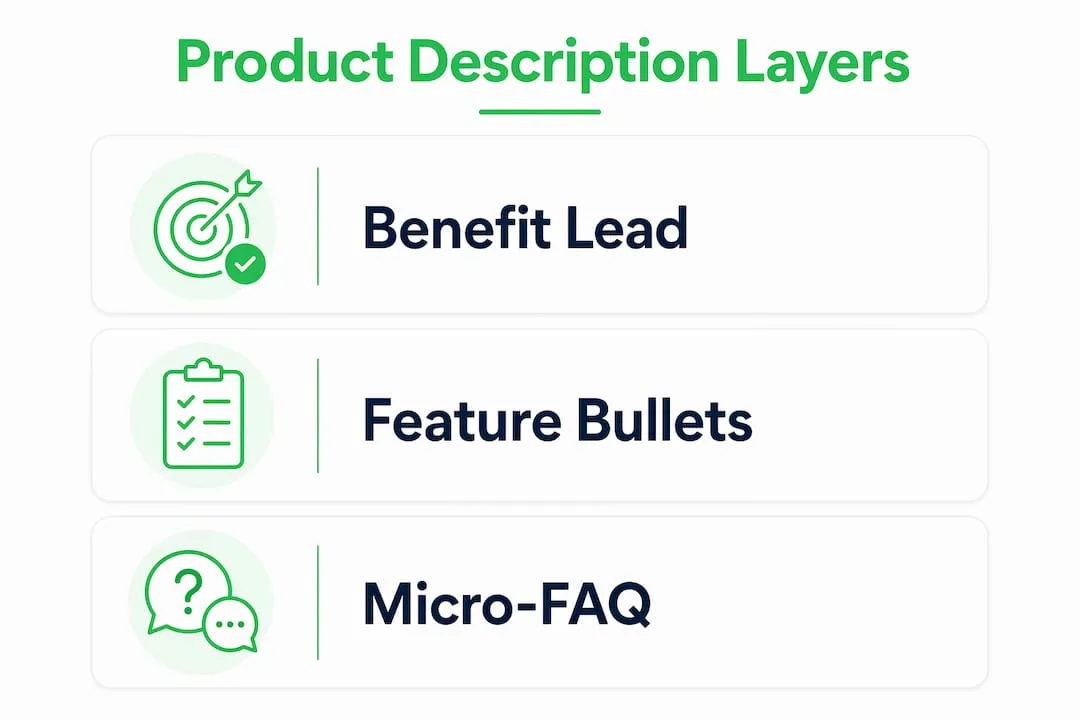
The three-layer product description framework is the most reliable structure for combining clarity with conversion performance. Each layer serves a distinct purpose.
Layer 1: Benefit-driven lead paragraph. Open with what the product does for the buyer, not what it is. Two to three sentences, written at a conversational reading level, focused on the outcome the customer gets. For a standing desk: “Work without back pain. This height-adjustable desk moves from sitting to standing in eight seconds, designed for full-day use in home offices and co-working spaces.”
Layer 2: Scannable feature bullets. Follow the lead with five to eight bullet points covering the specifications a buyer needs to make a decision. Each bullet should pair a feature with its benefit: “Adjusts from 72cm to 120cm, suitable for users from 5ft 2in to 6ft 4in.” This format serves both human readers and search engine crawlers.
Layer 3: Micro-FAQ for objection handling. Addressing common purchase objections directly in the description leads to measurably higher conversion rates. The most efficient way to identify those objections is to mine one-star reviews on your own listings and competitor pages. If buyers repeatedly ask “Does this work with X?” or “How long does delivery take?”, answer those questions in a short Q&A block at the bottom of the description.
The comparison below shows the difference in practice:
| Element | Vague version | Clear version |
|---|---|---|
| Lead sentence | “Premium quality desk for modern offices.” | “Adjusts from sitting to standing in 8 seconds, built for all-day home office use.” |
| Feature bullet | “Durable construction.” | “Steel frame rated to 80kg, with a 5-year structural warranty.” |
| Objection answer | Not included. | “Compatible with dual monitor setups up to 27 inches.” |
Sensory language can boost purchase intent by up to 30%, according to a Journal of Consumer Psychology study. That means words like “brushed,” “matte,” “weighted,” and “whisper-quiet” are not decorative. They reduce the sensory gap between reading about a product and holding it. Use them wherever they are accurate and relevant.
Pro Tip: Test your descriptions sequentially rather than all at once. Change the lead paragraph first, measure the conversion impact for two weeks, then move to the feature bullets. This approach, recommended in conversion optimisation research, isolates what is actually driving improvement.
Key takeaways
Clear, benefit-driven product descriptions are the single most controllable factor in reducing cart abandonment, improving SEO rankings, and increasing conversion rates for ecommerce stores.
| Point | Details |
|---|---|
| Clarity drives purchase decisions | 87% of shoppers rate descriptions as very important; vague copy loses sales before price is even considered. |
| Cart abandonment is a clarity problem | Baymard Institute links the 69.99% abandonment rate directly to unclear product information increasing cognitive load. |
| SEO requires consistency | Aligning visible copy, schema, and feed data removes clarity friction and improves AI search engine rankings. |
| Three-layer framework works | Lead paragraph, feature bullets, and a micro-FAQ address buyer needs at every stage of the decision. |
| Manufacturer copy is a liability | Duplicated descriptions harm Google rankings and fail to differentiate your store from every other seller. |
The uncomfortable truth about product descriptions in 2026
Most ecommerce store owners treat product descriptions as a box to tick rather than a tool to test. I have reviewed hundreds of Shopify product pages, and the pattern is consistent: the description was written once, at launch, and never touched again. Meanwhile, the store owner spends money on paid ads wondering why the conversion rate refuses to move.
The product description is evolving beyond static text into a dynamic decision-support element. That shift has practical consequences. A description written in 2023 does not account for the questions your current buyers are asking in 2026. It does not reflect the objections surfacing in your recent reviews. It is not aligned with the schema and feed data that AI search systems now use to rank your pages.
Clarity is a foundational imperative in ecommerce, not an aesthetic preference. The stores that treat their product copy as a living asset, one that gets updated based on support queries, review analysis, and A/B test results, consistently outperform those that do not. That is not a theory. It is what the data from Baymard Institute, Salsify, and conversion rate research all point toward.
The practical implication for you: pick your five worst-converting products, apply the three-layer framework, and measure the result over 30 days. The improvement will make the case for doing the rest.
— Koen
How Ecom-eye automates clear, SEO-ready product descriptions
Writing clear, original descriptions for hundreds of products is where most dropshippers stall. The time cost is real, and the risk of reverting to manufacturer copy is high when you are managing a large catalogue.
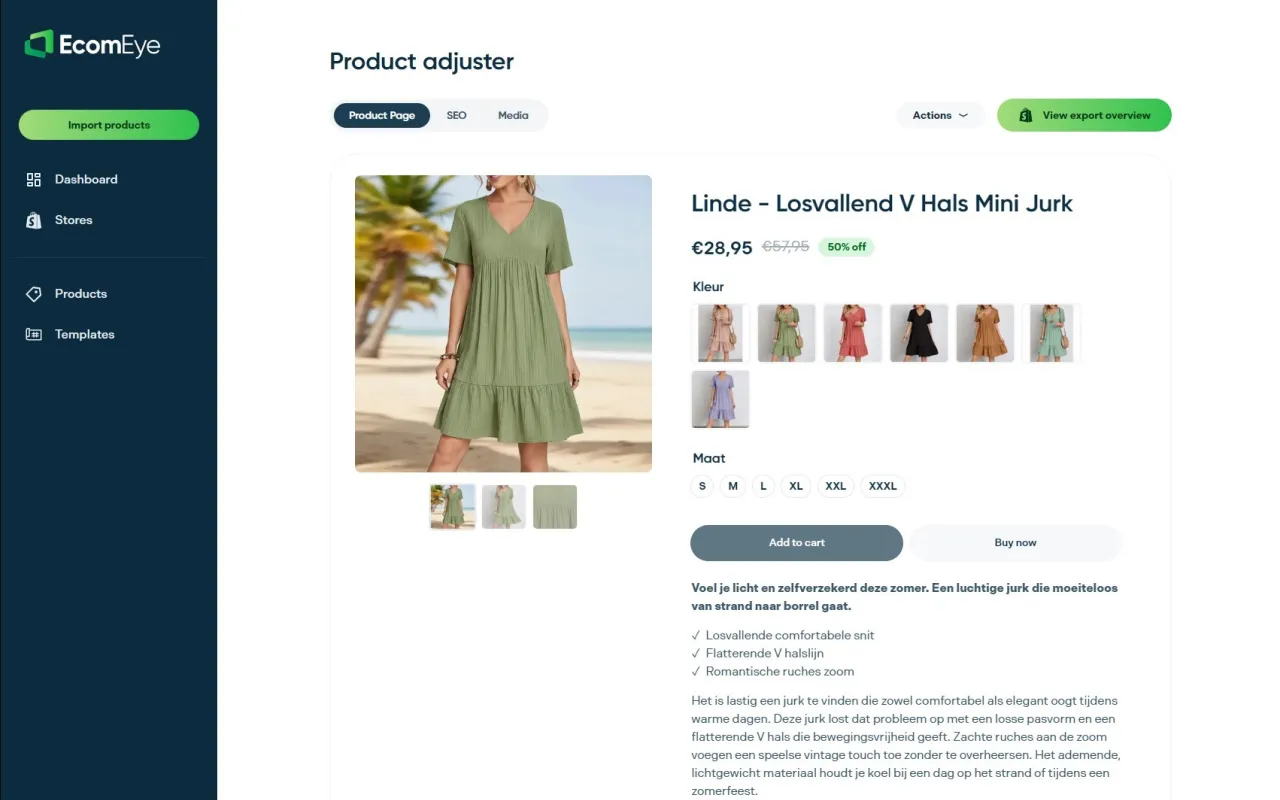
Ecom-eye is built specifically for this problem. Its bulk AI product lister generates original, benefit-driven, SEO-aligned descriptions at scale, directly from AliExpress imports or competitor links. Every output includes optimised titles, clean copy, and structured content ready for Shopify export in one click. There is no duplicate content risk, no manual rewriting, and no Google Merchant Centre disapprovals from copied text. For store owners who want the clarity benefits covered in this article without the hours of copywriting work, Ecom-eye removes the bottleneck entirely. You can also explore automating product descriptions to understand the full efficiency case.
FAQ
Why does clarity in product descriptions matter for SEO?
Clear, original descriptions aligned with your schema and product feed data are prioritised by AI search engines including Google. Duplicate or vague copy creates ranking friction and risks Google Merchant Centre disapprovals.
How do unclear descriptions cause cart abandonment?
Baymard Institute data shows that unclear product information increases cognitive load, which is a primary driver of the 69.99% average cart abandonment rate. Shoppers who cannot quickly answer their key questions leave rather than buy.
What is the three-layer product description framework?
The three-layer framework structures descriptions as a benefit-driven lead paragraph, a set of scannable feature bullets, and a micro-FAQ that addresses common purchase objections. Each layer serves a different stage of the buyer’s decision process.
How do I find the objections to address in my descriptions?
Mine your one-star and two-star reviews, along with competitor reviews for the same product category. The recurring complaints and questions in those reviews are the objections your description needs to answer directly.
Does sensory language genuinely improve conversions?
A Journal of Consumer Psychology study found that sensory language in product descriptions can boost purchase intent by up to 30%. Words that describe texture, weight, sound, and appearance reduce the gap between reading about a product and experiencing it.
Ready to boost your product pages?
Generate high-converting, SEO-optimized product pages in bulk using AI automation used by e-commerce experts.
No credit card required