Why e-commerce needs content variety to grow
Discover why e-commerce needs content variety to boost engagement and conversion rates. Explore effective strategies for growth now!

Why e-commerce needs content variety to grow

TL;DR:
- Using multiple content formats increases engagement, conversions, and organic visibility for e-commerce stores. Relying on diverse and connected content strategies boosts revenue, avoids channel blindness, and enhances AI search rankings. Implementing five to six formats with deliberate planning creates a strong competitive advantage and sustainable growth.
Content variety in e-commerce is defined as the deliberate use of multiple content formats, including video, written guides, user-generated content, and interactive experiences, to engage buyers at every stage of their purchase journey. AI-driven personalisation influences 67% of purchase decisions, and brands that deploy multi-format strategies see conversion rates rise by 35% on average. That is why e-commerce needs content variety: a single format cannot serve every buyer, every device, or every search engine simultaneously. Formats like short-form video, buying guides, and product FAQs each reach different customer segments that text-only stores simply miss.
Why e-commerce needs content variety: the core formats
The most effective e-commerce content strategies use at least five to six distinct formats, each targeting a different stage of the buyer journey.
- Short-form video. Video grabs attention through motion and is the fastest format for communicating product value. Video stops the scroll where text cannot, making it the strongest tool for cold audiences on social platforms.
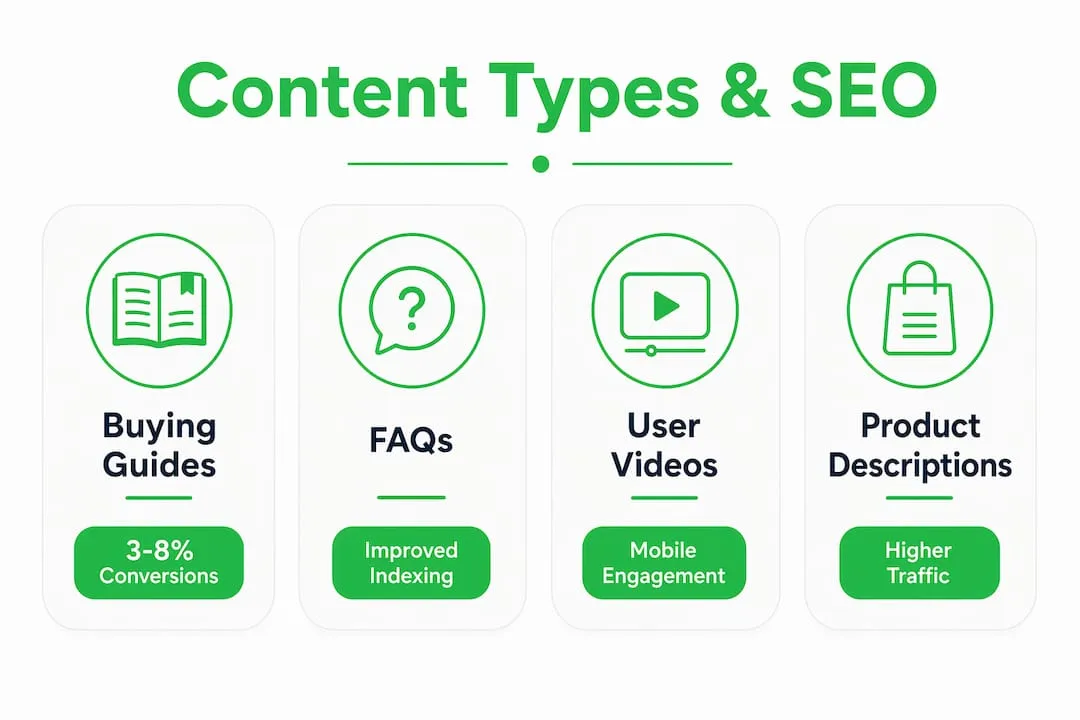
- Long-form blog posts and buying guides. These build trust and capture high-intent organic search traffic. Buying guides convert at 3–8% conversion rates, compared to 0.5–2% for purely informational posts.
- Live shopping and product demonstrations. Live formats create urgency and allow real-time objection handling. They work particularly well for fashion, beauty, and electronics categories.
- User-generated content (UGC) and reviews. Social proof reduces purchase anxiety at the decision stage. UGC also generates fresh, crawlable content that search engines reward.
- Interactive product experiences. Size guides, comparison tools, and product configurators reduce return rates by helping buyers self-qualify before purchase.
- FAQs and scenario-specific use case pages. These answer the precise questions buyers type into Google and AI search engines, capturing traffic that product pages alone cannot reach.
Each format targets a different device context too. Video dominates mobile, while detailed buying guides perform better on desktop where buyers research at length. Covering both contexts is not optional if you want to maximise reach.
Pro Tip: Pair one immediate-impact format (video or UGC) with one long-term format (buying guide or FAQ page) for every product category. The first drives traffic now; the second compounds returns over months.

How does content variety improve e-commerce SEO?
Diverse content is the single most reliable driver of organic e-commerce revenue. Top-performing e-commerce brands generate 30–50% of total revenue from organic channels, and that figure is built on original, varied content rather than copied product feeds.
Product descriptions that rank
Product descriptions of 400–800 words that include specifications, use cases, and comparison data increase organic traffic by 15–30%. That depth signals topical authority to Google and gives AI search engines the contextual data they need to surface your pages in synthesised answers. A bare 50-word description copied from a supplier simply cannot compete.
Content types that AI search engines prioritise
AI search engines synthesise answers using FAQs, scenario pages, buying guides, comparison pages, and rich product data. Brands that publish only product listings are invisible in AI-generated results. The table below shows how each content type contributes to organic visibility.
| Content Type | Primary SEO Benefit | Typical Conversion Rate |
|---|---|---|
| Buying guides | High-intent keyword capture | 3–8% |
| FAQ pages | AI answer engine visibility | 1–3% |
| Comparison pages | Mid-funnel decision support | 2–5% |
| Product descriptions (400–800 words) | Long-tail organic traffic | 1–4% |
| UGC and reviews | Fresh crawlable content | 2–4% |
Content also compounds over time in a way that paid advertising cannot. A buying guide published today can generate qualified traffic for two to three years without additional spend. That compounding effect is why diversifying your product pages on Shopify is a structural advantage, not a cosmetic one.
Pro Tip: Score every content opportunity by purchase intent before you create it. A “best wireless earbuds under £50” buying guide will outperform a “history of wireless audio” post every time, because the buyer is already in purchase mode.
What happens when you rely on too few content formats?
Relying on one or two content formats causes format fatigue, a measurable drop in engagement that occurs when audiences repeatedly encounter the same type of content from a brand. Repeated use of only one or two formats lowers engagement across all channels, not just the one you are overusing.
The second risk is channel blindness. Every content format has a native audience. Brands that publish only written blog posts miss the segment that discovers products through short-form video. Brands that rely only on social video miss the buyer who searches Google for a detailed comparison before spending £200. Neither segment is small.
| Narrow Content Mix | Varied Content Mix |
|---|---|
| High format fatigue | Sustained engagement across channels |
| Misses video-first audiences | Captures social, search, and email segments |
| Weak mid-funnel coverage | Guides buyers from awareness to purchase |
| Low AI search visibility | Surfaces in AI-generated answers |
| Single traffic source dependency | Multiple compounding traffic streams |
The funnel gap is the most damaging consequence. A store with only product pages and paid ads has no content to nurture a buyer who is not yet ready to purchase. Without buying guides, comparison pages, or use case content, that buyer leaves and finds a competitor who does answer their questions.
Repurposing content into diverse formats is the most efficient fix. A single product webinar becomes a blog post, a FAQ page, a short video clip, and an email sequence. One core asset, four formats, four audience segments reached.
How to build a content variety strategy for your store
A practical content variety strategy starts with scoring opportunities, not brainstorming topics. Use a simple matrix: revenue potential on one axis, purchase intent on the other. Content that scores high on both gets created first.
- Start with commercial-stage content. Buying guides, comparison pages, and “best of” roundups sit closest to the purchase decision. They convert at higher rates and generate revenue faster than purely informational posts.
- Map formats to funnel stages. Awareness content (short video, social posts) brings new visitors in. Consideration content (buying guides, comparison tables) moves them toward a decision. Decision content (detailed product descriptions, UGC, FAQs) closes the sale.
- Build topical pillars, not scattered posts. Content variety must be coherent with clear thematic pillars. Scattered, unrelated formats confuse both AI search engines and human readers, and can result in ranking penalties. Link every piece of content back to your core product expertise.
- Use design to signal variety. Perceived variety depends on grouping and structure, not just the number of formats you publish. Organising content into clearly labelled categories reduces decision fatigue and improves the customer’s impression of your store’s depth.
- Set a publishing cadence that covers multiple formats. A realistic weekly cadence might include one long-form guide, two short-form social videos, and one UGC feature. That mix covers SEO, social discovery, and social proof simultaneously without requiring a large team.
Crafting engaging product pages is the foundation of this strategy. Every other content format you create should link back to a product page that is detailed enough to convert the traffic you send to it.
Curated e-commerce stores with cohesive content strategies achieve conversion rates of 2.5–5%, compared to 0.5–1.2% for generic catalogues. That gap is the financial case for content variety in a single number.
Key takeaways
E-commerce stores that deploy five or more content formats consistently outperform single-format competitors on both organic traffic and conversion rate.
| Point | Details |
|---|---|
| Multi-format strategy drives conversions | Brands using diverse content see conversion rates rise by 35% on average. |
| AI search requires content depth | FAQs, buying guides, and comparison pages are required for AI search engine visibility. |
| Format fatigue is a real risk | Repeating one or two formats lowers engagement; repurposing one asset into multiple formats fixes this efficiently. |
| Coherence beats scatter | All content formats must link back to core topical pillars to avoid search engine penalties. |
| Commercial content converts fastest | Buying guides convert at 3–8%, making them the highest-priority content type for revenue. |
Content variety is the competitive moat most stores ignore
Most e-commerce owners I speak with treat content as a box to tick rather than a revenue channel to build. They publish a product description, run some paid ads, and wonder why their organic traffic is flat. The stores that genuinely grow in 2026 think about content the way a publisher does: every format serves a specific reader, at a specific moment, with a specific job to do.
The part that surprises people is how much AI has changed the rules. Two years ago, a decent product page and a few blog posts were enough to rank. Now, AI search engines like Perplexity and Google’s AI Overviews pull answers from FAQs, comparison pages, and use case content. If you do not have those formats, you are simply not in the conversation.
The mistake I see most often is what I call scattered variety: publishing a recipe blog, a lifestyle video, and a product tutorial with no thematic connection between them. That confuses both algorithms and customers. True content variety means creating multiple expressions of the same expertise. If you sell outdoor gear, your video, your buying guide, and your FAQ page should all reinforce the same authority signal.
My honest advice: treat your content mix like a multi-channel marketing strategy. Each format is a channel. Each channel reaches a segment the others miss. Build the mix deliberately, link everything back to your product pages, and measure revenue contribution, not just traffic.
— Koen
How Ecom-eye helps you scale content variety without the manual work
Producing five or six content formats at scale sounds like a full-time job. For most Shopify dropshippers, it has been. Ecom-eye changes that equation.
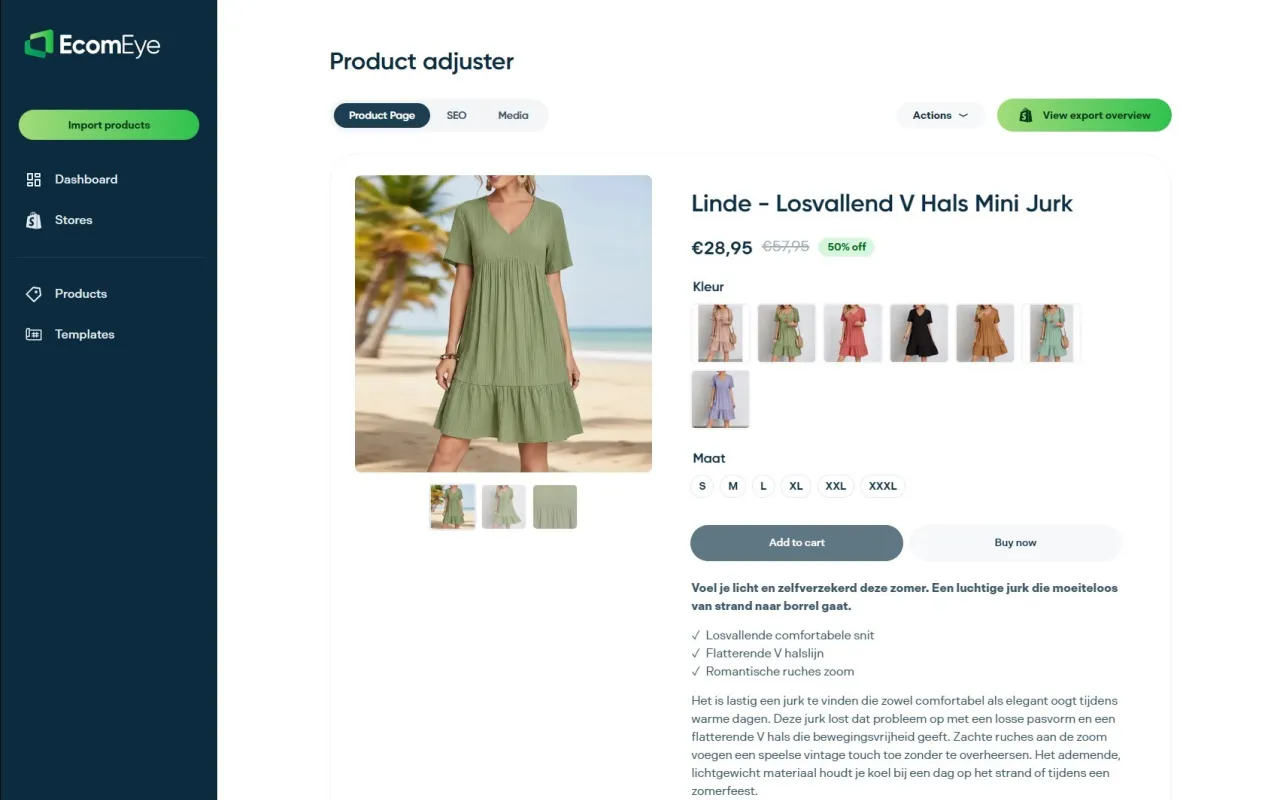
Ecom-eye’s Bulk AI Product Lister generates SEO-optimised product titles, detailed descriptions, and multi-language pages in bulk from AliExpress or competitor links. Every page it produces is original, copyright-safe, and built to rank. That means you get the product content depth that Google and AI search engines reward, without rewriting a single line manually. For store owners who want to add buying guides and FAQ content on top of strong product pages, Ecom-eye gives you the foundation to build from. No duplicate content. No Google Merchant disapprovals. Just product pages that work.
FAQ
What is content variety in e-commerce?
Content variety in e-commerce is the practice of using multiple content formats, such as video, buying guides, FAQs, UGC, and comparison pages, to engage buyers at different stages of the purchase journey. Each format serves a distinct audience segment and funnel stage.
How does content variety affect conversion rates?
Brands implementing multi-format content strategies see conversion rates increase by 35% on average. Curated stores with cohesive content strategies achieve conversion rates of 2.5–5%, compared to 0.5–1.2% for generic single-format catalogues.
Which content format converts best for e-commerce?
Buying guides convert at 3–8%, making them the highest-converting content type for e-commerce. Purely informational blog posts convert at 0.5–2%, so prioritising commercial-intent content delivers faster revenue returns.
How does content variety improve SEO rankings?
Diverse content gives search engines and AI answer engines more signals to index. Product descriptions of 400–800 words increase organic traffic by 15–30%, and FAQs, comparison pages, and use case content are required for visibility in AI-generated search results.
How many content formats should an e-commerce store use?
A minimum of five to six formats is recommended to cover awareness, consideration, and decision stages of the buyer journey. A practical weekly cadence combines long-form guides, short-form video, and UGC to cover SEO, social discovery, and social proof simultaneously.
Ready to boost your product pages?
Generate high-converting, SEO-optimized product pages in bulk using AI automation used by e-commerce experts.
No credit card required