What are product page trust signals? 2026 guide
Discover what product page trust signals are and how they boost your sales. Learn to enhance credibility and convert browsers into buyers!

What are product page trust signals? 2026 guide

TL;DR:
- Product page trust signals prove legitimacy, safety, and reliability to shoppers before purchase.
- Strategically placing three to six trust signals at moments of doubt increases conversions significantly.
Product page trust signals are specific visual and textual cues that prove a product page’s legitimacy, safety, and reliability to shoppers before they buy. They include verified customer reviews, SSL badges, recognised payment logos, transparent return policies, and clear contact details. Each one addresses a specific doubt a shopper might have at a specific moment in their buying journey. Get them right, and you convert browsers into buyers. Get them wrong, or ignore them entirely, and you lose sales to stores that simply look more credible than yours.

What are product page trust signals and why do they matter?
Product page trust signals are the conversion layer between a shopper’s interest and their purchase decision. They are not decoration. They are proof. 98% of consumers are more likely to purchase when they recognise trusted symbols on a page. That figure tells you trust signals are not a nice addition to your product pages. They are a prerequisite for selling online.
The importance of trust signals comes down to one psychological reality: online shoppers cannot touch, smell, or inspect a product before buying. They rely entirely on what your page tells them. If your page cannot answer the questions “Is this store real?”, “Will my payment be safe?”, and “What happens if this goes wrong?”, the shopper leaves. Trust signals answer those questions without the shopper having to ask.
The industry term for this broader discipline is conversion rate optimisation (CRO), and trust signals are one of its most direct levers. Ecom-eye’s own research into persuasive product page elements confirms that trust signals consistently rank among the top factors separating high-converting product pages from low-converting ones.
What are the most effective types of trust signals for product pages?
The best trust signals for products fall into five clear categories. Each one targets a different shopper doubt.
1. Social proof
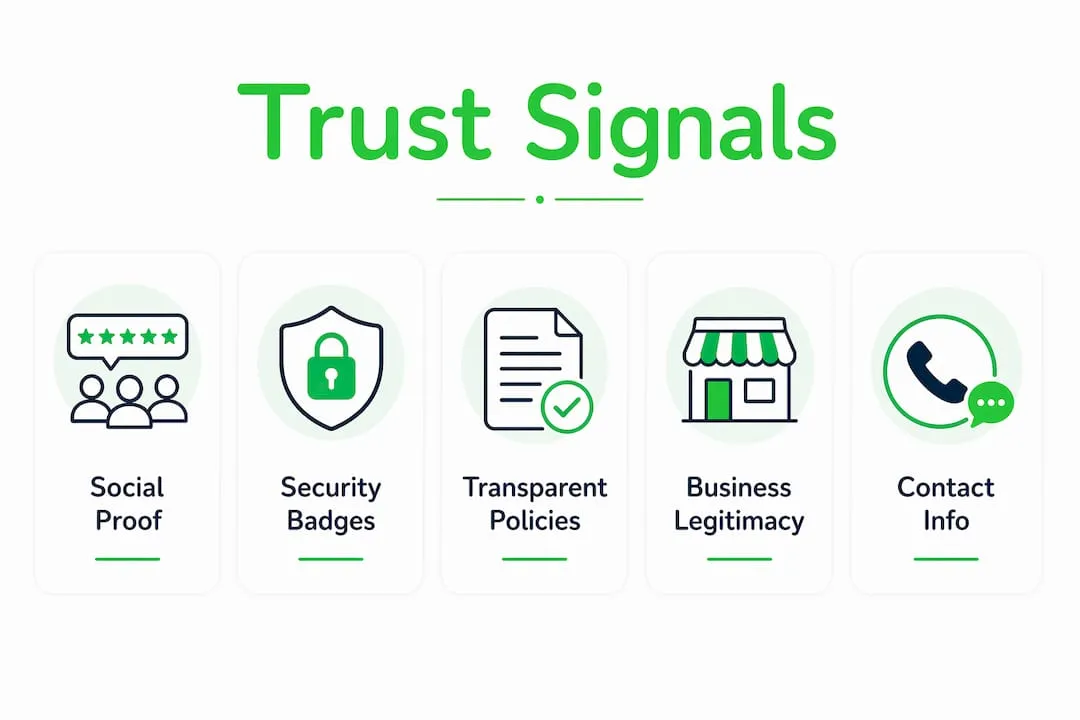
Verified customer reviews are the single most powerful trust signal available to you. 86% of online shoppers say social proof is the primary driver of their purchase decisions. Critically, 58% of users who engage with reviews go on to complete a purchase. Display star ratings prominently below the product title. Show review volume alongside the score. A product with 4.6 stars and 3,000 reviews is perceived as more trustworthy than one with a perfect 5 stars and only 12 reviews. Volume signals real-world validation in a way a perfect score never can.
2. Security and payment badges
SSL certificates, PCI compliance marks, and recognised payment logos such as Visa, Mastercard, PayPal, and Apple Pay reduce payment anxiety at the moment it peaks. Place these inside or directly adjacent to the payment form, not buried in a footer.
3. Transparent policies
Return policies, shipping timelines, and warranty terms must be visible on the product page itself, not hidden behind a link in the footer. Shoppers who can see “Free 30-day returns” next to the Add to Cart button face far less hesitation than those who have to hunt for that information.
4. Contact and business legitimacy signals
A real physical address, a phone number, and named team members tell shoppers there is a real business behind the page. Anonymous stores trigger suspicion. This is especially relevant for dropshippers, where page authenticity is a known conversion and compliance challenge.
5. Guarantees and risk reversals
Money-back guarantees placed near the price and CTA directly reduce the perceived risk of buying. “Not happy? Full refund within 60 days” placed next to the buy button removes the last barrier for hesitant shoppers.
- Avoid generic “Trusted Store” badges with no verifiable source behind them.
- Never display aspirational certifications your store has not actually earned.
- Third-party review platforms such as those covered in Ecom-eye’s Trustpilot alternatives guide add independent credibility that self-hosted reviews cannot match.
Pro Tip: Link your review count directly to a filtered reviews section lower on the page. Shoppers who click through to read reviews convert at a significantly higher rate than those who only see the summary score.
How does strategic placement of trust signals improve conversions?
Placement is where most stores fail. Placing trust signals next to relevant page elements generates conversion uplifts between 15% and 42%. Badges placed near payment fields alone drive a 15–30% lift. The principle is straightforward: place the signal at the exact moment the doubt arises, not before it and not after it.
Here is how to apply that principle across a product page:
- Below the product title: Display the star rating and review count immediately. This is the first moment a shopper assesses credibility, and the signal needs to be there instantly.
- Adjacent to the price: Place your money-back guarantee or free returns statement here. Price is the moment of maximum hesitation. Address it directly.
- Inside the Add to Cart section: Security badges and recognised payment logos belong here. The shopper is about to commit. Reinforce their decision at the point of action.
- Above the fold on mobile: Mobile shoppers scroll less and decide faster. If your trust signals are below the fold on a phone screen, many shoppers will never see them.
- Near the reviews section: A “Verified Purchase” tag next to each review reinforces authenticity at the moment the shopper is reading social proof.
The most counterintuitive finding in this area comes from A/B testing: reducing scattered badges from 11 to 6, strategically placed near CTAs, increased conversion rates by 62%. More badges do not mean more trust. Clutter signals desperation, not credibility.
Common mistakes include scattering badges randomly across the page, placing security logos only in the footer, and front-loading trust signals in the hero section where shoppers are not yet in a decision-making mindset. Visual cues such as subtle borders, lock icons, and green colour accents around payment areas further reinforce perceived security without adding noise.
Pro Tip: Run a simple A/B test: remove all trust badges from your current positions and rebuild with only your three strongest signals placed at the five moments listed above. Measure conversion rate over two weeks. The result will tell you more than any audit.
Why does authenticity matter more than volume of trust signals?
Authenticity is the defining factor separating trust signals that convert from those that are ignored. Verified purchase badges and publishing all relevant reviews, including negative ones, build buyer confidence in a way that curated five-star collections never will. Shoppers in 2026 are sophisticated. They recognise filtered review sets immediately, and they distrust them.
The Federal Trade Commission (FTC) guidelines require that review displays not suppress negative feedback. Beyond compliance, publishing a mix of reviews is commercially smart. A product with 4.3 stars and a handful of honest two-star reviews reads as genuine. A product with 847 five-star reviews and nothing below four reads as manipulated.
Key principles for authentic trust signals:
- Use “Verified Purchase” tags on every review where applicable.
- Display the review source clearly, whether that is your own platform, Google Reviews, or a third-party service. Third-party review platforms carry more weight than self-hosted reviews because shoppers know you cannot edit them.
- Publish the date of each review. Recent reviews signal an active, legitimate business.
- Avoid AI-generated review summaries presented as real customer feedback. Shoppers and search engines are both increasingly able to detect them.
Long-term brand trust is built through consistent transparency, not through the appearance of perfection. Every authentic signal you add compounds over time into a credibility asset that competitors who fake their signals cannot replicate.
How do trust signals affect SEO and AI search visibility?
Trust signals are a direct input into Google’s E-E-A-T framework, which stands for Experience, Expertise, Authority, and Trustworthiness. Product pages lacking transparent policies, verified reviews, and contact information receive lower trustworthiness scores from Google’s search quality raters. Lower scores mean lower rankings, which means fewer visitors before you even get the chance to convert them.
The connection between trust signals and E-E-A-T is not theoretical. Google’s search quality rater guidelines explicitly reference the presence of verifiable author information, customer reviews, and clear business contact details as indicators of page quality for transactional content. Dropshippers who copy product pages from competitors fail this assessment on multiple counts, as Ecom-eye’s guide on why dropshippers fail Google checks explains in detail.
“Trust signals directly influence AI search engines’ ability to cite sources, affecting visibility on generative search platforms like ChatGPT. Absence of verifiable author and review data reduces AI search snippet inclusion.” Source
This matters because generative AI platforms such as ChatGPT and Perplexity now surface product recommendations directly in search results. Pages with clear authorship, verified reviews, and transparent policies are far more likely to be cited. The E-E-A-T framework rewards sites that visibly demonstrate trustworthiness, and that reward now extends beyond Google’s own search results into the AI-powered discovery layer that sits above it.
Key takeaways
Product page trust signals are conversion tools, not decorative additions. Strategic placement at moments of shopper doubt outperforms volume of badges every time.
| Point | Details |
|---|---|
| Define trust signals clearly | They are specific visual and textual cues that prove legitimacy, safety, and reliability to shoppers. |
| Prioritise social proof | Verified reviews with high volume convert better than perfect scores with few reviews. |
| Place signals at doubt moments | Security badges near payment fields drive a 15–30% conversion lift when placed correctly. |
| Fewer signals, better placement | Reducing from 11 to 6 strategically placed badges increased conversions by 62% in testing. |
| Authenticity over perfection | Publishing negative reviews alongside positive ones builds more credibility than filtered five-star displays. |
Why most stores get trust signals completely wrong
I have reviewed hundreds of product pages for e-commerce clients, and the same mistake appears almost every time. Stores treat trust signals as a checklist. They add a row of badges to the footer, paste a “Secure Checkout” logo somewhere near the header, and consider the job done. The signals are there. They just are not working.
The problem is that trust signals placed away from the moment of doubt do almost nothing. A security badge in the footer does not help a shopper who is hesitating over the price. A money-back guarantee buried in the product description does not reassure someone who is about to click Add to Cart. The signal has to meet the doubt where it lives.
What I have found actually works is ruthless prioritisation. Pick your three strongest signals. Place each one at the specific page moment it addresses. Test it. The stores I have seen go from 1.8% to 3.4% conversion rates did not add more trust signals. They moved the ones they already had to the right places and removed the noise around them.
The other thing most stores overlook is that social proof through influencer content and user-generated content functions as a trust signal in its own right. A real customer photo in a review section outperforms a polished product image for conversion purposes. Authenticity is the currency of trust in 2026, and you cannot fake your way to it.
— Koen
How Ecom-eye helps you build trust-ready product pages at scale
Building trust signals into every product page manually is time-consuming. For dropshippers managing hundreds of SKUs, it is practically impossible without the right tooling.
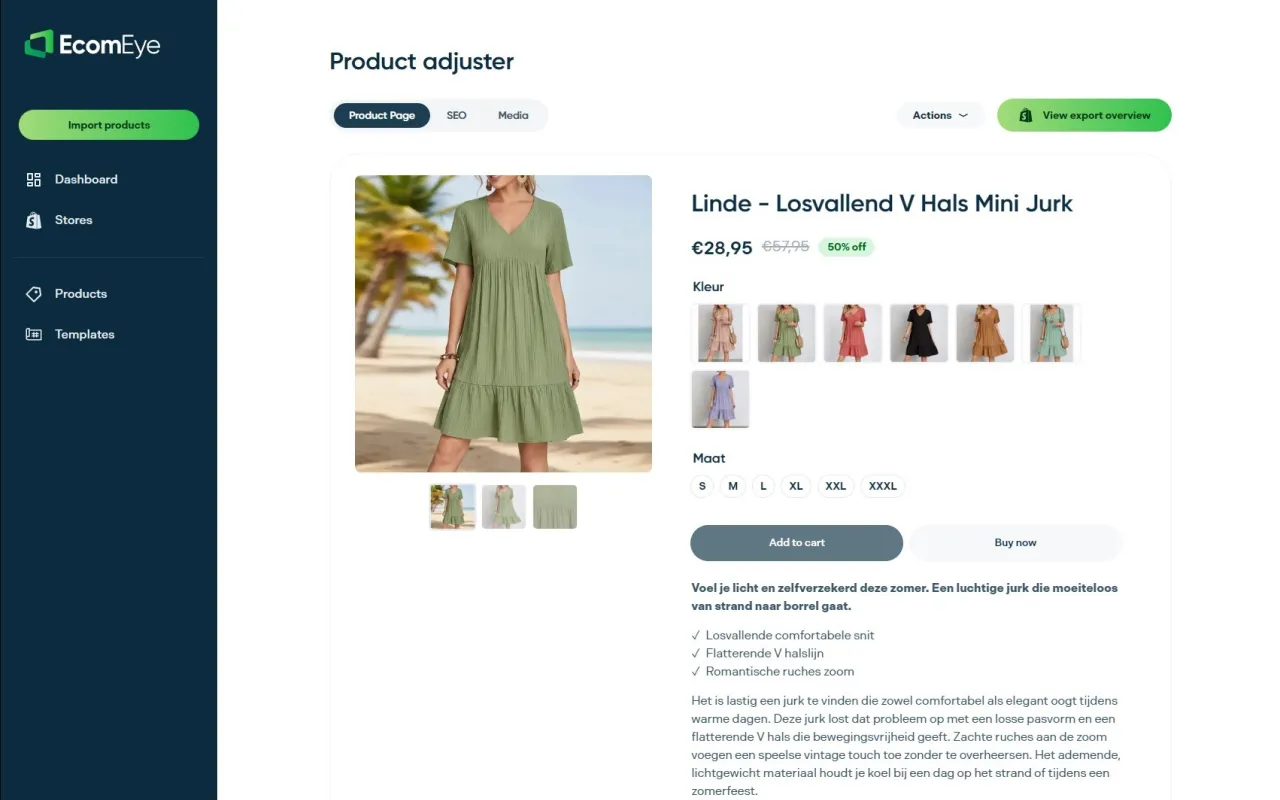
Ecom-eye’s bulk AI product lister generates SEO-ready product pages that include clean, original descriptions, structured content, and the transparency signals Google and shoppers both require. You import products from AliExpress or competitor links, and Ecom-eye automatically produces optimised titles, clear descriptions, and high-quality AI product images. Every page is copyright-safe and built to pass Google Merchant checks. No rewriting, no duplicate content risk, and no manual work per listing. For stores that need to build credibility fast and at scale, it is the most direct route from product import to conversion-ready page.
FAQ
What are trust signals on a product page?
Product page trust signals are visual and textual cues that prove a store’s legitimacy and safety to shoppers. They include verified reviews, security badges, payment logos, return policies, and contact information.
How do trust signals improve conversion rates?
Recognised trust symbols can boost conversion rates by 15–25% when placed at the moments where shoppers experience doubt, such as near the price, CTA, and payment fields.
What is the most effective trust signal for e-commerce?
Verified customer reviews are the strongest trust signal. Social proof drives purchase decisions for 86% of online shoppers, and review volume carries as much weight as the star rating itself.
How do trust signals affect Google rankings?
Trust signals feed directly into Google’s E-E-A-T framework. Product pages with verified reviews, transparent policies, and clear contact details score higher on trustworthiness assessments and rank accordingly.
How many trust signals should a product page have?
Fewer, well-placed signals outperform many scattered ones. A/B testing shows that reducing badges from 11 to 6, placed strategically near CTAs, increased conversions by 62%.
Ready to boost your product pages?
Generate high-converting, SEO-optimized product pages in bulk using AI automation used by e-commerce experts.
No credit card required