Why avoid copied product descriptions: the SEO cost
Learn why to avoid copied product descriptions to boost your SEO. Discover the costs of duplicate content and improve your Shopify rankings!

Why avoid copied product descriptions: the SEO cost

TL;DR:
- Copying product descriptions leads to SEO signal dilution, wasted crawl budget, and misindexed pages that hurt store visibility.
- Creating unique, original descriptions based on product features, use cases, and buyer questions improves rankings, trust, and brand authority.
Copied product descriptions are defined as duplicate content, the recognised SEO term for identical or near-identical text appearing across multiple URLs, and they are one of the most damaging mistakes a Shopify dropshipper can make. When you paste a supplier’s description straight onto your product page, search engines like Google and Bing face a choice: which version of that text deserves to rank? The answer is rarely yours. Rather than applying a formal penalty, search engines split ranking signals between every URL carrying the same copy, diluting the authority of each page. Understanding why avoid copied product descriptions matters is the first step to fixing the problem permanently.
Why copied product descriptions damage your SEO
The core SEO problem with duplicate descriptions is signal dilution. Every backlink, click, and engagement signal your product page earns gets divided across all URLs sharing the same text. No single page accumulates enough authority to rank competitively. The Microsoft Bing Webmaster team confirmed in december 2025 that duplicate content reduces ranking potential precisely because signals are divided rather than consolidated to one high-performing page.
Crawl budget is the second casualty. Google allocates a fixed number of page crawls to your site per day. On large ecommerce stores, up to 72% of crawl budget is wasted on duplicate URLs. That means new products you add to your catalogue may never get indexed, simply because Google spent its daily allowance re-crawling pages it has already seen.
The dangers of duplicate content extend to wrong-page indexing. Google does not always pick the URL you expect. It may prioritise unintended page versions such as print-friendly variants or filtered category pages, suppressing your main commercial product page entirely. When the wrong page ranks, your conversion rate suffers alongside your visibility.
Here is a summary of the specific SEO problems caused by copied descriptions:
- Signal dilution: Backlinks and engagement are split across duplicate URLs, weakening every page’s authority.
- Crawl budget waste: Google repeatedly crawls duplicate pages instead of discovering new products.
- Wrong-page indexing: Search engines may index a filtered or print variant instead of your main product page.
- AI search invisibility: AI answer engines synthesise answers from fewer sources, so duplicated content reduces your chances of being cited at all.
Pro Tip: Run a crawl audit using Screaming Frog or Sitebulb before you launch any new product range. Catching duplicate URLs early costs far less than fixing them after rankings have dropped.
Copied vs original descriptions: SEO and sales compared
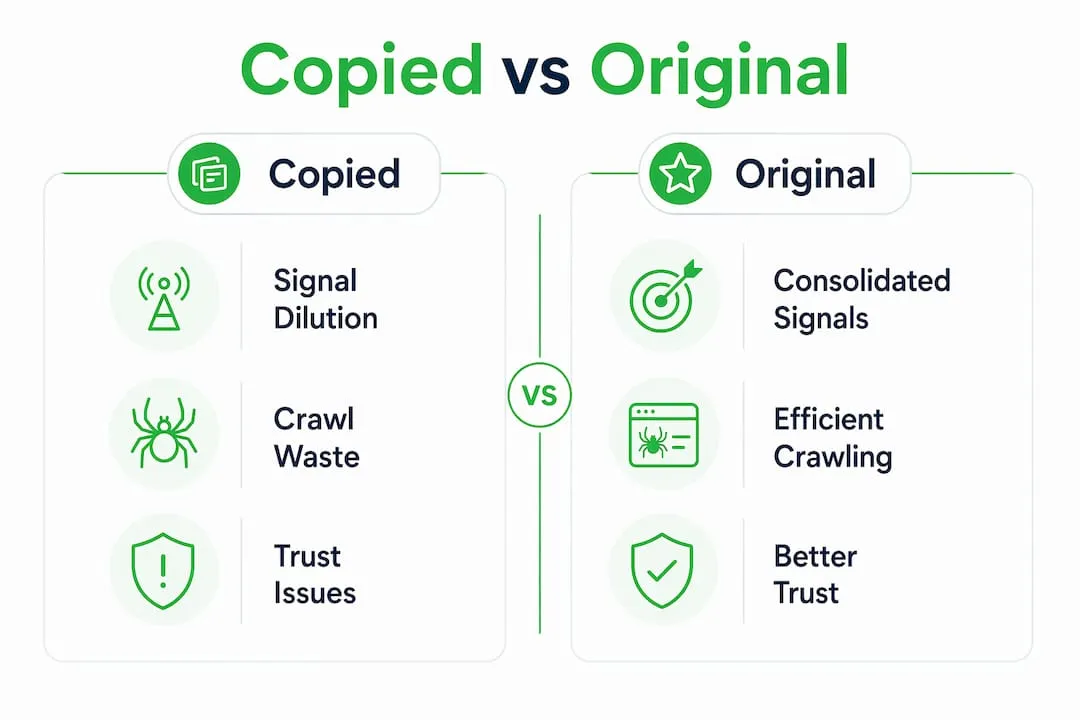
Original product descriptions outperform copied supplier text on every measurable dimension. Unique copy gives search engines a clear, unambiguous signal about which page to rank. It also gives shoppers a reason to trust your store over the dozens of other dropshippers selling the same item with identical text. The benefits of original product descriptions include stronger rankings, higher engagement, and a lower bounce rate because your page says something the others do not.
The most common trap is what SEO professionals call triplicate content. When ten resellers copy the same AliExpress supplier description, Google sees ten identical pages competing for the same query. None of them rank well. The supplier’s own page, or a dominant retailer who rewrote the copy, takes the top position instead. You have done the work of listing the product but handed the ranking to someone else.
Relying on supplier copy also creates a trust problem with shoppers. Generic, manufacturer-written text rarely addresses the questions real buyers have: will this fit a UK plug socket, how long does delivery take, what is the return policy? Original descriptions answer those questions and build the kind of credibility that converts browsers into buyers.
| Factor | Copied description | Original description |
|---|---|---|
| Ranking signal | Split across multiple URLs | Consolidated to your page |
| Crawl budget impact | Wastes budget on duplicates | Budget used on new content |
| Shopper trust | Generic, impersonal | Specific, store-branded |
| AI search visibility | Low, often cites competitors | Higher, unique content cited |
| Conversion potential | Weak, no differentiation | Stronger, answers buyer questions |
How search engines and AI handle duplicate product text
Google does not penalise duplicate content in the traditional sense. The issue arises only when the wrong version is indexed or ranking signals are split between competing URLs. That distinction matters because it changes how you fix the problem. You are not trying to avoid punishment; you are trying to give Google a clear, unambiguous signal about which page deserves to rank.
Canonical tags are the most commonly recommended fix, but they are widely misunderstood. A canonical tag is a hint, not a command. Google frequently overrides canonical tags and selects a different version of the page as the canonical. If Google Search Console reports “Duplicate, Google chose different canonical than user,” a canonical tag alone will not solve the problem. You need stronger signals: consistent internal linking to the preferred URL, and in many cases a 301 redirect. A practical guide to canonical tags explains when each approach is appropriate.
AI answer engines add a new dimension to this problem. Tools like Perplexity and Microsoft Copilot synthesise answers from a small number of sources. When your product descriptions are duplicated across your store or match supplier text on other sites, AI engines struggle to attribute the content to your brand and will often cite a competitor instead. In 2026, unique content is no longer just an SEO ranking factor. It is a prerequisite for brand visibility in AI-driven search results.
Pro Tip: Check Google Search Console’s “Pages” report under Indexing regularly. Filter by “Duplicate, Google chose different canonical than user” to find pages where your canonical tags are being ignored. These are your highest-priority fixes.
How to create unique product descriptions that rank
The most direct way to avoid the risks of copied content for ecommerce is to rewrite every product description before it goes live. That sounds obvious, but the method matters. Simply paraphrasing a supplier’s text produces thin content that still shares the same structure and ideas. Effective rewriting means starting from the product itself: its features, its use cases, and the specific questions your target buyer would ask.
Here is a practical process for creating original descriptions at scale:
- List the product’s three most important features in plain English, from the buyer’s perspective rather than the manufacturer’s.
- Add one use-case sentence that places the product in a real scenario your customer recognises.
- Address one common objection or question such as compatibility, sizing, or delivery time.
- Write a short closing sentence that reinforces your store’s value, whether that is fast shipping, a guarantee, or a returns policy.
- Check for duplication using a tool like Copyscape or Siteliner before publishing.
Beyond the description itself, supplementing manufacturer copy with buying guides, FAQs, and customer reviews adds layers of original content that competitors who copy-paste cannot replicate. A buying guide for a product category, for example, earns backlinks and builds topical authority in a way that a single product description never will.
URL governance is equally important. Uncontrolled URL generation from faceted navigation, session parameters, and tracking codes creates duplicate pages at scale without any new content being added. The long-term fix is fewer URLs and cleaner site architecture, not more canonical tags applied reactively. Use 301 redirects to consolidate pages that do not need separate public access. 301 redirects pass nearly all link equity and send a definitive consolidation signal that canonical tags cannot match.
Pro Tip: When importing products from AliExpress or a competitor link, treat the supplier description as a brief, not a final copy. Use it to understand the product, then write your own version from scratch. The extra ten minutes per product compounds into a significant ranking advantage over time.
Key takeaways
Original product descriptions are the single most effective way to consolidate ranking signals, protect crawl budget, and maintain visibility in both traditional and AI-driven search results.
| Point | Details |
|---|---|
| Duplicate content dilutes signals | Backlinks and engagement split across identical URLs, weakening every page’s authority. |
| Crawl budget is finite | Up to 72% of crawl budget on large ecommerce sites is wasted on duplicate URLs, blocking new product discovery. |
| Canonical tags are hints only | Google overrides them regularly; use 301 redirects and consistent internal linking for stronger consolidation signals. |
| AI search requires unique content | AI answer engines cite fewer sources, so duplicated text reduces brand visibility and hands citations to competitors. |
| Governance beats reactive fixes | Fewer URLs and clear content ownership prevent duplication at scale more effectively than tags applied after the fact. |
Content governance is the real competitive advantage
Most ecommerce operators treat duplicate content as a technical problem to patch. I have seen this pattern repeatedly: a store launches, copies supplier descriptions to save time, then scrambles to add canonical tags when rankings plateau. The tags help at the margins, but they do not address the root cause.
The stores that consistently outrank their competitors share one characteristic: they treat content as an asset that requires ownership, not a box to tick at launch. Duplicate content is a signal management problem, and signal management is a governance discipline. That means deciding, before you import a single product, what your description process will be, who is responsible for it, and how you will audit it over time.
The counterintuitive insight I keep coming back to is this: the impact of plagiarism on SEO is not a penalty you receive. It is an opportunity you forfeit. Every time you copy a description, you hand your ranking potential to whoever wrote the original. Original content does not just protect you from indexing problems. It actively accumulates authority that copied text never can. The SEO impact on ecommerce growth compounds over months and years, and the stores that invest in original content early are the ones that are hardest to displace later.
— Koen
How Ecom-eye solves the duplicate content problem for dropshippers
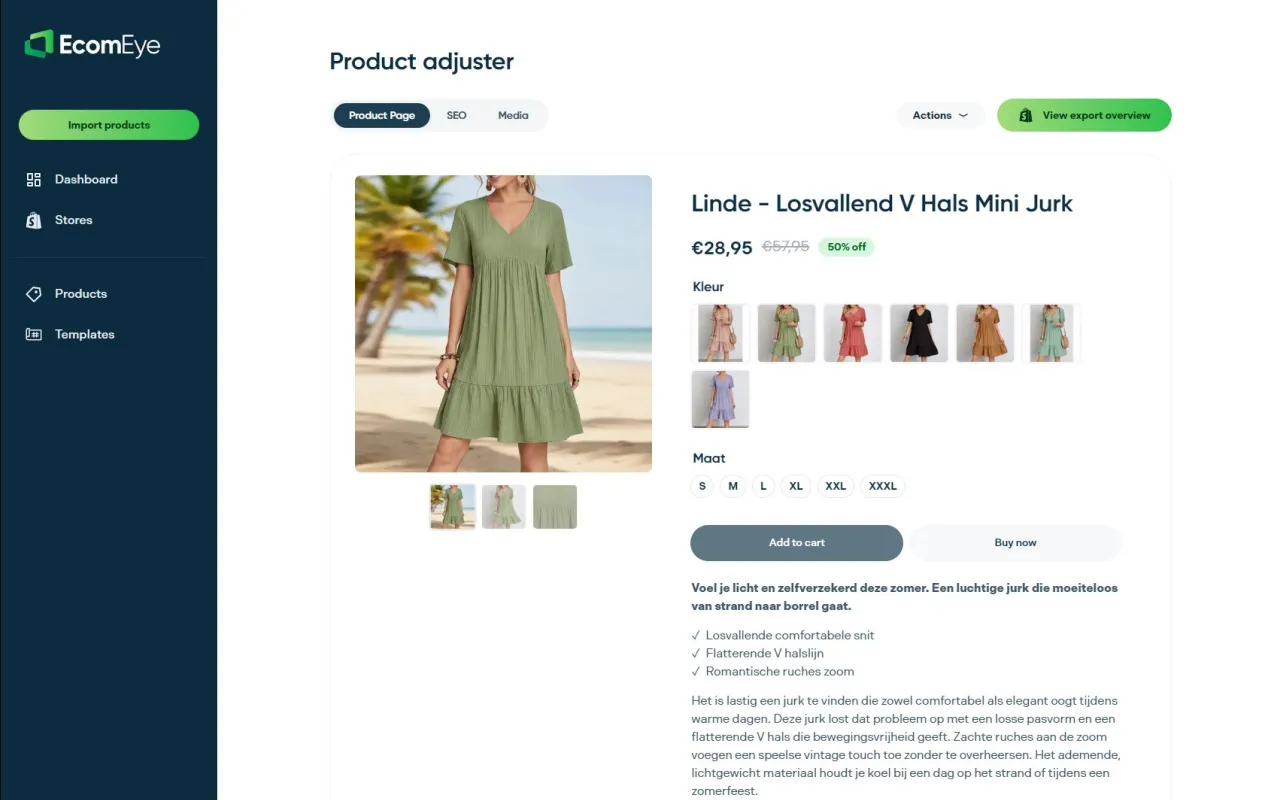
Ecom-eye is built specifically for Shopify dropshippers who need original, SEO-ready product pages without the manual rewriting. The platform imports products in bulk from AliExpress or competitor links and automatically generates unique titles, clean descriptions, and AI product images. Every page is copyright-safe and structured to consolidate ranking signals rather than split them. You can read more about avoiding duplicate product pages in Ecom-eye’s 2026 SEO guide, or go straight to the platform and start generating original product pages in minutes. No rewriting. No copyright risk. No manual work.
FAQ
Does Google penalise copied product descriptions?
Google does not apply a formal penalty for duplicate content. The real risk is that ranking signals are split between identical URLs, reducing the authority of every page involved.
What is the impact of duplicate descriptions on crawl budget?
Large ecommerce sites waste up to 72% of their crawl budget on duplicate URLs. This prevents Google from discovering and indexing new products, directly limiting your store’s growth.
Are canonical tags enough to fix duplicate product pages?
Canonical tags are hints, not commands, and Google overrides them regularly. For strong consolidation, pair canonical tags with consistent internal linking and 301 redirects where pages do not need separate public access.
How do AI search engines handle duplicate product descriptions?
AI answer engines like Perplexity and Microsoft Copilot synthesise answers from a small number of sources. Duplicated content reduces your brand’s chances of being cited and increases the likelihood that a competitor’s unique page is referenced instead.
What is the fastest way to create unique product descriptions at scale?
Import the supplier description as a brief, then rewrite it using the product’s features, a real use-case scenario, and one answer to a common buyer question. Tools like Ecom-eye automate this process for bulk product imports, generating original copy without manual rewriting.
Ready to boost your product pages?
Generate high-converting, SEO-optimized product pages in bulk using AI automation used by e-commerce experts.
No credit card required