Why avoid duplicate product pages: 2026 SEO guide
Discover why avoid duplicate product pages is crucial for SEO success. Learn how to enhance your e-commerce growth and boost conversions.

Why avoid duplicate product pages: 2026 SEO guide

TL;DR:
- Duplicate product pages divide search authority and lower rankings across your store. Implementing correct canonical tags and writing unique descriptions improves SEO and boosts conversions. Avoid copying supplier content and use automation tools to scale creating original, optimized product pages.
Duplicate product pages are defined as two or more URLs on your store that serve substantially identical or near-identical content to both users and search engines. Every dropshipper who copies product listings from AliExpress or a competitor creates this problem instantly. The result is split ranking signals, wasted crawl budget, and lower conversion rates across your entire catalogue. Understanding why avoid duplicate product pages is not optional for serious e-commerce growth. It is the difference between ranking on page one and being invisible.
Why duplicate product pages damage your store’s SEO
Duplicate content issues do not trigger a manual Google penalty in most cases. What they do cause is far more damaging over time. Search engines split authority across URLs rather than consolidating it on one strong page. Your best product page ends up competing against its own copies for the same ranking position.
The industry term for this problem is content duplication, and it covers everything from identical descriptions to near-identical pages that differ only by a colour variant or a filter parameter in the URL. Google’s crawlers encounter these pages, struggle to determine which one deserves to rank, and frequently choose neither. The practical outcome is that pages you have invested time building simply do not appear in search results.
Link equity dilution compounds the problem. When external sites link to your product, that authority is spread across every duplicate URL rather than concentrated on one. Canonical consolidation can boost rankings by up to 40% by directing all authority to a single preferred URL. That figure represents the real cost of ignoring duplication on a live store.
What causes duplicate product pages in e-commerce?
Duplicate pages arise from several predictable sources in e-commerce. Recognising them early saves significant remediation work later.
Common causes include:
- Product variation URLs. A red T-shirt and a blue T-shirt at different URLs with identical descriptions create two duplicate pages. If both are indexed, neither ranks well.
- Filter and faceted navigation. Category filters for size, price, or brand generate new URLs with the same product content. A single category page can spawn dozens of indexed duplicates this way.
- Manufacturer or supplier descriptions. Copying text directly from AliExpress or a supplier catalogue means your page shares content with hundreds of other stores. Google sees no reason to rank yours above theirs.
- HTTP and HTTPS versions. Stores accessible at both http:// and https:// are technically serving duplicate content unless a redirect or canonical tag resolves the conflict.
- www and non-www versions. The same page at www.yourstore.com and yourstore.com counts as two separate URLs without a canonical directive.
The distinction between a genuine product variation and a duplicate page matters here. Separate pages are only warranted when a variation carries distinct search demand and buyer intent. A “red running shoes” page and a “blue running shoes” page may both deserve to exist if shoppers search for each specifically. A page that differs only by a URL parameter does not.
Manufacturer descriptions are the most widespread cause for dropshippers. Thousands of Shopify stores import the same AliExpress listing text and publish it unchanged. Search engines recognise the duplication immediately and the importance of unique pages becomes apparent when none of those stores rank for the product.
How do duplicate pages affect rankings and conversions?
The SEO consequences of duplicate product pages are concrete and measurable. Search engines reduce indexing for pages they identify as duplicates, which means those pages stop appearing in search results entirely. The store loses organic traffic without any obvious error message or warning.
“Duplicate content usually leads to indexing reduction, spreading link equity thin rather than triggering manual penalties.” This distinction matters because many store owners wait for a penalty that never arrives, while their rankings quietly decline.
User experience suffers alongside SEO performance. Shoppers who land on a product page with a generic manufacturer description lack the specific information they need to make a purchase decision. 42–50% of online shoppers abandon purchases due to incomplete or generic product information. That is not a marginal conversion loss. It represents nearly half of your potential customers leaving without buying.
A further 20% of purchase abandonments are attributed specifically to insufficient product information on the page. When your description is copied from a supplier, it is written to describe a product generically, not to answer the specific questions your customer has before buying. The gap between what the page says and what the buyer needs to know drives them to a competitor.
Product pages are the highest-leverage conversion surface in any e-commerce store. Fixing copy and calls to action on a single strong page delivers more measurable return than bulk technical fixes spread across dozens of weak duplicates.
What are the best methods to handle duplicate product pages?
Resolving duplicate content issues requires a combination of technical SEO and content strategy. No single fix works for every situation.

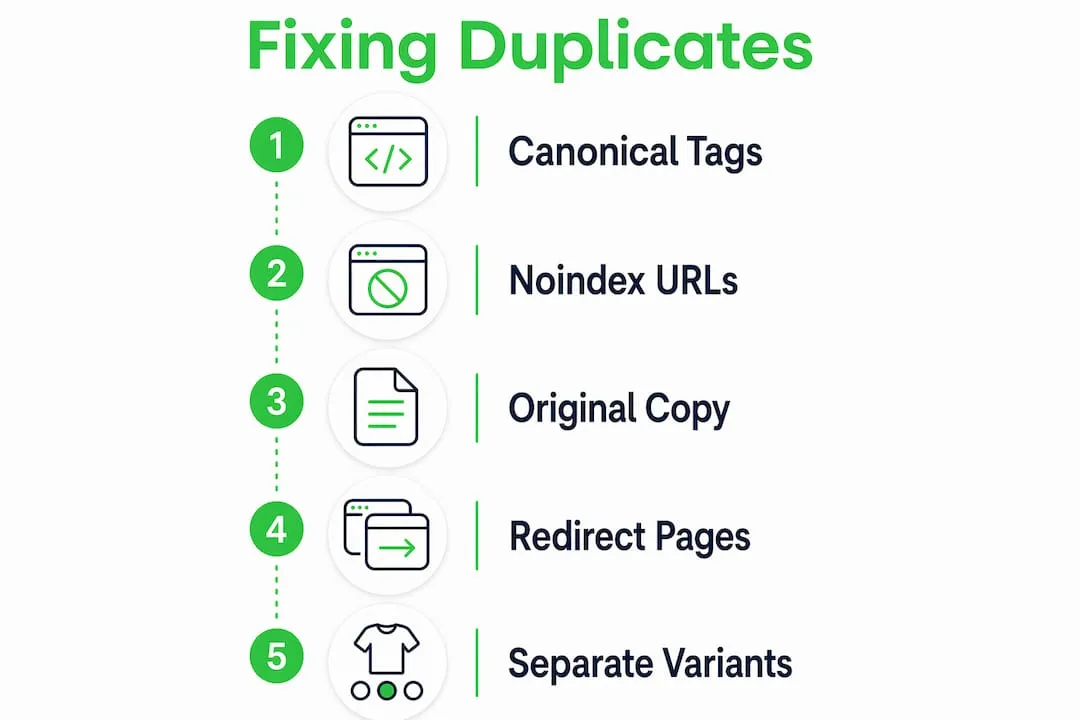
1. Implement canonical tags correctly. A canonical tag tells search engines which URL is the authoritative version of a page. Place a self-referencing canonical on every product page and point variant URLs back to the primary page. Avoid canonical loops, which occur when Page A canonicals to Page B and Page B canonicals back to Page A. Search crawlers ignore both pages when this happens. A strict, one-directional canonical structure is the correct approach.
2. Use noindex directives for filter and parameter URLs. Faceted navigation pages that add no unique content should carry a noindex meta tag. This prevents search engines from indexing them without removing them from your site’s functionality. Shopify stores using collection filters are particularly vulnerable to this issue.
3. Write original product descriptions. Unique, benefit-driven descriptions outperform manufacturer copy on conversions. Write for the buyer’s decision, not the product’s specification sheet. Describe what the product does for the customer, not just what it is. This single change addresses both the SEO duplication problem and the conversion rate problem simultaneously.
4. Redirect or merge low-value duplicate pages. Where two pages cover the same product with no meaningful content difference, a 301 redirect from the weaker URL to the stronger one consolidates authority. This is the correct approach for HTTP to HTTPS migrations and www to non-www conflicts.
5. Decide when to keep separate pages. Experts advise using a single canonical URL for variants that share the same search intent. Only create separate indexed pages for variations when keyword research confirms distinct search demand exists for each.
Pro Tip: Run a crawl of your Shopify store using Screaming Frog SEO Spider or Sitebulb before implementing any canonical changes. Export all duplicate title tags and meta descriptions first. This gives you a clear map of which pages need consolidation before you touch a single canonical tag.
How to optimise product pages and prevent duplication at scale
Product page optimisation for large catalogues requires a systematic approach. Manual rewriting of every description is not realistic for stores with hundreds or thousands of SKUs.
Content differentiation techniques
The table below compares the most common approaches to creating unique product content at scale.
| Approach | Best For | SEO Impact | Effort Level |
|---|---|---|---|
| Manual unique descriptions | Small catalogues (under 100 SKUs) | Highest | High |
| Dynamic variable injection | Large catalogues with structured data | High | Medium |
| AI-generated bulk descriptions | Dropshipping stores importing at volume | High | Low |
| Manufacturer copy (unchanged) | Not recommended | Negative | None |
Dynamic variable injection keeps descriptions unique across thousands of SKUs without requiring manual rewrites for each one. A template pulls in product-specific attributes such as material, dimensions, and use case to generate a distinct description for every item. This approach works well for stores with structured product data.
Structured data for product variations
Schema markup using Schema.org’s Product type allows you to signal product variations to search engines without creating separate indexed pages. Colour, size, and material variants can be expressed within a single page’s structured data. This satisfies search engine understanding of your product range while keeping your canonical structure clean.
Prioritising high-impact changes
Not all product pages deserve equal attention. Focus optimisation effort on pages that already receive some organic traffic but convert poorly. A page ranking on page two with a copied description is a far better candidate for rewriting than a page with zero impressions. Google’s Helpful Content system prefers pages that deliver specific decision-support content over lengthy generic essays. Short, specific, and buyer-focused descriptions consistently outperform long, vague ones.
The anatomy of a high-converting product page consistently includes original photography or AI-generated images, a benefit-led description above the fold, clear calls to action, and social proof. Duplicate pages almost never include all four elements because they are built for speed of import, not quality of experience.
Pro Tip: Audit your ten best-selling products first. Rewrite their descriptions, add original images, and measure the conversion rate change over 30 days. Use that data to justify the time investment before scaling the process across your full catalogue.
Key takeaways
Avoiding duplicate product pages is the single most impactful technical and content decision an e-commerce store can make for both search rankings and conversion rates.
| Point | Details |
|---|---|
| Duplication splits authority | Duplicate URLs divide link equity, weakening every page’s ability to rank. |
| Canonical tags prevent dilution | A correct canonical structure can recover up to 40% of lost ranking potential. |
| Generic descriptions lose sales | Up to 50% of shoppers abandon purchases when product information is insufficient. |
| Separate pages need search demand | Only create distinct pages for variants when keyword research confirms unique buyer intent. |
| Scale with automation | Dynamic injection or AI generation produces unique descriptions across large catalogues without manual effort. |
The uncomfortable truth about copied product pages
Most dropshippers know copying descriptions is bad practice. They do it anyway because rewriting hundreds of listings feels impossible. I understand that logic. The problem is that the maths does not work in your favour.
When you copy a supplier description, you are not just risking a ranking drop on that one page. You are telling Google that your entire store adds nothing new to the web. That signal compounds. Stores with high rates of duplicated content see their crawl budget reduced over time, meaning Google visits fewer of their pages per day. New products take longer to index. Ranking improvements from other work you do, such as building links or improving site speed, are partially offset by the duplication signal pulling in the opposite direction.
The stores I have seen recover most dramatically from duplicate content issues are the ones that treat description quality as a product decision, not an SEO task. They ask: “Would a customer who reads this description feel confident enough to buy?” If the answer is no, the description is not finished. That standard, applied consistently, produces pages that rank and convert.
The common product listing challenges that hold most Shopify stores back are not technical mysteries. They are content decisions that have been deferred. The stores that fix them first gain a compounding advantage that is very difficult for competitors to close.
— Koen
Stop duplicate pages killing your shopify rankings
If your store is built on imported AliExpress listings with unchanged descriptions, every page is a duplicate content risk. Rewriting them manually is not a realistic option at scale.
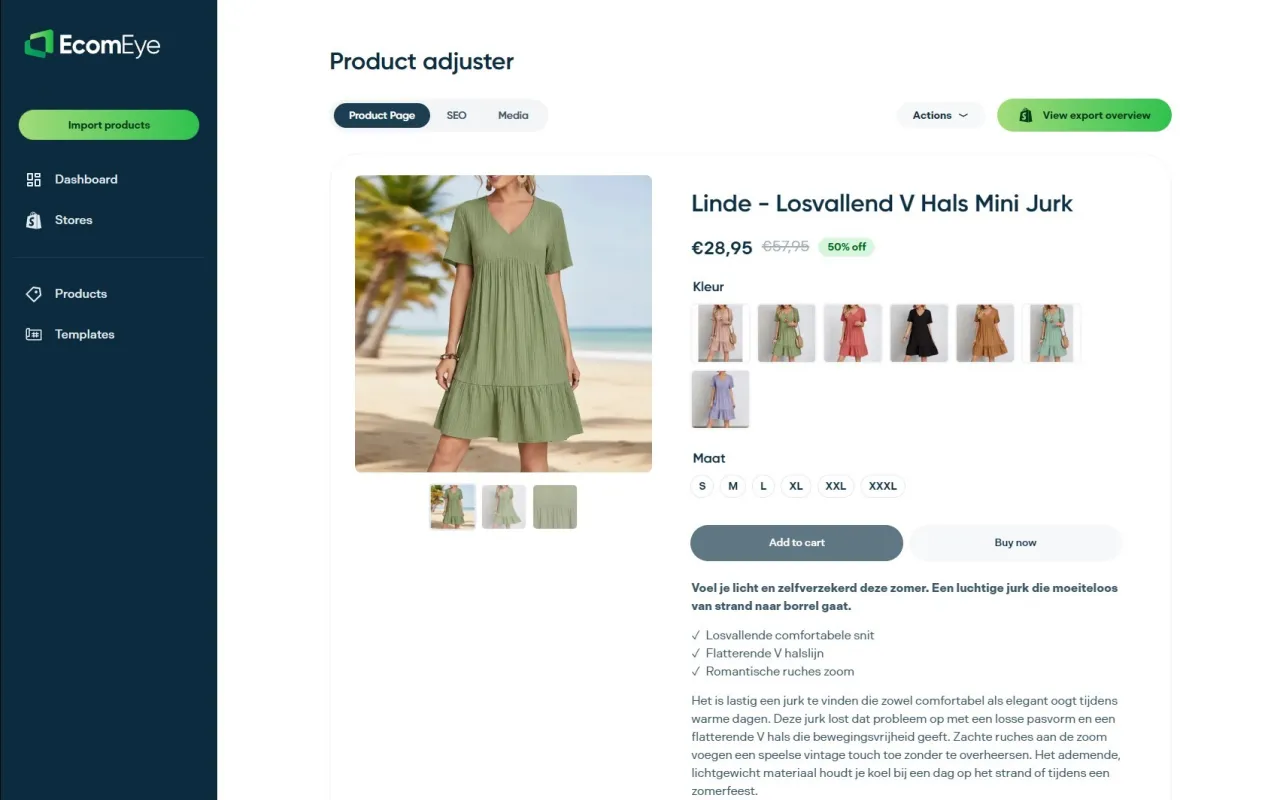
Ecom-eye solves this directly. The Bulk AI Product Lister imports products from AliExpress or competitor URLs and automatically generates original titles, clean descriptions, SEO-ready content, and AI product images. Every page is unique, copyright-safe, and ready to export to Shopify in one click. No rewriting. No manual work. No duplicate content risk. If you are serious about ranking and converting in 2026, Ecom-eye is the most direct route from imported listing to live, optimised product page.
FAQ
What are duplicate product pages in e-commerce?
Duplicate product pages are two or more URLs on a store that serve substantially identical content to search engines and users. They arise from product variants, filter parameters, copied supplier descriptions, and protocol conflicts such as HTTP versus HTTPS.
Do duplicate product pages cause a google penalty?
Duplicate content does not typically trigger a manual Google penalty. The real damage is indexing reduction and link equity dilution, which quietly lower your rankings without any formal warning.
How do canonical tags fix duplicate content issues?
A canonical tag signals to search engines which URL is the preferred version of a page. Correct canonical implementation consolidates link equity onto one URL and can improve rankings by up to 40% compared to leaving duplicates unresolved.
When should product variations have separate pages?
Product variations deserve separate indexed pages only when distinct search demand exists for each variant. If shoppers search specifically for “black leather wallet” and “brown leather wallet” as separate queries, separate pages are justified. Variants with no independent search volume should be managed on a single canonical page.
Why do unique product descriptions matter for conversions?
Original product copy outperforms manufacturer descriptions on conversion rates because it addresses buyer questions directly. Generic supplier text describes the product. A well-written unique description explains why the customer should buy it.
Ready to boost your product pages?
Generate high-converting, SEO-optimized product pages in bulk using AI automation used by e-commerce experts.
No credit card required