Top 3 copyecom.ai alternatives 2026
Explore 3 copyecom.ai alternatives to help you choose the best option for generating optimised product content and enhancing your SEO.

Top 3 copyecom.ai alternatives 2026

Creating ecommerce product content at scale while maintaining brand consistency and SEO quality is time-consuming and labour intensive. Many solutions require ongoing subscription costs, manual editing for consistency, or lack bulk automation for both images and descriptions. This comparison covers price, automation capacity, and integration support across three content generation platforms so you can select the best fit for your shop’s workflow and budget.
Table of contents
EcomEye
At a glance
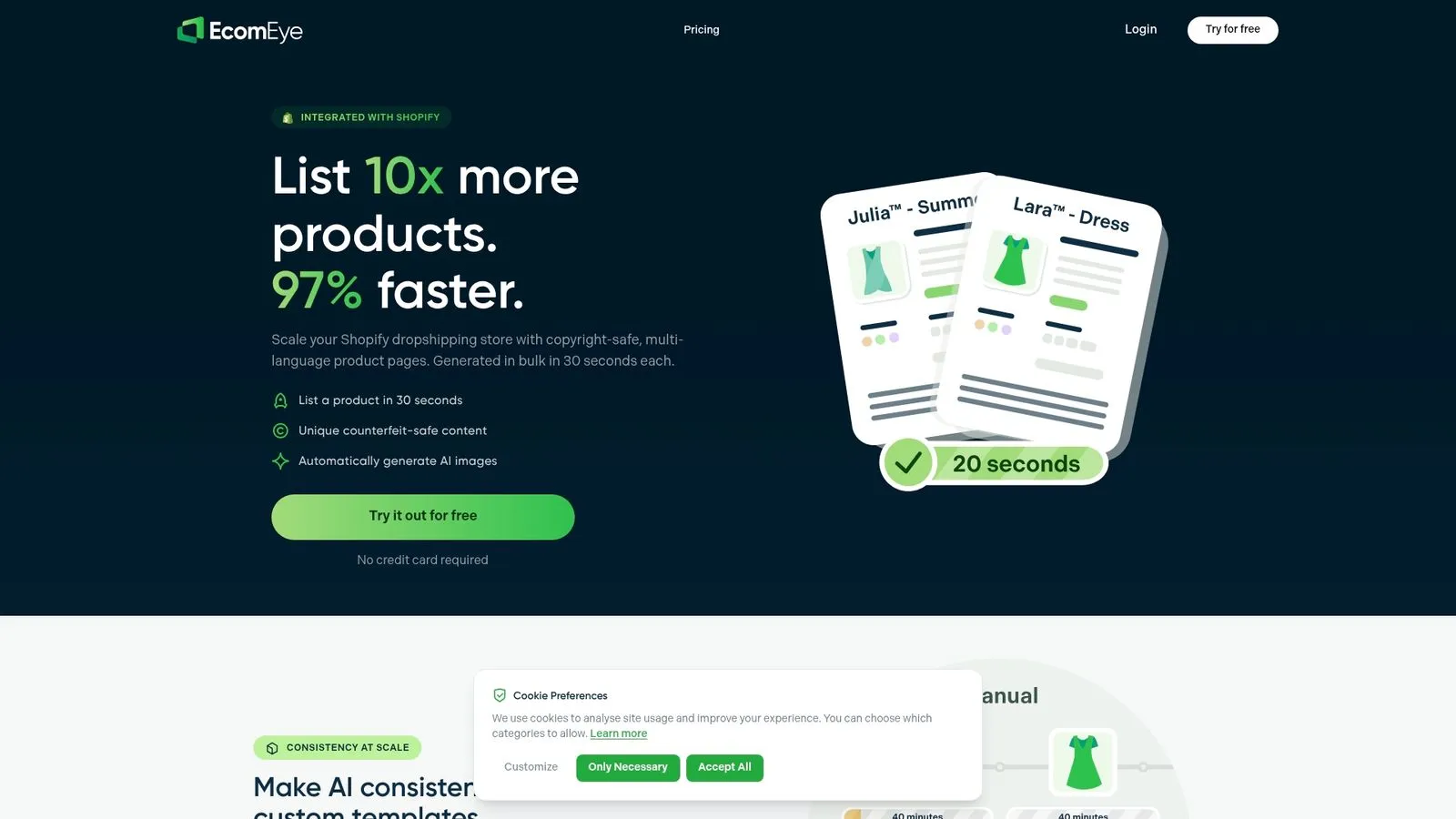
€324.00 buys 300 product pages and 900 images as a one time payment. That package targets stores that need a large batch of listings without ongoing subscription fees. EcomEye imports products in bulk, generates SEO ready copy and AI generated images, and exports the results to Shopify in one click.
Core features
- Bulk import from AliExpress or Shopify for fast mass listing and updates.
- AI generated product descriptions and images that are claimed to be copyright safe and unique.
- Custom templates to keep branding consistent across thousands of pages.
- SEO and Google Ads optimised product pages with multi language support and international sizing conversions.
- A content framework to generate optimised listings in bulk for different markets and languages.
Key differentiator
EcomEye focuses on bulk output of both product pages and studio quality images through AI. That combination reduces the manual work required to scale a dropshipping catalogue. The platform also emphasizes Google and shopping ads optimisation so listings are ready for paid and organic channels.
Pros
-
Saves listing time. Users replace batches of manual entries or a VA team with automated imports and template driven output.
-
Produces copyright safe assets. The vendor states images and copy are generated to avoid straightforward copyright reuse.
-
Low upfront cost for a large batch. The one time payment covers a substantial number of pages and images compared with per item pricing.
-
Supports international selling. Multi language content and sizing conversions reduce manual localisation work for new markets.
-
Scales bulk operations. The export to Shopify and batch update tools suit stores adding hundreds of SKUs.
Cons
- May require manual adjustments for highly niche or complex products where AI output lacks product specific nuance.
Notable integrations
- Shopify. EcomEye offers direct export to Shopify so pages and images push into a live store without CSV work.
Who it’s for
Shopify dropshipping entrepreneurs and e commerce managers who need fast bulk listing at low cost. It fits teams replacing virtual assistants for routine listing work. It also suits stores that plan to advertise product sets on Google or shopping channels.
Unique value proposition
A one time payment of €324 for 300 pages and 900 images gives a clear cost anchor for high volume launches. That price point can replace ongoing VA fees and reduce per item creation cost. For a store adding hundreds of listings at once the model turns listing labour into a single procurement decision.
Real world use case
According to the company, a store owner can generate thousands of product pages and images in days using EcomEye. A merchant imports AliExpress links, applies a branding template, and exports SEO ready pages to Shopify. The result is faster product launches and fewer manual edits for standard SKUs.
Pricing
The vendor lists a one time payment of €324.00 for 300 product pages and 900 images. Additional costs for extra images or translations may apply for higher volume needs. Consider those extras when planning a store that will upload thousands of SKUs.
Website: https://ecom-eye.com
Describely
At a glance
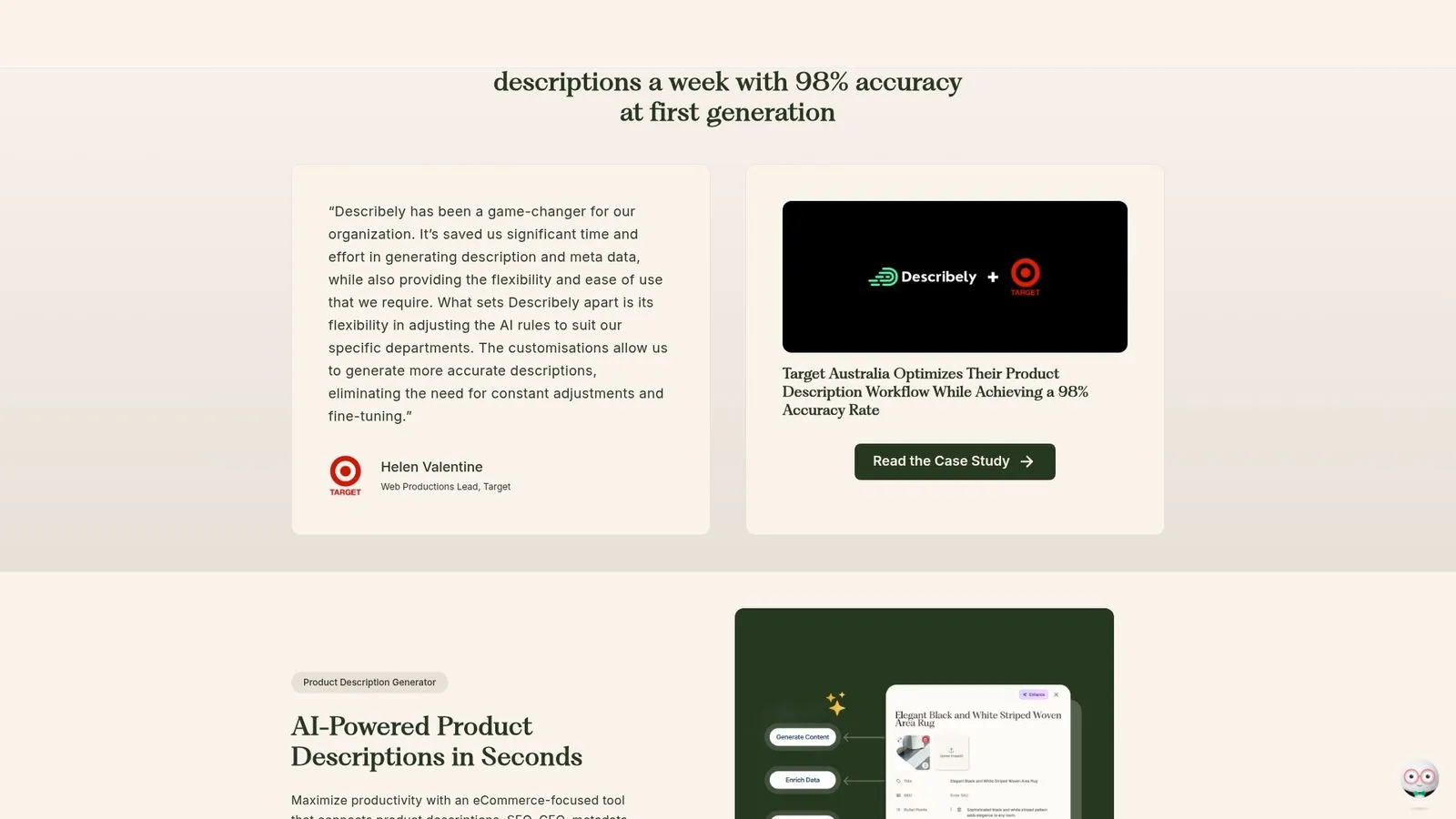
According to the vendor, Target Australia increased product description accuracy to 98% using Describely. That case study shows the platform can tighten catalog quality and cut manual editing for large inventories. The platform targets teams who need consistent, SEO-friendly product copy across thousands of SKUs.
Core features
Describely produces AI-generated product descriptions and supports bulk content generation for thousands of products. It enriches product data from external sources and applies custom content rules to keep brand voice consistent. The platform includes bulk image enhancement, an AI content audit to check for errors and compliance, and a ShopAssist chatbot for basic customer support.
Key differentiator
Describely focuses on configurable content rules that enforce brand voice across large catalogues. That lets you set strict templates and SEO patterns before generation. For stores with many suppliers or inconsistent source data, those rules reduce the need for manual rewrites and keep listings uniform.
Pros
-
Streamlines large-scale content work. Describely handles thousands of records in bulk, which reduces repetitive writing.
-
Keeps SEO in focus. The built-in SEO optimisation tools help produce descriptions that follow search patterns and AI discovery signals.
-
Easy storefront connections. The platform connects to common store systems so you can import and publish without manual CSV juggling.
-
Custom rules for brand voice. You can lock phrasing and tone to match your existing listings or client briefs.
-
Image enhancement in bulk. The image tools adjust product visuals at scale, helping listings look more professional.
Cons
-
Limited independent reviews. The vendor provides case studies, but there are few detailed third-party reviews to validate long-term reliability.
-
Output can vary. Large batches still require manual oversight to catch odd phrasing or factual errors.
-
Cost for very large catalogues. The pricing model may become expensive for stores with extremely high SKU counts.
When it may not fit
If you run a very small store with under a few dozen SKUs, the overhead of rules and bulk tooling may be unnecessary. If you require zero-touch legal or regulatory assurances for product claims, the platform still needs human review. Also, teams that need deep marketplace-specific optimisation may prefer a tool focused on a single channel.
Notable integrations
-
Shopify: Direct connection for import and publish.
-
WooCommerce: Sync product updates back to WordPress stores.
-
Wix and Squarespace: Import workflows for page-driven storefronts.
-
Akeneo and CSV/Excel imports: Useful for PIM integration or spreadsheet-driven catalogues.
Who it’s for
Describely suits ecommerce teams, digital marketing agencies, and retail brands that manage large product catalogues. It benefits stores that pull inconsistent supplier data and must apply one voice across many listings. Agencies handling multiple clients will value the rule templates and bulk workflows.
Real world use case
A national retailer used Describely to enrich sparse supplier data and reduce manual copy work across tens of thousands of SKUs. The vendor case study above shows faster turnaround and fewer editorial corrections. That approach works well when products share attributes and need consistent naming and SEO structure.
Pricing
The vendor advertises a pay-as-you-go model starting at $0.75 per product, with high volume and custom enterprise options available. Contact sales for volume discounts and enterprise licensing for very large catalogues.
Website: https://describely.ai
Hypotenuse AI

At a glance
According to the vendor, Hypotenuse AI is trusted by Fortune 500 ecommerce teams. The platform combines product copy generation, image automation, and catalogue enrichment under one roof. That mix aims to let large teams handle high volumes of SKUs without rebuilding workflows.
Core features
Hypotenuse AI focuses on bulk content and asset workflows for ecommerce catalogues. It offers a set of features that target catalogues and marketplace requirements.
- AI powered product description generation for titles, bullets, and long descriptions.
- Product data enrichment and standardisation to pull disparate attributes into a consistent catalogue.
- Product tagging and categorisation to speed listings and filters.
- Digital asset management with image editing tasks such as background removal and placement in lifestyle scenes.
- Bulk workflows, APIs, and enterprise management tools, plus security and compliance claims such as SOC 2 from the vendor.
Key differentiator
Hypotenuse AI aims to be a unified solution for content, imagery, and data enrichment that plugs into existing commerce systems. Its strength lies in combining image automation with text generation at catalogue scale. That makes it a narrower fit for teams that need both content and assets handled inside the same automation flow.
Pros
-
Reduces content time for large catalogues. Teams with thousands of SKUs will see fewer manual edits when templates and bulk runs are applied.
-
Intuitive interface for non technical staff. Merchandisers and catalogue managers can run jobs without developer support.
-
Produces diverse content types. The system covers descriptions, titles, ads, and localisation in one workflow.
-
Integrates with common ecommerce stacks. Native connectors sit alongside API options for custom pipelines.
-
Enterprise security and customisation. The vendor highlights features aimed at compliance and large team management.
Cons
-
The AI can need careful instruction for niche or highly technical product requirements. Complex briefs still require human editing.
-
Citation and reference handling is not automated. Users must add precise sourcing or verification manually when required.
-
Some customers report friction around cancellation terms and support responsiveness. That can matter for teams testing the service.
When it may not fit
Hypotenuse AI is not intended for very small catalogues or sole traders who need only a few pages. Organisations that lack internal resources to design custom workflows may face a learning curve. If you need a plug and play, single page generator for a handful of products, this will likely feel like overkill.
Notable integrations
Hypotenuse AI lists direct connections to common commerce systems and product information tools. The vendor documents these integrations as standard connectors.
- Shopify
- Salsify
- Salesforce Commerce Cloud
- NetSuite
- Akeneo
- Plytix
- API
- Wix
Who it’s for
The product suits large ecommerce teams, brands, and retailers that operate extensive catalogues and multiple channels. Teams that manage marketplaces or international listings will benefit from the localisation and bulk enrichment features. This is aimed at organisations with the process maturity to adopt catalogue automation.
Real world use case
The vendor describes a Fortune 500 fashion retailer using Hypotenuse AI to automate product descriptions and image enhancements. That example shows faster catalogue updates and improved marketplace visibility when many SKUs require regular refreshes. The case highlights gains in operational tempo rather than a single metric.
Pricing
Pricing details are not included in the provided data. The vendor directs prospective customers to the website for current plans and enterprise quotes. Expect pricing to scale with catalogue size and enterprise feature needs.
Website: https://hypotenuse.ai
Comparison of alternatives
When considering solutions for ecommerce product content generation, distinct capabilities define each tool’s suitability for particular needs.
Image and content automation capabilities
When focusing on producing large batches of product listings quickly and effectively, EcomEye distinguishes itself by combining bulk importing, generation, and exporting features in one-time pricing. Hypotenuse AI, alternatively, offers powerful options for creating diverse content types, such as descriptions and tags, within high-volume operations. It particularly benefits teams managing large multilingual or marketplace-centric catalogues while requiring dedicated workflows for nuanced products.
Customisation and brand voice enforcement
Maintaining a consistent brand image is critical, and Describely rises excellently to this challenge. Its template-based approach and rule system ensure that even vast product ensembles exhibit a unified style and tone. In contrast, EcomEye simplifies standardised output, which suits stores prioritising efficiency over bespoke adjustments.
Best fit
- For rapid and economical launches with high-content quantities, EcomEye delivers exceptional value.
- For organisations demanding meticulous brand voice consistency across mixed supplier data, Describely serves as a targeted solution.
- For enterprises requiring operational scalability across multiple ecommerce channels, Hypotenuse AI establishes itself as a powerful tool.
Our pick
EcomEye stands out with its unique ability to facilitate fast, cost-effective set-up of substantial catalogues, including high-quality product descriptions and images. This makes it ideally suited for teams launching new ventures or expanding existing product lines to broader regions. While suitable for jump-starting a store’s catalogue efficiently and economically, stores requiring more continuous or niche adaptations may find Describely better addresses their priorities.
To determine the most suitable platform for scalable ecommerce product content generation, review the following comparison of leading tools in the industry:
| Product | Primary Use Case | Key Differentiator | Pricing | Limitation |
|---|---|---|---|---|
| Ecom-eye | Bulk creation of SEO-enhanced product pages and images | Focus on automated bulk output with integrated AI tools | €324 one-time fee for 300 pages and 900 images | Adjustments needed for niche or complex product types |
| Describely | Configurable rules for brand-consistent product copy | Customised rules for content consistency | From $0.75 per product | Limited independent reviews and higher costs for large catalogues |
| Hypotenuse AI | Unified content, image creation, and data enrichment workflows | Combines text and image automation for catalogue scale | Not disclosed | Manual input required for niche or complex product data |
Discover why Ecom-eye stands out among Copyecom.ai alternatives
When seeking copyecom.ai alternatives, the greatest challenge lies in avoiding duplicate content and manual product listing effort that harm SEO and result in Google Merchant disapprovals. Ecom-eye directly addresses these issues by generating copyright-safe, SEO optimised product pages and AI-driven images in bulk. This approach saves considerable time compared to copy-pasting competitor listings or tedious rewriting.
Ecom-eye offers
- Bulk imports from AliExpress and competitor links
- Clean, optimised product descriptions ready for Google Ads
- Direct export to Shopify to eliminate manual uploads
Explore Ecom-eye to transform your dropshipping store today. Import hundreds of products in minutes and generate SEO-compliant pages that get approved and rank. Don’t let cumbersome listing processes hold you back. Visit Ecom-eye and start generating your SEO-ready pages with high-quality AI imagery in a single click.
FAQ
How does Ecom-eye assist with bulk product listing for shopify?
Ecom-eye enables users to import products in bulk from AliExpress or Shopify, simplifying the mass listing process. The platform exports product pages directly to Shopify with just one click, making it an efficient choice for fast-paced eCommerce businesses. Consider using Ecom-eye if you need to create many listings quickly without complex setups.
What is the difference between Ecom-eye and describely regarding SEO optimisation?
Describely provides advanced SEO optimisation tools that focus on ensuring product descriptions align with search patterns and AI discovery signals. In contrast, while Ecom-eye also includes SEO-optimised product pages, its main strength lies in generating bulk content and images efficiently. For businesses prioritising SEO consistency across many SKUs, Describely might be a better fit.
Can i use Ecom-eye for different languages and international selling?
Yes, Ecom-eye supports multi-language content and international sizing conversions, making it suitable for global markets. This feature reduces the manual localisation required when expanding into new regions. If you’re looking for an affordable way to manage diverse markets, Ecom-eye’s capabilities make it a strong option.
What types of product content can be generated with Ecom-eye?
Ecom-eye generates AI-driven product descriptions and images that are claimed to be copyright safe and unique. With this functionality, users can create a large volume of content for their online stores without the risk of copyright issues. If your business needs a quick way to generate compliant product content, Ecom-eye offers a robust solution.
How does ecom-eye’s pricing compare to using virtual assistants for product listings?
Ecom-eye has a one-time payment of €324.00 for generating 300 product pages and 900 images, which can be more cost-effective than hiring virtual assistants for ongoing listing tasks. This pricing structure can significantly lower your overall listing costs while providing the capability for bulk operations. If you’re planning a comprehensive product launch, Ecom-eye’s pricing model makes it a worthwhile investment.
Ready to boost your product pages?
Generate high-converting, SEO-optimized product pages in bulk using AI automation used by e-commerce experts.
No credit card required