Why linguistic adaptation in ecommerce drives sales
Discover why linguistic adaptation in ecommerce boosts sales. Tailor your messaging to connect with customers and enhance trust. Learn more!

Why linguistic adaptation in ecommerce drives sales

TL;DR:
- Linguistic adaptation in ecommerce involves tailoring language and cultural messaging for specific markets, not just translating words. It significantly boosts conversion rates by enhancing trust and cultural alignment, especially in checkout flows. Successful scaling requires tiered localisation, ongoing cultural knowledge, and strategic use of AI with human oversight.
Linguistic adaptation in ecommerce is defined as the process of tailoring language, tone, and cultural messaging to match the expectations of a specific local market, not merely converting words from one language to another. 76% of online shoppers favour product information in their native language. That single figure explains why so many international stores underperform despite offering competitive prices and fast shipping. The businesses winning in global markets understand that language is not a technical checkbox. It is the primary signal of trust between a brand and its customer.
Why linguistic adaptation in ecommerce affects conversion rates
The most direct evidence for the importance of linguistic adaptation comes from checkout behaviour. A case study by Translated Right found that localising checkout flows produced a 40% lift in conversions. The localisation covered language tone, formality levels, and regional process adjustments, not just translated button labels. That distinction matters enormously.
“Correct translation may not be right for your customers. Familiarity and trust come through alignment with cultural expectations, not literal accuracy.”
Customers abandon carts when something feels off. A payment page that uses formal German phrasing for a casual Dutch audience, or American idioms on a French checkout, creates friction that no discount code can fix. The language must feel native, not imported.
Research published in academic journals confirms that linguistic and sociocultural factors account for nearly 29% of variance in international business performance. That is not a marginal effect. It means that nearly a third of the gap between a thriving international store and a struggling one can be traced directly to how well the language fits the market.
Trust is built through small signals. When a German customer sees “Mwst.” instead of “VAT” on a receipt, or a Japanese shopper reads a product description that uses appropriate levels of politeness, they feel recognised. That recognition converts. Brands that treat tone and terminology as core elements of localisation consistently outperform those that treat them as optional refinements.
How does linguistic adaptation differ from standard translation?
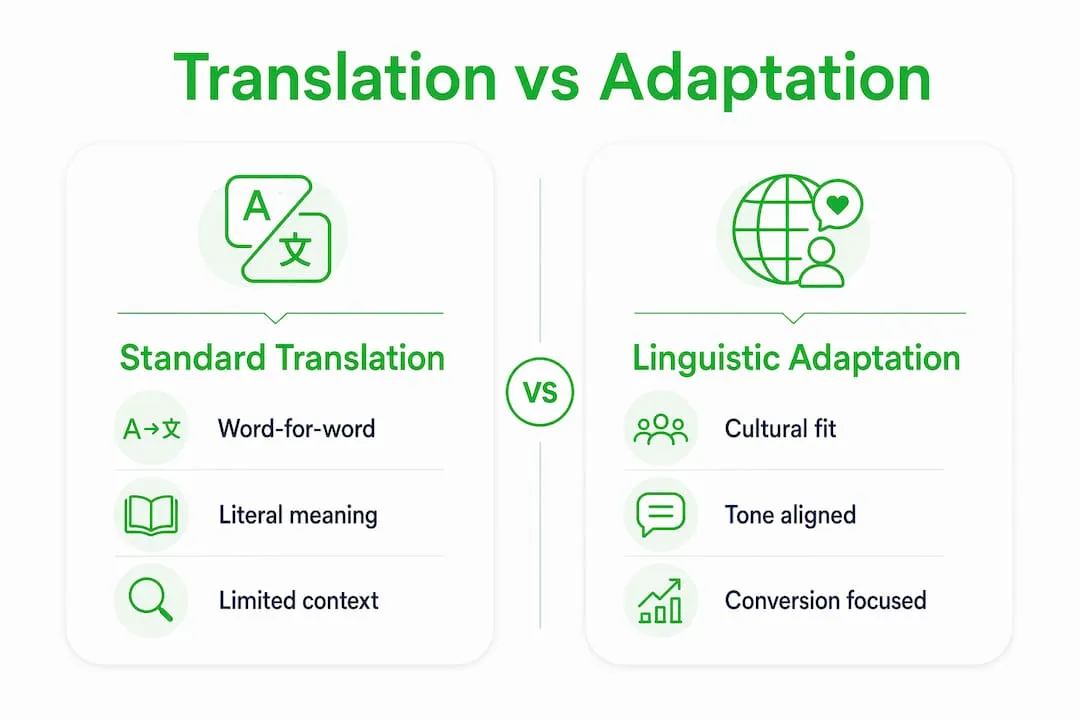
Standard translation converts text accurately. Linguistic adaptation makes that text work. The difference is significant for any ecommerce business expanding internationally.

A literal translation of “Buy now, pay later” into Mandarin may be grammatically correct but culturally unconvincing. In markets where instalment payment carries different social connotations, the phrasing needs to reflect local attitudes toward credit, not just the dictionary definition. Poor literal translations cause confusion, mistrust, and lost sales due to cultural misalignment.
| Feature | Standard Translation | Linguistic Adaptation |
|---|---|---|
| Approach | Word-for-word conversion | Cultural and tonal alignment |
| Scope | Text only | Text, tone, UX copy, and process |
| Trust impact | Neutral to negative | Positive and trust-building |
| Brand voice | Often lost | Preserved with local credibility |
| Conversion effect | Minimal improvement | Measurable uplift |
The concept of cultural stretch describes how far a brand can adapt its voice before it loses coherence. A luxury brand entering the Japanese market may need to adopt more formal, deferential language. But if it goes too far, it no longer sounds like itself. The goal is to find the local register that feels natural to the customer while still reflecting the brand’s core identity.
Tiered localisation is the practical answer to this challenge. High-visibility pages such as homepages, product pages, and checkout flows receive full human linguistic review. Lower-priority content such as FAQs and policy pages can be handled through machine translation with expert post-editing. This approach, sometimes called Machine Translation with Automated Post-Editing, allows scalable multilingual content without sacrificing quality on the pages that matter most.
Pro Tip: Map your content by conversion impact before assigning localisation resources. Product pages and checkout flows deserve full human review. Category descriptions and policy pages can use machine translation with a lighter editorial pass.
What linguistic strategies in ecommerce actually work?
Effective linguistic strategies in ecommerce go well beyond swapping currencies and translating product titles. The following workflow reflects what actually moves the needle for international stores.
- Audit your highest-traffic pages first. Identify which pages drive the most revenue and start localisation there. A homepage in French with an English checkout is worse than no localisation at all.
- Localise call-to-action phrasing by market. “Add to basket” works in the UK. “In den Warenkorb” is the German equivalent, but the tone and urgency of surrounding copy must match local shopping norms.
- Adapt measurement units, sizing, and payment terms. Shoe sizes, clothing measurements, and instalment payment labels vary significantly across markets. Mismatched units are a silent conversion killer.
- Adjust formality levels per language. Spanish in Spain uses “usted” for formal address; Latin American Spanish often defaults to “tú.” Getting this wrong signals that you do not know your customer.
- Localise error messages and support copy. These are the moments when customers are most frustrated. A warm, culturally appropriate error message retains customers. A cold, machine-translated one loses them.
- Review idioms and promotional phrases. “Unbeatable deals” translates poorly into several Asian languages. Work with native speakers to find equivalent phrases that carry the same persuasive weight.
- Test localised copy with real users. A/B testing localised versus non-localised checkout copy in a target market gives you data, not assumptions.
The role of cultural familiarity in driving trust and sales is well documented in ecommerce marketing. Customers who feel understood buy more and return more often. That is the commercial case for investing in proper linguistic strategies rather than relying on automated translation alone.
Pro Tip: Build a linguistic brief for each target market before running any automated translation. Define the tone, forbidden phrases, preferred terminology, and formality level. This brief becomes the quality control layer that keeps AI-generated translations on-brand.
What are the biggest challenges in linguistic adaptation?
Linguistic adaptation is not a one-time project. It is an ongoing process with genuine complexity, and several pitfalls catch even experienced ecommerce teams off guard.
- Language variety within a single market. Brazilian Portuguese and European Portuguese share a language but differ significantly in vocabulary, formality, and idiom. A single translation serves neither audience well.
- Excessive standardisation flattens brand voice. Research on communication in diverse environments shows that message naturalness matters more than strict adherence to grammar rules. Overly standardised language sounds robotic and fails to persuade.
- AI tools without linguistic briefs produce neutral, unconvincing copy. Automated translation defaults to the most common phrasing, which is rarely the most persuasive. Human oversight remains critical to avoid bland, unpersuasive output.
- Cultural distance affects adaptation depth. Adapting from English to Dutch requires less cultural recalibration than adapting from English to Japanese. The greater the linguistic distance, the more intensive the adaptation process needs to be.
- Brand voice preservation across markets. A brand that sounds confident and direct in English may need to soften considerably for a Korean audience without losing its authority. Finding that balance requires market-specific expertise, not just translation skills.
The most common failure mode is treating linguistic adaptation as a cost to minimise rather than an investment to calibrate. Stores that cut corners on localisation quality for high-traffic markets consistently report higher cart abandonment and lower repeat purchase rates. The ecommerce localisation guide from Ecom-eye covers the foundational practices that prevent these errors before they compound.
Key takeaways
Linguistic adaptation in ecommerce is the single most underinvested lever for improving international conversion rates, customer trust, and long-term retention across diverse markets.
| Point | Details |
|---|---|
| Adaptation beats translation | Cultural and tonal alignment drives conversions; word-for-word accuracy alone does not. |
| Checkout localisation is highest priority | A 40% conversion lift is achievable by localising tone, formality, and process in checkout flows. |
| Sociocultural factors are measurable | Nearly 29% of international business performance variance is attributable to linguistic and cultural fit. |
| Tiered localisation scales efficiently | Use full human review for high-visibility pages and machine translation with post-editing for lower-priority content. |
| AI needs human briefs | Automated translation without expert linguistic guidelines produces neutral copy that fails to persuade. |
The part most ecommerce teams get wrong
I have reviewed dozens of international ecommerce setups over the years, and the pattern is almost always the same. The team invests in translation. They do not invest in adaptation. The product pages are technically correct in French or German or Japanese. But they read like they were written by someone who has never visited the country, let alone shopped there.
The uncomfortable truth is that linguistic adaptation requires cultural knowledge, not just language skills. A translator who speaks fluent Spanish but has never lived in Mexico will miss the register shifts, the colloquial payment terms, the specific way trust is signalled in product descriptions. That gap is invisible until it shows up in your conversion data.
What I advocate for is building a local feedback loop into your localisation process. This means recruiting native-speaking customers or micro-influencers in each target market to review copy before it goes live. It costs less than a single month of underperforming ad spend, and the insight it generates is irreplaceable. The global ecommerce language guide from Ecom-eye is a good starting point for understanding the structural decisions that underpin this kind of approach.
The brands that get this right treat linguistic adaptation as a product decision, not a marketing afterthought. They assign it the same rigour they give to pricing strategy or logistics planning. That mindset shift is what separates stores that scale internationally from those that plateau.
— Koen
Scale your international store with Ecom-eye
If you are running a Shopify dropshipping store and expanding into new markets, the volume of content that needs localising can feel unmanageable. Ecom-eye is built for exactly this problem.
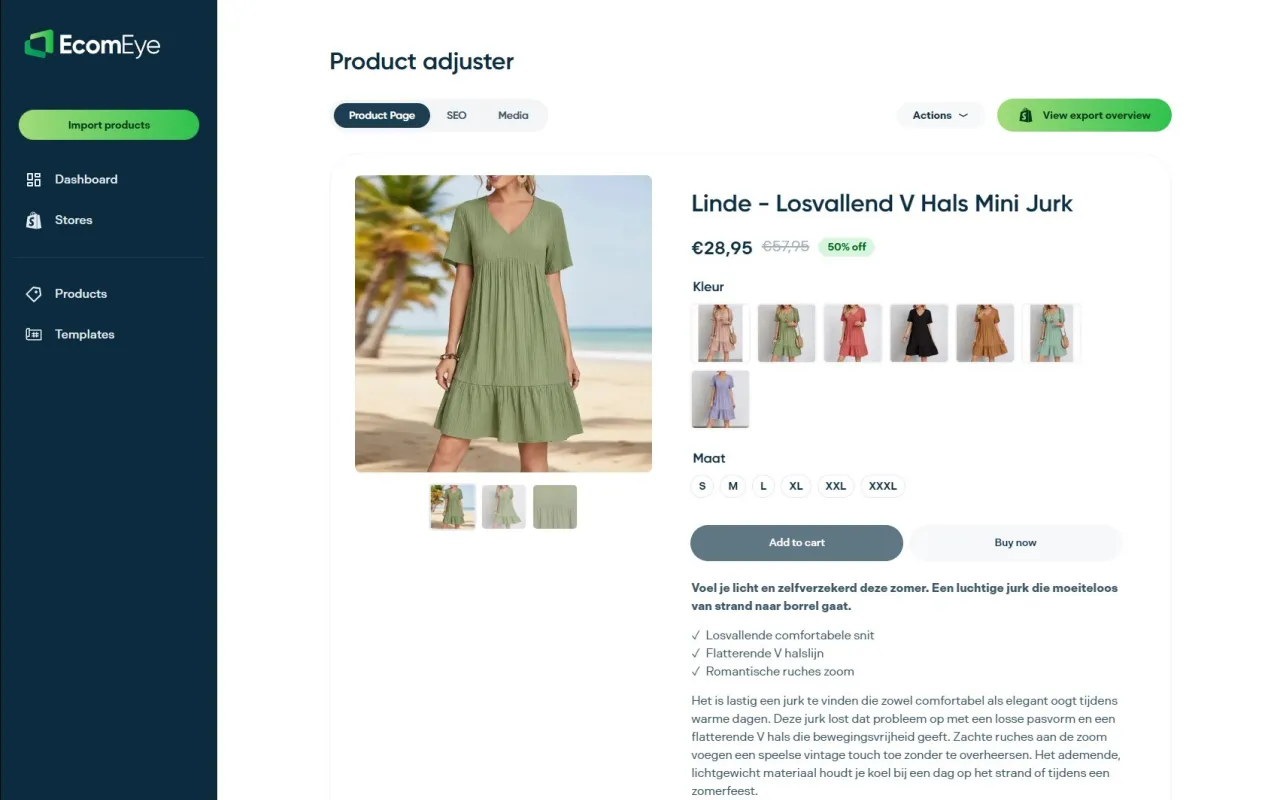
Ecom-eye generates multilingual product pages in bulk using AI, covering optimised titles, clean descriptions, and SEO-ready content across multiple languages. You import products from AliExpress or competitor links, and Ecom-eye produces localised, copyright-safe pages ready to export directly to Shopify in one click. No rewriting, no manual work, and no duplicate content risk. For ecommerce professionals who understand why linguistic adaptation matters and need to act on it at scale, Ecom-eye removes the bottleneck between insight and execution.
FAQ
What is linguistic adaptation in ecommerce?
Linguistic adaptation in ecommerce is the process of tailoring language, tone, and cultural messaging to fit a specific local market. It goes beyond translation to include formality levels, idioms, payment terminology, and cultural expectations.
How does language affect ecommerce conversion rates?
Localising checkout flows with culturally appropriate language and tone can lift conversions by 40%, according to a Translated Right case study. Language that feels native to the customer reduces friction and builds trust at the point of purchase.
Is machine translation enough for ecommerce localisation?
Machine translation alone is not sufficient for high-visibility pages. Automated translation requires expert linguistic briefs and human post-editing to avoid neutral, unconvincing copy that fails to persuade customers.
What is cultural stretch in ecommerce localisation?
Cultural stretch describes how far a brand can adapt its voice to a new market before losing brand coherence. Understanding this limit helps brands balance local credibility with consistent brand identity across markets.
Which pages should be localised first?
Prioritise checkout flows, product pages, and homepages. These pages have the highest conversion impact and benefit most from full human linguistic review, as outlined in tiered localisation strategies recommended by localisation specialists.
Ready to boost your product pages?
Generate high-converting, SEO-optimized product pages in bulk using AI automation used by e-commerce experts.
No credit card required