How to localise e-commerce content for global sales
Discover how to localize e-commerce content effectively for global sales. Enhance customer experiences and increase conversions today!
How to localise e-commerce content for global sales
TL;DR:
- Effective e-commerce localisation involves adapting product descriptions, checkout processes, and SEO metadata to build trust with local shoppers. Prioritise high-demand markets with full localisation resources, and ensure hreflang tags are correctly implemented to improve search visibility. Focus on offering local payment methods and continuously test and optimise the entire customer journey for better conversions worldwide.
E-commerce content localisation is the practice of adapting every element of your online store, from product descriptions and checkout flows to SEO metadata and payment methods, so that shoppers in each target market feel the experience was built for them. Knowing how to localise e-commerce content correctly means going far beyond translation. Shopify defines localisation as a cross-system strategy spanning currencies, payment methods, and customer support, all grounded in market research. Tools such as Shopify Markets, Smartling, and Stripe each handle different layers of this process. Get it right and you remove every friction point between a foreign shopper and the buy button.
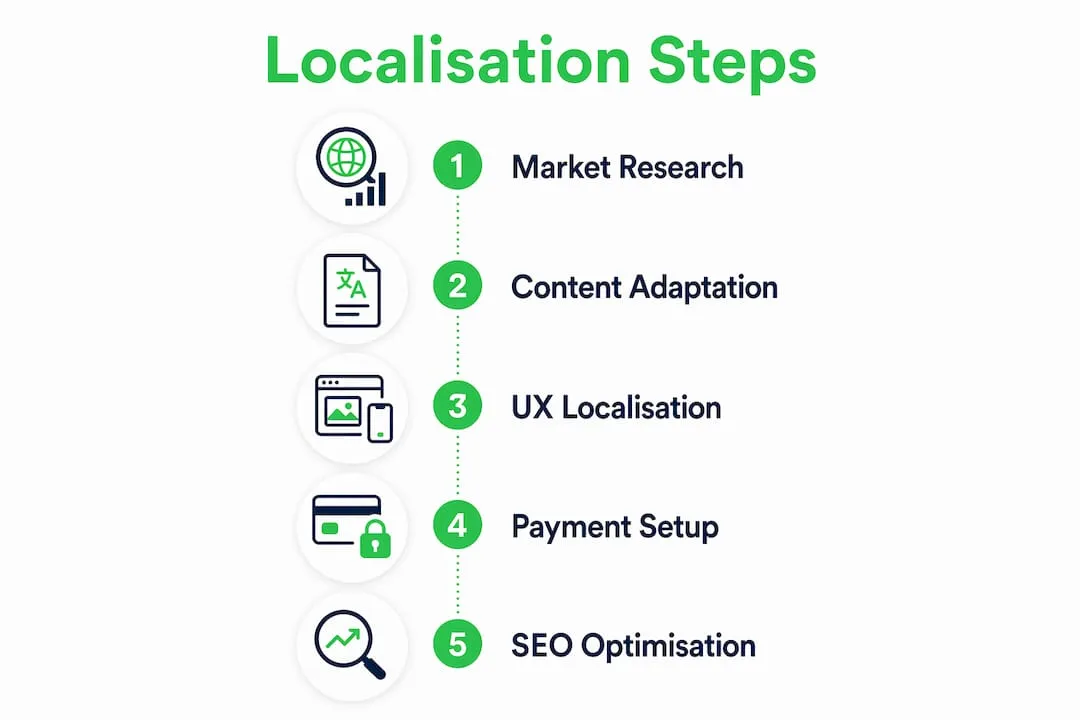
How do you research and prepare for e-commerce localisation?
Preparation determines whether your localisation budget generates returns or disappears into low-traffic pages. Start by pulling your existing analytics to identify which countries already send you organic traffic, add items to cart, or abandon at checkout. Those signals tell you where demand exists without paid acquisition.
Once you have candidate markets, assess each one across four dimensions: market size, local buyer behaviour, legal requirements, and the competitive landscape. A Brazilian shopper expects Pix as a payment option. A Dutch shopper expects iDEAL. A German shopper expects an imprint page and GDPR-compliant consent flows. Missing any of these signals to local buyers that your store is foreign, and incomplete localisation causes users to perceive a store as untrustworthy.
A tiered approach prevents resource dilution. Allocate full localisation resources, including native copywriting, transcreation, and dedicated SEO, to your top two or three markets. For secondary markets, tiering by ROI and running automation covers the essentials without overstretching your team. This is the single most effective way to scale localisation without burning out.
Your domain structure decision also belongs in the preparation phase. Country-code top-level domains (ccTLDs such as .de or .fr) give the strongest local SEO signal but require separate hosting and maintenance. Subdirectories (/de/, /fr/) on a single domain are easier to manage and consolidate domain authority. Subdomains (de.yourstore.com) sit between the two. Choose based on your technical capacity and long-term market commitment, not on what sounds impressive.
Before writing a single word of localised copy, map every customer touchpoint where language affects trust: homepage banners, category pages, product titles, descriptions, size guides, error messages, transactional emails, and returns policy. That map becomes your localisation scope document and your quality checklist.
What are the best practices for localising site content and UX?
Product titles and descriptions are the highest-leverage content to localise because they affect both conversion and organic search rankings simultaneously. Direct translation of product copy rarely works. A “slim-fit chino” translated word-for-word into German may be grammatically correct but miss the search terms German shoppers actually use. Using native speakers to review translations and back-translate copy into the source language catches meaning shifts before they reach customers.

Transcreation goes further than translation. It rewrites marketing copy and calls-to-action so they carry the same emotional weight in the target language as the original. A CTA that reads “Grab yours today” in English might need to become something entirely different in Japanese, where direct sales pressure reads as impolite. Review competitor sites in each target market to understand the register and tone that local shoppers respond to.
Pro Tip: Build a localisation style guide for each market before you begin. Include preferred terminology, banned phrases, tone of voice notes, and a translation memory. This cuts review cycles and keeps brand voice consistent as your catalogue grows.
On the UX side, localisation extends to navigation labels, filter options, error messages, and mobile layouts. Mobile responsiveness is non-negotiable: m-commerce dominates retail e-commerce sales in most growth markets, and a checkout that works on a UK desktop may break on an Android handset in Southeast Asia. For Shopify stores, product page translation at scale requires a structured workflow, not ad-hoc editing.
Local SEO for on-page content means transcreating metadata, not just translating it. Write page titles and meta descriptions using the search terms local shoppers type, which are often different from a direct translation of your English keywords. Localise URL slugs too. A slug like "/rote-sneaker/outperforms/red-sneakers/` in German search results because it matches local query language.
How to localise payments, checkout, and logistics for global customers?
Payment localisation is the most commercially critical layer of the entire process, and the most frequently underestimated. Customers abandon carts when familiar local payment methods are absent, and displaying prices in a foreign currency adds friction that kills conversions before checkout even loads. Most localisation teams also underestimate the backend architecture required to support localised currency display and payment routing.
The practical rule from Stripe is to offer two or three payment methods that dominate in the target region rather than a long list of irrelevant options. For the Netherlands, iDEAL is non-negotiable. For Sweden and Germany, Klarna is expected. For Brazil, Pix has become the default. Research the top two methods per market and prioritise those.
- Display prices in local currency on product pages, not just at checkout
- Show tax and duty estimates before the final payment screen to avoid surprise abandonment
- Adapt address fields to local formats (postcode position, prefecture fields for Japan, state fields for the US)
- Test every payment method with a real transaction before launch, not just a sandbox test
WooCommerce Adaptive Pricing simplifies local currency display for many stores, though it does not support subscriptions, pre-orders, or saved payment methods. For those use cases, a more custom Stripe integration is required. Stripe’s own payment localisation tools handle dynamic currency conversion and local method routing at scale.
Pro Tip: Place a test order in each target locale using a VPN and a local payment method before you go live. This single step catches more localisation errors than any automated QA tool.
What SEO strategies maximise international discoverability?
International SEO for localised e-commerce content requires locale-specific keyword research, not keyword translation. The German phrase for “running shoes” that shoppers actually search is different from a direct translation of your English target keyword. Use tools such as Google Search Console filtered by country, Ahrefs, or Semrush with local market data to find the terms that drive volume in each locale.
Correct hreflang implementation is the technical foundation of international SEO, and it is where most stores fail. Missing self-referencing hreflang tags and non-reciprocal links cause Google to ignore localised pages entirely, meaning your translated content earns zero search visibility. Every hreflang set must include a self-referencing tag on each page and reciprocal links pointing back from every other language version.
The table below compares the most common hreflang mistakes against the correct implementation:
| Common mistake | Correct approach |
|---|---|
| No self-referencing tag on localised pages | Add hreflang="x-default" and the page’s own locale tag on every page |
| One-directional hreflang links | Every language version must link to all other versions reciprocally |
Using es instead of es-ES or es-MX |
Always specify language and region code for accuracy |
| Localised pages with translated slugs missing | Transcreate URL slugs to match local search terms |
Beyond hreflang, localise every SEO-relevant field: page titles, meta descriptions, alt text on product images, Open Graph tags, and structured data. Structured data localisation, particularly for Product and BreadcrumbList schema, increases the chance of rich snippets appearing in local search results. For Shopify stores, SEO metadata localisation at the product level is one of the highest-ROI tasks you can automate.
How to test, measure, and optimise your localisation efforts?
Testing localisation is not a one-time pre-launch task. It is an ongoing process that keeps your localised store accurate as products, promotions, and platform updates change. Placing test orders and running A/B tests on localised CTAs and product pages is critical both before launch and continuously afterwards.
Follow this sequence for each locale before going live:
- Place a real test order using a local payment method and a local delivery address
- Check every page for mixed-language content, broken links, and UI layout issues on both desktop and mobile
- Verify that prices, taxes, and shipping costs display correctly in local currency
- Confirm hreflang tags are present and reciprocal across all language versions
- Run A/B tests on localised CTAs and product page headlines to identify the highest-converting copy
After launch, track conversion rate, average order value, cart abandonment rate, and organic search impressions per locale separately. These per-locale metrics tell you which markets justify deeper investment and which need a revised approach. Continuous localisation pipelines that automatically push new product content through translation and review workflows outperform one-time translation projects on every metric, including speed, accuracy, and cost per word.
For Amazon sellers expanding internationally, the same principles apply. Localisation strategies for Amazon follow a similar tiered logic, prioritising listing quality in core markets before scaling to secondary ones.
Key takeaways
Effective e-commerce localisation requires adapting payments, SEO, UX, and copy together as a system, not as isolated translation tasks.
| Point | Details |
|---|---|
| Localisation scope | Adapt every touchpoint including metadata, checkout, and error messages, not just product copy. |
| Payment prioritisation | Offer the two or three dominant local payment methods per region to reduce cart abandonment. |
| Hreflang accuracy | Include self-referencing tags and reciprocal links in every hreflang set or Google ignores the pages. |
| Tiered market strategy | Allocate full resources to core markets and use automation for secondary ones to protect ROI. |
| Continuous pipelines | Ongoing localisation workflows outperform one-time translation projects on speed, cost, and accuracy. |
Why most localisation projects stall before they pay off
Most e-commerce teams I have worked with treat localisation as a translation project with a finish line. They translate the product catalogue, flip the currency display, and call it done. Then they wonder why conversion rates in the new market sit 40% below their home market.
The honest answer is almost always payments and checkout. A beautifully translated product page means nothing if the shopper reaches checkout and cannot pay the way they expect to. Local payment method availability influences cart abandonment more than any amount of aesthetic polish on the UI. I have seen stores spend months on copy transcreation and zero hours on verifying that iDEAL or Pix actually processes correctly. That is backwards.
The second most common failure is hreflang. Teams assume that publishing translated pages is enough for Google to serve them to local searchers. It is not. I have audited stores where every page had a translated version but zero search visibility in the target market because the hreflang implementation was missing self-referencing tags. The content was invisible to the algorithm despite being perfectly translated.
My practical advice: prioritise your top two markets and do them properly before touching a third. Use AI tools like Ecom-eye to generate localised product content at scale, but always route marketing copy and CTAs through a native speaker review. AI handles volume; native speakers handle nuance. The combination is what actually converts.
— Koen
Scale your localisation with Ecom-eye
Localising a product catalogue across multiple markets is the task that breaks most manual workflows. Rewriting hundreds of product titles, descriptions, and SEO fields for each locale is slow, expensive, and inconsistent without the right tooling.
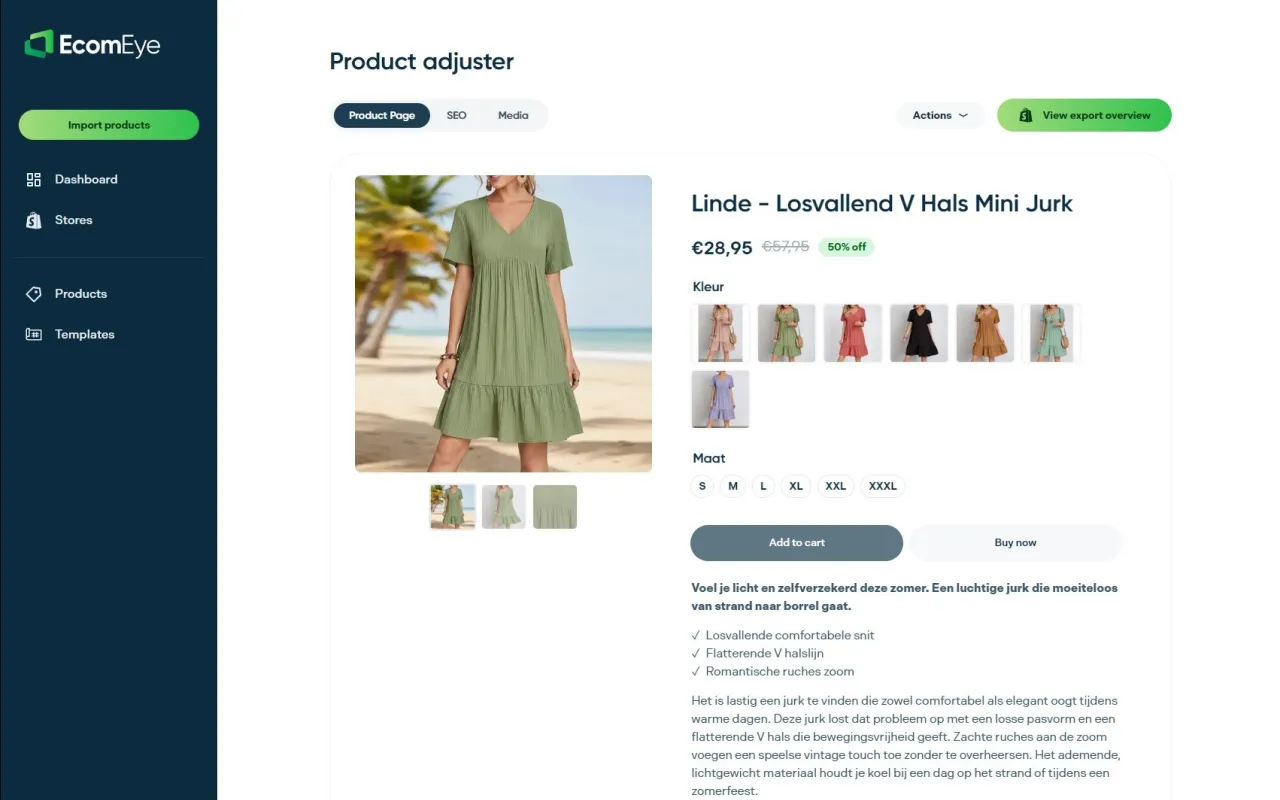
Ecom-eye generates copyright-safe, SEO-optimised product pages in bulk across multiple languages, directly from AliExpress imports or competitor links. You get localised titles, clean descriptions, AI product images, and SEO-ready metadata exported to Shopify in one click. No rewriting, no copyright risk, and no manual effort per locale. For dropshipping stores targeting multiple markets, it removes the biggest bottleneck between importing a product and ranking for it in local search.
FAQ
What does e-commerce content localisation actually include?
E-commerce localisation covers the entire buying experience: product pages, navigation, checkout, payment methods, transactional emails, legal content, and SEO metadata. Translation of product text is only one component of a full localisation strategy.
How do you translate product descriptions for local markets?
Effective product description localisation combines direct translation with transcreation, using native speakers to adapt tone, cultural references, and search terms rather than producing a word-for-word translation. Back-translation QA catches meaning shifts before they reach customers.
Why do localised pages sometimes not appear in local search results?
Missing or incorrect hreflang tags are the most common cause. Google requires self-referencing tags and reciprocal links across all language versions. Without these, localised pages are ignored by the algorithm regardless of content quality.
Which payment methods should I prioritise when localising checkout?
Prioritise the two or three payment methods that dominate in each target region. Examples include iDEAL for the Netherlands, Klarna for Sweden and Germany, and Pix for Brazil. Offering irrelevant options adds visual clutter without improving conversion.
How do I measure whether my localisation is working?
Track conversion rate, cart abandonment rate, average order value, and organic search impressions separately for each locale. Per-locale metrics reveal which markets justify deeper investment and where the localisation strategy needs adjustment.
Ready to boost your product pages?
Generate high-converting, SEO-optimized product pages in bulk using AI automation used by e-commerce experts.
No credit card required