What is high-quality product content for ecommerce?
Discover what is high-quality product content for ecommerce. Learn how it drives conversions and boosts visibility while building trust.

What is high-quality product content for ecommerce?

TL;DR:
- High-quality product content clearly conveys benefits, builds trust, and improves search visibility for ecommerce success. It relies on layered descriptions, benefit-focused bullet points, high-quality images, and standardized data to optimize both search rankings and conversions. AI tools can produce images and content at scale, but human oversight ensures accuracy, tone, and consistency.
High-quality product content is carefully crafted product information that clearly conveys benefits, builds trust, and improves search visibility to drive ecommerce conversions. The industry term for this discipline is product content management, and it covers everything from titles and descriptions to images and structured data attributes. Product content has evolved into a digital shelf strategy requiring clarity, consistency, and connection across every retail channel. For ecommerce entrepreneurs and marketers, getting this right is not optional. It is the difference between a listing that ranks and converts and one that disappears into page two.
What key elements make product content high quality?
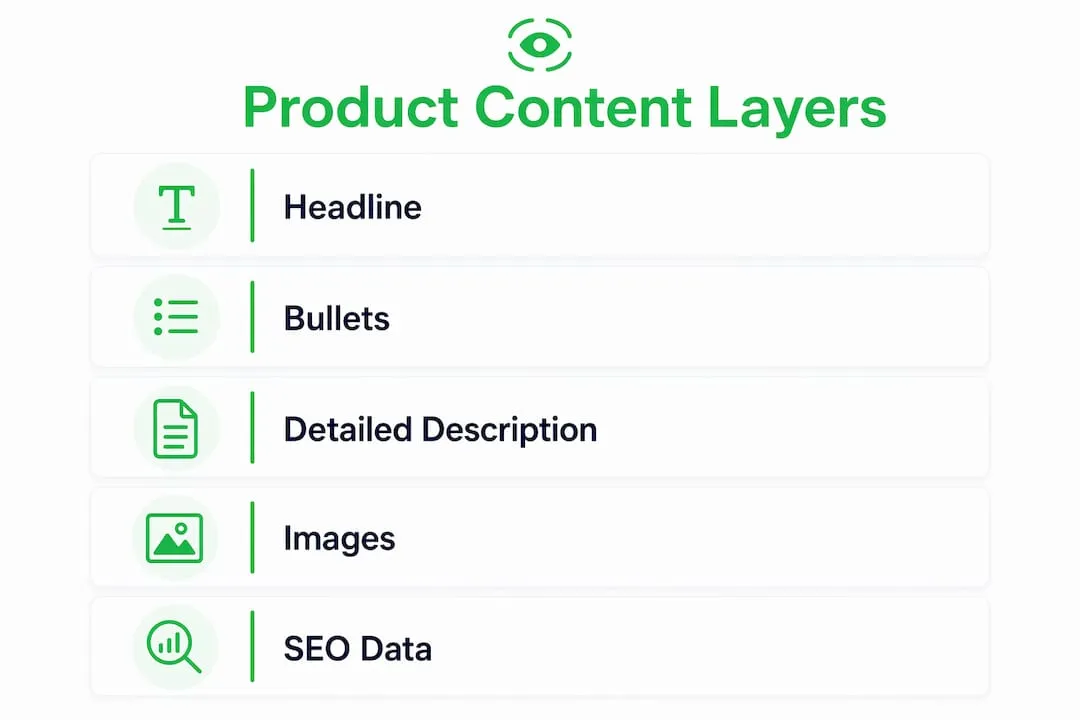
High-quality product content is built from several distinct layers, each serving a different purpose in the buyer journey. Strip out any one layer and you lose a segment of shoppers.
Layered product descriptions
Effective descriptions are layered so that scanners understand key information from headlines and bullets, while researchers get full detail from extended copy. This matters because 80% of shoppers scan content focusing on headlines, short benefit statements, and bullet points. Only 20% read long descriptions. That means your short-form copy must work independently, not just as a teaser for the paragraph below.
A standard product description should run 150–300 words. Complex items, such as electronics or supplements, require 300–500 words to build enough confidence for purchase. Anything under 100 words is insufficient for SEO and fails to answer the questions that hesitant buyers ask.
High-quality product images
Images are the closest thing to a physical inspection that online shoppers get. High-quality product images show the item from multiple angles, in context, and at a resolution that holds up when zoomed. Flat, low-resolution photos signal low quality before a shopper reads a single word.

AI-generated product photography now produces consistent, high-fidelity results when the platform offers explicit controls over lighting, framing, and composition. Generic text-prompt approaches produce inconsistent outputs. Platforms with structured, repeatable controls are the better choice for maintaining a coherent visual identity across a catalogue.
Benefit-focused bullet points
Bullet points are not a feature dump. Each bullet should translate a product feature into a customer outcome. “Stainless steel body” becomes “stays rust-free after years of daily use.” That shift from specification to benefit is what moves a shopper from interest to intent.
Pro Tip: Write your bullets in the second person and lead with the outcome. “You get a rust-free finish that lasts” outperforms “Made from stainless steel” every time.
Structured data and standardised attributes
Good product data requires attribute standardisation, clear ownership, and controlled values. Without these, product information becomes inconsistent across channels, creating a poor shopper experience and costly rework. Structured content also feeds search engines the signals they need to index and rank your listings correctly. Think of it as the skeleton beneath the visible copy.
How does high-quality product content improve SEO and conversions?
Well-crafted product content serves two audiences simultaneously: search engine crawlers and human shoppers. Satisfying both is what separates high-performing listings from average ones.
SEO benefits of detailed descriptions
Search engines reward depth and relevance. A description that covers materials, dimensions, use cases, and care instructions gives Google more signals to match your listing with buyer queries. Thin copy, by contrast, offers little for an algorithm to work with. Product descriptions matter for SEO because they determine which search terms your page can realistically rank for.
Keyword placement in titles, meta descriptions, and the first paragraph of body copy remains a core ranking factor. Structured content formats, including schema markup for products, help search engines surface your listings in rich results, which increases click-through rates without requiring a higher organic position.
Conversion benefits of trust-building content
Shoppers abandon listings when they cannot find the answer to a specific question. Clear, detailed content reduces that friction. A listing that addresses size, compatibility, delivery expectations, and return policy within the product page removes the need to search elsewhere. That reduction in uncertainty directly lifts conversion rates.
Content drives ecommerce sales growth by building the kind of trust that paid advertising cannot manufacture. A shopper who finds every answer on your page is far more likely to complete a purchase than one who leaves to verify a detail on a competitor’s site.
Social proof embedded within product content, such as review summaries or usage statistics, adds a further layer of credibility. It tells the shopper that other people have already made this decision and found it worthwhile.
Continuous refinement with analytics
Product content is not a one-off task. Analytics data reveals which listings generate traffic without converting, which exit pages lose buyers, and which search queries land on the wrong page. Use that data to rewrite underperforming descriptions, add missing specifications, and test new headline formats. Treating content as a living asset rather than a published document is what separates growing stores from stagnant ones.
What are best practices for creating high-quality product descriptions?
The most effective product descriptions follow a repeatable framework rather than relying on inspiration.
The feature-benefit-emotion framework
Copywriter Rob Palmer’s framework connects every feature to a benefit and then to an emotion. A waterproof jacket is not just waterproof. It keeps you dry (benefit), so you can stay out longer without worrying about the weather (emotion). That chain moves the reader from information to feeling, and feeling drives purchase decisions.
Apply this framework to every significant feature, not just the headline claim. A product with five key features should produce five feature-benefit-emotion chains, each targeting a different buyer concern.
Recommended structure and word counts
- Headline title: Include the primary keyword and the most important product attribute. Keep it under 70 characters for clean display in search results.
- Short description: 2–3 sentences covering the core benefit. Written for scanners. Must work as a standalone summary.
- Bullet points: 4–6 bullets, each leading with a benefit. No more than 15 words per bullet.
- Long description: 150–500 words depending on product complexity. Cover materials, dimensions, use cases, compatibility, and care. Written for researchers.
- Structured attributes: Size, weight, colour, material, and any category-specific fields. These feed filters and comparison tools.
Pro Tip: Write the long description last. Start with bullets, then expand each one into a sentence or two. You will find the structure writes itself.
Sensory language and social proof
Sensory language makes abstract products tangible. “Soft-touch matte finish” tells a shopper more than “matte finish” alone. “Whisper-quiet motor” communicates something a decibel rating cannot. Use specific, concrete language that triggers a physical impression.
Avoid generic copy that could apply to any product in your category. Phrases like “premium quality” and “great value” carry no information. Replace them with specifics: the thread count, the battery life in hours, the load capacity in kilograms.
How can AI tools improve product images and content at scale?
AI has changed the economics of product content production. Tasks that once required a photographer, a copywriter, and a data entry team can now be handled with far less manual effort.
AI product photography
AI-generated product images cost approximately $0.55 per image and generate in 30–40 seconds. That is a fraction of the cost and time of a traditional studio shoot. The speed matters most when you are launching hundreds of products at once, as dropshippers routinely do.
The quality gap between AI and studio photography has narrowed significantly. Platforms that offer manual control over lighting angle, shadow, and background colour produce results that are consistent enough for professional catalogues. The key is choosing a platform with structured controls rather than one that relies solely on text prompts.
Automated content generation
Automated content workflows maintain consistent messaging across titles, descriptions, bullets, and metadata without requiring a writer to produce each one from scratch. Structured content approaches are particularly valuable for stores with large catalogues, where manual writing at scale is not realistic.
The risks of automation are real. AI-generated copy can be generic, factually inaccurate, or tonally inconsistent. Human oversight remains necessary. The best workflow uses AI to produce a first draft and a human editor to verify accuracy, adjust tone, and confirm that the feature-benefit-emotion chain holds.
- Batch generation: Produce titles, descriptions, and bullets for hundreds of products simultaneously.
- Template consistency: Apply a fixed structure across all listings to maintain brand voice.
- SEO integration: Embed target keywords automatically based on category and product type.
- Image generation: Create lifestyle and studio-style images without a physical shoot.
- Multi-language output: Generate localised versions of listings for international markets.
Key takeaways
High-quality product content is a strategic asset that requires layered descriptions, benefit-led copy, consistent images, and structured data to drive both search rankings and conversions.
| Point | Details |
|---|---|
| Layer your descriptions | Write short copy for scanners and long copy for researchers so both shopper types get what they need. |
| Use the feature-benefit-emotion chain | Connect every product feature to a customer outcome and then to a feeling to drive purchase decisions. |
| Meet minimum word counts | Standard products need 150–300 words; complex items need 300–500 words to build buyer confidence. |
| Standardise your product data | Set attribute ownership and controlled values to prevent inconsistency across channels and avoid costly rework. |
| Use AI with human oversight | AI cuts image and copy production time dramatically, but human review keeps accuracy and tone on track. |
Why I think most ecommerce stores treat product content as an afterthought
After working across dozens of ecommerce stores, the pattern I see most often is this: merchants spend weeks on store design and paid advertising, then copy product descriptions directly from a supplier’s feed. That approach creates three problems at once. The copy is generic, the SEO value is zero because it is duplicated across hundreds of other stores, and the shopper gets no reason to trust the listing over a cheaper alternative.
The stores that grow consistently treat product descriptions as infrastructure, not decoration. They build templates, set standards, and govern their data the same way a manufacturer governs a bill of materials. When you treat content as a one-off task, you accumulate what data professionals call data debt: inconsistent attributes, missing fields, and copy that no longer reflects the actual product. Fixing that debt later costs far more than building it correctly the first time.
The shift I would encourage every ecommerce entrepreneur to make is simple. Stop thinking of product content as the last step before publishing. Start thinking of it as the primary reason a shopper chooses your listing over the next one.
— Koen
How Ecom-eye helps you build better product listings at scale
Producing high-quality product content across a large catalogue is where most ecommerce entrepreneurs hit a wall. Writing, imaging, and structuring hundreds of listings manually is not a realistic workflow.
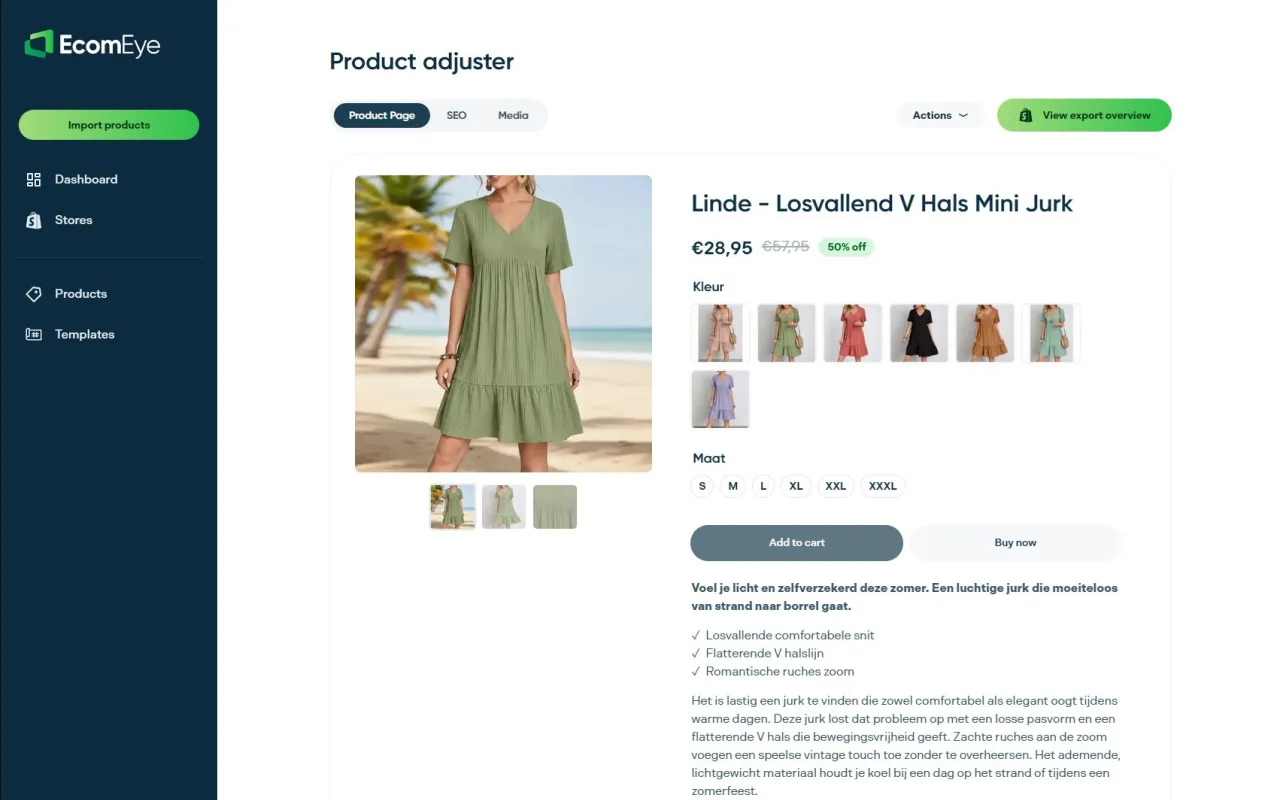
Ecom-eye is built specifically for Shopify dropshippers who need copyright-safe, SEO-ready product pages generated in bulk. Import products from AliExpress or competitor links, and Ecom-eye automatically produces optimised titles and descriptions, AI product images, and multi-language pages. Everything exports to Shopify in one click. No rewriting, no copyright risk, and no manual data entry. For stores scaling from tens to hundreds of products, that is a meaningful shift in what is possible. Visit Ecom-eye to see how it works.
FAQ
What is high-quality product content?
High-quality product content is product information that clearly communicates benefits, builds shopper trust, and is structured for both search engines and human readers. It includes layered descriptions, benefit-led bullet points, accurate images, and standardised data attributes.
How long should a product description be?
Standard product descriptions should be 150–300 words. Complex products such as electronics or supplements require 300–500 words to give shoppers enough information to buy with confidence.
Why does product content matter for SEO?
Detailed, keyword-rich product descriptions give search engines more signals to match your listing with buyer queries. Thin or duplicated copy produces low rankings and, on platforms like Google Merchant Centre, can result in disapprovals.
What is the feature-benefit-emotion framework?
The feature-benefit-emotion framework connects each product feature to a customer benefit and then to an emotional outcome. It is the most effective structure for writing product descriptions that move shoppers from interest to purchase.
Can AI generate high-quality product images?
AI product photography platforms generate images in 30–40 seconds at a fraction of studio costs. Platforms that offer explicit controls over lighting, framing, and composition produce the most consistent and professional results.
Ready to boost your product pages?
Generate high-converting, SEO-optimized product pages in bulk using AI automation used by e-commerce experts.
No credit card required