Top dropshipping localisation tips for global success
Discover the top dropshipping localization tips to enhance your global success. Adapt payments, cultures, and operations to boost sales today!

Top dropshipping localisation tips for global success

TL;DR:
- Dropshipping localization involves adapting payment methods, delivery promises, and cultural cues to each market. Implementing local payment options and displaying prices in local currency significantly boosts conversion rates, while proactive shipment updates reduce support inquiries. Focusing on operational and experiential changes helps build trust and drives long-term growth in international markets.
Dropshipping localisation is the practice of adapting every element of your store, from payment methods and delivery promises to language and cultural cues, so that shoppers in each market feel they are buying from a local retailer. Translation accounts for only about 15% of localisation effort. Payment, fulfilment, and cultural adaptation drive most of the conversion lift. The top dropshipping localization tips covered here go well beyond swapping languages. They address the operational and experiential changes that turn international browsers into paying customers. Regulatory awareness matters too: EU consumers hold a statutory 14-day withdrawal right, and ignoring it costs you chargebacks and trust.
1. What are the top dropshipping localisation tips for payments and currency?
Payment localisation is the single highest-impact change you can make when entering a new market. Offering local payment options such as iDEAL in the Netherlands, Pix in Brazil, or SEPA direct debit across the eurozone increases conversions by up to 40% compared to card-only checkouts. That gap exists because shoppers abandon carts when they do not see a trusted, familiar method at checkout.

Currency display matters just as much as the payment method itself. Show prices in the local currency, rounded to local conventions, with tax included or excluded as local norms dictate. A German shopper expects gross prices inclusive of VAT. A US shopper expects net prices with tax added at checkout. Getting this wrong signals that you are a foreign operator, which erodes trust immediately.
Use a payment aggregator that bundles local rails rather than integrating each method individually. This cuts development time and keeps your checkout compliant as local regulations change. After going live, monitor authorisation rates per market weekly. A sudden drop in a specific country often signals a routing problem or a bank-level block that you can fix quickly once you spot it.
- Display prices in local currency with correct rounding
- Include or exclude VAT based on local convention
- Offer market-specific methods: iDEAL, Pix, Klarna, SEPA
- Use a payment aggregator for easier multi-market management
- Test checkout flows with local cards before launch
Pro Tip: Run a test transaction from a local device and local network in each new market before you go live. Technical declines that never appear in your home country are common and easy to miss without this step.
2. How should dropshippers localise delivery promises and returns?
Delivery transparency is a direct driver of customer satisfaction and a major source of support costs when it fails. WISMO enquiries represent 60–70% of dropshipping support volume. Proactive shipment notifications cut that volume significantly, freeing your team to handle higher-value issues.
State shipping windows clearly in the local language on product pages, at checkout, and in confirmation emails. Do not use vague phrases like “ships in 7–15 days.” Give a specific date range based on your actual supplier lead times and the destination country’s customs clearance history. Shoppers in Germany and the Netherlands have lower tolerance for long waits than shoppers in some other markets, so match your messaging to local expectations.
Returns are where many dropshippers lose EU customers permanently. EU buyers hold a statutory 14-day withdrawal right, and you must state this clearly in the local language with a local or accessible return path. A returns process that requires posting goods back to China at the customer’s expense will generate chargebacks, not compliance. Partner with a local returns hub or use a returns management service to keep costs manageable.
- State specific delivery date ranges, not vague windows
- Communicate duty and tax policies before checkout
- Send proactive tracking updates at each shipment milestone
- Display the EU 14-day withdrawal right in the local language
- Provide a locally accessible return option
Pro Tip: Integrate a shipment tracking app such as AfterShip to automate delivery notifications. Automated updates reduce WISMO contacts without adding headcount.
3. What linguistic and cultural adaptations matter beyond translation?
True localisation means adapting the entire customer experience to feel native, not just converting words from one language to another. A product description translated word-for-word from English to French will often read as unnatural, and shoppers notice. Hire native speakers or use professional localisation services rather than machine translation alone for customer-facing copy.
Adapt units and measurements to local standards. UK shoppers expect imperial clothing sizes and miles. German shoppers expect metric units throughout. Brazilian shoppers use different sizing conventions from European ones. Getting sizes wrong generates returns and negative reviews, both of which damage your rankings and margins. The same logic applies to ingredients lists, material descriptions, and technical specifications.
Visuals require localisation too. Product photography featuring models, seasonal settings, or colour schemes that resonate in one market can feel jarring or irrelevant in another. Red signals luck in China but danger in some Western contexts. Summer imagery in your hero banner will confuse shoppers in the Southern Hemisphere during their winter months. Align your product image strategy with local seasonal calendars and cultural colour associations.
- Adapt sizes, units, and measurements to local standards
- Use native speakers for product descriptions and support copy
- Align visuals with local seasonal buying patterns
- Localise promotional calendars to regional holidays
- Structure product categories to match local search behaviour
4. How can dropshippers build trust through localisation?
Trust signals are the fastest way to close the credibility gap between a local retailer and a foreign dropshipper. Localised trust signals such as recognised payment badge logos, local review platforms, and market-specific security seals significantly increase buyer confidence. A Dutch shopper who sees the iDEAL logo and a Trustpilot badge with Dutch reviews feels far more confident than one who sees only generic global logos.
Branded packaging and custom inserts are another layer of trust that most dropshippers overlook. Investing in branded packaging and localised customer relationships builds lasting brand recognition that generic white-label shipping cannot achieve. A small branded card inside the parcel, printed in the local language with a local customer service contact, transforms a commodity purchase into a brand experience.
Consistent, professional design across your store, emails, and packaging signals that you are a serious business. Inconsistency, such as English error messages on a French-language store, or a logo that changes between pages, undermines every other trust-building effort. Treat brand differentiation in dropshipping as an ongoing investment rather than a one-time setup task.
- Display locally recognised payment and security badges
- Use local review platforms familiar to your target market
- Add branded inserts in the local language inside parcels
- Maintain consistent design across all customer touchpoints
- Consider private label options to strengthen brand identity
5. What operational and technology best practices support localisation?
Operational resilience underpins every localisation strategy. Maintaining multiple vetted suppliers per SKU with regular test orders mitigates the risk of delays and quality failures that damage your reputation in a new market. A single supplier failure during a peak season can wipe out months of trust-building work.
Automation tools handle the volume and complexity that manual processes cannot. Tools such as AutoDS, Gorgias, and AfterShip cover order routing, customer communication, and proactive shipment tracking. Each of these functions has a direct localisation dimension: routing orders to the nearest supplier reduces delivery times, localised support macros in Gorgias cut response times, and AfterShip notifications in the local language reduce WISMO contacts.
Start your localisation rollout in one market before expanding. Test payment flows, delivery messaging, and returns processes thoroughly before moving to the next country. This phased approach lets you identify problems cheaply and build repeatable workflows that scale. A multi-country dropshipping workflow becomes far easier to manage once you have a proven template from your first market.
- Maintain at least two vetted suppliers per core SKU
- Use order routing automation to select the nearest supplier
- Set up localised support macros for common queries
- Integrate tracking apps to send proactive local-language updates
- Negotiate packaging upgrades suited to each market’s expectations
Pro Tip: Scale localisation gradually. Launch with payment and delivery localisation in market one, then add linguistic and cultural adaptation in market two once your operational baseline is solid.
Key takeaways
Effective dropshipping localisation requires adapting payments, delivery, language, visuals, and trust signals to each market, not just translating text.
| Point | Details |
|---|---|
| Payment localisation drives conversions | Offering local methods like iDEAL or Pix can lift conversions by up to 40% versus card-only checkout. |
| Delivery transparency cuts support costs | WISMO enquiries make up 60–70% of support volume; proactive tracking notifications reduce them significantly. |
| Cultural adaptation goes beyond words | Adapt sizes, units, visuals, and seasonal calendars to local norms, not just the language of your copy. |
| Trust signals close the credibility gap | Local payment badges, review platforms, and branded inserts build confidence that generic stores cannot match. |
| Operational resilience enables scale | Multiple suppliers per SKU and automation tools keep localisation consistent as you expand into new markets. |
Localisation is the competitive moat most dropshippers ignore
I have watched hundreds of dropshipping stores launch into European and Asian markets with a translated homepage and nothing else. They wonder why conversion rates are half what they expected. The answer is almost always the same: the checkout still only accepts Visa and Mastercard, the delivery estimate is vague, and the returns policy is buried in English legalese.
The stores that grow consistently treat localisation as a brand-building discipline, not a technical checkbox. They spend time understanding why a Dutch shopper trusts iDEAL more than a credit card, or why a Brazilian customer expects Pix at checkout as a basic standard. That understanding shapes every decision from supplier selection to packaging design.
What surprises most dropshippers is how much of localisation is operational rather than linguistic. Localisation as long-term brand building is the mindset that separates stores with durable growth from those that spike and fade. The linguistic work matters, and linguistic adaptation in e-commerce is well worth investing in. But the payment rails, the delivery promise, and the returns path are what actually convert a first-time visitor into a repeat customer.
My honest advice: pick one market, get every layer right, and document what you did. That document becomes your localisation playbook for every market that follows.
— Koen
How Ecom-eye helps you localise product pages at scale
Localising product content across dozens of SKUs and multiple languages is the part of the process that consumes the most time. Ecom-eye removes that bottleneck entirely.
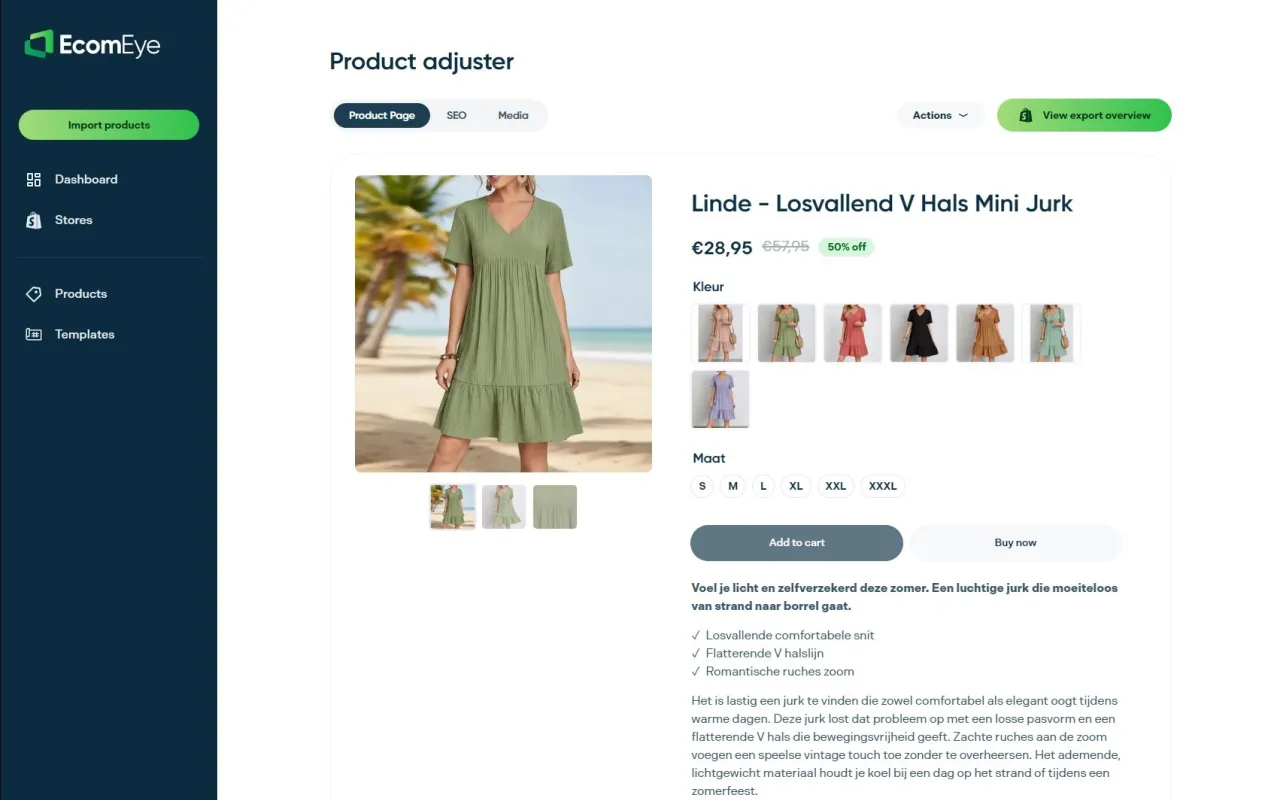
With Ecom-eye’s bulk AI product lister, you import products from AliExpress or competitor links and receive SEO-ready titles, clean descriptions, and AI-generated product images in multiple languages, all without rewriting a single line manually. Every page is copyright-safe and free of duplicate content, which means no Google Merchant disapprovals and no ranking penalties. You can also generate localised SEO product descriptions tailored to each market’s search behaviour, then export everything directly to Shopify in one click. For dropshippers scaling across borders, that is the difference between weeks of manual work and a single afternoon.
FAQ
What does dropshipping localisation actually involve?
Dropshipping localisation means adapting payments, delivery promises, language, visuals, and trust signals to each target market. Translation accounts for only about 15% of the total effort required.
Which localisation change has the biggest impact on conversions?
Offering local payment methods is the highest-impact single change. Local options like iDEAL, Pix, or SEPA can increase conversions by up to 40% compared to card-only checkouts.
Do EU dropshipping stores need to display a returns policy?
EU law grants consumers a statutory 14-day withdrawal right. You must state this clearly in the local language and provide a locally accessible return path, or risk chargebacks and regulatory complaints.
How do I reduce ‘where is my order’ enquiries?
WISMO enquiries represent 60–70% of dropshipping support volume. Integrating a shipment tracking app that sends proactive, local-language notifications at each delivery milestone cuts this volume significantly.
How many suppliers should I use per product when selling internationally?
Maintain at least two vetted suppliers per core SKU. This protects you against delays and quality failures that would otherwise damage your reputation in a new market during critical trading periods.
Ready to boost your product pages?
Generate high-converting, SEO-optimized product pages in bulk using AI automation used by e-commerce experts.
No credit card required