Why adaptive product content matters for e-commerce in 2026
Discover why adaptive product content is crucial for e-commerce in 2026. Learn how it boosts conversions and enhances user experience.

Why adaptive product content matters for e-commerce in 2026

TL;DR:
- Adaptive product content personalizes pages in real time based on user context, boosting conversions and revenue. Implementing it effectively relies on organizational coordination and incremental updates rather than complex technology. It scales empathy by listening to customer needs and responding dynamically to improve shopping experiences.
Adaptive product content is defined as product page information that changes in real time based on who is viewing it, where they came from, and what device they are using. This is not a minor UX refinement. Brands using adaptive product content see mobile conversion increases of 14% to 22%, with some AI implementations reporting a 423% conversion surge. The industry term for this approach is “dynamic personalisation,” and it sits at the intersection of SEO, behavioural targeting, and content architecture. For e-commerce entrepreneurs and digital marketers, understanding why adaptive product content works is now a commercial necessity, not an optional upgrade.
Why adaptive product content drives SEO and conversions
Static product pages treat every visitor the same. A shopper arriving from a Google search for “waterproof running shoes” sees the same page as someone clicking through from a Facebook ad for “trail gear.” That mismatch costs sales.

Adaptive content fixes this by matching what the page shows to what the visitor expects. A modern product page is a key SEO asset that serves both human shoppers and AI agents simultaneously, creating a durable competitive advantage. Search engines and AI-powered discovery tools increasingly favour structured, context-rich content over generic copy. Pages that adapt their structure to user intent give crawlers more signals to work with.
The business case is compelling. AI-driven product recommendations contribute up to 31% of total e-commerce revenue. Sessions featuring adaptive elements see a 369% increase in average order value. That is not a marginal improvement. It represents a fundamental shift in how product pages generate revenue.
The benefits of adaptive content also compound over time. Each personalised interaction generates behavioural data that refines future recommendations. A page that learns from traffic patterns becomes more effective month by month, without requiring a full redesign.
- Conversion uplift: Mobile conversion rates rise 14%–22% with adaptive content, and up to 423% in high-performing AI deployments.
- Revenue attribution: AI-driven recommendations account for up to 31% of total e-commerce revenue.
- Order value: Sessions with adaptive elements show a 369% increase in average order value.
- SEO advantage: Structured adaptive content gives search engines and AI agents richer signals, improving discoverability.
Pro Tip: Start tracking your product page bounce rate by traffic source. A high bounce rate from paid social often signals a content mismatch, which adaptive content directly solves.
What are the core mechanisms behind adaptive content?
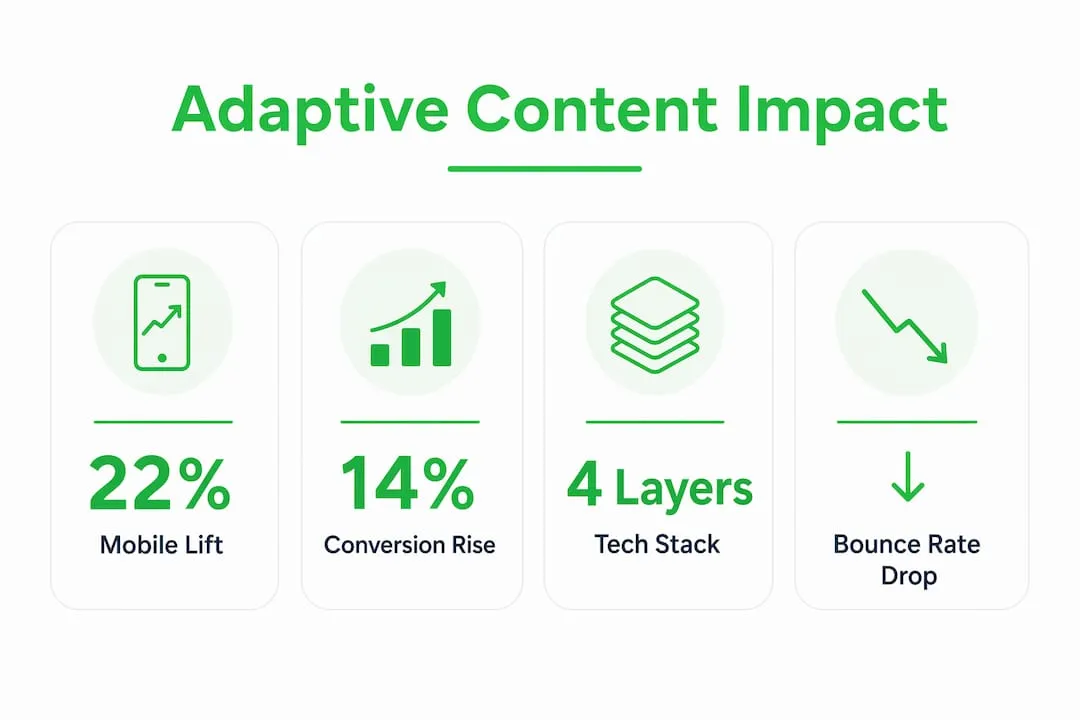
Adaptive content works through four distinct technical layers. Each layer targets a different part of the visitor’s decision-making process.
Dynamic image sequencing
The hero image is the first thing a visitor sees. Dynamic image sequencing changes that image based on the referral source, lifting add-to-cart rates by an average of 9%. A visitor arriving from a fitness influencer’s Instagram post sees a lifestyle image of the product in use. A visitor from a Google Shopping ad sees a clean product shot with specs. The same product, two different first impressions, both optimised for the visitor’s context.
Benefit-first copy and contextual social proof
Adaptive copy reorders benefit bullets based on what the visitor’s behaviour suggests they care about most. A price-sensitive shopper sees value messaging first. A quality-focused shopper sees durability claims at the top. Contextual social proof filtered by shopper use case or demographics outperforms generic reviews by 31% in engagement metrics. Showing a runner a review from another runner is simply more persuasive than showing them a generic five-star rating.
Modular content architecture
Modular content architecture uses reusable content blocks that can be assembled dynamically. Instead of one fixed product description, you have separate blocks for features, use cases, technical specs, and social proof. The system assembles the right combination for each visitor. This approach supports consistent delivery across channels, from Shopify product pages to Google Shopping feeds, without duplicating manual effort.
Sticky mobile calls-to-action
Mobile UX is where most adaptive gains are won or lost. Sticky mobile CTAs with urgency indicators convert 18% better than static buttons. A button that follows the visitor down the page and shows “Only 3 left in stock” removes the friction of scrolling back up to buy. This single feature alone can justify the investment in adaptive content infrastructure.
Pro Tip: When building modular content blocks, write each block as if it is the only content the visitor will read. Blocks must stand alone and still make sense out of sequence.
What challenges come with implementing adaptive content?
The primary challenge in adaptive content adoption is not the technology. Organisational prioritisation and coordination between merchandising, SEO, and operations teams is the real barrier. Most e-commerce businesses have the tools available. Few have assigned clear ownership of the product content layer.
- Ownership gaps: Without a dedicated owner for product content strategy, adaptive changes get deprioritised against other development work.
- Testing complexity: Adaptive pages create fluid variants, which makes standard A/B testing unreliable. Cohort-isolated testing is required to measure true impact.
- Creative production: Adaptive content demands multiple image variants, several copy versions, and ongoing review curation. This is a production workload that many teams underestimate.
- Cross-team alignment: SEO, paid media, and product teams often optimise in silos. Adaptive content only works when all three teams share data and goals.
The good news is that incremental content layering consistently delivers higher ROI than full redesigns. Reordering benefit bullets or swapping a hero image based on referral source requires far less resource than rebuilding a page from scratch. Small, compounding changes are both more manageable and more measurable.
How do you build an adaptive content strategy that works?
A phased approach removes the complexity of trying to do everything at once. Each phase builds on the last, and each delivers measurable results before you move forward.
-
Foundation phase. Audit your current product pages by traffic source. Identify which pages have the highest bounce rates from specific channels. These are your first candidates for adaptive treatment. Use structured product data to ensure your content is machine-readable from day one.
-
Social proof phase. Add contextual review filtering before you touch copy or images. This is the lowest-effort, highest-impact change available. Tag reviews by customer type, use case, or demographic, then surface the most relevant ones based on visitor behaviour.
-
Personalisation phase. Introduce dynamic image sequencing and benefit-first copy reordering. Start with your two or three highest-traffic product pages. Measure add-to-cart rate and time on page before and after each change.
-
Experimentation phase. Run cohort-isolated tests on sticky CTAs, urgency messaging, and modular content assembly. Use the data to build a prioritisation framework for rolling adaptive content across your full catalogue.
| Phase | Focus | Key metric |
|---|---|---|
| Foundation | Structured data and page audit | Bounce rate by traffic source |
| Social proof | Contextual review filtering | Engagement rate on reviews |
| Personalisation | Image and copy adaptation | Add-to-cart rate |
| Experimentation | CTA and urgency testing | Mobile conversion rate |
Linking your adaptive content strategy to the full customer journey is what separates average results from exceptional ones. A visitor who lands on a well-matched page, sees relevant social proof, and encounters a sticky CTA at the moment of decision is far more likely to convert than one who navigates a generic page. The impact of dynamic product content is greatest when every element of the page reinforces the visitor’s intent at arrival.
Key takeaways
Adaptive product content is the single most effective way to close the gap between traffic and revenue on e-commerce product pages.
| Point | Details |
|---|---|
| Conversion impact is significant | Mobile conversions rise 14%–22% with adaptive content; some AI deployments report 423% surges. |
| Revenue attribution is direct | AI-driven adaptive recommendations account for up to 31% of total e-commerce revenue. |
| Modular architecture reduces workload | Breaking content into reusable blocks enables dynamic assembly without excessive manual effort. |
| Organisation beats technology | Successful implementation requires cross-team ownership, not just the right software. |
| Start small and layer | Incremental changes like hero image swaps and review filtering deliver higher ROI than full redesigns. |
Adaptive content is scaling empathy, not just technology
I have watched e-commerce teams spend months debating platform migrations when the real problem was a product page that said the same thing to everyone. The insight that changed how I think about this is simple: adaptive content is an exercise in scaling empathy. You are not automating a page. You are automating the act of listening to a customer and responding to what they actually need.
The teams that get this right are not always the ones with the biggest budgets. They are the ones that assign clear ownership to the product content layer and treat it with the same rigour they apply to paid media. The teams that struggle are the ones that treat adaptive content as a technical project rather than a marketing discipline.
My honest prediction is that by the late 2020s, adaptive product pages will be the baseline expectation, not a differentiator. The stores that build this capability now will have a compounding advantage. Every month of data they collect makes their pages more effective. Every store that waits will face a steeper climb to catch up.
The risk of ignoring adaptive strategies is not just lower conversions today. It is a growing gap in institutional knowledge and data that becomes harder to close over time. Start with one page, one traffic source, and one content variable. The evidence is clear enough to act on.
— Koen
How Ecom-eye helps you build adaptive product content at scale
Duplicate product pages are the number one reason Shopify dropshipping stores fail on Google. Ecom-eye solves this by generating copyright-safe, SEO-ready product pages in bulk, with AI-produced images and multi-language support, all exportable to Shopify in one click.
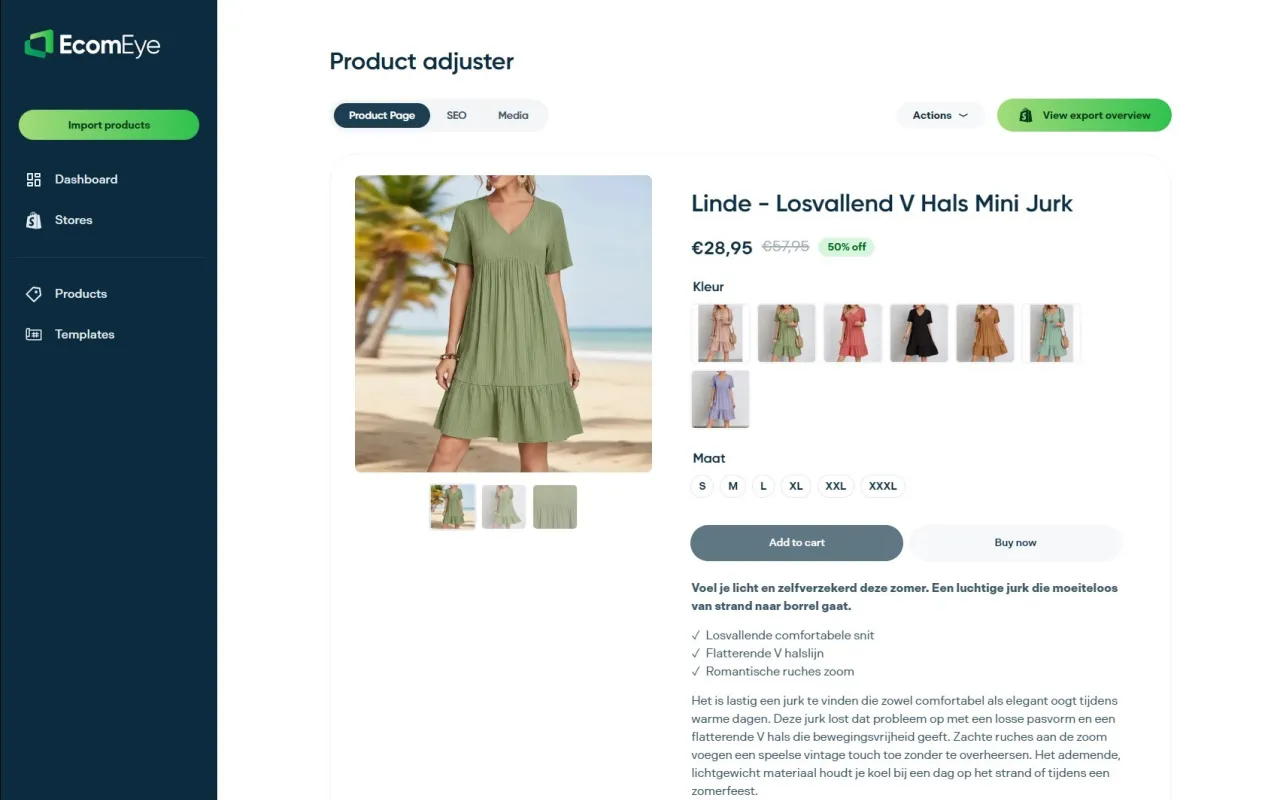
Every page Ecom-eye generates is built from structured, modular content that supports the adaptive content strategies covered in this article. You get AI-generated product listings that are unique, search-engine-friendly, and ready to personalise. No rewriting, no copyright risk, and no manual work. If you are ready to stop copying competitor pages and start building product content that actually ranks and converts, Ecom-eye is where to start.
FAQ
What is adaptive product content?
Adaptive product content is product page information that changes in real time based on user context, including referral source, device type, and browsing behaviour. It is also referred to as dynamic personalisation in the industry.
How does adaptive content improve conversion rates?
Brands using adaptive product content see mobile conversion rate increases of 14%–22%, with some AI-powered implementations reporting surges of up to 423%. The improvement comes from matching page content to the visitor’s specific intent at arrival.
Is adaptive content only for large e-commerce stores?
Adaptive content strategies scale from single-page changes, such as swapping a hero image by referral source, to full catalogue personalisation. Incremental content layering delivers strong ROI without requiring enterprise-level resources.
How does adaptive content affect SEO?
Structured adaptive content gives search engines and AI agents richer, more contextually relevant signals. A well-structured product page that serves both human visitors and crawlers functions as a durable SEO asset that improves discoverability over time.
What is the biggest challenge in implementing adaptive content?
The primary challenge is organisational, not technical. Successful adaptive content requires clear ownership and coordination between SEO, merchandising, and paid media teams, rather than simply deploying new software.
Ready to boost your product pages?
Generate high-converting, SEO-optimized product pages in bulk using AI automation used by e-commerce experts.
No credit card required