Why contextual product information wins more sales in 2026
Discover why contextual product information boosts sales in 2026. Learn how AI-driven data enhances purchase decisions and drives conversions.

Why contextual product information wins more sales in 2026

TL;DR:
- Contextual product data, which adapts to specific shopper situations, is becoming essential for winning AI-driven sales.
- Most brands lack comprehensive schema and real-time feeds, limiting AI discoverability and recommendation accuracy.
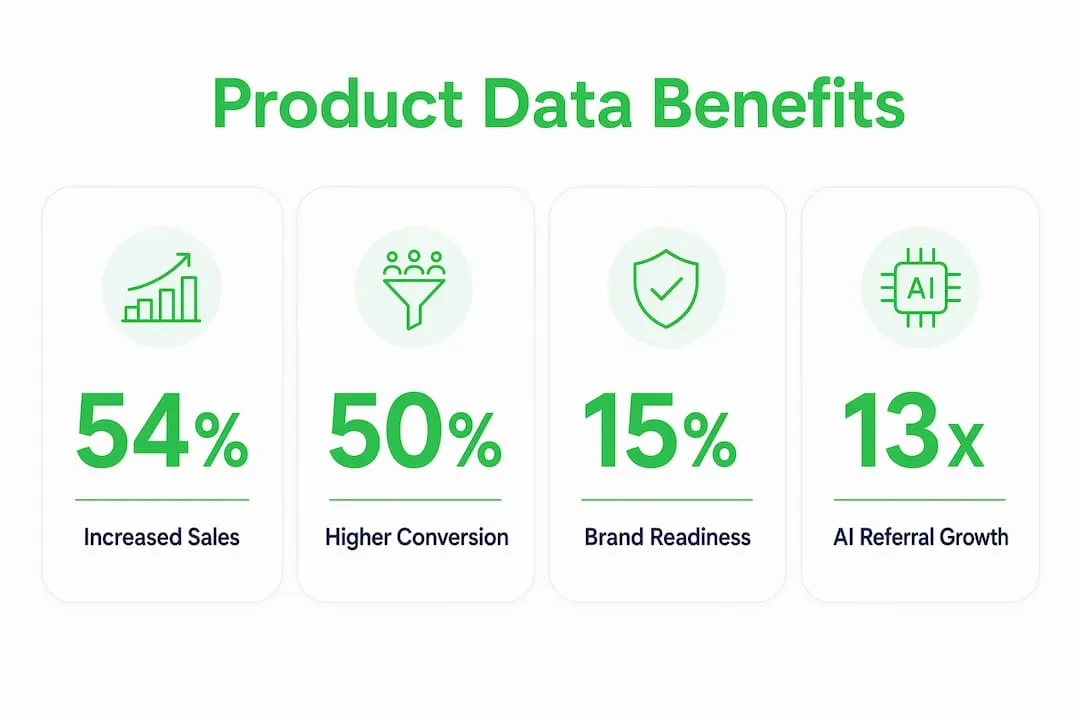
Contextual product information is product data that adapts to a shopper’s specific situation, giving AI systems and human buyers the exact details they need to make a confident purchase decision. This is the industry term “context engineering” applied to e-commerce product data, and it is rapidly becoming the defining factor in who wins AI-driven sales. AI-referred visitors convert at nearly 50% higher rates than traditional organic search traffic. That single figure explains why contextual product data is no longer optional for serious e-commerce professionals. Brands that invest in it now are building a structural advantage that compounds as AI shopping agents become the dominant discovery channel.
Why contextual product information outperforms traditional SEO
Traditional SEO focuses on keyword density, backlink profiles, and page authority scores. Contextual product information focuses on structured, real-time, machine-readable data that AI agents can parse and act on at the moment a shopper queries them. The two approaches are not interchangeable.

A product page that ranks on page one of Google may be completely invisible to an AI shopping agent. 54% of brands that rank well on Google are bypassed by AI systems because their product data lacks the enrichment those systems require. That is more than half the brands investing heavily in traditional SEO, receiving zero return from the fastest-growing sales channel.
The technical gap is specific. Traditional SEO optimises for human readers scanning a webpage. AI agents consume structured formats: JSON-LD schema, direct APIs, and machine-readable feeds. A beautifully designed product page with no machine-parsable schema is, from an AI agent’s perspective, an empty room.
Pro Tip: Run a schema audit on your top 20 product pages using Google’s Rich Results Test. If fewer than half pass with complete product schema, your AI discoverability is critically low.
The shift matters because AI agents do not browse. They query structured data sources, compare attributes, and surface recommendations. Brands that treat their product data as a structured, queryable asset rather than marketing copy are the ones AI agents recommend.
What are the business benefits of contextual product data?
The commercial case for contextual product information is concrete and growing fast. AI-referred orders have grown nearly 13x year-over-year in Q1 2026. That growth rate means the brands capturing AI-referred traffic now are building a lead that will be very difficult to close later.
The benefits extend beyond raw traffic volume:
- Higher conversion rates. AI-referred shoppers arrive with specific intent already shaped by the agent’s recommendation. They convert at nearly 50% higher rates than organic search visitors because the AI has already matched the product to their need.
- Fewer lost sales from stock and pricing errors. AI agents rely on real-time data via direct APIs, not cached pages. Brands with live inventory and pricing feeds prevent the agent from recommending an out-of-stock product or quoting a wrong price.
- More confident AI recommendations. Without rich product context, AI agents summarise products too broadly or route shoppers to a competitor with better data. Rich context moves an agent from recognising a product exists to actively recommending it.
- Improved product discovery accuracy. Structured attributes like material, dimensions, GTIN, and use-case tags allow AI agents to match products to highly specific queries that keyword-based search would miss entirely.
The contrast between brands with and without comprehensive product context is stark. Less than 15% of e-commerce brands currently have the schema necessary for AI discovery. Brands that close that gap now face almost no competition in the AI recommendation channel.
Which elements make up effective contextual product information?
Effective contextual product information has two distinct layers, and confusing them is one of the most common mistakes brands make.
The first layer is foundational facts: SKUs, GTINs, dimensions, weight, materials, colour variants, and compatibility data. These are objective, verifiable, and should never change based on audience or context. Keeping them clean and separate from marketing copy is critical. Segregating simple product facts from complex marketing context prevents AI hallucinations and produces more accurate recommendations.
The second layer is decision context: who the product is for, what problems it solves, which use cases it fits, and how it compares to alternatives within your own catalogue. This is the layer that helps AI agents move from recognising a product to making a confident purchase recommendation.
| Data layer | Examples | Primary function |
|---|---|---|
| Foundational facts | SKU, GTIN, dimensions, materials | Enables accurate product identification and filtering |
| Decision context | Use cases, audience fit, problem solved | Enables AI recommendation and buyer matching |
| Real-time signals | Live pricing, stock levels, delivery times | Prevents failed transactions and lost sales |
| Structured schema | JSON-LD, product schema markup | Makes data machine-readable for AI agents |
The technical delivery format matters as much as the content. JSON-LD schema embedded in product pages and accessible product APIs using protocols like MCP (Model Context Protocol) are the current standards for AI discoverability. Static HTML descriptions, no matter how well written, do not satisfy these requirements.
Pro Tip: Structure your product data feeds so the most critical attributes appear at the beginning and end of each entry. AI transformer models suffer from a “lost in the middle” effect, where information buried in the middle of a long data context receives less attention.
Natural language context also plays a role. Product descriptions written to answer specific buyer questions, rather than to stuff keywords, give AI agents the reasoning material they need to match products to nuanced queries.
How can you optimise contextual product information for AI and SEO?
Optimising contextual product information requires treating your product data as a living asset rather than a static catalogue entry. Here is a practical sequence for e-commerce professionals:
- Audit your current schema coverage. Use Google’s Rich Results Test and a structured data validator to identify which product pages have incomplete or missing schema. Prioritise your highest-revenue SKUs first.
- Separate facts from marketing copy. Create a clean data layer containing only objective product attributes. Keep marketing language in a separate layer. This separation reduces AI errors and makes your foundational data reusable across channels.
- Implement JSON-LD product schema on every product page. Include price, availability, GTIN, brand, description, and image at minimum. Extend to include material, dimensions, and audience attributes where relevant.
- Connect real-time inventory and pricing via API. Static product feeds go stale. Real-time pricing and inventory must be accessible at the moment of a buyer query. A product feed updated once a day is not sufficient for AI agent commerce.
- Apply bookending to your data feeds. Place the most critical product attributes at the start and end of each product data entry. Bookending critical information in AI data feeds improves model attention and output accuracy due to how transformer attention mechanisms work.
- Test and version your product data. Brands that treat product data as a versioned, testable product reduce AI hallucinations and improve recommendation accuracy over time. Run A/B tests on product context the same way you would test ad copy.
- Schedule quarterly data audits. Product attributes change. Pricing changes. New use cases emerge. A quarterly review of your ecommerce data hygiene prevents data decay from eroding your AI visibility.
Pro Tip: Context quality is a stronger predictor of AI output success than prompt quality. Investing in your product data structure delivers more return than any amount of prompt engineering.
What challenges do brands face when adopting contextual product information?
The biggest practical obstacle is data fragmentation. Most e-commerce brands store product information across multiple systems: an ERP, a PIM, a Shopify store, supplier spreadsheets, and marketing platforms. Consolidating these into a single, structured, machine-readable feed requires cross-team effort and clear ownership.
Common challenges include:
- Legacy formats. Static product pages built for human readers do not map cleanly to JSON-LD schema or API feeds. Retrofitting existing catalogues is time-consuming without the right tooling.
- Organisational silos. Marketing teams own copy. IT teams own data infrastructure. SEO teams own schema. Without a shared understanding of why contextual product data matters, these teams optimise in isolation and produce inconsistent data.
- Underestimating the cost of invisibility. Brands often weigh the cost of investment against the cost of doing nothing. The correct comparison is the cost of investment against the cost of being absent from AI recommendation channels entirely.
- Emerging standards adoption. Protocols like MCP are relatively new. Many brands are waiting for the standard to mature before investing. That wait is itself a competitive disadvantage.
“Structured product context reflecting unique business processes is a durable competitive edge beyond interchangeable AI models. The brands that build it now will not be easily copied, because their context reflects years of product knowledge and customer understanding.”
The solution to most of these challenges is the same: treat context engineering as a product discipline, not a one-off technical project. Assign ownership, set quality standards, and build continuous enrichment into your regular workflow. High-quality product content is not a launch task. It is an ongoing operational function.
Key takeaways
Contextual product information is the single most important factor determining whether AI agents recommend your products or route buyers to a competitor with better data.
| Point | Details |
|---|---|
| AI traffic converts better | AI-referred visitors convert at nearly 50% higher rates than organic search traffic. |
| Schema coverage is low | Less than 15% of e-commerce brands have the schema needed for AI discovery. |
| Separate facts from context | Keep objective product attributes in a clean data layer, separate from marketing copy. |
| Real-time data is non-negotiable | Live pricing and inventory feeds prevent lost sales from stale product information. |
| Bookend your data feeds | Place critical attributes at the start and end of product data entries to improve AI attention. |
Why I think most e-commerce teams are solving the wrong problem
I have watched e-commerce teams spend months refining their keyword strategies and link-building campaigns while their product data sits in a spreadsheet last updated in 2023. The SEO work is not wasted, but it is increasingly insufficient on its own.
The shift to AI-driven commerce is not a gradual evolution. The 13x year-over-year growth in AI-referred orders is a signal that the channel is already material for brands paying attention. The brands I see winning are not the ones with the best-written product descriptions. They are the ones whose product data is structured, versioned, and accessible to machines at query time.
The mindset shift required is significant. Product data has historically been treated as a back-office function. In 2026, it is a front-line sales asset. Every missing GTIN, every stale price, every product page without JSON-LD schema is a lost recommendation. The content that drives SEO and sales growth in this environment is not blog posts. It is clean, structured, machine-readable product data.
My honest advice: stop optimising your prompts and start auditing your product data. The return on context engineering is measurable, compounding, and far less crowded than traditional SEO right now.
— Koen
How Ecom-eye helps you build product context that AI agents actually use
Ecom-eye is built for Shopify dropshippers who need product pages that are original, structured, and ready for both Google and AI discovery channels.

When you import products from AliExpress or competitor links, Ecom-eye automatically generates unique titles, clean descriptions, and SEO-ready content in bulk. Every page it produces avoids duplicate content, which means no Google Merchant disapprovals and no copyright risk. The AI-generated product images and multi-language page support give your catalogue the depth and structure that AI shopping agents need to recommend your products with confidence. If you are ready to build a product catalogue built for AI, Ecom-eye handles the heavy lifting so you can focus on growing your store.
FAQ
What is contextual product information?
Contextual product information is structured product data that gives AI agents and human buyers the specific details they need to make a confident purchase decision. It includes foundational facts like SKUs and dimensions, plus decision-layer context such as use cases and audience fit.
Why does contextual product data matter for AI shopping agents?
AI agents rely on structured, machine-readable data rather than browsing web pages. Without rich product context, agents either skip a product entirely or route the shopper to a competitor with better data.
How does contextual information differ from traditional SEO?
Traditional SEO targets human readers and search engine crawlers through keyword placement and page authority. Contextual product information targets AI agents through JSON-LD schema, real-time APIs, and structured data feeds that machines can parse directly.
What percentage of brands are ready for AI product discovery?
Less than 15% of e-commerce brands currently have the comprehensive product schema required for AI discovery. That means the majority of brands ranking well on Google remain invisible to AI shopping agents.
How do I start improving my product context?
Begin with a schema audit of your top-revenue product pages, then implement JSON-LD product schema and connect real-time inventory feeds via API. Separate your objective product facts from marketing copy to reduce AI errors and improve recommendation accuracy.
Ready to boost your product pages?
Generate high-converting, SEO-optimized product pages in bulk using AI automation used by e-commerce experts.
No credit card required