Why use AI-powered content: a 2026 guide for marketers
Discover why leverage AI-powered content is essential for marketers. Unlock faster, scalable production and enhance your content strategy in 2026.

Why use AI-powered content: a 2026 guide for marketers

TL;DR:
- AI-generated content accelerates production and reduces costs but requires human review to ensure quality and trust. A structured workflow with proprietary data and systematic measurement maximizes AI’s benefits and builds competitive advantage. Relying solely on AI without strategic input risks producing generic, low-value content that damages credibility.
AI-powered content is the process of using artificial intelligence to generate, optimise, and distribute written material faster, more consistently, and at scale. For content creators, marketers, and business owners asking why leverage AI-powered content, the answer is direct: it removes the bottleneck between strategy and execution. AI content generation cuts article production time from 3–4 hours to under one minute for initial drafts. That speed does not replace human judgement. It frees you to spend your time on the thinking that machines cannot replicate.
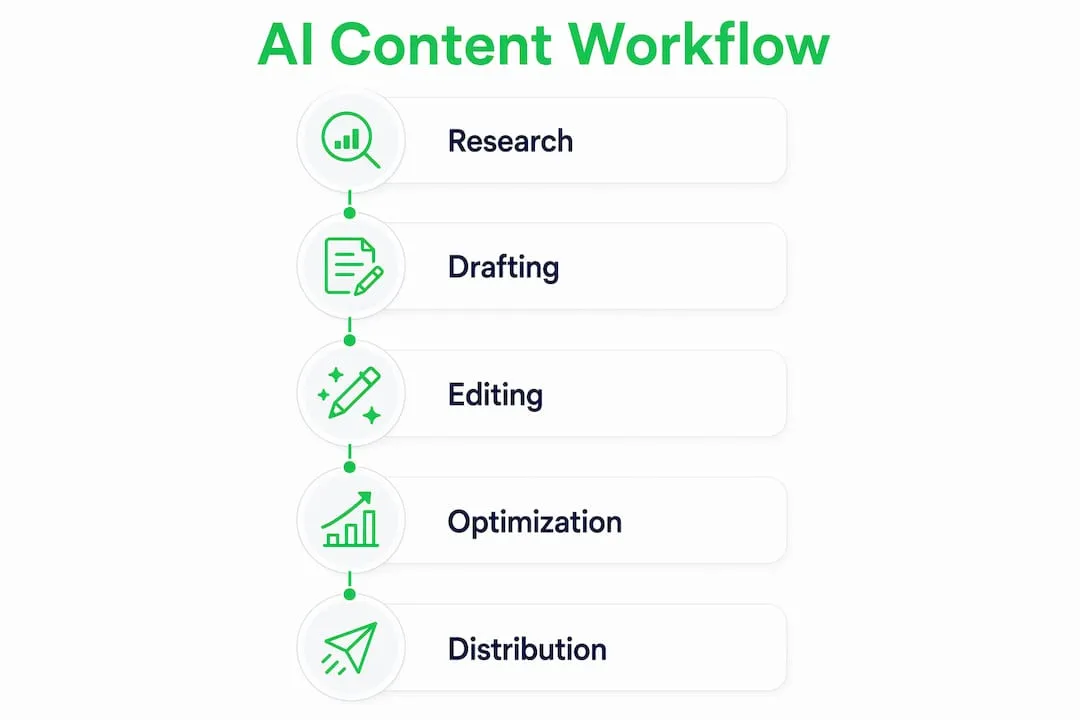
What are the main benefits of leveraging AI-powered content?
The benefits of AI content go well beyond speed, though speed alone is striking. The real advantage is what that speed makes possible across your entire content operation.
- Faster production. Initial drafts produced in under one minute mean your team can publish more without hiring more writers.
- Lower cost per piece. Reducing reliance on large writing teams cuts your cost per article significantly, freeing budget for distribution and paid amplification.
- Built-in SEO structure. AI tools apply heading hierarchies, keyword placement, and meta descriptions consistently, which manual writers often skip under deadline pressure.
- Multilingual and multichannel reach. AI-generated content supports consistent brand tone across thousands of pieces and scales into multiple languages without proportional cost increases.
- 24/7 production capacity. AI does not work business hours. You can queue briefs overnight and wake up to finished drafts.
- Dynamic personalisation. AI can adapt tone, length, and angle for different audience segments from a single brief, something that would take a human team days to replicate manually.
The personalisation point is underappreciated. Most marketers use AI to write faster. The sharper operators use it to write differently for each channel, each segment, and each stage of the buying cycle, all from one source document.
A luxury marketing campaign that took six weeks in 2024 can now be completed in five days with structured AI content models. That compression does not just save time. It means you can respond to market shifts, product launches, and competitor moves in near real time.

Pro Tip: Track cost per published piece before and after introducing AI drafting. Most teams see a reduction within the first month, which makes the business case for further investment straightforward.
How does AI content creation work alongside human expertise?
AI drafts are a starting point, not a finished product. The distinction matters enormously for quality, trust, and search performance.
Adding a human-led review phase of 30–45 minutes boosts a piece’s E-E-A-T signals and AI citation potential significantly. E-E-A-T stands for Experience, Expertise, Authoritativeness, and Trustworthiness. It is the framework Google uses to evaluate content quality. A named author, a proprietary data point, and a specific opinion all contribute to it. Generic AI output contributes none of those things.
Effective AI content workflows combine AI drafting with human enrichment for proprietary data and narrative voice. The workflow looks like this in practice:
- AI generates the structure and first draft from a detailed brief.
- A subject expert adds proprietary data, a named opinion, or a case study that only your organisation holds.
- An editor checks tone, removes generic phrasing, and confirms the piece matches your documented brand voice.
- A final pass checks for factual accuracy and SEO alignment before publication.
Compounding proprietary data and expert content increases future AI citations and search visibility, building a competitive advantage over time. Each piece that contains genuine insight becomes a reference point for AI search tools like Perplexity and ChatGPT. That compounds. Organisations that publish generic AI content get none of that benefit.
The technique known as vibewriting, iterative steering of AI output with human rough feedback, produces richer and more authentic content than one-shot generation requests. Rather than writing one prompt and accepting the result, you push back, redirect, and refine. The output reflects your actual thinking rather than an averaged version of everything the model has read.
Pro Tip: Document your brand voice in a one-page reference sheet covering tone, vocabulary preferences, and topics to avoid. Share it with every AI prompt as a system instruction. The consistency improvement is immediate.
What practical workflows help build an effective AI content strategy?
An AI content strategy is a documented system spanning audience, keyword, production, distribution, and measurement layers. Most marketers skip the system and jump straight to the tool. That is why their results plateau after the first few weeks.
The five-layer model works as follows:
- Audience layer. Define who you are writing for, what questions they ask, and what they already know. This feeds every brief you create.
- Keyword layer. Map search intent to content types. Informational queries need explanatory articles. Transactional queries need product pages and comparison content.
- Production layer. Use AI to draft from structured briefs. One brief should generate a long-form article, a social post series, an email, and a short video script simultaneously.
- Distribution layer. Automate publishing to your CMS and scheduling to social channels. Tools that integrate directly with platforms like Shopify or WordPress remove the manual handoff entirely.
- Measurement layer. Track AI overview rankings, inbound conversations attributed to content, and cost per published piece. These three metrics tell you whether your system is working.
| Workflow layer | Primary input | Key output | Success metric |
|---|---|---|---|
| Audience | Research and personas | Validated brief template | Brief completion rate |
| Keyword | Search data | Content calendar | Keyword coverage |
| Production | Structured brief | AI draft plus expert edit | Cost per piece |
| Distribution | Finished content | Published and scheduled posts | Time to publish |
| Measurement | Analytics data | Performance report | AI citation rate |
Brands that document brand voice, optimise AI workflows, and measure AI overview rankings dominate content reach and engagement. The measurement step is where most teams fail. They produce content and hope for results. The teams that win treat measurement as a feedback loop that improves every subsequent brief.
Repurposing is where the economics become genuinely compelling. One strategic brief, properly structured, produces a long-form article, three social posts, one email newsletter section, and a short-form video script. That is five assets from one hour of strategic thinking. For e-commerce businesses, the same logic applies to bulk product listing automation, where a single product data import generates dozens of unique, SEO-ready descriptions simultaneously.
Aligning your content output with paid media also sharpens returns. A well-structured Google Ads quality guide shows how content quality scores directly affect ad costs. Better organic content and better paid content reinforce each other.
What are the risks of AI-powered content, and how do you avoid them?
The biggest risk is not that AI produces bad content. The risk is that it produces enormous volumes of mediocre content very efficiently. Content volume matters only when it is useful and specific. Generic AI content wastes time and damages trust.
The pitfalls to watch for:
- Skipping human review. AI drafts contain confident-sounding errors. A 30-minute editorial check catches factual mistakes before they reach your audience.
- Removing named authorship. Anonymous content scores poorly on E-E-A-T signals. Every published piece should carry a named author with a verifiable profile.
- Ignoring AI search optimisation. Content must serve two audiences: humans needing trust and AI bots requiring clear structured data for citation. Failing to optimise for both reduces traffic as AI-driven search grows.
- Publishing without proprietary data. A piece that contains only information available elsewhere gives readers no reason to cite, share, or return to your site.
- Over-relying on one AI tool. Single-tool dependency creates a single point of failure. Diversify your production stack across drafting, editing, and SEO checking functions.
Misusing AI to replace expertise with generic content results in low trust and poor SEO performance. The correction is not to use less AI. It is to use AI for what it does well, which is structure, speed, and consistency, and to use human experts for what they do well, which is insight, opinion, and proprietary knowledge.
Pro Tip: Read your AI draft aloud before publishing. Phrases that sound plausible in text often sound hollow when spoken. If a sentence makes you pause, rewrite it. That pause is your editorial instinct working correctly.
Key takeaways
AI-powered content delivers genuine speed and scale advantages only when paired with documented workflows, human editorial review, and proprietary expert input.
| Point | Details |
|---|---|
| Speed without system fails | AI drafting saves hours per piece, but only a documented five-layer system sustains quality at scale. |
| Human review is non-negotiable | A 30–45 minute editorial pass adds E-E-A-T signals that generic AI output cannot produce alone. |
| Proprietary data compounds | Expert insights and original data increase AI citations over time, building lasting search visibility. |
| Dual-audience optimisation | Content must satisfy human trust needs and AI bot structures simultaneously to maintain traffic. |
| Measurement closes the loop | Tracking AI citation rate and cost per piece turns content production into a self-improving system. |
The shift I keep seeing content teams miss
The content creators who get the most from AI are not the ones using the most tools. They are the ones who have stopped thinking of themselves as writers and started thinking of themselves as editors and strategists. That shift is harder than it sounds.
Most people I speak with still treat AI as a faster typewriter. They write a prompt, accept the output, and publish it with light edits. The results are predictable: content that reads like everything else, ranks briefly, and earns no citations. The role of a content creator has shifted towards strategic direction and editorial control rather than pure writing. That is not a threat to good writers. It is an upgrade in what good writing actually requires.
What I have found works is treating the brief as the creative act. A well-constructed brief, with audience context, a specific angle, proprietary data points, and a documented brand voice, produces AI output that needs far less correction. The thinking happens before the AI touches the keyboard. The AI executes. You judge and refine.
The measurement piece is where I see the most neglect. Teams publish consistently for three months, see modest results, and conclude that AI content does not work for their industry. They have never measured AI overview rankings, inbound conversations, or citation rates. They are flying without instruments. Build the measurement layer first, even before you scale production, and you will know within weeks what is working and what needs adjusting.
— Koen
How Ecom-eye applies AI content at scale for e-commerce
For e-commerce businesses, the gap between AI content theory and practical application is where most time and money gets lost. Ecom-eye closes that gap directly.

Ecom-eye generates SEO-ready product descriptions in bulk from AliExpress imports or competitor links, producing unique titles, clean descriptions, and AI product images without any manual rewriting. Every page is copyright-safe and structured for Google Merchant approval. For Shopify dropshippers who currently copy competitor pages and wonder why their rankings stagnate, this is the direct fix. The Ecom-eye bulk AI product lister exports finished pages to Shopify in one click, with multilingual support built in. The same AI content advantages discussed throughout this article apply directly to your product catalogue, at a scale no manual team can match.
FAQ
What is AI-powered content?
AI-powered content is written material generated, structured, or optimised with artificial intelligence tools. It covers everything from blog articles and product descriptions to social posts and email copy.
How does AI content improve SEO performance?
AI applies consistent heading structures, keyword placement, and meta descriptions across every piece it produces. Paired with human editorial review, this consistency improves search rankings more reliably than manual writing under deadline pressure.
Does AI content replace human writers?
AI does not replace human writers. It handles drafting and structure so that writers can focus on proprietary insights, editorial judgement, and brand voice, which are the elements that determine whether content earns trust and citations.
How long does a human review of AI content take?
A thorough editorial review of an AI draft takes 30–45 minutes. That investment adds E-E-A-T signals, catches factual errors, and separates genuinely useful content from generic filler.
What metrics should I track for AI content performance?
Track AI overview rankings, inbound conversations attributed to content, and cost per published piece. These three metrics show whether your AI content system is building visibility or simply adding volume.
Ready to boost your product pages?
Generate high-converting, SEO-optimized product pages in bulk using AI automation used by e-commerce experts.
No credit card required