AliExpress SEO Titles: Put AI Copy’s First 45 Characters to Work
Write AliExpress titles for SEO with the product type and strongest keyword first, then add attributes within platform limits and avoid promotional filler.

AliExpress SEO Titles: Put AI Copy’s First 45 Characters to Work

Lead with the product type and strongest keyword in the first 15–45 characters, keep the title factual and readable, and use structured-title attributes for AI-generated copy. That habit can help make titles clearer and more suitable for product feeds. Everything else, from spelling to symbols, supports it. Below, we show you the rules and a copyable formula.
TL;DR:
- Place the product type first, then its main attribute and any searched or filtered variant, keeping these essentials within the first 15–45 characters.
- Keep titles natural and factual; remove promotional wording, repeated keywords, misspellings, and decorative symbols that may trigger Merchant Center warnings.
- Google Merchant Center permits feed titles up to 150 characters and requires titles created with AI to use the structured_title attribute.
- Test title changes on a small product sample, changing titles alone; compare impressions, click through rates, conversions, and feed diagnostics against similar unchanged listings.
Table of Contents
- What rules should your AliExpress title follow?
- How do AI and feed rules change your title strategy?
- What formula should you use to write each title?
- How do you test titles and scale the rewrite?
- Why do unique, readable titles reduce friction?
- How do we apply this guide across a whole catalogue?
- FAQ
- Sources
What rules should your AliExpress title follow?
Seller guidance on optimising AliExpress titles points to the first 15–45 characters as the part that matters most. It also notes the platform allows roughly 128 characters in total. You can use that space when you need it, but treat the front of the title as the headline and the rest as supporting detail. Seller guidance recommends prioritising the opening characters of AliExpress titles. Check how your title appears to buyers, since display can vary by device and layout.
This matters for two reasons. First, ranking: the start of the title is where the platform expects the product type. Second, display: on a phone, a shopper sees only the first few words in a search grid. If those words are promotional filler, you have used the opening of the title on terms a buyer may not search for.
What goes at the front of the title
Put these items first, in this order:
- Product type, named the way a buyer would search for it (“Wireless Earbuds”, not “Audio Device”).
- Main attribute, such as material, compatible device or key feature.
- Size or variant, only when buyers filter or search by it.
Anything else, such as a use case or an extra feature, belongs after the first 45 characters or so. If the title is cut off, you lose the extras, not the essentials.
What to keep out of the indexed portion
The same seller guidance recommends removing unnecessary conjunctions, controlling how often a word repeats, and avoiding special symbols. Promotional tokens add nothing a buyer searches for. Repeated keywords make the title read like spam, and a misspelling means the right shoppers never find you.
Here is a quick scan list:
- Do start with the product type and the one keyword buyers use most.
- Do write in natural phrases a person could read aloud.
- Do check spelling against the terms your target market actually uses.
- Do use the full 128 characters only when each extra word adds a real attribute.
- Don’t open with “Hot sale”, “Best price”, “Free shipping” or similar.
- Don’t repeat keywords just to make a title look relevant.
- Don’t use stars, arrows, brackets or other decorative characters.
- Don’t copy the supplier’s machine-translated title untouched.
Pro Tip: Read the first 45 characters of your title on its own. If a stranger could not tell what you sell from those characters alone, rewrite the opening.
For a wider view on length across channels, our guide to Google Shopping title length explains how to approach titles when your products reach Google.
How do AI and feed rules change your title strategy?
Search on large marketplaces is no longer a simple keyword match. Alibaba Group has said it deployed generative AI at scale across its commerce platforms to improve search and recommendations. In practice, that changes how product copy is interpreted. Because systems interpret language, it may be useful to describe what the product is and who it suits.
Google’s own position on machine-written content points the same way. Its guidance on generative AI content stresses usefulness for people over the method used to produce the text. A title that states the product plainly and accurately holds up under both views. A keyword-stuffed list does not.
What Google Merchant Center asks for
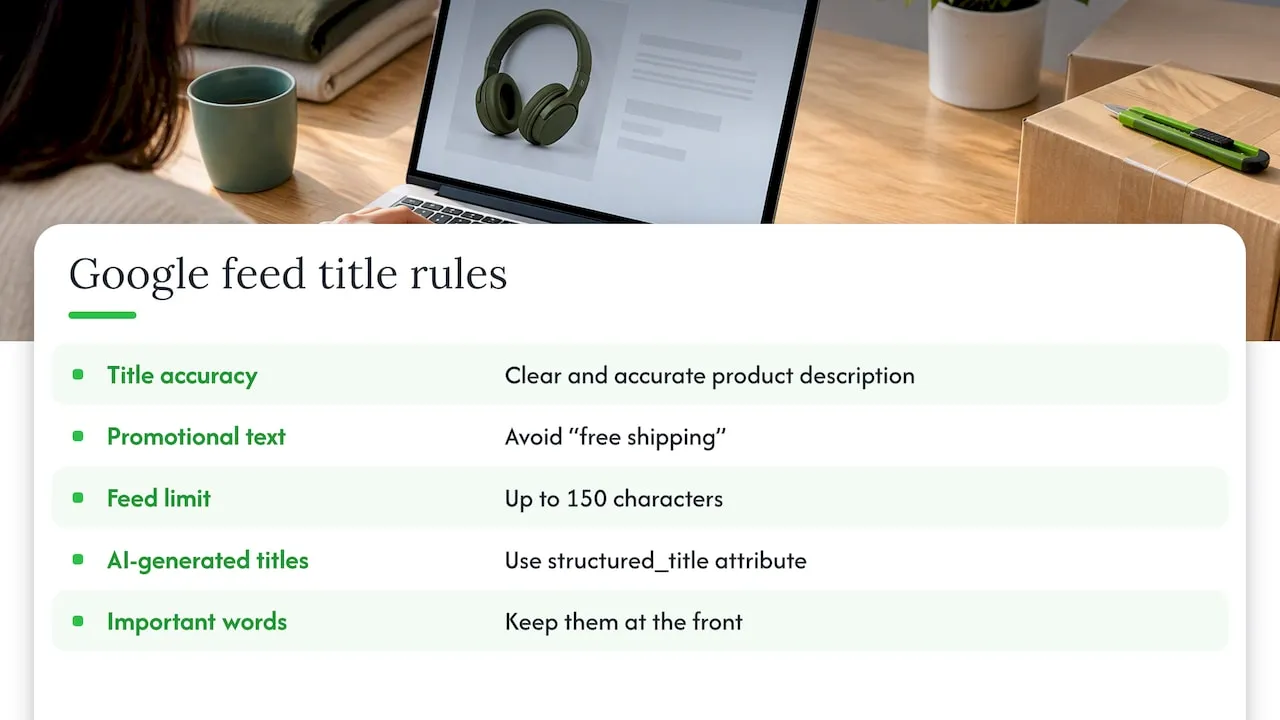
If your products flow into Shopify and then into Google, the feed rules apply too. The Merchant Center product data specification requires clear, accurate titles that describe the product. It tells sellers to avoid promotional text such as “free shipping” and allows titles of up to 150 characters in feed attributes. It also says AI-generated titles should be supplied with the structured_title attribute, so the platform knows the text was produced by a model.
Google allows feed titles of up to 150 characters, but asks that AI-generated ones be labelled through the structured_title attribute. Keep the important words at the front anyway: a longer limit is room for detail, not permission to bury the product type.
A checklist for AI-written titles
Use this before you publish a batch:
- Supply AI-generated titles through the structured_title attribute, as the feed specification describes.
- Make sure the title matches the product on the landing page: same item, same variant, same brand.
- Remove promotional phrases, delivery claims and decorative characters.
- Check that each title reads naturally and says something different from your other listings.
- Confirm the product type appears in the first words, not after a list of adjectives.
Why gimmicks hurt exposure
Promotional words and odd symbols are discouraged because they describe the offer rather than the product. Merchant tools may flag promotional wording or unusual symbols, so keep titles focused on the product. Shopify practitioners also note that raw supplier titles are often machine-translated and keyword-stuffed, which is why many dropshippers rewrite them into readable, benefit-led titles and treat the original as a placeholder. Rewriting also avoids the duplicate-content problem that comes from publishing the same title as hundreds of other stores.
What formula should you use to write each title?
Use one repeatable pattern, so that every product in your catalogue follows the same logic:
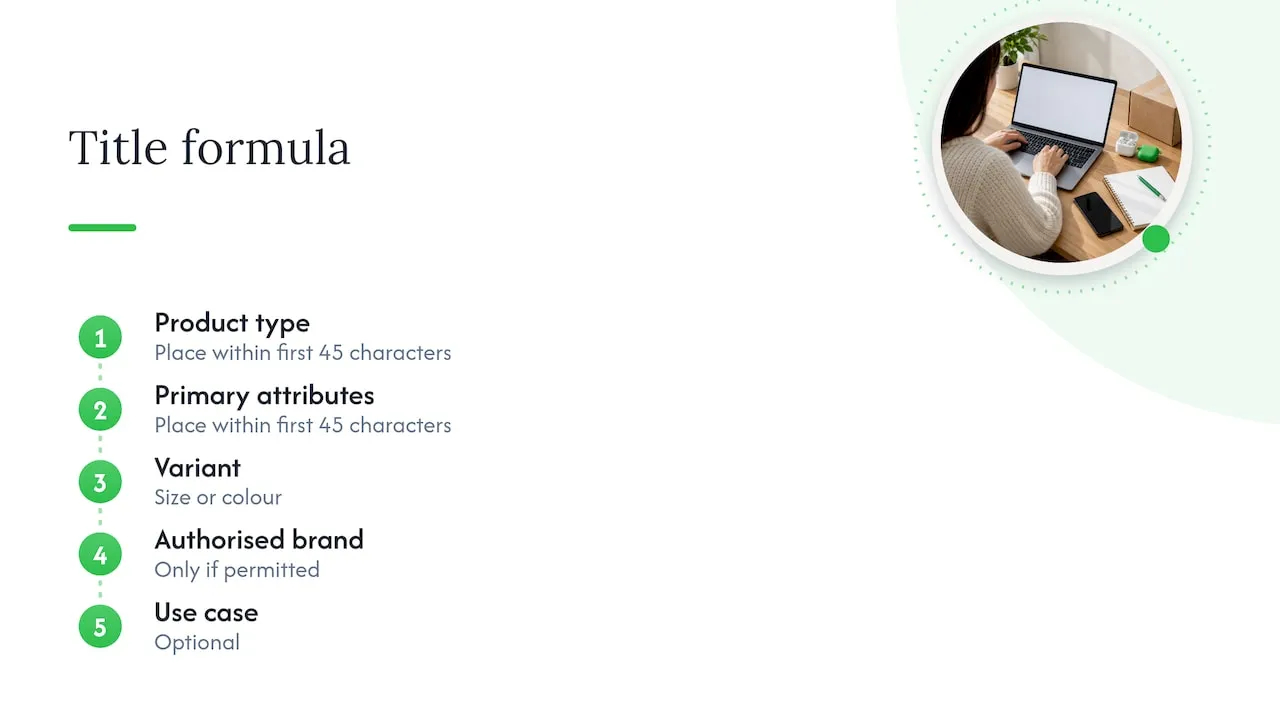
Product type + primary attribute(s) + variant (size or colour) + authorised brand (only if permitted) + optional use case
The first two parts must land inside the first 45 characters. Everything after that is a bonus that may or may not be seen.
How do you choose attributes?
Pick the attributes a buyer would type or filter by: material, size, colour, compatible device, and use case. Cross-border buyers often use different words for the same item, so research the terms used in your target market instead of relying on the supplier’s English. One practitioner source on AI compliance for Merchant Center makes this point about alternative terminology. If a US shopper says “sneakers” and the supplier wrote “casual sports shoes”, the supplier’s phrase loses.
Three before and after examples
- Before: “Hot Sale Fashion Women Casual Sport Shoes Breathable Mesh Sneakers Lady Running Shoes Female”. After: “Women’s Running Sneakers, Breathable Mesh, Lightweight, Available Sizes”. The product type and main attribute now open the title, and the repeated “shoes” and the year are gone.
- Before: “Wireless Bluetooth Headset Earphone Sport Earbuds Noise Cancelling Waterproof Hot New”. After: “Wireless Earbuds, Bluetooth, Noise Cancelling, Waterproof, Charging Case”. We kept the product term, cut the filler, and listed attributes buyers may compare.
- Before: “★Best Price★ Phone Case For iPhone Pro Max Luxury Shockproof Silicone Cover Free Ship”. After: “iPhone Pro Max Case, Shockproof Silicone Cover, Black”. The stars and the “Free Ship” claim are removed, and the compatible device is stated clearly.
Each change makes the title easier for a person to scan and easier for a system to classify.
Plurals, numbers and variants
Choose singular or plural based on how buyers search (“earbuds” is naturally plural, “phone case” is singular) and keep it consistent across similar products. Write numbers as digits with their unit when the value is relevant to the product. Put variant identifiers such as size or colour after the core description, and keep the wording the same as on the product page so feed checks match.
Pro Tip: Write the formula on a card and fill it in for ten products by hand before you automate anything. You will spot which attributes buyers care about in your niche.
If you want more worked examples, we cover the pattern in depth in the product title formula every ecommerce seller should use.
How do you test titles and scale the rewrite?
Start small. Pick a sample of products, change only the titles, and compare results over a fixed period against similar products you left alone. Our walkthrough on how to test SKUs with SEO-ready AI titles shows one way to run this.
Watch these measures:
- Impressions: are more shoppers seeing the listing?
- Click-through rate: does the new opening make people click?
- Conversion rate: do the clicks turn into orders, or did the title attract the wrong buyers?
- Merchant and feed diagnostics: are there new warnings about titles, promotional text or mismatches?
Change one thing at a time. If you rewrite titles, images and prices together, you will not know what worked. Our notes on optimising product page titles for Shopify SEO and conversions cover how to read these metrics together.
A bulk workflow that holds up
When the sample works, scale it with a fixed routine:
- Extract the supplier titles for every product.
- Research the keywords your target market uses for each product type.
- Generate readable titles that follow the formula, with the product type up front.
- Preview the first 45 characters on a mobile screen.
- Check that each title is unique and matches its landing page.
- Export to Shopify and review feed diagnostics after a few days.
What kinds of tools help
You do not need a long list of products. You need a few categories: keyword research tools that show what buyers search, feed validators that flag title problems before submission, and bulk editors that import supplier data and export to your store. For AI-assisted generation workflows more broadly, this overview of AI poster generation tools shows how teams structure bulk creative output, and the same discipline applies to titles: fixed inputs, review, then publish.
Why do unique, readable titles reduce friction?
Some dropshippers may struggle with content as well as product selection. They publish the supplier’s title, the supplier’s description and the supplier’s photos, then wonder why Google ignores them or Merchant Center disapproves the feed. We built our workflow to create unique, readable, factual titles that clearly describe each listing.
We discuss ways to evaluate title changes in our posts on testing product samples. AI-generated copy tailored to each store can help make listings more distinctive. Rather than simply adding keywords, we prefer a cleaner title with a clear product type because it is easier for shoppers to read.
— Koen
How do we apply this guide across a whole catalogue?
Rewriting titles one by one can become painful as your catalogue grows. We automate the full workflow: you import products in bulk from AliExpress or competitor links, and we generate unique AI titles and descriptions, produce AI product images, and export everything to Shopify in one click. Our titles are generated for each listing, and every listing is unique even when based on the same product link.
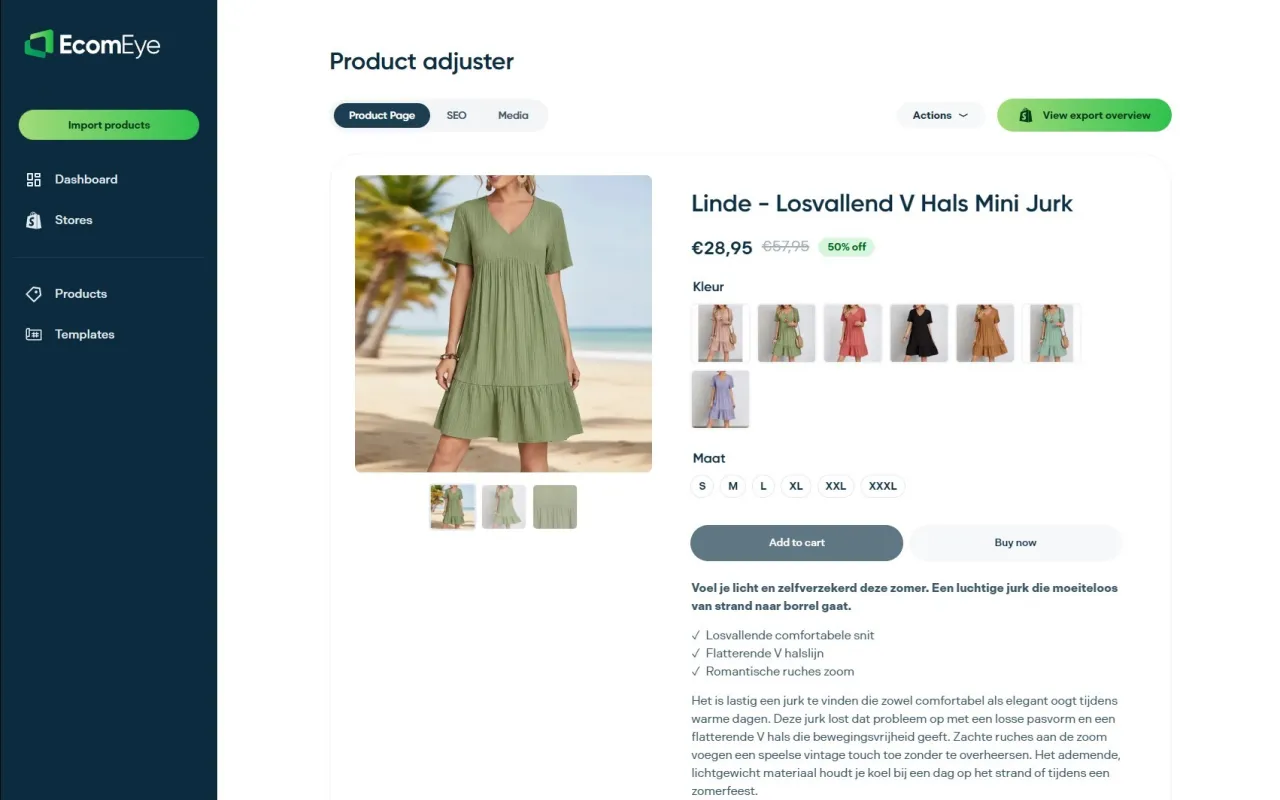
Our Try-out plan costs 39 EUR per month and Scaler costs 99 EUR per month, both listed on our pricing page. You can also see how our AI product description generator works. Pick a small batch, run it through, and check the result against the formula above.
FAQ
What should your SEO title be?
Your SEO title should name the product type first, add the one or two attributes buyers search for, and read like natural language. Keep the most important words in the first 15–45 characters and avoid promotional phrases and decorative symbols.
Does AliExpress have an affiliate program?
Yes, AliExpress runs an affiliate programme for people who promote its products, but its terms and commission rules change, so check the current details on the official AliExpress affiliate page before you join. It is separate from selling on the platform, which is what this guide covers.
How long can an AliExpress title be?
AliExpress allows roughly 128 characters, according to seller guidance on title optimisation. You can use the full length when each word adds something real, but the first 15–45 characters carry the most weight.
Should I label AI-generated titles in my feed?
Yes. Google’s feed rules say AI-generated titles should be supplied with the structured_title attribute, as described in the Merchant Center specification. The title should also match the product on your landing page.
Sources
Ready to boost your product pages?
Generate high-converting, SEO-optimized product pages in bulk using AI automation used by e-commerce experts.
No credit card required