LSI keywords in product pages: the 2026 SEO guide
Discover the essential role of LSI keywords in product pages. Boost your SEO strategy and connect with buyers effectively in 2026!

LSI keywords in product pages: the 2026 SEO guide

TL;DR:
- Semantic keywords build topical context for product pages, helping Google match content to buyer queries. They improve search visibility and increase conversions by addressing customer concerns naturally. Using structured data and interlinked content further strengthens SEO authority in 2026.
LSI keywords, more accurately described as semantic keywords or related topical concepts, are terms that signal to search engines what a product page is genuinely about. The role of LSI keywords in product pages is not to trigger rankings through exact phrase matching. Their function is to build semantic context, helping Google understand the full scope of your content and match it to the right buyers. For e-commerce professionals, this distinction changes everything about how you write and structure product pages.
What are LSI keywords really: misconceptions versus modern semantic SEO
The term “LSI keywords” is a misnomer that has persisted in SEO circles for over a decade. Latent Semantic Indexing was a document retrieval technique from the 1980s. Google does not use it for ranking. Treating it as a ranking mechanism leads to wasted effort and poorly written product pages.
Google’s actual systems rely on NLP models like BERT and MUM to interpret what a page means. These models read context, not keyword lists. A product page for a waterproof hiking boot that mentions “grip”, “ankle support”, “wet terrain”, and “trail conditions” signals topical completeness. One that simply repeats “waterproof hiking boot” six times signals nothing useful.
The practical implication is significant. Semantic SEO focuses on topical depth and content completeness rather than keyword density. Google’s algorithms reward pages that comprehensively cover a topic and align with what the searcher actually wants to know.
Using the phrase “LSI keywords” with technical SEOs can undermine your credibility. The preferred terminology is semantic entities or related topical concepts, which aligns with how modern NLP systems actually process content. Adopting this language also sharpens your thinking about what belongs on a product page.
Key distinctions to keep in mind:
- LSI keywords (outdated framing): A checklist of related words inserted to manipulate rankings.
- Semantic keywords (current framing): Naturally occurring terms that reflect how real customers talk about a product.
- Entity recognition: Google identifies named things, attributes, and relationships, not just word frequency.
- Topical coverage: A page ranks better when it answers the full range of questions a buyer might have, not just the primary query.
Pro Tip: Run your product page through a question-based framework. Ask: what would a first-time buyer want to know before purchasing? Every answer you include is a semantic keyword opportunity.
How do semantic keywords improve product page SEO and conversions?
Semantic keywords do two jobs simultaneously. They help search engines understand your page, and they help buyers trust your product. Both outcomes improve your bottom line.

Product pages with benefit-led, semantically varied content achieve 15–25% higher add-to-cart rates compared to keyword-stuffed pages. The reason is straightforward: varied, natural language reads like a knowledgeable recommendation rather than a sales script. Buyers respond to that.
The conversion impact goes further. Fixing semantic mapping and core UX on product pages yields an average conversion rate improvement of 35.26%. That figure reflects what happens when a page stops trying to rank and starts trying to answer. Semantic language that addresses customer concerns, such as sizing accuracy, material durability, or compatibility, removes the friction that kills purchases.
Customer reviews and FAQs are your best source of semantic language. They contain the exact words buyers use when they search. A review that says “runs small, order a size up” gives you the phrase “sizing” and the concern “fit accuracy”. Both belong in your product description. This approach also connects naturally to high-converting product descriptions that map customer language directly to purchase decisions.
The four practical benefits of semantic keyword integration on product pages:
- Improved topical relevance: Google reads the full page and recognises it as authoritative on the subject.
- Reduced bounce rate: Buyers find answers to their questions without leaving the page.
- Higher add-to-cart rates: Trust built through complete information converts browsers into buyers.
- Broader search visibility: Semantic coverage captures long-tail queries you never explicitly targeted.
Best practices for optimising product pages with semantic keywords in 2026
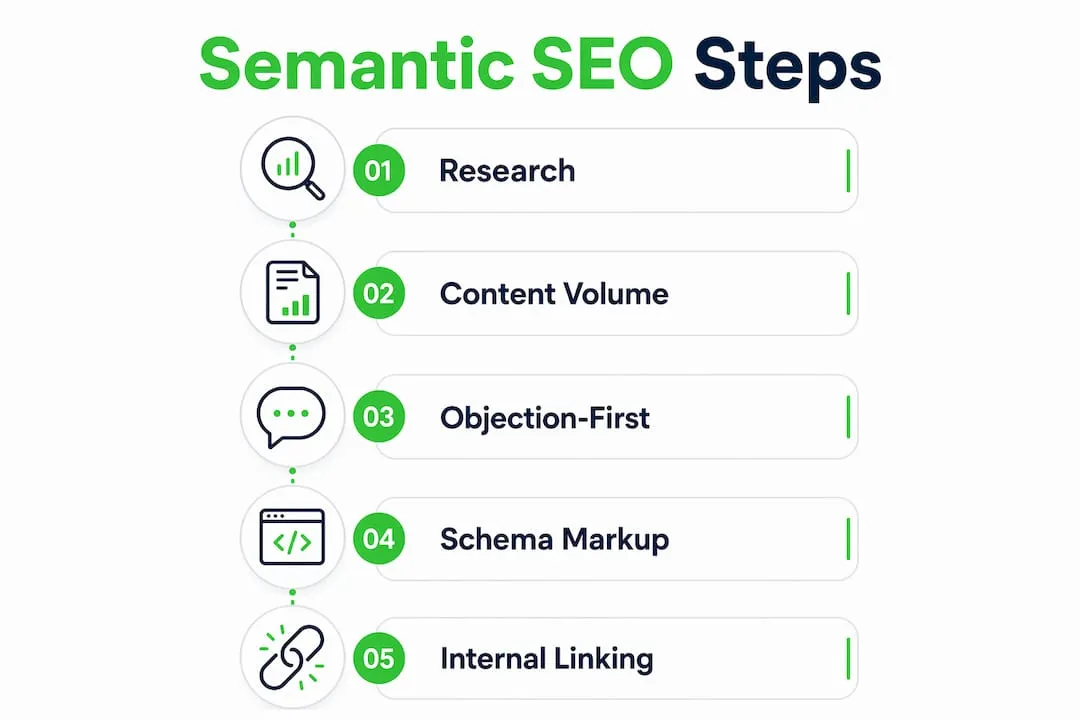
Effective semantic optimisation starts with content volume and structure. Best practice is 150–300 words of unique copy with natural semantic variations in headings and body text. That range is enough to cover a topic thoroughly without padding. Every sentence should earn its place by answering a real buyer question.
Where to place semantic keywords
Placement matters as much as selection. Distribute related terms across every content element on the page:
- H1 and H2 headings: Use benefit-led language and product attributes, not just the product name.
- Body copy: Write in the language of your customer, drawing from reviews, FAQs, and support queries.
- Meta title and description: Include the primary term and one or two closely related attributes.
- Image alt text: Describe what is in the image using natural product language, not keyword strings.
- Bullet point specifications: Format technical details as scannable lists. Buyers scan before they read.
Objection-First Architecture
Objection-First Architecture is a content structure that places your most common customer objections at the top of the product description. If buyers consistently ask about compatibility, durability, or returns, address those concerns in the first 50 words. This approach uses semantic phrases naturally because objections are written in customer language, not SEO language.
Schema markup
Schema markup for product pages is non-negotiable in 2026. Product schema tells Google the price, availability, rating, and category of your item in structured data. This enables rich results in Google Shopping and AI Overviews. Schema also reinforces the semantic signals in your page copy by giving Google a machine-readable summary of what the page is about.
| Content element | Semantic keyword placement | Priority |
|---|---|---|
| H1 heading | Primary term plus key attribute | High |
| Body copy | Customer language, objections, benefits | High |
| Meta description | Primary term plus one related concept | Medium |
| Image alt text | Descriptive product language | Medium |
| Schema markup | Structured product data | High |
Pro Tip: Pull your top five customer support questions for each product and answer them directly in the product description. You will cover semantic ground you would never find through keyword research alone.
How do semantic clusters and internal linking strengthen product pages?
No product page ranks in isolation. Topical authority builds from overall site architecture, not from a single well-written page. A product page embedded within a cluster of interlinked content, including category pages, buying guides, and blog posts, carries far more weight than a standalone page with identical copy.
A semantic cluster works like this. Your category page for “running shoes” links to individual product pages. Each product page links back to the category and to a relevant blog post, such as “how to choose trail running shoes”. That blog post links to two or three product pages. Google reads the entire cluster and recognises your site as a genuine authority on running footwear. Embedding product pages within interlinked content significantly enhances SEO authority in exactly this way.
For Shopify stores, this means your product page structure should be planned at the collection level, not the individual product level. Collections are your cluster hubs. Blog content feeds authority into them. Product pages receive that authority through internal links and shared semantic context.
| Approach | SEO outcome |
|---|---|
| Isolated product page optimisation | Limited authority, narrow ranking potential |
| Semantic cluster with interlinked content | Broader topical authority, stronger ranking signals |
The internal linking strategy also distributes page authority across your store. A well-linked product page benefits from the domain authority of your blog and category pages. That compound effect is why ecommerce SEO best practices consistently emphasise site architecture alongside on-page content.
Key takeaways
Semantic keywords, not outdated LSI keyword lists, are what drive product page rankings and conversions in 2026.
| Point | Details |
|---|---|
| LSI is a misnomer | Google uses BERT and MUM, not Latent Semantic Indexing, to interpret page content. |
| Semantic coverage converts | Benefit-led, varied copy achieves 15–25% higher add-to-cart rates than keyword-stuffed pages. |
| Objection-First Architecture works | Address top customer concerns at the start of your description to build trust and reduce bounce. |
| Schema markup is non-negotiable | Product schema enables rich results and AI Overview visibility in 2026. |
| Clusters outperform isolated pages | Interlinked category pages and blog content build topical authority that single pages cannot achieve alone. |
Why I stopped chasing LSI keywords and started building semantic depth
I spent years watching e-commerce clients obsess over LSI keyword lists generated by tools that were already outdated. The lists felt productive. They gave teams something to tick off. But the results rarely matched the effort, because the underlying model was wrong.
The shift that actually moved rankings was simpler and harder at the same time. Write product pages as if you are the most knowledgeable salesperson in the room. Cover every question a buyer might have. Use the language your customers use, not the language a keyword tool generates. That approach naturally produces semantic depth because real product knowledge is inherently varied and specific.
What I have observed consistently is that brands which build semantic credibility through complete, honest product content also build customer trust. Those two outcomes compound. Better rankings bring more traffic. More trust converts that traffic at a higher rate. The brands still chasing keyword density are competing for scraps.
The uncomfortable truth is that semantic SEO rewards genuine expertise. You cannot fake topical authority with a keyword list. You build it by knowing your products deeply and communicating that knowledge clearly. That is the standard Google is moving towards, and it is the right standard for buyers too.
— Koen
Ecom-eye: semantic product pages at scale
Scaling semantic product page optimisation manually is the bottleneck most Shopify dropshippers hit first. Writing 150–300 words of unique, benefit-led copy for hundreds of products is not realistic without a system.
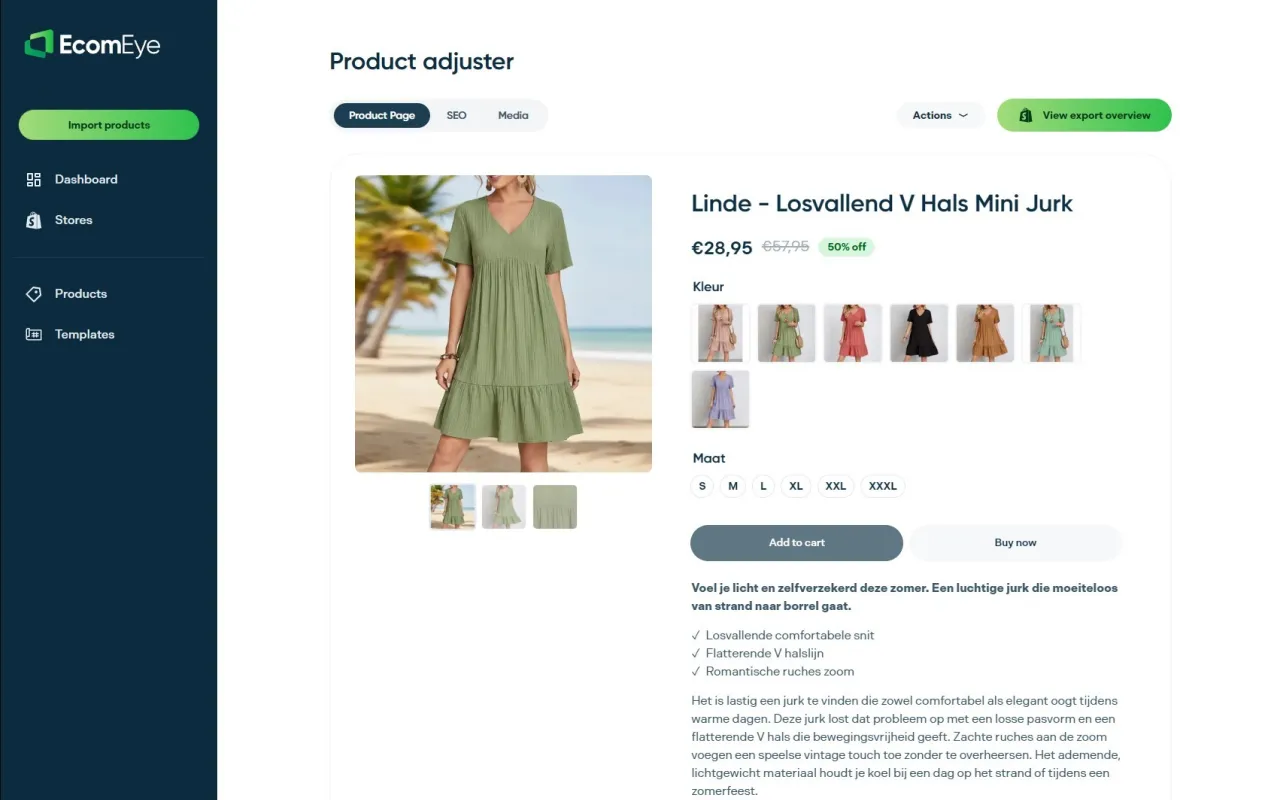
Ecom-eye solves this directly. The platform imports products in bulk from AliExpress or competitor links and generates SEO-ready titles, clean descriptions, and semantically varied content automatically. Every page is unique, copyright-safe, and built to avoid the duplicate content penalties that sink most dropshipping stores in Google rankings. You can explore the full bulk AI product lister to see how it handles semantic optimisation at scale, including multi-language pages and direct Shopify export in one click.
FAQ
What is the actual role of LSI keywords in product pages?
The role of semantic keywords in product pages is to build topical context, helping search engines understand the full scope of your content and match it to relevant buyer queries. Google does not use Latent Semantic Indexing; it uses NLP models like BERT and MUM to interpret meaning.
Do LSI keywords directly improve rankings?
Semantic keywords do not directly trigger rankings through exact matching. They improve rankings indirectly by increasing topical relevance, which Google’s algorithms reward with better visibility across a wider range of related search queries.
How many semantic keywords should a product page include?
There is no fixed number. Best practice is 150–300 words of unique copy with naturally varied language drawn from customer reviews, FAQs, and product specifications. Coverage of the topic matters more than keyword count.
What is Objection-First Architecture on a product page?
Objection-First Architecture places your most common customer concerns, such as sizing, compatibility, or durability, at the top of the product description. It uses semantic phrases naturally because customer objections are written in buyer language, not SEO language.
How does schema markup support semantic SEO on product pages?
Product schema provides Google with structured data about price, availability, and category, reinforcing the semantic signals in your page copy. In 2026, schema is essential for rich results in Google Shopping and visibility in AI Overviews.
Ready to boost your product pages?
Generate high-converting, SEO-optimized product pages in bulk using AI automation used by e-commerce experts.
No credit card required