The best AI product descriptions come from a spec block, not a blank prompt
Unlock the power of AI product descriptions by using a structured spec block for better conversions and compliance with Google Merchant.

The best AI product descriptions come from a spec block, not a blank prompt

The fastest way to get AI product descriptions that actually convert is to feed the generator a strict spec block (title, three to six real facts, buyer persona, tone, keywords), apply an SEO and brand ruleset, then run bulk generation and check every claim before you publish. This beats freehand prompting on every count: it is faster per SKU, it keeps you out of Google Merchant trouble for duplicate content, and structured descriptions built around specs and benefits have been shown to lift purchase intent by 14 to 20% over bare-bones listings. Do this first:
- Build one spec block template with title, features, benefits, persona, tone, keyword
- Run a test batch of 10 to 20 SKUs before touching your full catalogue
- Human-verify every measurement, certification, and compatibility claim
Key Takeaways
AI product descriptions convert best when generated from a structured spec block, refined against SEO rules, scaled through a bulk ruleset, and checked by a human before publishing.
| Point | Details |
|---|---|
| Start with a spec block | Feed the generator title, 3 to 6 facts, persona, tone, and keywords before writing anything. |
| Match template to channel | Use 5-bullet formats for Amazon and 200 to 400 word storytelling for Shopify. |
| Front-load keywords, don’t stuff them | Place your primary keyword in the first 100 words and keep density around 1 to 2%. |
| Build a ruleset before scaling | Set banned words, tone guardrails, and spec validation once, then reuse it across every batch. |
| Verify before publishing | Check every spec, certification, and measurement against source data, never AI inference. |
| Use Ecom-eye for bulk, copyright-safe scaling | Ecom-eye imports products in bulk and exports unique, SEO-ready Shopify pages in one click. |
Table of Contents
- How AI product description generators actually work
- What’s the best way to prompt an AI product description generator?
- How do you SEO-optimise an AI product description without stuffing keywords?
- How do you scale AI product descriptions across a whole catalogue?
- What should you check before publishing an AI-written description?
- What does a good AI product description look like in practice?
- Scale your product pages without the copy-paste risk
- Sources
- FAQ
How AI product description generators actually work
Every generator, from Shopify’s built-in tools to standalone SaaS platforms, runs on the same logic: it can only write well about what you tell it. Feed it a bare product title and you get filler. Feed it a title plus real detail and it writes something a buyer would actually read.
- The model needs five things minimum: product title, a factual spec block (materials, dimensions, compatibility), a one-line buyer persona, a tone instruction, and the channel it’s writing for.
- Channel presets change everything about the output. Ecommerce platforms report that generators perform best when input is detailed and channel-specific, because a marketplace listing and a Shopify product page aren’t the same writing task.
- Amazon wants five punchy, benefit-led bullets. Shopify rewards 200 to 400 words of proper storytelling with specs woven in, a split confirmed by platform-specific formatting guidance that most sellers ignore until their conversion rate tells them to stop.
- The spec block also acts as a guardrail. When you hand the model rigid, labelled facts, it has far less room to invent a certification or a measurement that doesn’t exist.
Skip the spec block and you’re not saving time. You’re just moving the editing work from “before” to “after.”
What’s the best way to prompt an AI product description generator?
Structure beats cleverness.
- Title: exact product name, as it’ll appear on the page
- 3 to 6 factual specs: materials, size, weight, compatibility, included parts
- 2 to 3 benefits: what the buyer gets, not what the product is
- Buyer persona: one line (“busy parent replacing a broken kettle”)
- Tone: playful, premium, technical, minimal
- Top 1 to 3 keywords: the terms you actually want to rank for
Match the template to the job. A short template (50 to 100 words) suits impulse buys and accessories. A medium template (150 to 300 words) fits most Shopify product pages and is where the storytelling-plus-specs mix works hardest. A long/story template (300+ words) earns its length for hero products or anything with a genuine origin story. For marketplaces, use a 5-bullet template: hook, top benefit, second benefit, spec line, trust signal.
Two lines fixed at the end of every prompt do more work than anything else: “Only use facts provided above. Do not invent specifications, certifications, or claims not listed.” That single instruction is the difference between a description you can publish and one you have to fact-check line by line.
Pro Tip: Append a verification checklist to your prompt: “List every factual claim you made, tagged as either ‘from input’ or ‘inferred’.” Anything tagged inferred needs a human check before it goes live.
How do you SEO-optimise an AI product description without stuffing keywords?
Put your primary keyword in the first 100 words, then let it go. Sellers following front-loading guidance tend to rank better without triggering the over-optimisation penalties that come from repeating a phrase four times in one paragraph.
Some working rules:
- Keep keyword density around 1 to 2%, and use natural variations rather than the exact phrase every time.
- Target 50 to 60 characters for the meta title, 150 to 160 for the meta description.
- Generate meta fields as a separate AI pass, not an afterthought bolted onto the product copy.
- Write a genuinely unique description per SKU. Never reuse manufacturer copy verbatim, and keep manufacturer-supplied data confined to spec fields rather than the flowing description text.
The 14 to 20% purchase-intent lift from well-structured, platform-appropriate descriptions only shows up when the copy is unique per product. Duplicate content across your catalogue doesn’t just risk a Google Merchant disapproval. It also cannibalises the SEO value you were trying to generate in the first place.
There’s a second audience now too: AI discovery engines like ChatGPT and Gemini increasingly surface products based on how complete and search-ready their content is, and SKU scoring against that standard is becoming as relevant as scoring for Google.
How do you scale AI product descriptions across a whole catalogue?
Freehand prompting works for ten products. It falls apart at ten thousand. Scaling safely means building a ruleset once and applying it everywhere.
- Write a content ruleset first. This covers banned words, tone guardrails, mandatory SEO rules (keyword placement, meta length), and a spec-validation step that rejects any SKU missing core facts.
- Import in bulk. Pull product data from a CSV, a supplier spec sheet, or directly from AliExpress, Amazon, Temu, or a competitor’s Shopify link, then apply your ruleset to the whole batch at once.
- Template, generate, review, export. Run the batch through your templates, spot-check a sample, then push the approved pages live with one-click Shopify export rather than copying each one by hand.
Rulesets aren’t a nice-to-have at scale. Platform guidance on bulk generation confirms that applying restricted words and tone instructions once and reusing them is what keeps thousands of SKUs sounding like one brand instead of a patchwork of AI drafts, and workflows built this way can automate titles, meta tags, and descriptions across dozens of languages without a proportional rise in headcount.
The sellers who fail at scale aren’t the ones with bad AI output. They’re the ones who never built a ruleset, so every batch of 500 products needs its own manual clean-up pass.
Ecom-eye is built around exactly this pattern: bulk import straight from AliExpress or a competitor’s Shopify link, copyright-safe generation that avoids the duplicate-content trap entirely, and one-click export once the batch is approved.
What should you check before publishing an AI-written description?
AI writers hallucinate in predictable ways: an invented certification, a fabricated compatibility claim, a measurement that’s close but wrong. The fix is a hard rule, not a hope. Never let the model state a spec, measurement, or certification that wasn’t in your original data.
Before anything goes live, check:
- Every factual spec matches the source data, not a plausible-sounding rewrite of it
- Legal or regulatory claims (organic, certified, patented) are genuinely accurate
- Measurements and currency or size conversions are correct for your target market
- The copy follows platform rules (Amazon’s bullet limits, Shopify’s character caps)
Pro Tip: Run new tools through a small test batch first and check third-party reviews before committing a whole catalogue to them. Community feedback on platforms like Trustpilot often flags accuracy issues faster than a vendor’s own marketing does.
After publishing, track conversion rate, return rate (a spike often means the copy overpromised), search position for your target keyword, and time on page as a rough proxy for whether people are actually reading the description.

What does a good AI product description look like in practice?
A Shopify medium-length template fills in: opening hook, two to three benefits, a specs paragraph, and a closing trust signal (guarantee, review count, shipping detail). An Amazon template fills in five bullets: hook, top benefit, second benefit, spec line, trust signal.
- Raw spec block: “Ceramic mug, 350ml, dishwasher safe, matte finish, four colours.”
- AI-refined version: “Start your morning right with a mug that keeps its shine wash after wash. This 350ml ceramic mug has a matte finish that resists chips and stains, and it’s fully dishwasher safe. Available in four colours.”
The jump from raw to refined isn’t magic. It’s structure plus one small human touch: a use-case sentence (“start your morning right”) and a trust signal (dishwasher safe, stated plainly) that a generic spec dump never includes on its own.
A practical note from Koen
Every catalogue I’ve seen improve did the same two things: a written ruleset and a human doing spot checks on the first batch. Skip either step and errors compound fast across thousands of SKUs. For deeper workflows, the Ecom-eye blog covers Shopify-specific description tactics worth reading before your next bulk run.
— Koen
Scale your product pages without the copy-paste risk
Ecom-eye removes the single biggest reason Google dropshippers get flagged: copied competitor listings, a challenge also tackled by MS EXP SP Z O O | Trusted used goods wholesaler in their AI-assisted bulk product listing workflows. Instead of rewriting product pages one by one, or risking Merchant disapprovals from duplicate content, you import products in bulk straight from AliExpress, Amazon, Temu, or a competitor’s Shopify link, and Ecom-eye generates unique titles, SEO-ready descriptions, and AI product images for every SKU automatically.
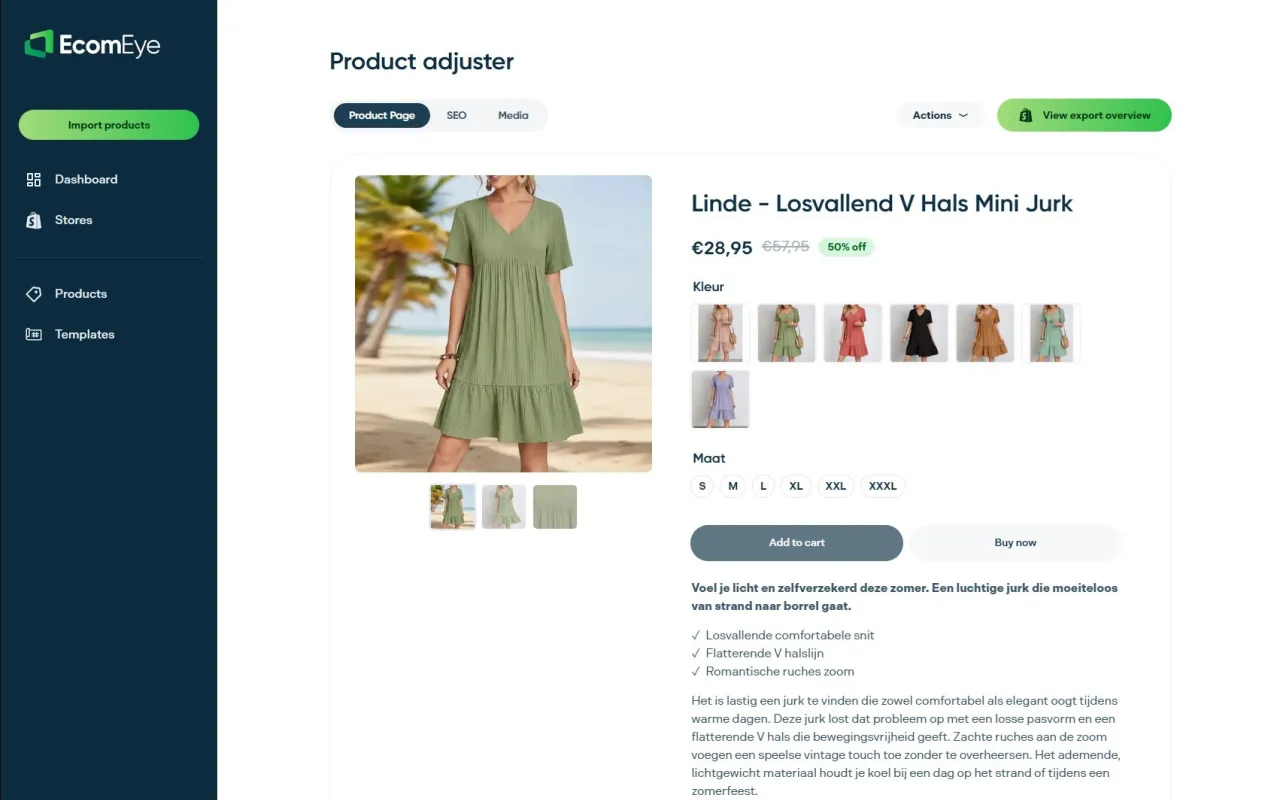
This fits stores adding hundreds of products a week just as well as it fits someone launching their first fifty. You get multi-language pages, built-in templates, bulk editing, and size-system conversion, then a one-click export straight to Shopify with no manual rewriting on your end. If you’re also generating imagery at scale, the AI product image generator runs the same bulk logic for photos. Start with a free trial on the AI product description generator and run your next batch of SKUs through it before you commit your full catalogue.
Sources
- Shopify Magic AI: what it does and how to use it
- Shopify: Magic product descriptions (app listing / feature notes)
- Free AI SEO product description generator | InsightAgent
FAQ
How can I generate a product description with AI?
Feed a generator a spec block (title, three to six facts, benefits, persona, tone, keywords) rather than a bare title, then check the output against your source data before publishing.
What does a good product description example look like?
A strong example opens with a use-case hook, states two to three benefits, lists specs plainly, and closes with a trust signal like a guarantee or review count, rather than a flat list of features.
What are the best AI tools for product descriptions?
Options range from platform-built tools like Shopify Magic to dedicated bulk platforms like Ecom-eye, which focuses on copyright-safe, SEO-ready pages generated at scale from imported product data.
Can AI-generated descriptions hurt my Google Merchant standing?
Yes, if they duplicate competitor or manufacturer copy across multiple SKUs; generating unique descriptions per product through a proper ruleset is what avoids the disapprovals that duplicate content triggers.
Ready to boost your product pages?
Generate high-converting, SEO-optimized product pages in bulk using AI automation used by e-commerce experts.
No credit card required