Google Merchant Center GTIN Requirements for Shopify Dropshippers
What Google Merchant Center actually requires for GTINs, how to find the right one for a supplier's product, and how to avoid disapprovals on a Shopify store.

Google Merchant Center GTIN Requirements for Shopify Dropshippers

Google Merchant Center (GMC) requires a GTIN for every new product that has a manufacturer-assigned one. It must be the real number, with a valid check digit, submitted once per variant. If the product has no GTIN, you submit brand and MPN instead, or mark it as having no identifiers. Anything else risks a disapproval. For a dropshipper, the work is in the details: finding the right number, mapping it to each size and colour, and keeping it intact when you list hundreds of products. Our bulk page generator for Shopify is built for that kind of volume, and the rules below tell you what the data has to look like.
TL;DR
- Google calls the GTIN “strongly recommended if available” in its product data specification: required for new products that have a manufacturer-assigned GTIN, and an incorrect value gets the product disapproved.
- Use the number printed on the supplier’s product, never an invented or borrowed one. Each variant needs its own GTIN.
- No GTIN? Send brand and MPN, or set identifier_exists to no where Google allows it.
- Check digit, restricted prefixes and variant grouping are the three technical points that cause most rejections.
Table of Contents
- What a GTIN is, and how it differs from a barcode
- When Merchant Center requires a GTIN
- What happens when the GTIN is missing or wrong
- The technical rules Google checks
- Variants: one GTIN each
- How to find the right GTIN for a supplier’s product
- Buying a GTIN: when you have your own brand
- Keeping identifiers consistent in bulk
- Our view
- Put it into practice
- FAQ
- Sources
What a GTIN is, and how it differs from a barcode
A GTIN (Global Trade Item Number) is the unique number that identifies one specific product. The barcode is only the scannable picture of that number. According to GS1’s explanation, one GTIN is assigned to one product, but it can be printed on that product an unlimited number of times.
GS1 is the organisation that issues these numbers. Its US guideline says a GTIN has 8, 12, 13 or 14 digits and that a UPC-A barcode encodes a 12-digit GTIN. The names you meet in Merchant Center are the same thing in different regions:
| Name | Digits | Where you see it |
|---|---|---|
| UPC (GTIN-12) | 12 | US and Canada retail |
| EAN (GTIN-13) | 13 | Europe and most of the world |
| JAN | 8 or 13 | Japan |
| ISBN | 13 | Books (convert ISBN-10 to 13) |
| ITF-14 (GTIN-14) | 14 | Multipacks and cartons |
These formats come from Google’s GTIN help page, which also says to convert an 8-digit UPC-E to 12 digits. If you want the difference between this number and your own stock code, our guide on SKU vs GTIN covers it.
When Merchant Center requires a GTIN
The rule depends on whether the manufacturer assigned a GTIN to the product.
- The product has a manufacturer GTIN: submit it. Google’s specification says products that have one but are submitted without it may have limited visibility.
- The product has no GTIN: you generally need not submit one. If you are the only seller or it is a store brand, submit brand and MPN (manufacturer part number) instead, as Google’s GTIN page explains.
- The product is custom or one of a kind: custom T-shirts, art and handmade goods are exempt. Google’s identifier_exists page also lists vintage items and books published before 1970.
For new products without identifiers, the identifier_exists attribute should be set to no (or false). The same page warns that if a product does have identifiers, submitting no may cause disapproval. So the attribute is not a shortcut for products you simply could not find a number for. Our article on GTIN exemptions for Shopify sellers goes deeper on when it applies.
What happens when the GTIN is missing or wrong
Google states that products with incorrect or missing GTINs are not synced and are disapproved. Google also advises providing a GTIN only when you are sure it is correct, because a missing one means accurate product matching cannot be assured.
The practical consequence for a dropshipper is that one bad column in a bulk import can take a whole batch of products out of Shopping. If that has already happened, our walkthrough of the common Merchant Center disapprovals shows how to read the diagnostics and fix them.
The technical rules Google checks
Google validates the GTIN against GS1’s rules. From the GTIN attribute page:
- Correct check digit. The last digit is calculated from the others. GS1 offers a check digit calculator. A number with one mistyped digit fails.
- No restricted prefixes. Numbers starting 02, 04 or 2 are not accepted.
- No coupon ranges. Numbers starting 05, 98 or 99 are not accepted.
- No sharing. You must not submit multiple products for the same country and language with one GTIN and identical variant attributes.
A spreadsheet that has stripped leading zeros from a UPC is one of the most common causes of a failed check digit. Store the column as text, not as a number. GS1 US also says that for compliance, systems should hold GTINs in 14-digit format, which is a useful habit when you move data between tools.
Variants: one GTIN each
Every size and colour is a separate product in GTIN terms. Google’s help says to submit one GTIN per variant, and its product data specification requires an item_group_id for variants targeted to the US. That ID can be up to 50 characters, and using the parent SKU is recommended. You also define the group with item_group_title and variant_option.
A worked example: a hoodie in three colours and four sizes is 12 variants. That means 12 GTINs from the manufacturer (if it has them), one shared item_group_id such as the parent SKU, and 12 rows whose colour and size differ. If all 12 carry the same GTIN, Google sees duplicates.
Mismatches between variants and availability are a related trap, covered in our guide to variant and availability mismatches.
How to find the right GTIN for a supplier’s product
As a reseller you do not create GTINs for goods someone else made. GS1 says a seller of another company’s product should use the GTIN already assigned to it, by contacting the brand owner or manufacturer. Google lists these ways to find it:
- Check the product packaging.
- Ask the manufacturer or distributor.
- Search the product in Shopping ads and look under Details.
- For books, look it up on ISBNdb.com or Google Books.
These come from Google’s identifier help. Once you have it, Shopify lets you enter it in the barcode field on each product and variant. Shopify’s GTIN type accepts 8, 12, 13 or 14 digits, and UPC accepts 8 or 12.
Many AliExpress and Temu items are unbranded and carry no GTIN at all. For those, brand and MPN, or identifier_exists set to no, is the legitimate route. What you should avoid is filling the field with a number that belongs to something else.
Buying a GTIN: when you have your own brand
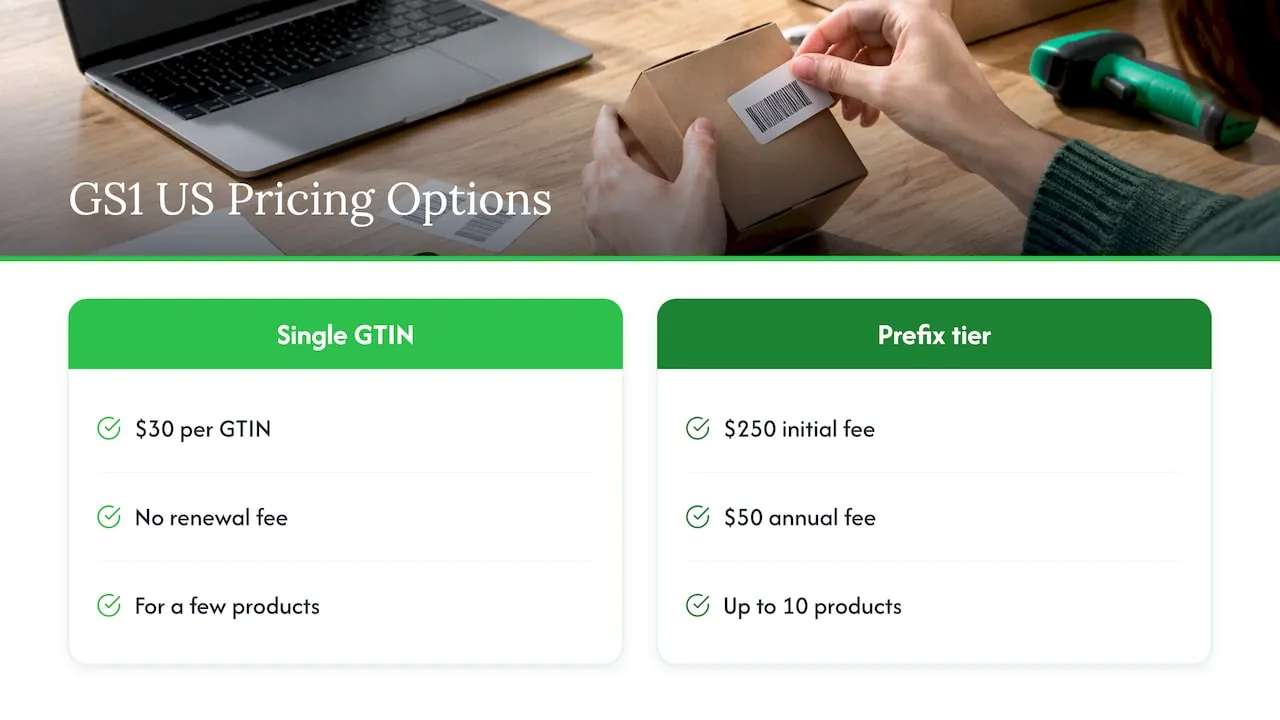
If you sell your own private label, you are the brand owner and the GTIN is yours to license. GS1 US pricing as reported in a June 2026 guide is $30 for a single GTIN with no renewal, and company prefix tiers starting at $250 initial and $50 annual for up to 10 products. A GS1 US channel partner describes the single GTIN as aimed at microbusinesses starting with a few products.
Avoid cheap resold barcodes. One analysis notes the GS1 agreement prohibits reselling numbers, and the consequences fall on the buyer. Retailers can check the owner in GS1’s database, and a mismatch can get a listing flagged or removed. Prices change, so confirm them on GS1 US before you buy.
Keeping identifiers consistent in bulk
GTINs are only part of feed quality. Titles, descriptions and structured data also decide whether Google accepts and ranks a product. If you want to add markup that supports your listings, this guide to ecommerce schema markup types is a good next read. For a step-by-step audit of your identifiers, use our three-step unique identifier checklist, and for broader feed hygiene see our data quality guide for dropshippers.
Our view
Most dropshippers we talk to treat the GTIN as a box to fill. It is really a matching key: Google uses it to decide which product you sell and whether your page adds anything new. When a store copies a competitor’s page, the identifier may be right while the content is a duplicate, and that combination is where disapprovals and weak rankings come from.
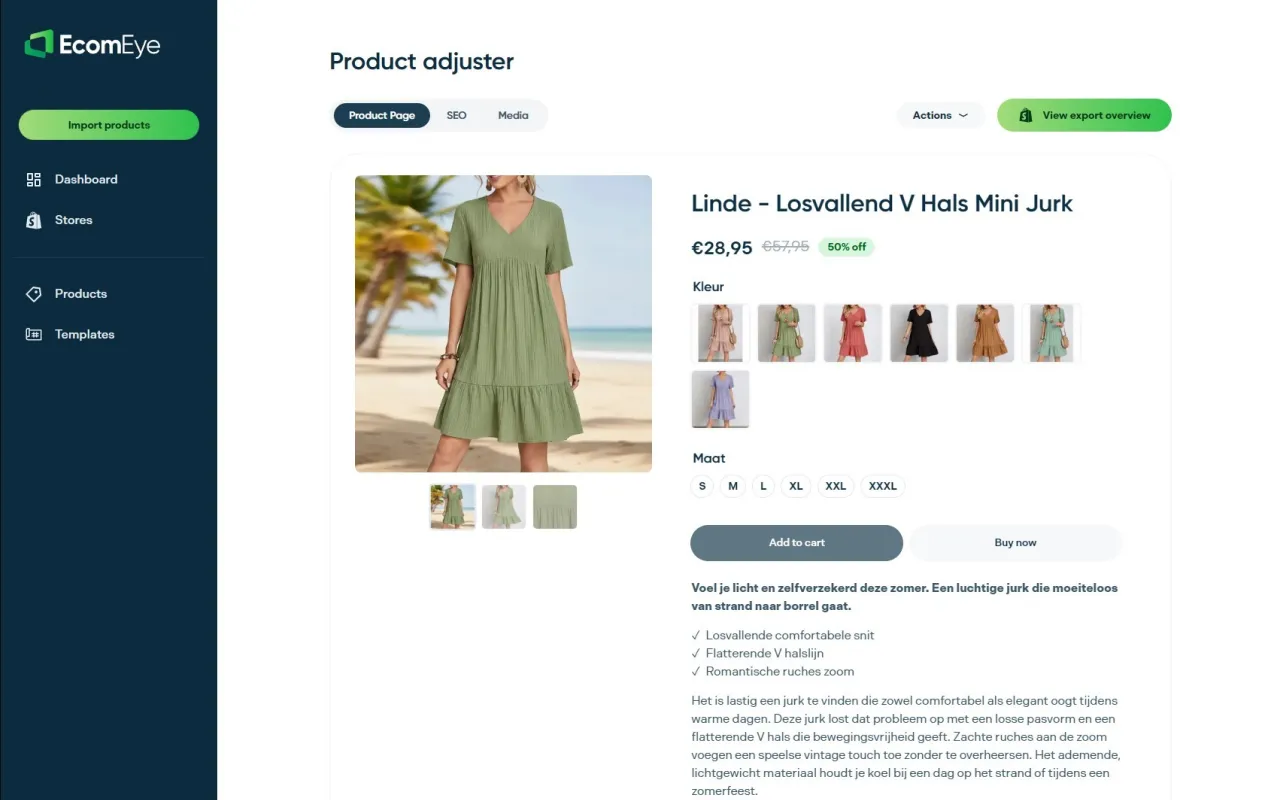
That is why we build pages around unique content. Every listing our platform generates is unique, even when it starts from the same product link, and we include built-in tools for Google Merchant Center and product variant management. Import from AliExpress, Amazon, Temu or a competitor’s Shopify link, edit in bulk, convert size systems and export to Shopify in one click.
The GTIN itself should always come from the manufacturer. Everything around it, the titles, descriptions and images, is what we take off your hands.
Koen
Put it into practice
If you are listing dozens or hundreds of products, our Try-out plan is €39 per month and Scaler is €99 per month, both on the pricing page. You get unique titles, descriptions and images per product, plus multi-language pages, ready to export to Shopify. See the AI product description generator for what the output looks like.
FAQ
Is a GTIN mandatory for Google Shopping?
Only for new products that have a manufacturer-assigned GTIN. Products without one can use brand and MPN or identifier_exists set to no, as described in Google’s specification.
Are GTIN and barcode the same thing?
No. The GTIN is the number, and the barcode is its scannable version. A UPC-A barcode encodes a 12-digit GTIN.
Can I use the same GTIN for all sizes and colours?
No. Each variant has its own GTIN, and variants share an item_group_id. Submitting several products with one GTIN and identical variant attributes is not allowed.
Can I buy a GTIN for a product I resell?
No. For another company’s product you use the GTIN it already has. Buying a GTIN is for products you own the brand of.
Sources
- Product data specification, Google Merchant Center Help
- GTIN [gtin], Google Merchant Center Help
- Identifier exists [identifier_exists], Google Merchant Center Help
- Fixing Merchant Center disapprovals for product data
- About unique product identifiers, Google Merchant Center
- About unique product identifiers, Manufacturer Center Help
- How do GS1 GTINs and barcodes work?
- An Introduction to the Global Trade Item Number (GTIN), GS1 US
- Get your GTIN for selling online, GS1
- Using barcodes for products, Shopify Help Center
- Unique Product Identifier: Types, GTINs, and Requirements
- How to Get a GTIN: Pricing, Steps, and Formats
- Global Trade Item Number (GTIN): What It Is and How It Works
- GS1 US authorised channel partner information
- 5 Ecommerce Schema Markup Types