Amazon Listing Text Reuse: What Dropshippers Can Copy
Can you reuse Amazon listing text on Shopify? Learn what is protected, what is free to use, and how to turn listing facts into unique, safe product pages.

Amazon Listing Text Reuse: What Dropshippers Can Copy

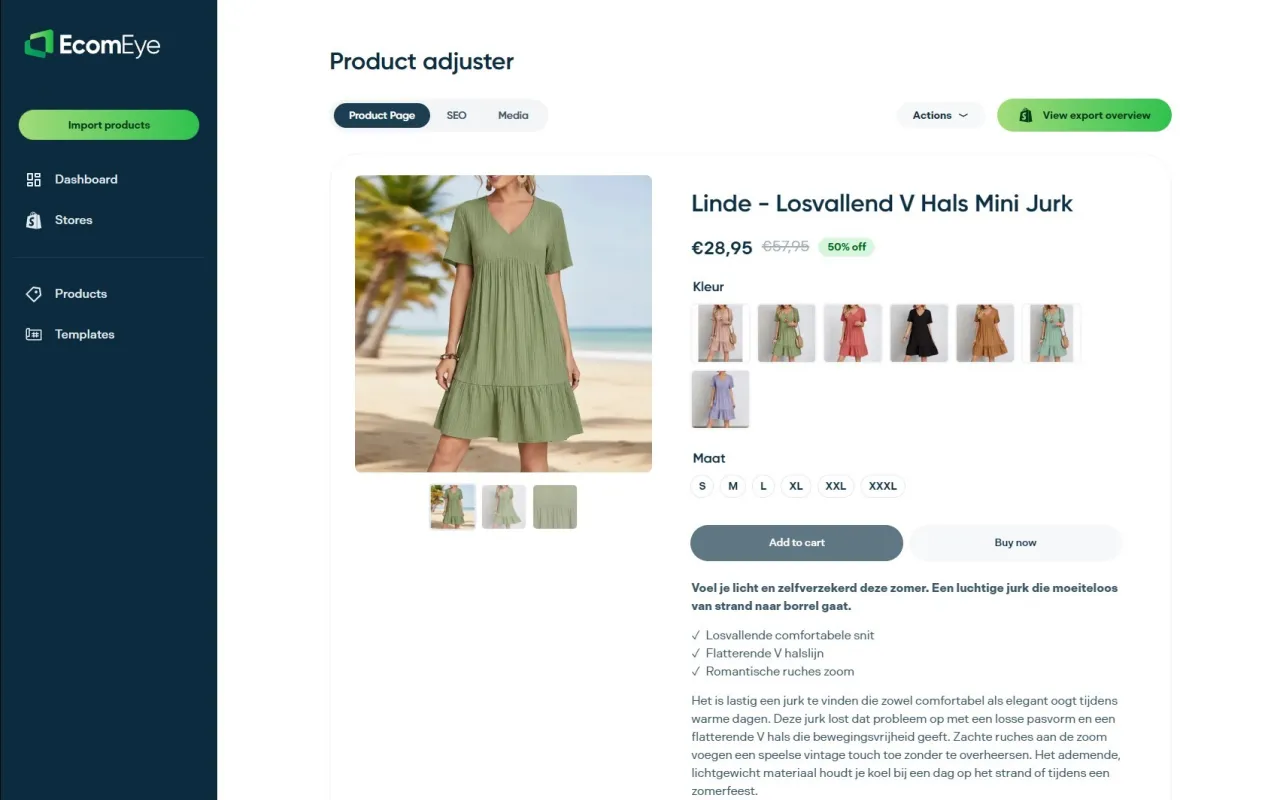
You can reuse the facts from an Amazon listing, but not the words. Dimensions, materials, compatibility and care instructions are free to use. The titles, bullets and descriptions someone wrote to sell the product are original writing, and copying them onto your Shopify store creates a copyright problem and an SEO problem at once. The safe route is to pull the facts out and write fresh copy on top of them. Doing that for 20 products is a long afternoon. Doing it for 500 is why we built Ecom-eye: it imports the product data from an Amazon link and generates a unique page for your store in bulk.
TL;DR
- Product facts are not protected by copyright. The wording, bullets and brand story around them can be.
- Changing a few words or adding “source: Amazon” does not make copied text safe. There is no safe percentage of words.
- Google does not run a flat “duplicate penalty”, but it favours pages that add original value over copied or lightly rewritten ones.
- The workable process: extract the facts, write in your own store voice, check every claim, keep your drafts.
- For bulk catalogues, generating unique copy from the product link removes the manual rewrite.
Table of Contents
- What counts as “listing text” and who owns it
- What Amazon’s own terms say about reusing listings
- Does changing a few words make it safe?
- Will reused listing text hurt your Google rankings?
- A safe process for turning an Amazon listing into your own page
- Reuse risk by scenario
- Why this matters more for bulk listers
- Our view on listing text reuse
- Generate unique pages from an Amazon link
- FAQ
- Sources
What counts as “listing text” and who owns it
An Amazon listing is several things stacked together: a title, five or so bullet points, a long description, a set of images, and structured data such as size, weight and material. These do not have the same legal status.
The U.S. Copyright Office explains that original writing on a website may be protected, while facts and ideas are not. Protection covers the expression, the particular way something is written, not the product information underneath it. Its Compendium adds that website content is copyrightable when it is fixed and contains enough human creative expression, while facts, ideas and short phrases lacking creativity are not protectable.
In practice, that gives you a simple sorting rule:
| Part of the listing | Usually free to reuse? | Why |
|---|---|---|
| Dimensions, weight, capacity | Yes | Facts |
| Materials, compatibility, certifications | Yes | Facts |
| Care instructions | Yes, in your own wording | Facts, but the phrasing may be original |
| Title with a distinctive slogan | No | Creative expression |
| Bullet points written as sales copy | No | Creative expression |
| Brand story, “why you’ll love it” paragraphs | No | Creative expression |
| Listing photos and lifestyle images | No | Separate copyright, see our guide to Amazon product image copyright |
A short, plain title such as “Stainless steel water bottle, 32 oz” is mostly facts. A bullet that tells a little story about mornings on the trail is not. The line between them is judgement, which is why a rule of thumb matters more than memorising cases.
The same logic applies well beyond Amazon. A piece on e-commerce product content shows how a single product category can be described through its practical specifics, and that is the layer you are free to use: what the product is, what it fits and how it is used.
What Amazon’s own terms say about reusing listings
Copyright is not the only layer. Amazon’s terms of use add contractual limits. For example, Amazon Shipping’s conditions of use, last updated 17 July 2025, state that Amazon or its content suppliers own content made available through its services, and they restrict commercial use, collecting listings or descriptions, and extraction or reuse without express written consent. The terms differ by Amazon service, so read the ones that govern the service you actually use. The direction is clear, though: scraping descriptions at scale for your own store is not something Amazon invites.
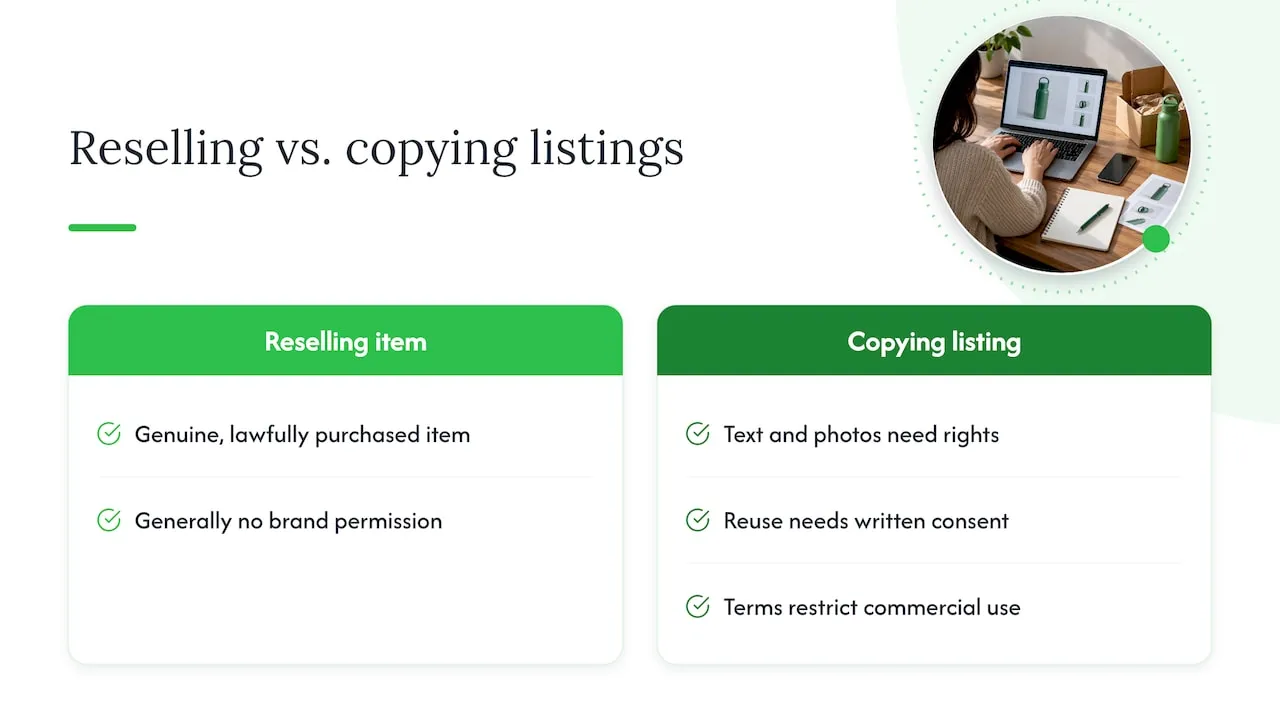
Amazon’s Intellectual Property Policy points the same way. It says authors of original works typically own the copyright, and advises uploading text or images only if you created them or have the copyright holder’s permission. That policy also touches on the exhaustion principle: reselling a genuine, lawfully purchased physical item generally does not need the brand’s permission. That covers the item itself. It does not give you rights to copy the listing text or photographs that go with it.
This distinction trips up many dropshippers. Being allowed to sell a product is not the same as being allowed to copy how someone else advertised it.
Does changing a few words make it safe?
No. This is the most common belief in dropshipping, and it is the one that causes the most takedowns.
The U.S. Copyright Office’s fair use guidance says that fair use depends on all the circumstances, and there is no fixed number of words or percentage that is automatically safe. The same page lists purposes such as commentary, criticism, news reporting and scholarship as the typical cases where limited portions may be used. Selling a product on your own store is not in that list.
So three habits that feel safe are not:
- Swapping synonyms. If the structure, order and sentences are still recognisably the original, you have copied the expression.
- Copying only the bullets. Bullets are often the most deliberately written part of a listing.
- Adding “via Amazon” or a credit line. Attribution is not permission.
There is a practical angle too. Rewording a paragraph by hand usually produces something worse than the original: stilted, with the same claims and the same order. That version helps neither the rights question nor your conversion rate. Our walkthrough on how to paraphrase manufacturer descriptions properly covers why a rewrite has to change structure, not just vocabulary.
Will reused listing text hurt your Google rankings?
There is no single “duplicate content penalty” switch, but that is no comfort for a store full of copied pages.
Google’s documentation says it may group duplicate or very similar pages and choose a canonical URL, meaning the one version it shows. It also says canonical signals are optional in many cases and that Google picks the version it considers best for users. For a new Shopify store using the same description as Amazon, a manufacturer, and fifty other dropshippers, the chance that Google picks your page as the one to show is small.
The quality guidance is more pointed. Google’s helpful-content documentation asks whether content that draws on other sources avoids simply copying or rewriting them and instead adds substantial value and originality. It also says its ranking systems prioritise helpful, reliable, people-first information rather than content made mainly to manipulate rankings.
Shopify’s own explainer on the topic describes duplicate content as similar or identical content across pages, including across different sites, and flags repeated product-page wording as a common ecommerce issue. The cost is not a penalty notice. It is invisibility: your page is one of many identical ones, so it has no reason to rank.
For Google Shopping and Merchant Center, the same pattern holds. Thin, copied or identical product data is a frequent reason feeds struggle. We go deeper on the ranking side in why copied product descriptions carry an SEO cost.
A safe process for turning an Amazon listing into your own page
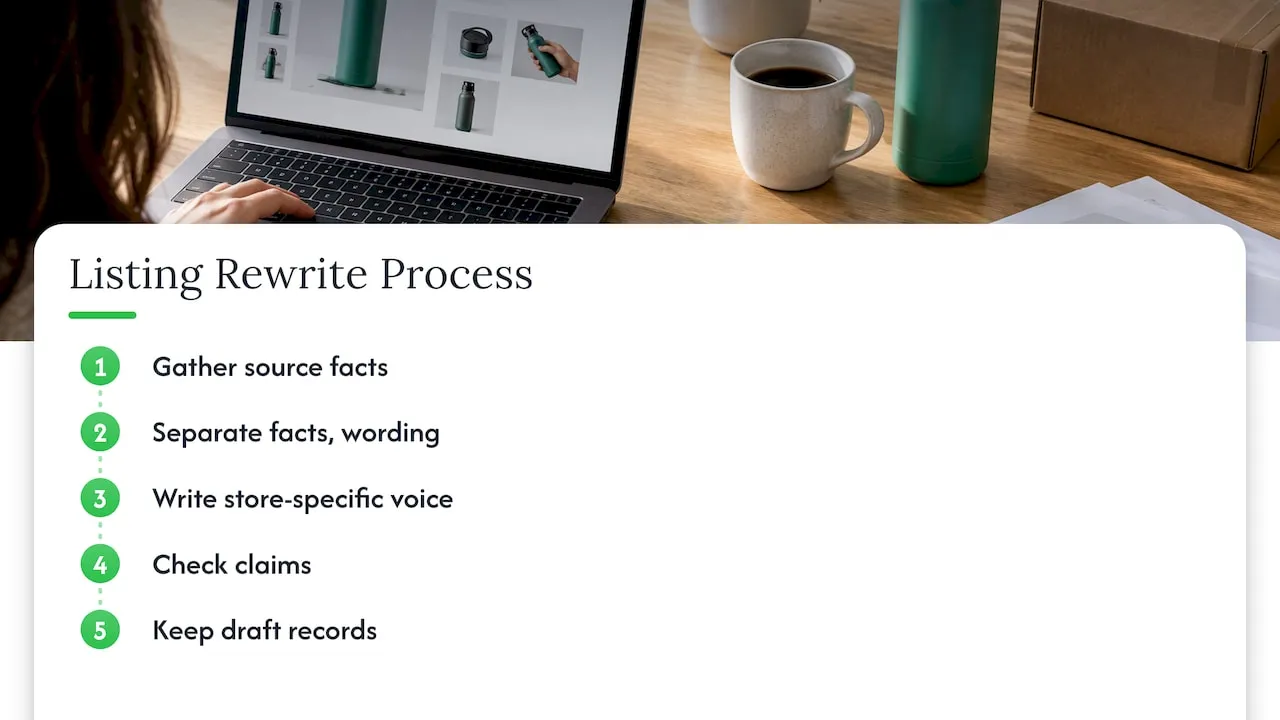
The process below keeps what is reusable (the facts) and replaces what is not (the wording). It follows the same steps legal and ecommerce writers recommend: gather factual source material, separate facts from wording, write in a store-specific voice, check claims and keep records of your drafts.
Step 1: Pull the facts into a spec sheet
Open the listing and write down only the verifiable details: size, weight, materials, colours, compatibility, what is in the box, care instructions. Cross-check against the manufacturer’s or supplier’s data where you can. Where this goes wrong: copying a sentence “because it is just a spec”. If it reads like marketing, it is wording, so leave it out.
With Ecom-eye, you paste the Amazon link (or an AliExpress, Temu or competitor Shopify link) and the platform imports the product data in bulk, so you are not retyping specs product by product.
Step 2: Decide your angle and voice
Decide who the buyer is and what they need to know before purchasing. A page for a camping stove should answer different questions from a page for a desk lamp. Pick a consistent tone for the whole store. This is the step that makes a page yours, and it is where most dropshippers skip ahead.
Our 150 to 300 unique words guide gives a practical length target for a product page that does more than repeat supplier copy.
Step 3: Write the title from your own keyword research
Build the title around what shoppers search for, in a clear order: brand if you have one, product type, key attribute, size or variant. Do not borrow the Amazon title’s phrasing. Amazon titles are written for Amazon’s search, and Amazon has been tightening them: one 2026 guide notes titles dropping to 75 characters on 27 July 2026 in the Amazon context, which has no bearing on how you should title a Shopify page.
For a repeatable structure, see the product title formula.
Step 4: Write the description from the spec sheet, not the listing
Close the Amazon tab before you write. Work only from your spec sheet and your angle. Cover what it is, who it is for, how it is used, what it is made of and what to know about size or fit. Short paragraphs and a few bullets are enough.
This is the stage that burns the hours at scale. In Ecom-eye, the descriptions, titles and SEO content are generated by AI for each user, so every listing is unique even when two users start from the same product link. You are not rewriting by hand. You are reviewing.
Step 5: Check every claim
Generated or hand-written, a page must be accurate. Check any claim about capacity, certification, waterproofing, safety or health. Remove anything you cannot back with the supplier’s documentation. Copied claims carry over the original seller’s mistakes and, sometimes, their legal exposure.
Step 6: Replace the images too
Text is only half of a listing. Amazon photos belong to whoever shot them. Original or AI-generated product images complete the job. Ecom-eye includes AI product image generation for this, and you can see how it works on the AI product image generator page.
Step 7: Keep your records, then publish
Save your spec sheet and drafts. If a rights holder ever questions a page, dated drafts built from facts are the best answer you can have. Then export to Shopify. Ecom-eye exports to Shopify in one click, with multi-language pages, size system conversion and bulk editing available before you publish.
Reuse risk by scenario
| What you do | Risk level | Better move |
|---|---|---|
| Paste the full Amazon description | High | Write from a spec sheet |
| Reword sentence by sentence | Medium to high | Change structure and angle, not just words |
| Copy the title as is | Medium | Build your own keyword-led title |
| Reuse specs in your own sentences | Low | Fine, keep it accurate |
| Use Amazon photos | High | Original or AI-generated images |
| Generate unique copy from the product facts | Low | Review and publish |
The table is a guide to relative risk, not legal advice. If you receive a takedown notice, or you are launching a brand around a specific copyrighted work, speak to an intellectual property attorney.
Why this matters more for bulk listers
One copied description is a small risk. Five hundred copied descriptions is a pattern. A store built by importing listings in bulk makes the same choice hundreds of times, and each page has to stand on its own. If competitors import the same Amazon text, you end up with the same page as everyone else. The fastest-growing Google-first dropshipping stores tend to differentiate on exactly this layer. Why it works is covered in our pieces on why product descriptions matter for sales, SEO and trust and why automating product descriptions saves time.
Clarity counts too. A unique page that is vague does not convert, which is why clear ecommerce descriptions drive more sales. Unique and clear is the target.
Our view on listing text reuse
We talk to Shopify dropshippers who started the same way: find a winning product on Amazon, copy the listing, launch. It feels efficient and it is where most stores stall.
Our view is that the facts of a product belong to everyone and the wording belongs to its author. A store that keeps this straight has no copyright exposure and a real chance in search, because Google is looking for pages that add something.
The trap is that the honest method, writing every page yourself, does not scale. So people take shortcuts. We built Ecom-eye so there is no shortcut to take. You import the product data in bulk, and the platform generates titles, descriptions and images that are unique to your store, even when another user starts from the same link. Our claim is simple: no rewriting, no copyright risk from borrowed text, no manual work.
If you are listing more than a handful of products, the question is not whether to write original copy. It is how many hours you want to spend doing it.
Koen
Generate unique pages from an Amazon link
If you are ready to stop copying and start listing, Ecom-eye turns an Amazon, AliExpress, Temu or competitor Shopify link into an optimised product page with its own title, description and images, then exports it to Shopify. Built-in tools for Google Merchant Center and product variants help with the feed side.
Plans start with Try-out at €39 per month and Scaler at €99 per month, and you can see both on the pricing page. New users can start with a free trial.
FAQ
Can I copy an Amazon product description onto my Shopify store?
No, not the wording. Original descriptions and bullets can be protected, and Amazon’s terms restrict reuse of its content. You can use the underlying facts, such as size, material and compatibility, in your own words.
Is it legal to reuse only the product specifications?
Generally yes. The U.S. Copyright Office says facts and ideas are not protected, only original expression. Keep the specs accurate and present them in your own sentences.
Does Google penalise duplicate product descriptions?
There is no blanket penalty, but Google groups similar pages and chooses one version to show. Its guidance favours pages that add original value instead of copying or lightly rewriting other sources. Copied pages rarely get picked.
What if I credit Amazon or change a few words?
Neither makes copied text safe. Attribution is not permission, and the Copyright Office says there is no fixed number of words or percentage that is automatically allowed.
Sources
- What Does Copyright Protect? (FAQ), U.S. Copyright Office
- Compendium Chapter 1000, U.S. Copyright Office
- Fair Use (FAQ), U.S. Copyright Office
- Site Terms, Amazon Shipping
- Amazon Intellectual Property Policy
- Consolidate duplicate URLs, Google Search Central
- Creating helpful, reliable, people-first content, Google Search Central
- Duplicate content: how to find and fix issues, Shopify
- Can I copy a competitor’s product description?, Sprintlaw