How to Paraphrase Manufacturer Descriptions Properly
Learn how to paraphrase manufacturer descriptions so they read as original, keep every spec accurate and hold up with Google, with a step-by-step method and checks.
How to Paraphrase Manufacturer Descriptions Properly
To paraphrase a manufacturer description, keep the facts (dimensions, materials, compatibility) and rebuild everything else: the structure, the order, the wording and the angle. Start from what your buyer wants to know, not from the supplier’s sentences. Swapping synonyms into the same sentence skeleton is not a paraphrase, and it is the shortcut that leaves thousands of Shopify stores looking identical to each other.
This guide gives you a repeatable method, a way to check that a rewrite is really different, the copyright and Google points that matter in the US, and a review routine for when you rewrite in bulk.
TL;DR
- A real paraphrase changes sentence structure and most of the wording while keeping the facts exactly right. Synonym swaps do not count.
- Write from your notes, not with the supplier text open, then compare the two and rewrite anything that still mirrors the source.
- Facts and short phrases are not protected by copyright, but closely following someone’s expression can still cause trouble. Rebuild the copy rather than lightly edit it.
- Google targets large volumes of unoriginal content, so before you scale, check every description for accuracy, usefulness and near-duplicate wording.
- For catalogues of dozens or hundreds of products, a bulk tool can do the first draft; you still review the facts.
Table of Contents
- What paraphrasing means for a product page
- Why synonym swapping fails
- A five-step method that works for any catalogue
- Titles, bullets and specs
- Copyright: what paraphrasing does and does not cover
- What Google says about unoriginal content at scale
- Reviewing rewrites before you publish
- When you have hundreds of products
- Doing it in bulk with EcomEye
- A short before and after you can copy
- FAQ
- Sources
What paraphrasing means for a product page
In school writing, a paraphrase expresses another writer’s ideas in your own words, with significantly different wording and sentence structure while preserving the essential meaning. The US Office of Research Integrity puts it similarly: a proper paraphrase changes much of the language and some of the structure, and superficial edits are not enough.
For an online store the idea is the same, with one twist. A product page has to do a job the manufacturer’s copy usually does not do. As one ecommerce guide describes it, paraphrasing means keeping accurate specifications while rebuilding the copy from the buyer’s angle, with a new structure and context aimed at the person buying.
Manufacturer copy is written to describe a product to a distributor. Your page is written to answer a shopper’s question: will this fit, what is it made of, is it right for what I need? That difference in purpose is what makes a good paraphrase different from a reworded copy.
Why synonym swapping fails
Yale’s Poorvu Center explains that replacing words with synonyms while keeping the original sentence structure and progression is cosmetic copying, not a fair paraphrase. The test it applies is whether the source’s blueprint is still visible. If someone laying your paragraph over the original could match them clause for clause, the blueprint is still there.
Practitioners say much the same about search: rewriting has to involve structural reorganisation and original wording, because simple synonym swapping is often detectable as a duplicate.
Here is what that looks like with an invented supplier line:
| Version | Text | Verdict |
|---|---|---|
| Supplier original | Premium stainless steel insulated bottle keeps drinks cold for 24 hours and hot for 12 hours. 750 ml capacity. | Source |
| Synonym swap | High-quality stainless insulated flask keeps beverages chilled for 24 hours and warm for 12 hours. 750 ml volume. | Same blueprint, fails |
| Real paraphrase | Pack it for a full day out. The 750 ml steel bottle is insulated, so a morning ice-water refill is still cold the next morning, and a hot coffee stays warm for half a day. | New order, new angle, same facts |
The third version keeps every verifiable fact (steel, insulated, 750 ml, the 24 and 12 hour figures) but opens with a use, not a material. Note that the hour figures must come from the supplier’s data. Never invent or inflate a performance claim while you rewrite.
A five-step method that works for any catalogue
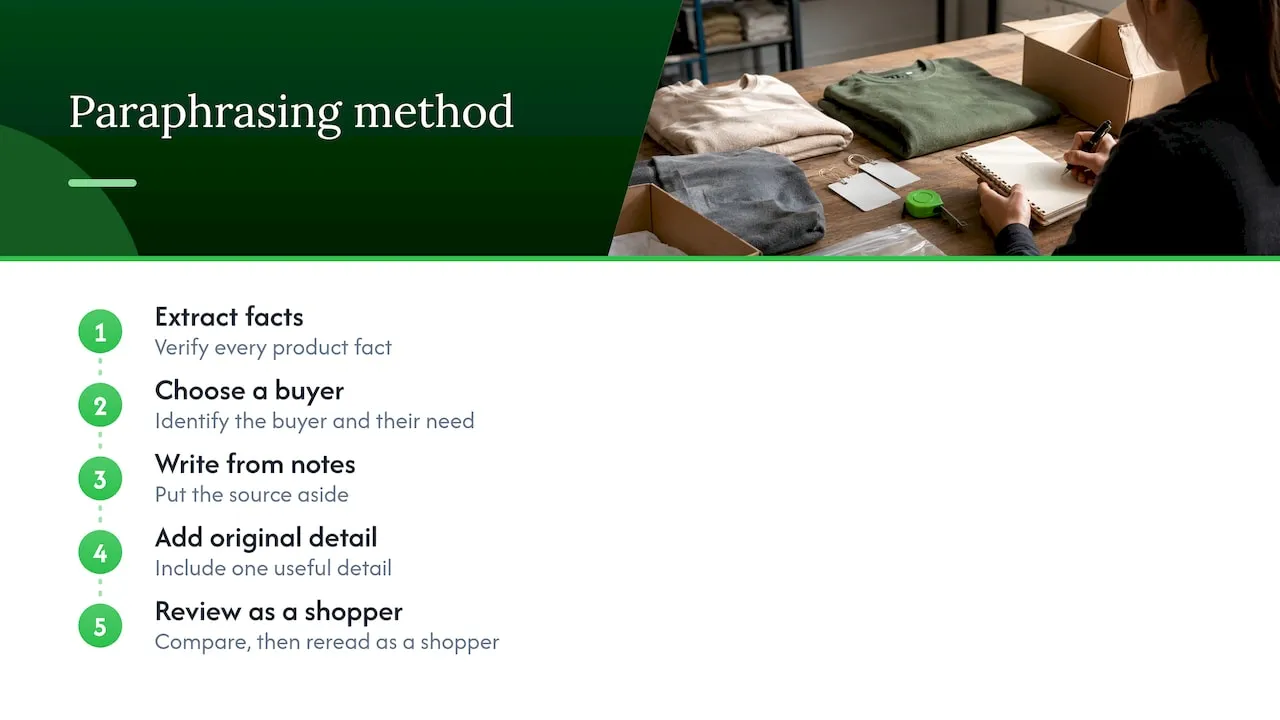
1. Extract the facts and nothing else
Copy the source text into a notes file and strip it down to verifiable facts: dimensions, weight, materials, colours, sizes, compatibility, what is in the box, certifications the supplier documents. Effective paraphrasing involves noting the key facts, then writing from your understanding instead of working sentence by sentence from the source.
Delete adjectives such as “premium” or “high-quality” unless you can back them up. They are the most copied and least informative words in any supplier description.
2. Decide who the buyer is
Pick one buyer and one need. A yoga mat can be for a beginner who wants grip, a traveller who wants it light, or a parent who wants easy cleaning. One practical approach is to research the language and questions of the intended buyer, rebuild the copy around a buyer need, and connect each supported specification to a clear use or benefit.
Customer reviews on similar products, your own support emails and the questions shoppers type into search all show the words buyers use. Use those words, not the manufacturer’s.
3. Write without the source open
Close the supplier page. Write from your notes and your buyer angle. This is the single habit that stops accidental mirroring. University writing guidance recommends exactly this: write the paraphrase without looking at the source, then compare the wording and structure, and rewrite if they are too similar.
4. Add something the source does not have
Strong paraphrasing adds something new, such as analysis, a use case or an honest opinion. On a product page that might be a sizing tip, a care instruction, a comparison with the previous version of the product, or an answer to the question you see most often.
A sensible length for the body copy is a short opening that names the use, a handful of benefit-led lines tied to specs, and a compact spec list. If you want a target, our post on 150 to 300 unique words beating manufacturer copy goes into the detail.
5. Compare, then reread as a shopper
Place your draft beside the original. Check three things: do the sentences follow the same order, do any phrases of five or more words match, and does your opening line do the same job as theirs? If yes to any, rewrite that part. Then read the page as a stranger would. Does it answer the practical question quickly?
Titles, bullets and specs
Paraphrasing does not stop at the description box. Titles, bullet points, alt text, meta descriptions and variant names all get copied from suppliers too. Rewrite them with the same method. Product titles in particular should say what the item is, the key attribute and the variant, in the words a shopper types. Our guide on descriptive product titles and Shopify SEO covers how to structure them.
Specs are different. A measurement is a measurement, and you should not paraphrase a number. Where a fact appears both in structured fields (size, colour, material) and in the prose, make sure they match. Mismatches between the two can confuse both customers and AI agents, so a size chart that says 750 ml should never sit under a paragraph that says 700 ml.
Copyright: what paraphrasing does and does not cover
This is general information, not legal advice. For a specific dispute, speak to an intellectual property attorney.
In the US, copyright protects expression, not facts or ideas. The Electronic Frontier Foundation notes in a filing to the US Copyright Office that titles and short phrases are not copyrightable, and copyright does not apply to facts or ideas. That is why a dimension, a material or a compatibility statement can be reused freely, while a distinctive paragraph of marketing prose is the part to rebuild.
Courts also look past word-for-word copying. In Salinger v. Random House, the court found that unauthorised paraphrasing and quoting of unpublished letters was not fair use, partly because of the effect on the market for the originals. And in Castle Rock v. Carol Publishing, the Second Circuit held that a commercial, non-transformative trivia book built on a protected show was not fair use.
The practical lesson for sellers is that a light edit of someone else’s expression is the weak spot. A rebuilt page with your own structure, your own angle and the underlying facts is the safe way to work. If a manufacturer’s terms say you need written permission to use their text or photos, get it or write your own. Images deserve the same care as copy, which is one reason we also generate original product visuals, covered below.
What Google says about unoriginal content at scale
Google defines scaled content abuse as creating large amounts of unoriginal content that provides little to no value to users. A catalogue where hundreds of pages repeat the same supplier text fits that description, and so does one where an automated tool lightly spins the same text. The fix in both cases is the same: each page needs to say something useful and distinct.
If you sell through Google Merchant Center, the product data specification has its own rules. Descriptions should contain product information only, with no store links, sales information, competitor details, accessory details or promotional text. The same page requires AI-generated descriptions submitted to Merchant Center to use the structured_description attribute. Remove phrases such as “free shipping today” or “better than brand X” from your rewrites before they reach your feed.
For the wider SEO picture, see our posts on the SEO cost of copied product descriptions and why product page uniqueness matters on Shopify. If you also sell on marketplaces, this walkthrough of marketplace product listing SEO lays out a first-month plan for listings that stay distinct.
Reviewing rewrites before you publish
Whether you wrote the copy by hand or generated it, run each description through the same checklist. One review routine is to trace every factual statement to the product record, confirm dimensions, materials, performance qualifiers and compatibility, and delete unsupported claims. After that, check the points below.
- Accuracy: every number matches the supplier data sheet or your own measurement.
- Usefulness: the copy answers a practical buyer question in the first two lines.
- Originality: no supplier sentence survives, and no five-word phrase matches the source.
- Natural reading: it sounds like a person describing a product to a customer.
- Channel rules: nothing promotional in a Merchant Center description, and nothing the channel prohibits.
- Consistency: size, colour and material in the text match the variant fields.
Test before you roll out
Do not rewrite the whole catalogue on a hunch. A suggested approach is to test the changes on five products and, after four weeks, compare sessions, add-to-cart activity and Search Console queries with the previous four weeks. If the numbers move the right way, roll the method out to the rest.
When you have hundreds of products
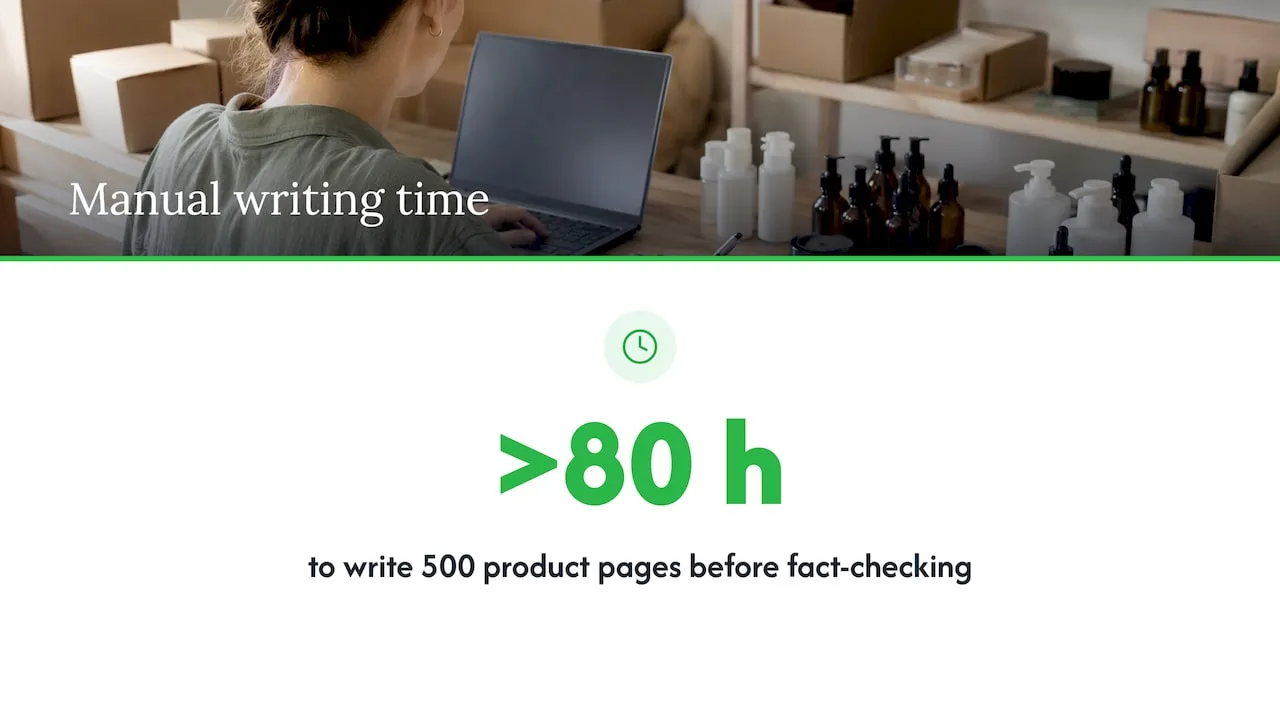
The method above works well for ten products. For 500, the maths changes: at ten minutes a page, that is more than 80 hours of writing before you check a single fact. This is the situation dropshippers face when they import a supplier feed in bulk.
Two habits keep it manageable. First, write a template: a structure for the opening line, benefit lines and spec block that you fill per product category. Our post on product description prompts that avoid duplicates shows how to build prompts that vary structure, not only wording. Second, automate the first draft and keep the human check for facts. We cover the reasoning in why automating product descriptions saves time and helps SEO.
Our perspective
Most dropshippers we talk to do not set out to copy. They import a product, the supplier text comes with it, and with 300 more to list the paste button wins. Then the store looks the same as every other store selling that item, and the rankings and Merchant Center approvals reflect it.
We built EcomEye on one belief: a paraphrase is only worth publishing if the structure, the wording and the angle are genuinely new, and the facts stay right. That is why our platform is designed to generate every title, description and image uniquely for each user, so that two sellers importing the same product link do not end up with the same page.
Speed matters just as much. Nobody scales a store by rewriting by hand, so we pair generation with bulk editing, templates, multi-language pages, size conversion and one-click export to Shopify. You keep control of the facts, and the repetitive rebuilding is done for you.
Koen
Doing it in bulk with EcomEye
EcomEye is built for Shopify dropshippers who need unique, SEO-ready product pages at volume. You import products in bulk from AliExpress, Amazon, Temu or competitor Shopify links, and the platform generates new titles and descriptions, AI product images and multi-language pages, then exports to Shopify in one click. It also includes built-in tools for Google Merchant Center and product variant management.
Plans are the Try-out at €39 per month and the Scaler at €99 per month, both listed on our pricing page. You can see how the text side works on the AI product description generator page.
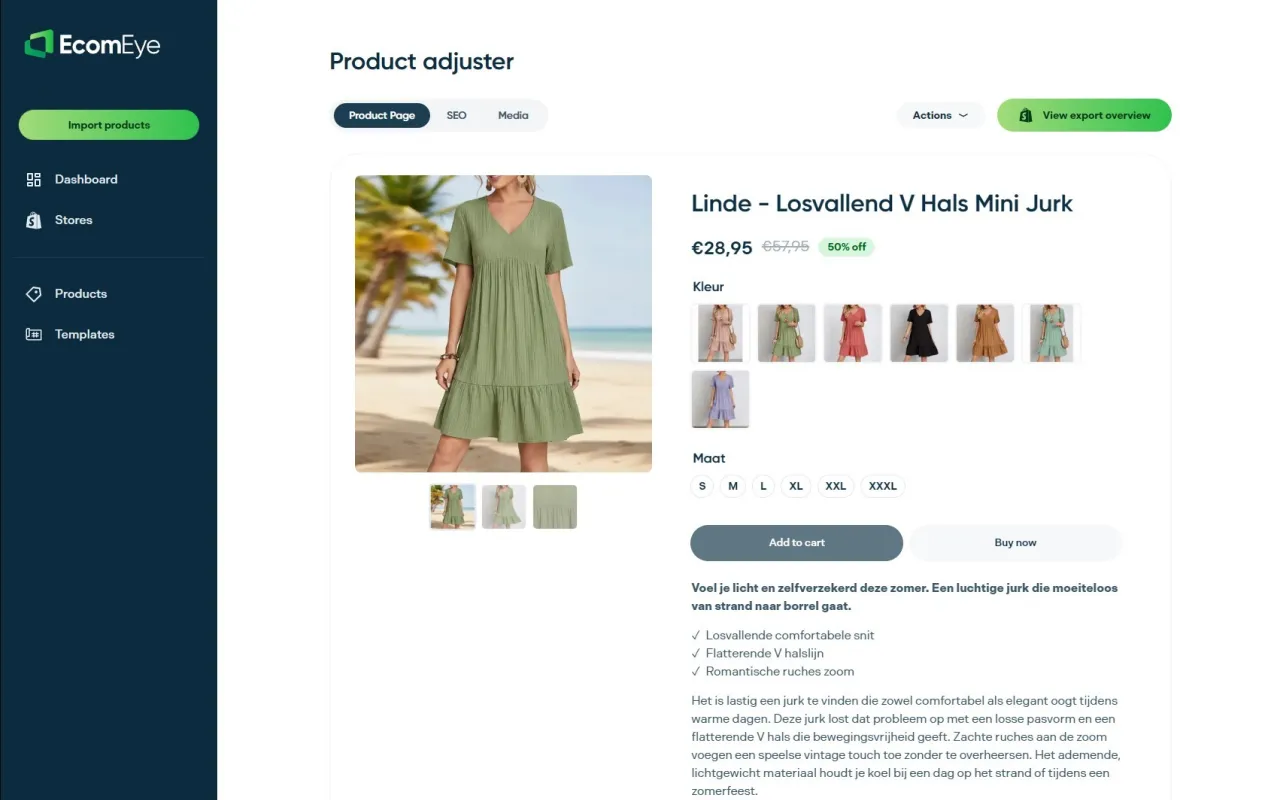
If your supplier images are as copied as the text, the AI product image generator produces original visuals to sit beside the new copy. Whichever way you work, keep the review checklist above: generation does the heavy rebuilding, and you confirm the facts before anything goes live.
A short before and after you can copy
Take a phone case imported from a supplier feed. The raw text reads like a list of adjectives and a model number. Your rebuilt version might follow this shape:
- Opening line: the use. “Drop-protection for commuters who keep their phone in a bag pocket with keys.”
- Two or three benefit lines: each tied to a spec. Raised edges, a stated thickness, wireless charging compatibility if the supplier confirms it.
- Fit and care: the exact models, how to clean it, what the box contains.
- Spec block: material, weight, colours, in the same order on every page of that category.
The same skeleton repeated across a category is fine for shoppers, who like predictability. It is the sentences inside it that must be different on every page. Our post on product description ideas for Shopify SEO has more angles to borrow, and the case for unique content in dropshipping explains why it pays.
FAQ
What should a good paraphrase of a product description look like?
It keeps the facts and meaning but changes the structure, the order and most of the words. If the original’s blueprint is still visible when you compare the two, it is not a paraphrase yet. It should also add something useful to the buyer, such as a use case or sizing tip.
Can I just run the supplier text through a paraphrasing tool?
A tool that only swaps words leaves the original sentence structure in place, which is the cosmetic copying described above. Use a tool that rebuilds the copy around a buyer angle, then check every fact against the product record before you publish.
Is it legal to reuse a manufacturer’s specifications?
Copyright does not apply to facts, so dimensions, materials and compatibility can be stated freely. The marketing prose around them is expression, so write your own. This is general information, and an intellectual property attorney can advise on a specific case.
Will rewritten descriptions help with Google Merchant Center approval?
They help when they are accurate, original and limited to product information. Google’s specification asks for no promotional text, store links or competitor details in descriptions, so strip those out of every rewrite and keep your feed data consistent with the page.
How do I know if the rewrite is working?
Test five products first. After four weeks, compare sessions, add-to-cart activity and Search Console queries against the previous four weeks, then decide whether to roll the approach out across the catalogue.
Sources
- How to paraphrase effectively, University of Technology Sydney
- Examples of Paraphrasing: Good and Bad, US Office of Research Integrity
- Understanding and Avoiding Plagiarism: Fair Paraphrase, Yale Poorvu Center
- How to Paraphrase Text Without Plagiarizing, Ecommerce Paradise
- Rewrite Manufacturer Product Descriptions: SEO Fixes
- How to Write Product Descriptions That Sell
- Rewriting Shopify Product Descriptions for AI Search
- EFF initial comment, US Copyright Office publishers’ protections study
- Salinger v. Random House summary, US Copyright Office
- Castle Rock v. Carol Publishing summary, US Copyright Office
- Search Quality User report, Google Search Console Help
- Product data specification, Google Merchant Center Help
Ready to boost your product pages?
Generate high-converting, SEO-optimized product pages in bulk using AI automation used by e-commerce experts.
No credit card required