Scale Past Dozens: Ecommerce Product Description Prompts Avoid Dupes
Use prompt first templates, locked spec blocks, and bulk tactics to scale ecommerce listings without duplicate content.

Scale Past Dozens: Ecommerce Product Description Prompts Avoid Dupes

The prompt structure that works best pairs a benefit-first instruction with a locked spec block: tell the AI who it’s writing as, hand it the exact product facts it isn’t allowed to invent, then specify format and keyword placement. That combination produces SEO-friendly, conversion-ready copy with far fewer hallucinated claims than a bare “write a description for this product” request. Tools like EcomEye automate this at bulk scale, but the underlying prompt logic is worth understanding whether you’re writing one listing or ten thousand.
TL;DR:
- Using a locked spec block reduces hallucinated claims and ensures product details are accurate across descriptions.
- Structuring prompts with a clear role, target tone, and format improves the quality and consistency of generated copy.
- Scaling product descriptions through automation tools like EcomEye maintains uniqueness and SEO effectiveness for large catalogs.
- Manual prompt iteration and revision are crucial for high-quality output, especially when refining tone or fixing unverifiable claims.
- Proper fact-checking and QA checks are essential before publishing to prevent errors, duplicate content, or disallowed claims.
Table of Contents
- The anatomy of a product description prompt that works
- Copy-ready prompt templates for every type of product description
- How to iterate and evaluate AI-generated descriptions before publishing
- SEO and formatting rules worth baking into every prompt
- Category-specific prompt recipes
- Pre-publication QA checklist
- How EcomEye scales prompt-driven product pages without the manual grind
- Product description prompts for ecommerce: what actually separates good from wasted effort
- EcomEye: skip the manual prompting once you’re past a few dozen listings
- Sources
- FAQ
The anatomy of a product description prompt that works
Most sellers write prompts the way they’d talk to a colleague: quick, vague, missing half the detail the AI actually needs. That’s why the output reads generic. A prompt that reliably produces usable copy has four distinct parts, and skipping any one of them is where things go wrong.
Role. Open by telling the model who it’s supposed to be. “You are an expert ecommerce copywriter who writes for Shopify stores selling [category]” does more work than it looks like it should. It anchors vocabulary, pacing and confidence level to a professional standard rather than a generic assistant tone. Copyhackers’ research on AI prompting backs this up directly: the most effective prompts encode persona, tone and emotional drivers, because without them the model defaults to flat, interchangeable copy that reads the same for a candle as it does for a cordless drill.
Context, or the spec block. This is the part sellers skip, and it’s the single biggest cause of AI-invented product claims. Give the model a locked list of facts it must use and nothing else: dimensions, materials, compatibility, weight, price band, what’s included in the box. If you don’t supply this, the AI fills gaps with plausible-sounding fiction, wrong battery life, invented certifications, a fabric blend that doesn’t exist. A spec block isn’t optional polish; it’s the guardrail. Structuring it clearly is worth the extra two minutes, and a locked spec block produces measurably fewer hallucinated details than an open-ended request.
Instructions. This is where you specify:
- Target word count (be exact, not “keep it short”)
- Tone (playful, technical, luxury, no-nonsense)
- Where the primary keyword goes (first sentence, ideally)
- Structure (headline, opening line, bullets, closing CTA)
- What to avoid (health claims, superlatives you can’t back up, competitor comparisons)
Examples. Feeding the model one or two short reference descriptions, ideally your own best-performing ones, locks in voice far faster than describing tone in the abstract. This matters more at scale than most sellers assume: seeding the model with a handful of existing high-performers before generating new copy reduces variance and keeps voice consistent across hundreds of listings, which is exactly the problem bulk sellers run into when descriptions start sounding like they were written by five different people.
There’s a useful process framework sitting underneath all four of these components. Google’s own approach to prompt engineering breaks the task into five steps: Task, Context, References, Evaluate, Iterate. It’s built for general use, but it maps almost exactly onto the structure product-description prompts need, task being your role and instructions, context being your spec block, references being your examples, and evaluate/iterate being the refinement loop covered further down.
Copy-ready prompt templates for every type of product description
Below are six prompt skeletons, grouped by what you’re trying to achieve. Swap the bracketed variables for your product’s real details and you have a usable prompt in under a minute.
1. All-purpose product description prompt
This is the one to reach for when you don’t have a strong angle yet and just need solid, publishable copy fast.
Example output for a stainless travel mug: “Keep Your Coffee Hot for 12 Hours, Not 12 Minutes. Built from double-wall stainless steel, this insulated travel mug keeps your morning coffee at drinking temperature well past lunch. No more microwave reheats, no more lukewarm disappointment at your desk.”
2. Benefit-first template
Lead with transformation, not features. This is the format Shopify and BigCommerce both converge on for conversion-focused copy.
3. Feature-to-benefit transformer
Use this when you’ve got a spec sheet and nothing else. It forces the model to do the translation work sellers usually skip.
4. Story-led / scenario prompt
Best for lifestyle, home, and gift products where the buying decision is emotional rather than purely functional.
5. SEO-optimised template
The 175 to 225 word range isn’t arbitrary. Descriptions in that band tend to give secondary keywords room to appear naturally without forcing repetition, which is where most SEO copy starts to read stuffed.
6. Revision prompts
These are the ones sellers forget exist, and they’re often more useful than the original generation prompt:
- “Shorten this to 120 words while keeping the benefit-first opening sentence intact.”
- “Rewrite this to lead with durability as the primary benefit instead of style.”
- “Create a second version with a more casual, conversational tone for A/B testing against the original.”
- “Rewrite this removing any claim that isn’t directly supported by the spec block provided.”
How to iterate and evaluate AI-generated descriptions before publishing
A single AI generation is a draft, not a finished product. Treating prompt engineering as a one-shot exercise underperforms compared with a comose, evaluate, iterate loop, and that loop is genuinely quick once you’ve done it a few times.
- Generate three variants from one prompt, changing only the tone instruction each time (e.g. confident, warm, technical). This gives you real options rather than one output you’re stuck defending.
- Run each variant against a fixed checklist: does every claim trace back to the spec block, does the keyword appear in sentence one, does the tone match your brand’s other listings, is it free of unverifiable superlatives (“the best,” “guaranteed to”)?
- Send back a targeted revision prompt rather than regenerating from scratch. “Shorten to 120 words while preserving the benefit-first sentence” gets you further than “try again.”
- Set up a simple A/B test on your two strongest variants once live, tracking click-through rate, add-to-cart rate, and conversion rate over a two-week window before declaring a winner.
Pro Tip: Keep a swipe file of three to five of your own best-performing descriptions and paste one into every new prompt as a reference example. It cuts revision rounds dramatically because the model has a concrete voice target instead of an abstract tone description.
SEO and formatting rules worth baking into every prompt
Keyword placement matters less than most sellers think, and structure matters more. The primary keyword belongs in the first sentence; after that, secondary keywords should surface naturally across the body rather than being forced into every paragraph. Shopify’s guidance on product copy is consistent on this point: short-form copy suits fast-scanning categories (accessories, low-consideration items), while longer 200 to 400 word descriptions support deeper SEO for higher-consideration purchases like furniture or electronics.
A format that scans well and satisfies both readers and search engines:
- One headline (5 to 8 words)
- A benefit-first opening sentence containing the primary keyword
- Three to five feature bullets, each framed as a benefit
- A one-line closing call to action
Completeness isn’t just an SEO nicety. In a 2026 omnichannel consumer study, Salsify found that incomplete or inconsistent product information drives a 34% abandonment rate among shoppers who can’t find the detail they need before checkout. That’s the practical argument for the spec block covered earlier: missing dimensions or unclear compatibility isn’t a minor gap, it’s a direct hit to conversion. Sellers building out category pages at volume will find more platform-specific tactics in Shopify SEO guidance for 2026, and keyword research fundamentals are covered well in BabyLoveGrowth’s ecommerce keyword guide.
Category-specific prompt recipes
Different categories need different variables in the spec block, and different tonal guardrails. A few quick recipes:
- Fashion: require fabric composition, fit type (slim, relaxed, true-to-size), and care instructions in the spec block. Tone can run descriptive and sensory. Avoid claims about durability you can’t verify.
- Electronics: require exact technical specs (battery life, ports, compatibility) and forbid the model from rounding or estimating any of them. Tone should be confident but precise, not hype-driven.
- Beauty: require ingredient list and skin type suitability. Legal caution matters here: strip out any health or efficacy claim not explicitly backed by the manufacturer, particularly anything implying a medical benefit.
- Home goods: require dimensions, materials, and assembly requirements. Story-led tone works well for anything sold on atmosphere (candles, textiles, décor).
- Bundles: require a full itemised list of contents and the individual value of each item, so the AI can build a genuine value argument rather than a vague “great value” line.
If you sell across multiple marketplaces, tone and structure expectations shift again. Savings Grove’s guide to eBay selling strategies is a useful reference for how marketplace-specific copy differs from a standalone Shopify listing.
Pre-publication QA checklist
Before anything goes live, run it through a short but non-negotiable checklist:
- Fact-check every measurement, material and compatibility claim against the actual product spec sheet, not the AI’s version of it.
- Run a duplicate-content check. At scale, near-duplicate phrasing across SKUs is a real risk that Google and Google Merchant Center both penalise.
- Confirm brand voice match against your last five published listings.
- Check image alt-text for accuracy and keyword relevance.
- Strip unverifiable claims, particularly health, safety, or performance superlatives that could trigger a Merchant Center disapproval if GTIN, brand or model fields don’t match supplier data.
Pro Tip: Turn every QA failure into a revision prompt instead of a manual edit. “Remove any claim not directly supported by the spec block” fixes the problem at the source and keeps your prompt library improving over time.
How EcomEye scales prompt-driven product pages without the manual grind
Running this workflow by hand across a handful of listings is manageable. Running it across a few thousand SKUs imported from AliExpress or a competitor’s Shopify store is where most sellers quietly give up, or worse, copy-paste competitor copy and get hit with duplicate content penalties and Merchant disapprovals.
EcomEye was built around the exact prompt logic covered in this article, applied automatically at bulk. The workflow: import product data directly from AliExpress, Amazon, Temu, or a competitor’s Shopify link, apply a consistent template across the batch, and generate genuinely unique output for every listing, even when ten sellers are importing the identical AliExpress product. That uniqueness check matters more than sellers realise; it’s the same duplicate-content problem that quietly tanks Google rankings for stores that skip it.
- Bulk import from supplier or competitor links, no manual copy-paste
- Consistent template application across an entire catalogue
- Unique output per listing, verified, not just reworded
- One-click export straight to Shopify, formatted and ready
This article was written from Koen’s perspective on how prompt engineering and bulk ecommerce content production actually intersect in practice, drawing on the workflow patterns that make or break stores scaling past a few hundred SKUs.
Product description prompts for ecommerce: what actually separates good from wasted effort
The gap between sellers who get real value from AI prompts and sellers who get generic filler isn’t skill with ChatGPT. It’s whether they treat the spec block as mandatory rather than optional. Most of the advice floating around treats prompting as a wording problem, find the magic phrase, tweak the adjectives, when the actual failure point is almost always missing or vague product facts. Fix that first.
The conventional advice to “just be more specific” also undersells how much iteration matters. One clever prompt rarely beats three mediocre ones evaluated and refined. Sellers who build a short revision habit, shorten this, re-tone that, strip that unverifiable claim, consistently outperform sellers chasing the perfect single prompt.
Where this really breaks down is at scale. A great prompt written once doesn’t survive being copy-pasted across two thousand SKUs without a uniqueness check, and that’s the piece manual workflows almost always skip because it’s tedious rather than because it’s hard.
— Koen
EcomEye: skip the manual prompting once you’re past a few dozen listings
Writing individual prompts works well until your catalogue outgrows your time. EcomEye is the automation route for sellers who’ve already proven the prompt structure works and now need it applied consistently across hundreds or thousands of listings without duplicate content or Merchant disapprovals creeping in.
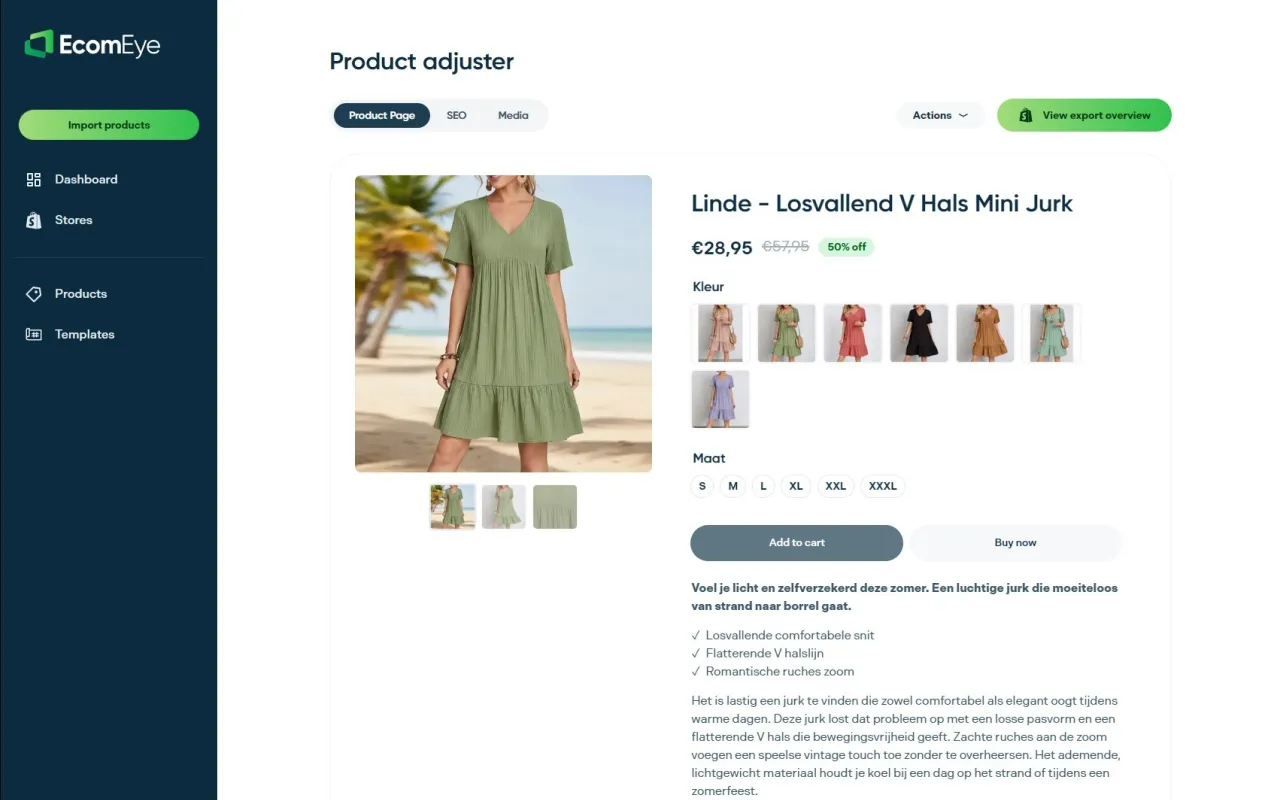
The platform imports product data straight from AliExpress, Amazon, Temu, or a competitor’s Shopify link, then generates unique titles, descriptions, and AI product images for every item in the batch, each one genuinely distinct even when built from the same source listing. Every page comes out SEO-ready and copyright-safe, with no manual rewriting between import and publish. That’s the practical difference from hand-writing prompts one product at a time: the same benefit-first, spec-locked structure covered in this article, just applied at volume instead of one listing at a time.
Pricing runs on two plans, Try-out at €39 per month and Scaler at €99 per month, both giving access to the bulk description generator and the AI product image generator for complete listing automation. If your catalogue has outgrown manual prompting, start with the AI product description generator and see how it handles your next import batch.
Sources
A handful of sources go further than this article on specific angles worth following up:
- AI Essentials — Google
- How to prompt AI to write product descriptions — Copyhackers
- How to write product descriptions that sell — Shopify
FAQ
What is an example of a good product description?
A strong example leads with the benefit before the feature: “Keep your coffee hot for 12 hours, not 12 minutes,” followed by the material and construction detail that proves the claim. That benefit-first structure is what Shopify and BigCommerce both recommend for descriptions that convert rather than just inform.
What are good ChatGPT prompts for writing product descriptions?
The strongest prompts assign a role (“you are an expert ecommerce copywriter”), supply a locked spec block of exact product facts, and specify format, tone and keyword placement rather than leaving those open. A template like “write a 150 to 200 word description with the keyword in the first sentence, three benefit bullets, and a closing CTA, using only these specs: [list]” consistently outperforms an open-ended request.
What should you say to sell a product effectively?
Lead with the transformation or outcome the customer gets, not the specification. State the benefit in one clear sentence, back it with two or three proof points drawn directly from the product’s real features, and close with a simple, low-pressure call to action.
How long should a product description be?
Short-form copy suits low-consideration, easily scannable products, while longer 200 to 400 word descriptions support deeper SEO for higher-consideration purchases. The 175 to 225 word range tends to give secondary keywords enough room to appear naturally without repetition.
Can automation like EcomEye replace manual prompt writing?
For catalogues beyond a few dozen SKUs, yes, in practical terms. EcomEye applies the same benefit-first, spec-locked prompt structure automatically across bulk-imported products, generating unique, SEO-ready descriptions and images without the manual prompting and uniqueness-checking that becomes unmanageable at scale.
Ready to boost your product pages?
Generate high-converting, SEO-optimized product pages in bulk using AI automation used by e-commerce experts.
No credit card required