Why bulk content generation wins for e-commerce SEO
Discover why bulk content generation boosts e-commerce SEO, driving faster organic growth and increasing visibility for your online store.

Why bulk content generation wins for e-commerce SEO

TL;DR:
- Bulk content generation uses AI and structured workflows to produce large volumes of targeted, SEO-optimized content quickly and efficiently. Retailers who implement keyword mapping, editorial review, and content pruning see faster ranking growth and increased domain authority. Proper quality control prevents penalties, ensures content relevance, and builds long-term organic traffic benefits.
Bulk content generation is the practice of producing large volumes of targeted, SEO-optimised content rapidly and efficiently to scale e-commerce visibility and sales. Online retailers who publish 50 or more optimised articles monthly through this approach see 73% faster organic growth and domain authority gains of 4.2 times compared to sporadic publishing. That gap is not marginal. It represents the difference between a store that ranks and one that stays invisible. Automation reduces per-article costs by up to 85% versus traditional content teams, making scale accessible to independent retailers, not just enterprise brands. The catch is that volume without editorial control triggers Google penalties, so quality guardrails are non-negotiable.
Why bulk content generation accelerates SEO and product listings
Bulk content generation builds topical authority through clusters, which is the single most reliable mechanism for accelerating search rankings in e-commerce. A topical cluster groups a pillar page, such as “running shoes,” with supporting articles covering subtopics like cushioning technology, sizing guides, and brand comparisons. Google reads the cluster as a signal that your site owns the subject. That ownership compounds: once you rank for the pillar, new cluster content ranks faster because it inherits authority from the established pages.

For online retailers, this matters at the product catalogue level. A store with 500 product listings needs 500 unique, keyword-mapped descriptions, plus category pages, buying guides, and comparison content. Writing these manually is not viable at speed. Bulk generation with AI drafts standardises the format, fills keyword gaps, and cuts production time from weeks to hours. The result is faster indexing, broader keyword coverage, and a content-driven SEO advantage that compounds month on month.
Internal linking is the structural glue that holds a bulk content strategy together. Each cluster article should link back to its pillar page and to two or three related cluster pieces. This passes authority between pages, reduces bounce rates, and prevents keyword cannibalisation, which occurs when multiple pages compete for the same search query and split ranking signals.
Key benefits of bulk content generation for e-commerce retailers:
- Topical authority: Covering an entire subject territory signals expertise to Google and accelerates rankings for current and future content.
- Faster indexing: A high publishing cadence trains Googlebot to crawl your site more frequently, reducing the lag between publication and ranking.
- Keyword coverage: Bulk generation fills long-tail keyword gaps that individual articles miss, capturing purchase-intent traffic at scale.
- Cost efficiency: Automated drafts cut production costs dramatically, freeing budget for paid acquisition or product development.
- Catalogue scaling: Retailers can generate optimised product descriptions, category pages, and blog content in parallel rather than sequentially.
Pro Tip: Map your keyword clusters before generating a single article. A structured keyword map prevents cannibalisation and ensures every piece of content has a clear, non-overlapping search intent.
What are the best practices for quality in bulk content?
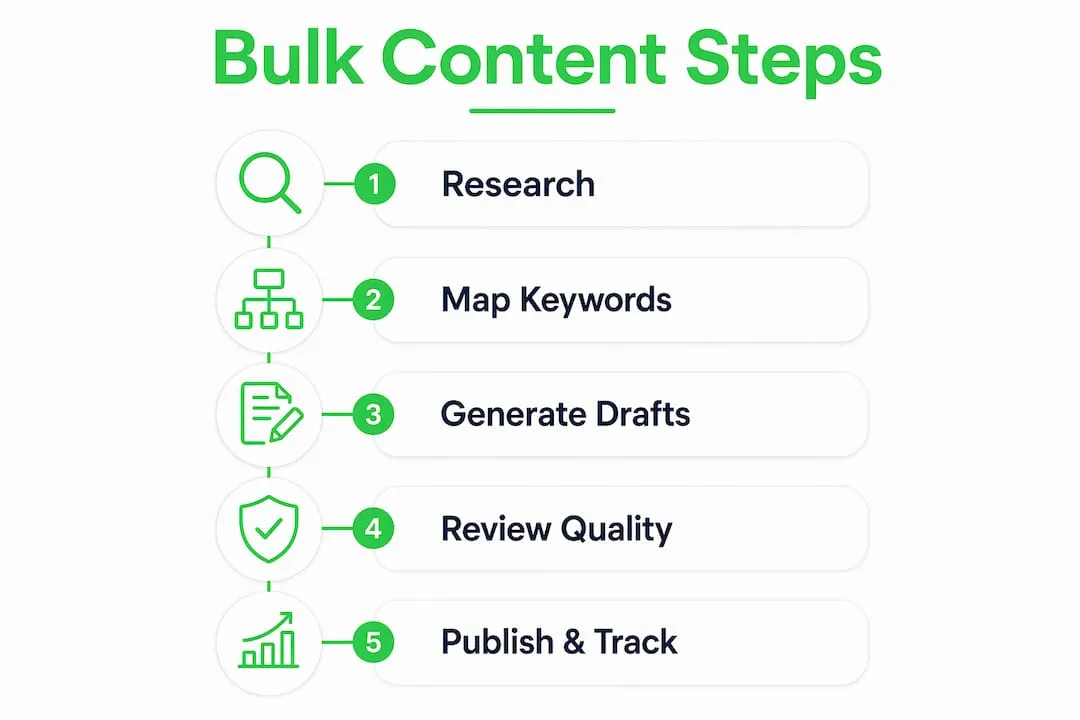
The most common failure in bulk content strategies is treating automation as a replacement for editorial judgement. It is not. AI drafts are starting points, not finished products. An editorial review of 15–20 minutes per article is the accepted standard for maintaining quality without sacrificing the speed advantage of bulk generation. That window is enough to catch factual errors, fix brand voice inconsistencies, and add specific product details that AI models cannot access.
A structured workflow makes this manageable at scale. The following process works for retailers producing high volumes of content without a large editorial team:
- Build a content brief template. Define the target keyword, search intent, word count, internal links, and required product references before generation begins. A consistent brief produces consistent drafts.
- Generate in batches. Produce 10–20 articles at a time rather than one by one. Batching reduces context-switching and allows reviewers to spot patterns in errors quickly.
- Review for factual accuracy first. AI models hallucinate product specifications, prices, and brand claims. Check every factual claim against your product data before anything else.
- Apply brand voice edits second. Adjust tone, terminology, and phrasing to match your store’s voice. This is where generic drafts become recognisable brand content.
- Add internal links manually. Automated tools rarely place internal links with the precision needed to support your cluster structure. Do this step by hand.
- Prune regularly. Remove or consolidate articles that attract no traffic after 90 days. Pruning weak posts drives traffic gains of around 11–12% by concentrating authority on stronger pages.
Pro Tip: Create a one-page editorial checklist covering factual accuracy, brand voice, internal links, and meta description. Reviewers who follow a checklist catch more errors in less time than those working from memory.
Avoiding keyword cannibalisation requires mapping every article to a unique search intent before generation. Cannibalisation dilutes site authority when two pages compete for the same query. A simple spreadsheet tracking keyword, URL, and intent category prevents this at scale.
What common mistakes should online retailers avoid?
The most damaging mistake in bulk content is publishing at volume without a quality filter. Google does not penalise AI-generated content as a category. It penalises thin, repetitive, or unoriginal content regardless of how it was produced. Retailers who use bulk generation to flood their sites with near-identical product descriptions or template blog posts risk a “scaled content abuse” manual action, which removes pages from search results entirely.
“Google’s algorithm targets scaled content abuse, not AI content itself. The distinction matters: useful, original content generated at scale is rewarded, not punished.”
Content decay is a subtler risk. Articles that ranked well in 2024 may lose ground in 2026 as competitors publish fresher, more detailed content on the same topics. Bulk strategies that focus only on new content and ignore existing pages accumulate decaying articles that drag down overall domain authority. A quarterly audit of existing content, with updates or consolidations where needed, prevents this erosion.
Brand voice dilution happens when AI drafts go live without review. Generic phrasing, incorrect product claims, and inconsistent terminology erode customer trust over time. A shopper who reads three product descriptions with contradictory specifications loses confidence in the store. That lost trust does not show up in analytics immediately, but it shows up in conversion rates and return visit rates over months.
Publishing cadence also matters. Releasing 200 articles in a single day sends an unusual crawl signal and may trigger quality reviews. A controlled cadence of 10–20 articles per day, spread across a publishing calendar, keeps crawl behaviour normal and quality signals consistent.
How can retailers implement bulk content generation effectively?
Effective implementation starts with research, not tools. Before generating a single article, build a keyword cluster map that covers your core product categories, supporting subtopics, and long-tail purchase-intent queries. This map becomes the production schedule. Every article generated has a pre-assigned keyword, intent, and position in the cluster before a single word is written.
The table below compares two implementation approaches by key criteria:
| Criteria | Unstructured bulk publishing | Cluster-mapped bulk publishing |
|---|---|---|
| Keyword cannibalisation risk | High | Low |
| Indexing speed | Variable | Consistent |
| Domain authority impact | Neutral or negative | Positive |
| Editorial review time | Unpredictable | Standardised |
| Long-term traffic growth | Unlikely | Probable |
Once the cluster map exists, AI tools generate drafts against the brief. The automated ecommerce workflows that produce the best results combine structured inputs, such as product data, target keywords, and tone guidelines, with human review at the output stage. Blind publication without review is the single step that separates successful bulk strategies from penalised ones.
Post-publication optimisation closes the loop. Track rankings for each published article at 30, 60, and 90 days. Articles that rank on page two for their target keyword need internal link reinforcement and content updates. Articles that attract no impressions after 90 days are candidates for consolidation or removal. This continuous cycle, generate, review, publish, audit, and prune, is what bulk listing automation looks like when it works at scale.
Pro Tip: Set a 90-day review calendar entry for every batch of articles you publish. Scheduled audits prevent content decay from accumulating unnoticed across your site.
Key takeaways
Bulk content generation delivers compounding SEO gains for e-commerce retailers only when volume is paired with structured keyword mapping, editorial review, and regular content pruning.
| Point | Details |
|---|---|
| Volume requires structure | Map keyword clusters before generating content to prevent cannibalisation and wasted output. |
| Editorial review is non-negotiable | Spending 15–20 minutes reviewing each AI draft catches factual errors and protects brand credibility. |
| Pruning boosts authority | Removing or consolidating weak articles concentrates domain authority and drives measurable traffic gains. |
| Cadence controls quality signals | Publishing in controlled daily batches keeps crawl behaviour normal and avoids triggering quality reviews. |
| Topical authority compounds | Covering a subject territory systematically accelerates rankings for both current and future content. |
The compounding advantage most retailers underestimate
I have watched online retailers approach bulk content generation in two very different ways. The first group treats it as a numbers game: generate as many articles as possible, publish immediately, and wait for traffic. The second group treats it as a system: build the cluster map first, generate against briefs, review every draft, and audit relentlessly. The first group rarely sees lasting results. The second group builds a content asset that grows in value every month.
The insight that most articles miss is that bulk content generation is not primarily about speed. Speed is a side effect of having a good system. The real advantage is coverage. When you systematically map and fill an entire topic territory, you capture search queries that competitors have not thought to target. That coverage compounds because Google rewards sites that demonstrate consistent expertise across a subject, not just sites that publish frequently.
AI is genuinely useful in this process, but it is a production tool, not a strategy tool. The strategy is the keyword map, the cluster architecture, and the editorial standards. AI executes against that strategy at a pace no human team can match. Retailers who understand this distinction build content operations that scale. Those who treat AI as a shortcut around strategy end up with large volumes of content that rank for nothing.
The uncomfortable truth is that the editorial review step, those 15–20 minutes per article, is where most bulk strategies succeed or fail. Skipping it saves time in the short term and costs rankings in the long term. The retailers I have seen build genuine organic traffic through bulk content are the ones who never skipped the review, even when publishing at high volume.
— Koen
How Ecom-eye handles bulk content generation for Shopify stores
Ecom-eye is built specifically for online retailers who need to generate product pages at scale without duplicating competitor content or risking Google Merchant disapprovals.

The platform imports products in bulk from AliExpress or competitor URLs and automatically generates SEO-optimised titles, clean descriptions, and AI product images. Every page is copyright-safe and unique, which removes the duplicate content risk that causes most dropshipping stores to stall in search rankings. Multi-language output means retailers can target international markets from the same workflow. Export to Shopify takes one click. For retailers who want to put the cluster-mapped, editorially reviewed bulk content strategy described in this article into practice, Ecom-eye’s bulk AI product lister is the production layer that makes it viable at scale.
FAQ
What is bulk content generation?
Bulk content generation is the practice of producing large volumes of SEO-optimised content rapidly, using AI tools and structured workflows, to scale website visibility and product listings. It works best when paired with keyword cluster mapping and editorial review.
Why use bulk content generation for e-commerce?
Retailers who publish 50 or more optimised articles monthly see 73% faster organic growth and domain authority gains of 4.2 times compared to sporadic publishing. Bulk generation also reduces per-article production costs by up to 85%.
Does bulk content generation hurt SEO?
Google penalises thin, repetitive, or unoriginal content, not bulk content itself. Retailers who use structured keyword clusters, editorial review, and regular pruning see positive SEO results rather than penalties.
How do you avoid keyword cannibalisation in bulk content?
Map every article to a unique search intent and keyword before generation begins. Cannibalisation dilutes authority when two pages target the same query, so a pre-generation keyword map is the most reliable prevention method.
How long does editorial review take for bulk-generated content?
An editorial review of 15–20 minutes per article is the accepted standard for catching factual errors, brand voice issues, and missing internal links without losing the speed advantage of bulk generation.
Ready to boost your product pages?
Generate high-converting, SEO-optimized product pages in bulk using AI automation used by e-commerce experts.
No credit card required