AliExpress Image Copyright: Can You Use the Photos?
AliExpress product photos are usually copyrighted. Learn who owns them, what the risks are, how to check an image and how to get safe images for Shopify.
AliExpress Image Copyright: Can You Use the Photos?
No, you should not assume you can. Product photos on AliExpress are almost always protected by copyright, and a public listing is not a licence. A supplier saying “use my pictures” does not settle it either, because the supplier may not own them. If you run a Shopify or dropshipping store, the safe route is permission in writing from the real owner, your own photos, or images generated for your own store.
Below we explain who owns these images, what can happen if you copy them, how to check an image, and how to get a clean image set without reshooting every product.
TL;DR
- Copyright in a photo exists automatically the moment it is created, with no notice or registration needed, so most AliExpress photos are protected.
- A listing being public, or a supplier being relaxed about it, does not give you a licence. Only the current owner of the exact image can grant permission.
- Consequences start with takedowns and store or account action, and can reach statutory damages of $750 to $30,000 per work in the US.
- A reverse image search tells you where a picture appears, not who owns it.
- The cleanest fix is unique images and copy per product, ideally produced in bulk before you publish.
Table of Contents
- Are AliExpress product images copyrighted?
- Why the supplier’s permission is not enough
- What can happen if you use them anyway
- How to check whether an image is protected
- Can you do an image search on AliExpress?
- If your own images were copied on AliExpress
- Safe ways to get product images for your store
- A clean-up plan for an existing store
- Perspective: why we built around unique output
- Generate original pages in bulk
- FAQ
- Sources
Are AliExpress product images copyrighted?
Yes, in the great majority of cases. In the US, the Copyright Office explains that copyright protection exists automatically from the moment an original work is fixed in a tangible form. Registration is optional, though it is needed before a US work can be enforced in court. Nobody has to add a watermark or a © symbol: a copyright notice has not been required since 1 March 1989.
A product photo is an original work. Someone chose the angle, lighting, background and retouching. That someone, or their employer if the photo was made for hire, is the initial owner.
The awkward part is working out who that is. On AliExpress a photo may come from:
- the factory that made the product
- a photographer the factory hired
- a brand’s official website or flagship store
- another seller who copied it from a third seller
The seller whose listing you are looking at may simply have taken it from somewhere else. The marketplace itself acts as a host, and its own rules treat image theft between sellers as a reportable offence (more on that below). So “it is on AliExpress” tells you where you found the picture, not who owns it.
“Royalty-free” claims you will see online
Some dropshipping guides say AliExpress pictures are generally free to use. That is an unwritten convention at best. Copyright law does not work on conventions: if you want to use a work you did not create, the Copyright Office says you must identify the owner and ask for a licence, unless a limitation such as fair use applies. The Office cannot grant that permission for you or tell you whether fair use covers your case.
Fair use is a defence argued case by case, and selling the same product with the same photo, in a store that competes for the same buyer, is a hard position from which to argue it. Do not build a business on it.
Why the supplier’s permission is not enough
Say a supplier replies, “Sure, use our images.” That helps only if the supplier owns them. The Copyright Office stresses that only the current owner of the exact material can give permission, and that ownership can be transferred, so the name on a notice may no longer be the owner.
The chain in dropshipping makes this murky. A factory commissions a photo, a wholesaler reuses it, a marketplace seller copies it. By the time it reaches you, a friendly “feel free” may be a permission the supplier never held.
If you do ask a supplier, make the request specific:
- Name the exact images (file names or links).
- State where you will use them: your Shopify store, ads, marketplaces.
- Ask who took them and whether the supplier is entitled to license them.
- Keep the reply, the date and the invoice together in one folder.
An email that covers these points is far better than a vague chat message. Even so, treat it as one layer of protection, not a guarantee. If you sell with an unclear chain of rights, your own images are the stronger position. Our guide on copyright in dropshipping goes deeper on the chain-of-rights question.
What can happen if you use them anyway
The risk is rarely a lawsuit on day one. It usually escalates in steps.
Takedowns and account action
Under the Digital Millennium Copyright Act (DMCA, 1998), platforms keep their Section 512 safe harbour by acting on valid notices within a reasonable time. In practice that means a listing, an ad or a page can disappear quickly after a complaint. Repeat complaints against the same store raise the stakes. Shopify, ad networks and marketplaces each have their own repeat-infringer policies, so check the current terms of every platform you rely on.
For a store that depends on paid traffic or Google Shopping, losing a product page or an ad account is often costlier than any legal fee.
Money
If the owner registered the work in time, US law allows statutory damages. According to a US law firm, these run from $750 to $30,000 per work, and up to $150,000 per work for wilful infringement, plus potential attorney fees. They are available only where the work was registered before the infringement began or within three months of first publication, as explained here.
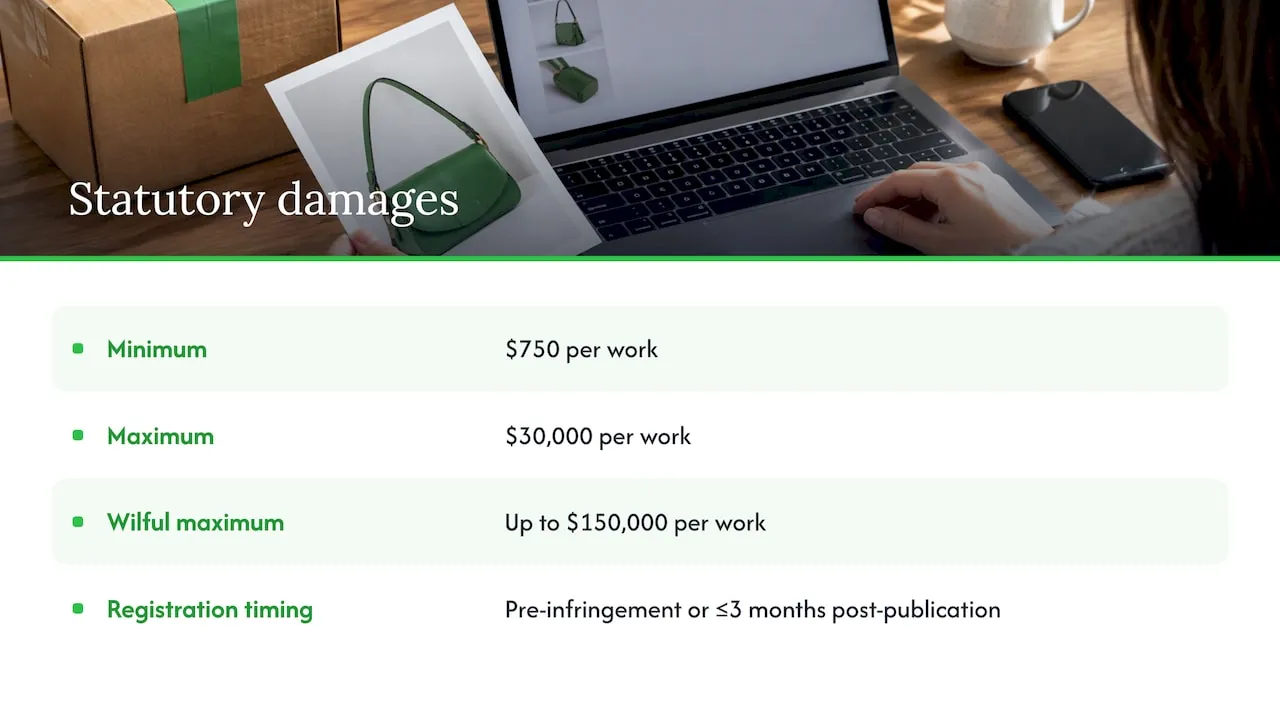
Note the “per work”. A store with 300 products and one copied image each is not one infringement. The same source describes criminal penalties for wilful infringement for commercial advantage, which is a rare outcome but shows how the law frames large-scale commercial copying.
Marketplace penalties
AliExpress’s own guidance says a valid complaint leads to the listing being removed, with possible penalties such as suspension or fines for the seller. Your supplier can lose the listing you source from, which can break your catalogue overnight.
How to check whether an image is protected
Assume protection by default. Checking is for working out who to ask, not for finding a loophole.
- Look at the file’s metadata. The Copyright Office notes that for digital files, author and copyright information may sit in the metadata. It is often stripped, so an empty field proves nothing.
- Search the registration records. The same circular points to the Office’s searchable records for works registered after 31 December 1977.
- Run a reverse image search. Google Images, TinEye and Bing Visual Search can show where a picture appears and its earliest known use, which often leads you to the brand or photographer. They show where an image exists, not who holds the rights.
- Look for watermarks and logos. A brand logo or watermark is a sign the image came from somebody’s official channel. Cropping it out does not make the photo yours.
If the earliest appearance is a brand’s own site or a flagship store, treat the image as that brand’s. On a branded product, trademark can also become an issue, which we cover in product trademark risks for online sellers.
Can you do an image search on AliExpress?
Yes, the app and site let you search by picture to find similar products. That is a sourcing tool. It finds listings, not licences, and it will happily show you ten sellers using the same stolen photo. Use it to find suppliers and then replace the images, not to decide an image is safe.
If your own images were copied on AliExpress
Some readers land here from the other side: a designer or brand finding their photos in someone else’s listing. AliExpress and its parent group have routes for rights holders.
- The Alibaba Intellectual Property Protection platform lets rights holders file copyright complaints for image theft. You choose Copyright as the IPR type, Product listing as the complaint type and Image Theft as the reason, and attach screenshots of the image with its URL as evidence.
- AliExpress’s seller site for the CIS region says rights holders can report infringement by email or through a complaint form, with a description, evidence and documents proving rights. For copyright, that can include original files, contracts with the author or a certificate of deposit.
Have your originals and dated proof of first publication ready before you file. Complaint forms and requirements change, so use the platform’s current page.
If your business is on Shopify and you want to protect your own photos, see our piece on enforcing image copyright on Shopify.
Safe ways to get product images for your store
Here are the realistic options, from most to least work.
| Option | Rights position | Effort | Works for bulk catalogues? |
|---|---|---|---|
| Order a sample and shoot it yourself | You own the photos | High | Poorly |
| Written licence from the verified owner | Licensed for named uses | Medium, repeated per product | Only for a few products |
| Supplier says “use them” | Unclear, depends on the chain | Low | Risky |
| Copying listing photos | No licence | Low | Not advisable |
| Unique images generated for your own store | Original to your store | Low | Yes |
For a handful of hero products, your own shoot is the gold standard. For a catalogue of hundreds, nobody reshoots everything, which is why bulk generation matters.
There is also a ranking angle. When many stores publish the same supplier photos and the same supplier copy, Google sees near-duplicates. We cover this in preserving metadata and using unique images per SKU. If you already have supplier images live, replacing them safely with a CSV is a practical clean-up route, and our product image best practices cover sizing and quality.
If you also sell on eBay, the same principle applies to your listing photos. A walkthrough of listing on eBay from photos shows how the photo step fits into the publishing flow.
A clean-up plan for an existing store
- Export your products and note which images came straight from suppliers.
- Rank by exposure: best sellers, ad landing pages and Google Merchant Center products first.
- Replace the images with originals or newly generated ones, product by product or in bulk.
- Rewrite titles and descriptions at the same time, so the text is not a copy of the supplier’s either.
- Keep records of any permission you did get, with dates and the file names it covered.
- Respond fast to any notice. Remove the content, then take legal advice from an IP attorney if a demand letter arrives. Do not ignore it.
Perspective: why we built around unique output
We see the same pattern in stores that stall. The owner imports a product, keeps the supplier photos and copy, and publishes. A hundred other stores did the same. Google sees duplicates, Merchant Center flags the feed, and sometimes a complaint lands as well.
Our view is that the fix belongs at the start, not after the first notice. That is why EcomEye is designed so that every listing’s text and images are generated uniquely for each user, even when two users start from the same product link. You bring the product data from AliExpress, Amazon, Temu or a competitor’s Shopify page, and we generate new titles, descriptions and images rather than passing the originals along.
We also think speed matters. Nobody can hand-rewrite 500 pages and reshoot 500 products, so the safe option has to be as quick as copying was. That is the job we built the platform to do, with bulk editing, templates, multi-language pages and a one-click export to Shopify.
Koen
Generate original pages in bulk
If you want to stop worrying about whose photo is whose, EcomEye imports your products from AliExpress, Amazon, Temu or competitor Shopify links and generates unique titles, SEO-ready descriptions and AI product images. You can then export them to Shopify in one click. It also offers multi-language pages, size system conversion and tools for Google Merchant Center and variant management.
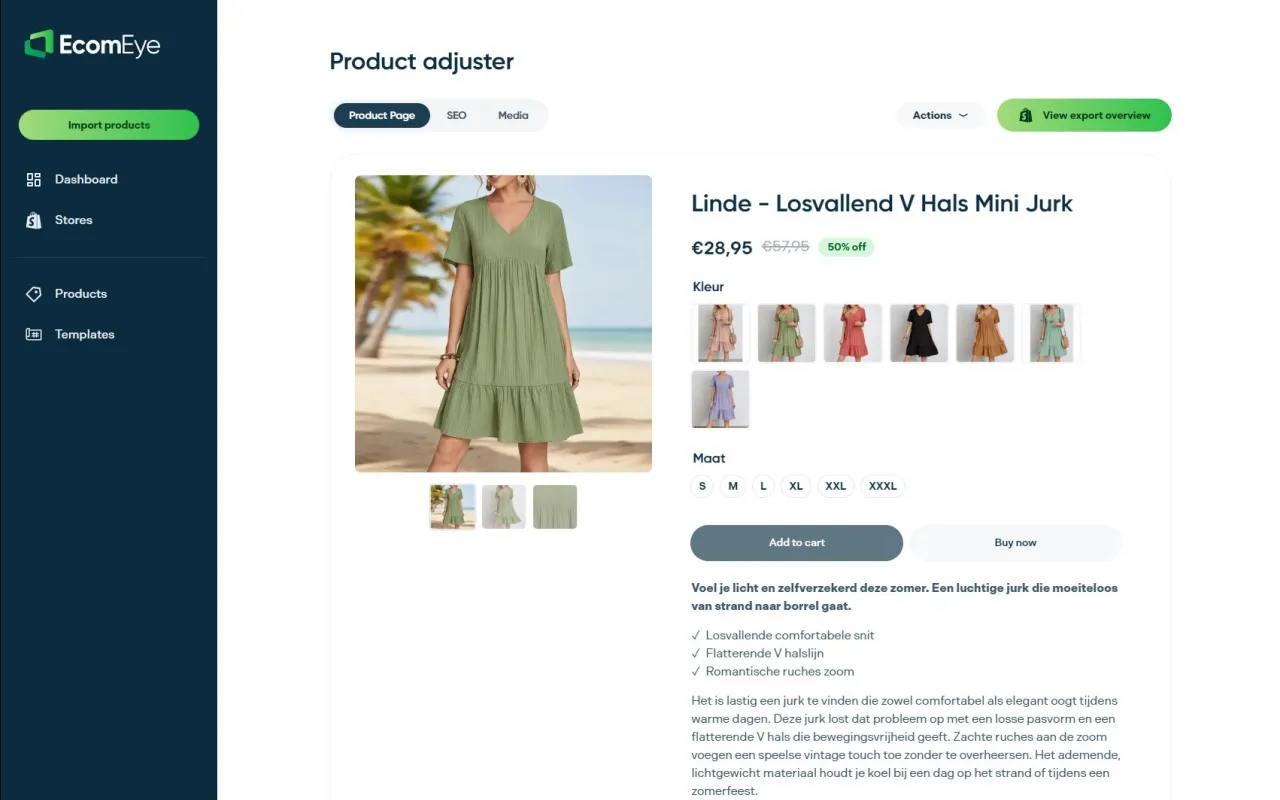
Plans start with Try-out at €39 per month, and Scaler is €99 per month, both on the pricing page. You can see how the generation works on the AI product image generator and AI product description generator pages, or start from the EcomEye home page.
FAQ
Can I use AliExpress pictures on my Shopify store?
Not safely without permission. The images are protected by copyright from creation, and being visible on a listing does not license them to you. Get written permission from the verified owner, shoot your own, or use images generated for your store.
How can you tell if an online image is copyrighted?
Assume it is. Check the metadata for author details, search the Copyright Office registration records, and run a reverse image search to find the earliest appearance. These steps help you find the owner, but none can tell you the image is free to use.
How do I report a seller on AliExpress?
If you own the image, file a copyright complaint through the Alibaba Intellectual Property Protection platform, choosing Copyright, Product listing and Image Theft. Attach screenshots with URLs and proof of ownership such as original files. Check the platform’s current form for requirements.
Is a supplier’s permission enough?
Only if the supplier truly owns the images and can license them. Because a factory, wholesaler and reseller may each have copied the photo, ask in writing who took it and for which uses you are covered. Own or generated images remove that doubt.
Sources
- Circular 1: Copyright Basics, US Copyright Office
- Circular 16A: How to Obtain Permission, US Copyright Office
- DMCA lawyer guide, LegalMoves Law Firm
- What is a DMCA case, Daeryun Law
- Understanding AliExpress copyright infringement, AliExpress
- How to check if an image is copyrighted, Mixpeek
- Alibaba IPP platform: image theft complaints
- Intellectual property, AliExpress for sellers
Ready to boost your product pages?
Generate high-converting, SEO-optimized product pages in bulk using AI automation used by e-commerce experts.
No credit card required