Amazon Product Image Copyright: What Dropshippers Can Reuse
Who owns Amazon product photos, whether dropshippers can copy them to Shopify, and how to source images safely and respond to a copyright complaint.
Amazon Product Image Copyright: What Dropshippers Can Reuse

No, you cannot copy product images from an Amazon listing onto your Shopify store just because they are public. The photographer or whoever commissioned the photo usually owns the copyright, and Amazon’s own rules do not hand that right to other sellers. The safe routes are images you shot yourself, images you licensed, images the supplier or brand has cleared in writing, or fresh images created for your listing. This guide explains who owns what, where the real risk sits for dropshippers, and what to do if a complaint lands in your inbox.
TL;DR
- Copyright in a photo exists from the moment it is taken, with no registration needed, and the photographer is generally the first owner.
- Uploading a photo to Amazon gives Amazon a licence. It does not give other sellers or dropshippers the right to reuse that file on their own stores.
- Editing, filtering or regenerating a copied image does not turn it into yours. Permission has to exist before the image goes on a listing.
- Keep a source record for every image: who made it, when, and under what licence or contract.
- If you get a complaint, collect the facts first, remove anything you cannot defend, and replace it with original or licensed images.
Table of Contents
- Who owns the copyright in an Amazon product photo?
- Does uploading an image to Amazon let others reuse it?
- Can dropshippers copy Amazon images to Shopify?
- What the risk looks like in practice
- Where to get product images you can actually use
- If someone has copied your product photos
- If you receive a copyright complaint
- Our perspective
- Build unique, Google-ready listings with EcomEye
- FAQ
- Sources
Who owns the copyright in an Amazon product photo?
The person who creates an original work usually owns the copyright in it, and that includes the person who takes a product photo. Amazon’s Intellectual Property Policy says as much: an author of an original work generally holds its copyright.
The U.S. Copyright Office is equally direct. Protection for a photograph starts once it is fixed in a tangible form, registration is not required for that protection, and the photographer is generally the initial author and owner. The USPTO’s copyright basics add that the owner holds the exclusive right to reproduce, adapt, distribute and publicly display the work.
Two practical consequences follow for anyone selling online:
- The brand does not always own its photos. If a brand hired a photographer, the contract decides who holds the rights. A transfer of copyright has to be in writing and signed by the owner under Section 204 of the Copyright Act. Paying an invoice alone is not a written transfer.
- Being public is not being free. A photo that appears on a product page, a marketplace listing or a supplier’s catalogue is still protected. Visibility says nothing about permission.
Does uploading an image to Amazon let others reuse it?
No. When a seller uploads a copyrighted image to a detail page, they give Amazon and its affiliates a non-exclusive licence to use it. Amazon’s policy, as summarised by one image-protection company, does not give other third-party sellers the right to copy that specific file.
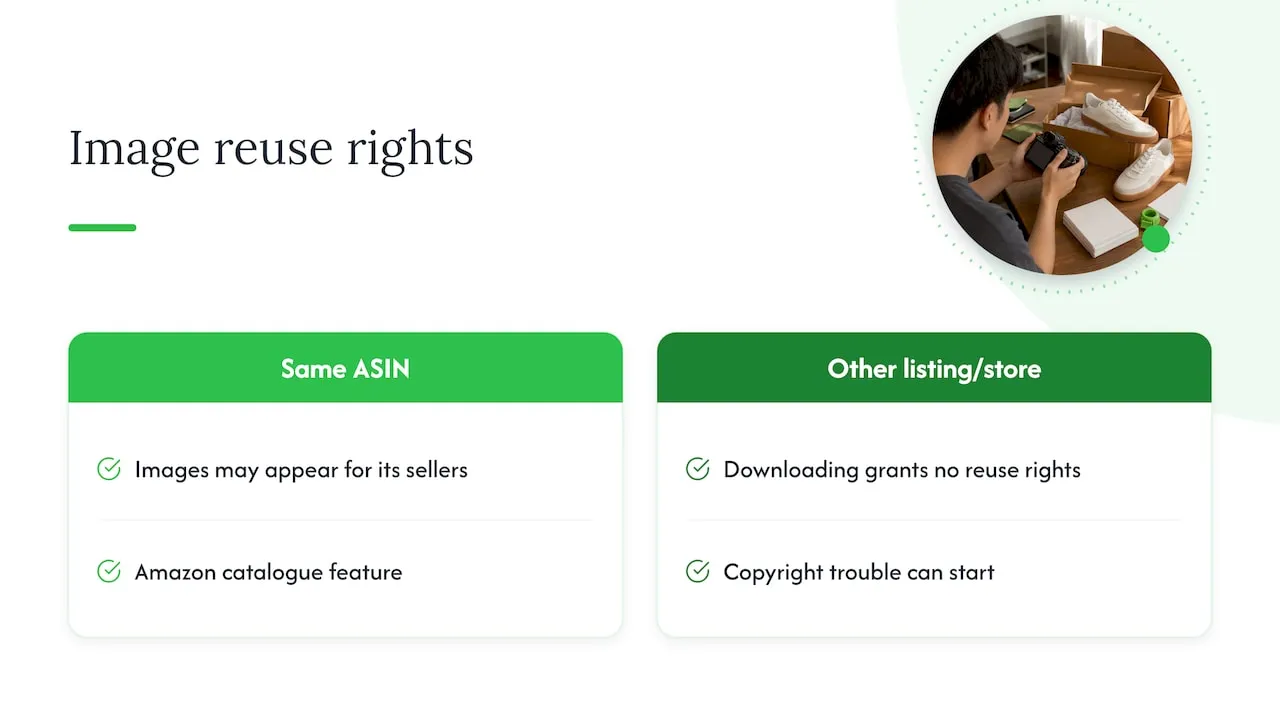
There is one nuance that confuses many new sellers. Several sellers can list the same product on the same ASIN, and the images attached to that listing may legitimately appear for each of them. That is a feature of how Amazon’s catalogue works. It is not the same as downloading those photos and uploading them to a different listing or a different store, which is where the trouble starts.
Can dropshippers copy Amazon images to Shopify?
Not safely. Amazon’s policy tells sellers not to upload a photo found on someone else’s website without permission, and copying images to sell a product on another page could violate the rights owner’s copyright.
There are two separate layers here, and it helps to keep them apart:
- Amazon’s terms of use. Amazon.com’s Conditions of Use, as described by a dropshipping guide, limit the licence to personal, non-commercial use. They also exclude collecting product listings, descriptions or prices, and using robots or extraction tools, without Amazon’s written consent. Scraping listings in bulk therefore creates a contract problem before any copyright question arises.
- Copyright law. Even if you never touched Amazon’s terms, the photo itself belongs to someone. A professional shot can carry protection through its lighting, staging and editing choices, so using your own photos or ones you have permission for is the safest course.
One more point catches dropshippers out. A supplier saying “use our pictures” in a chat message is not the same as a documented licence. If the supplier did not shoot the photos, it may not have the right to give you permission at all.
What the risk looks like in practice
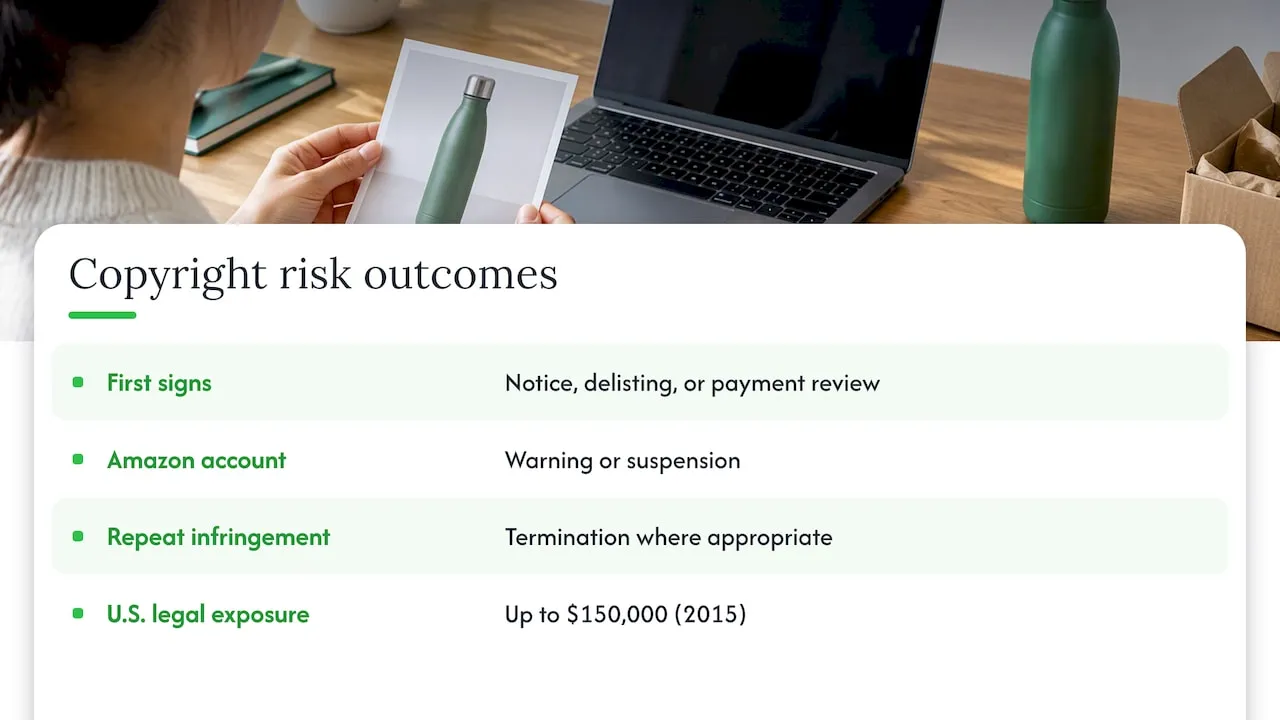
Copyright problems rarely start with a lawsuit. They usually start with a notice, a delisted product or a payment-platform review. The legal exposure sits behind that.
Marketplace and platform action. Amazon states that it acts even when a seller infringes without knowing it. The seller’s account may receive a warning or be suspended, and repeat infringers are terminated where appropriate. Shopify and Google Merchant Center have their own processes for handling infringement reports and disapprovals.
Legal exposure. One e-commerce publication notes that using product or lifestyle images on a shop without the creator’s permission can carry penalties of up to $150,000 in the United States. That figure is from 2015 and describes the upper end of the range, so treat it as a sign of how seriously the law treats the issue, and speak to an IP attorney if you are facing an actual claim.
The “I changed it” myth. Cropping, recolouring, adding a filter or running the image through an AI tool does not create a right to use it. IP lawyers writing for Amazon sellers point out that modifying or regenerating an image does not make it licensed if the source image was used without authorisation. Permission has to exist upstream.
Where to get product images you can actually use
The same IP lawyers say the fix is upstream, before anything goes on a listing: use images you created, properly licensed images, or images cleared for commercial use, and keep records of the source and the licence for each. In practice a dropshipper has five realistic routes.
| Route | What you need | Typical watch-out |
|---|---|---|
| Shoot your own photos | A sample order and basic lighting | Slower, and costs a sample per SKU |
| Written permission from the rights owner | A signed, dated message or licence naming the images and the use | The person granting it must actually own the rights |
| Commercial licence from a photographer or stock library | Licence terms that cover online retail | Read the limits on edits and exclusivity |
| Supplier-provided images with a licence of authority | A written letter or licence from the supplier or brand | See our guide on getting a letter of authority to remove supplier branding |
| Newly generated product images | Source product data and a generator whose output is created for you | Check the generator’s terms and keep the generation record |
Whichever route you choose, write it down. The record-keeping habit is the same on every marketplace, as this walkthrough on how to list on eBay from item photos to publication shows.
A simple source log
One spreadsheet row per image is enough. Include:
- The product SKU and the image file name.
- Who made the image and how to contact them.
- The date it was created or acquired.
- The contract, invoice, licence or email that grants the right to use it.
- A registration number, if the owner has one.
This mirrors what image owners are advised to keep when they have to prove authorship: creation date, photographer’s contact details, the contract or invoice, and the registration number where it applies. If you ever need to answer a complaint, that row is your defence.
For more on building a catalogue that does not trigger takedowns, see our six-step checklist to avoid listing takedowns and our guide to copyright in dropshipping.
If someone has copied your product photos
If you are the photographer or the brand, you have options. Work through them in this order.
- Preserve the evidence. Save dated screenshots, the listing details and your original file, ideally with camera metadata and a record of where and when it was first published.
- Identify the ASINs or URLs. Note every listing that uses the image.
- File the report. Amazon’s report form at amazon.com/report/infringement lets copyright owners report infringing listings. For copyright only, Amazon also accepts notices by email or post to its Copyright Agent. A formal DMCA takedown notice or Brand Registry’s Report a Violation tool are the other routes commonly recommended.
- Consider registering your photos. The U.S. Copyright Office says registration creates a public record of ownership and brings added benefits, such as the ability to bring an infringement claim and seek certain monetary remedies.
Our own guide on how Shopify sellers can enforce image copyright and register photos in bulk goes deeper on step four.
If you receive a copyright complaint
Do not panic and do not reply in a rush. The order matters.
- Collect the facts. Note the complaint ID, the ASIN and the exact content flagged, then decide whether the complaint is valid before responding.
- If it is valid, remove the challenged material, replace it with original or properly licensed content, and send a clear appeal that explains the correction and what you will do to prevent a repeat.
- If you have a relationship with the rights owner, ask them to retract the complaint. Amazon’s policy says an established relationship allows a retraction request, and that a seller who believes removal was mistaken can reply with specific reasons and supporting invoices or Order IDs. If the account is suspended, a Plan of Action goes through the account dashboard or in reply to the suspension notice.
- If you honestly believe the claim is wrong, a counter-notice is available. It must identify the removed content, include a good-faith statement that the removal was a mistake or misidentification, consent to the jurisdiction of a U.S. federal court, and be signed. One seller-support firm says Amazon typically restores the listing within 10 to 14 days if the claimant takes no further legal action.
A counter-notice carries a statement made under penalty, so talk to an IP attorney before you sign one.
Our perspective
Most dropshippers we talk to do not set out to steal images. They import a product, the supplier’s or the marketplace’s photos come along with it, and the store goes live with pictures nobody has cleared.
That is why we built EcomEye around the idea that every listing should be unique. Our platform generates product titles, descriptions and images for each user, so two stores selling from the same product link do not end up with the same page. By design, that removes the habit of lifting someone else’s photos and copy, which is where the copyright and takedown trouble starts.
Our advice is simple: decide your image source before you import a single product, keep a log of it, and never treat a copied photo as safe because it has been edited. Do that and you can scale without worrying about the next notice.
Koen
Build unique, Google-ready listings with EcomEye
If you want to move from copied pages to unique ones without writing every listing by hand, EcomEye is built for that. You import products in bulk from AliExpress, Amazon, Temu or competitor Shopify links, and the platform generates titles, descriptions and AI product images, with multi-language pages and one-click export to Shopify.
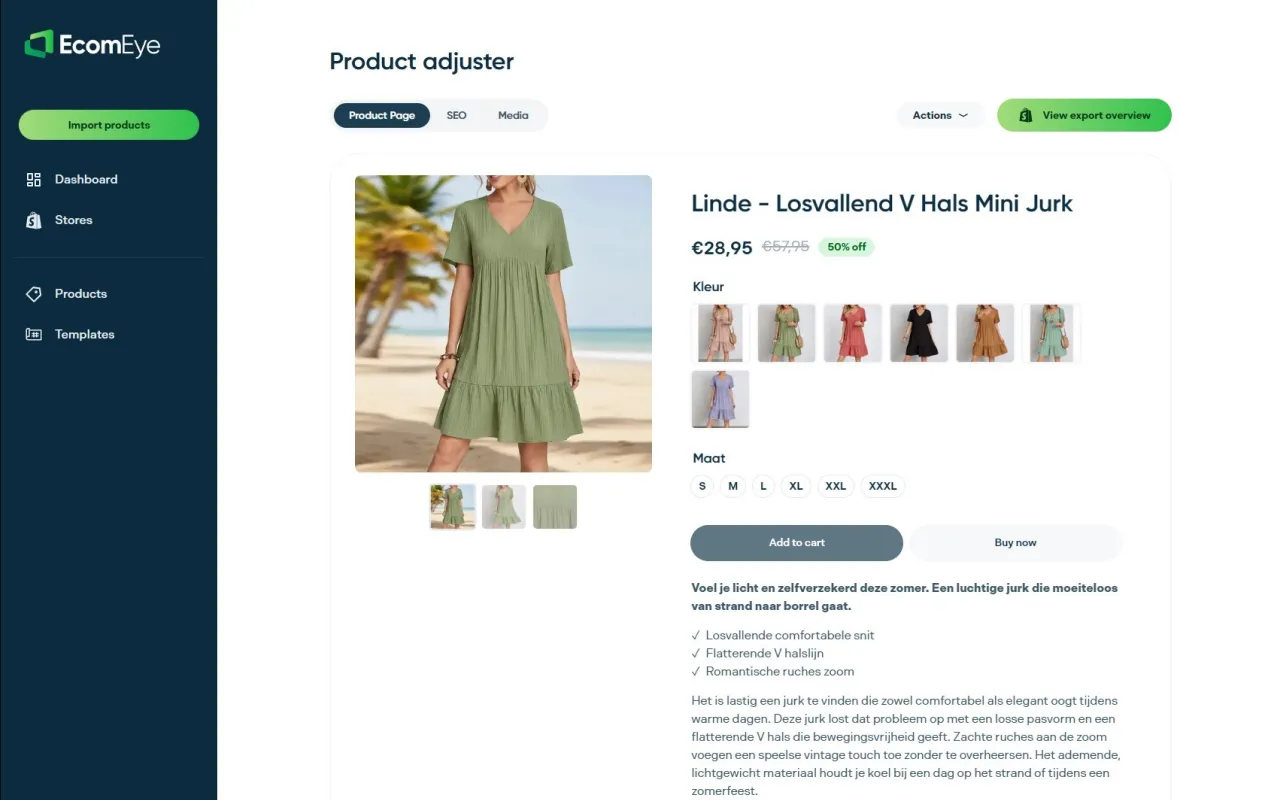
Plans start with Try-out at €39 per month, and Scaler is €99 per month. See the details on the pricing page, or look at the AI product image generator and the AI product description generator to see what each tool produces.
FAQ
Can I use Amazon product images if I am selling the same item?
Only if you have the rights. Sellers on the same ASIN may show the images attached to that listing inside Amazon. Copying those files to your own Shopify store or a different listing is a separate act, and it needs permission from whoever owns the photos.
Is it legal to use a photo if I credit the source?
Crediting the source does not replace permission. Copyright gives the owner the exclusive right to reproduce and display the work, so you need a licence or written consent. A credit line without one can still leave you exposed to a takedown or claim.
Does changing or AI-editing a copied image make it safe?
No. IP lawyers who advise Amazon sellers say that modifying or regenerating an image does not create a right to use it when the source image was used without authorisation. Start from your own photos, licensed images or newly created ones instead.
Do I have to register my photos to be protected?
No. Protection begins when the photo is fixed in a tangible form. The U.S. Copyright Office does recommend registration, because it creates a public record of ownership and allows you to bring an infringement claim and seek certain monetary remedies.
What should I do first after a copyright complaint on my listing?
Gather the complaint ID, the ASIN and the flagged images, and decide whether the complaint is valid. If it is, take the images down, replace them with original or licensed ones and appeal with an explanation. For anything contested, speak to an IP attorney.
Sources
- Amazon Intellectual Property Policy
- Amazon Intellectual Property Policy, earlier redline
- What Photographers Should Know about Copyright, U.S. Copyright Office
- Copyright basics, USPTO
- Copyright for Amazon Sellers: Protect Photos and Copy
- Amazon seller image copyright: risks for marketplace sellers
- Someone is using your product photos? How to get them removed
- Can You Dropship Amazon Products on Shopify?
- Can we use product images posted on Amazon?
- Online Retailer’s Guide to Photo Copyrights
- Can You Use Images You Found Online? What Amazon Sellers Get Wrong About Copyright
- Another Seller Stole My Product Images: what to do
- Amazon listing copyright infringement: how to report it
- How to File a Counter-Notice for Copyright Infringement on Amazon
- How to Handle a Copyright Complaint on Amazon
- How to list on eBay: from item photos to publication
Ready to boost your product pages?
Generate high-converting, SEO-optimized product pages in bulk using AI automation used by e-commerce experts.
No credit card required