AliExpress Image Licensing: Can You Use the Photos?
AliExpress images come with no licence for your store. Learn who owns them, what the terms say, the US risks, and how to get permission or use safer images.
AliExpress Image Licensing: Can You Use the Photos?
No. Photos on an AliExpress listing do not come with a licence for your Shopify store. The copyright usually sits with whoever took the photo, which is often not even the seller, and AliExpress’s own terms give you no right to copy listing content elsewhere. To use an image legally you need written permission from the real rights holder, your own photos, or images created for you. This guide explains why, what the risks are in the United States, and how to build a product catalogue you can defend.
TL;DR
- AliExpress images are not free to reuse. AliExpress’s own agreement bars copying listing content without written agreement and grants no licence in its intellectual property.
- Copyright in a photo belongs to its creator from the moment it is taken. Sellers often do not own the pictures they upload.
- Fair use is a weak defence when you use a supplier’s photo to sell the same product on your own store.
- Written permission helps, but only if the person giving it actually owns the rights. Keep the evidence.
- The safest routes are your own sample photos, a licensed supplier kit, or unique images generated for your store.
Table of Contents
- Who actually owns an AliExpress product photo?
- What AliExpress’s terms say about reusing listing images
- Why “fair use” rarely protects a dropshipping store
- What can happen if you use an AliExpress image without permission
- How to get permission and keep the evidence
- Safer options when you cannot verify a licence
- Do not forget the text and the trademarks
- Our perspective
- Build a catalogue of unique, licence-clean pages
- FAQ
- Sources
Who actually owns an AliExpress product photo?
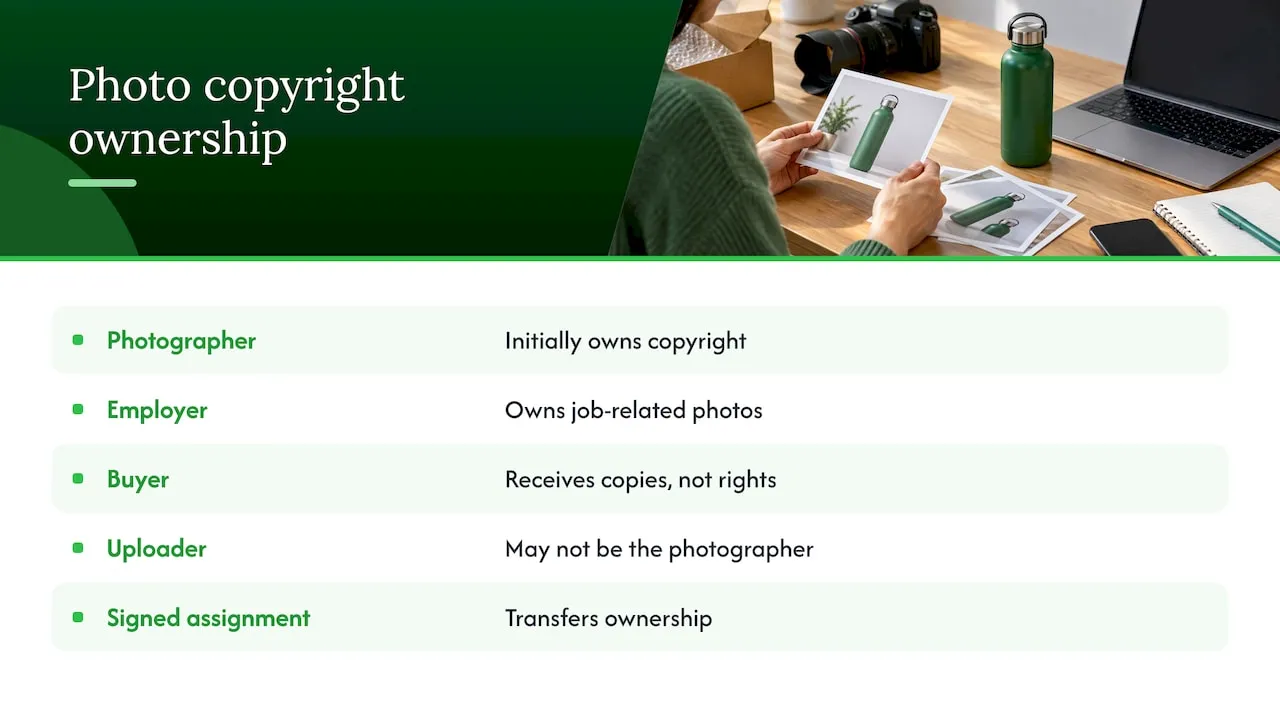
Under 17 U.S.C. § 201(a), copyright in a work initially belongs to its author. For a photograph, that means the person who pressed the shutter, or their employer if the photo was taken as part of the job. No registration or © symbol is needed for protection to exist.
The Professional Photographers of America puts it plainly: in most cases the photographer owns the copyright unless it has been assigned in a written agreement, and paying for a photo does not transfer ownership. A buyer receives copies, not the rights, unless usage rights were specifically purchased.
This matters because the person who uploaded the photo to AliExpress may not be the person who made it. One ecommerce image licensing guide notes that supplier photos on AliExpress and Alibaba are frequently pulled from a brand’s own marketing or a manufacturer’s catalogue, without the supplier securing any right to redistribute them. Use those photos and you inherit the problem.
There is a second layer. Even if a supplier did commission the photos, ownership does not move automatically. A standalone photograph generally does not qualify as a work made for hire, so a signed written assignment under § 204(a) is the reliable way to transfer ownership, as this ecommerce law firm explains. A seller with a broad licence to use a photo is not in the same position as one holding a signed assignment, and that licence may not be theirs to pass on.
What AliExpress’s terms say about reusing listing images
Many dropshippers assume that because they source a product through AliExpress, the pictures come with it. The marketplace’s terms say otherwise.
The AliExpress Business Program User Agreement covers this in several clauses:
- Clause 6.2: participants may not copy or modify content on AliExpress Business, sellers’ stores or AliExpress domains unless AliExpress or the sellers agree in writing.
- Clause 6.3: the agreement does not grant ownership or licence rights in AliExpress’s intellectual property.
- Clause 9.2: the participant is solely responsible for obtaining all necessary third-party licences and permissions for selling merchandise sourced from AliExpress.
In other words, the responsibility for clearing the images is yours. AliExpress does not clear them for you.
On the seller side, AliExpress’s seller terms make the uploader promise that they hold the rights to what they post. The seller agreement for non-Russian sellers has the seller warrant exclusive rights and all necessary third-party consents, while granting AliExpress a royalty-free licence to use the materials. That licence runs to AliExpress for hosting and display. It is not a licence for you. As the same ecommerce law firm points out, platform terms generally licence uploaded content for hosting and display and do not decide a dispute between a creator and someone who copied the content.
Why “fair use” rarely protects a dropshipping store
The most common defence sellers reach for is fair use. In this situation it is a poor bet. LegalClarity explains that when you use a product image to sell that same product on an ecommerce site, fair use is an extremely weak defence. The use is commercial, you are likely showing the whole image, and you are standing in for a photo the owner could have licensed.
Courts also weigh whether your use replaces the market for the original. Putting a supplier’s photo on a competing store does exactly that, which makes the argument very hard to win.
Two other beliefs do not hold up either:
- “The image is public, so it is free.” Public posting is not a free licence, as this Shopify copyright guide stresses.
- “I changed it slightly.” Cropping, resizing or adding a logo does not remove the original author’s rights in the underlying photo. Treat any lightly edited copy of someone else’s photo as the same photo.
What can happen if you use an AliExpress image without permission
The risk comes from three directions: the rights holder, Shopify and Google, and AliExpress itself.
Legal exposure in the United States
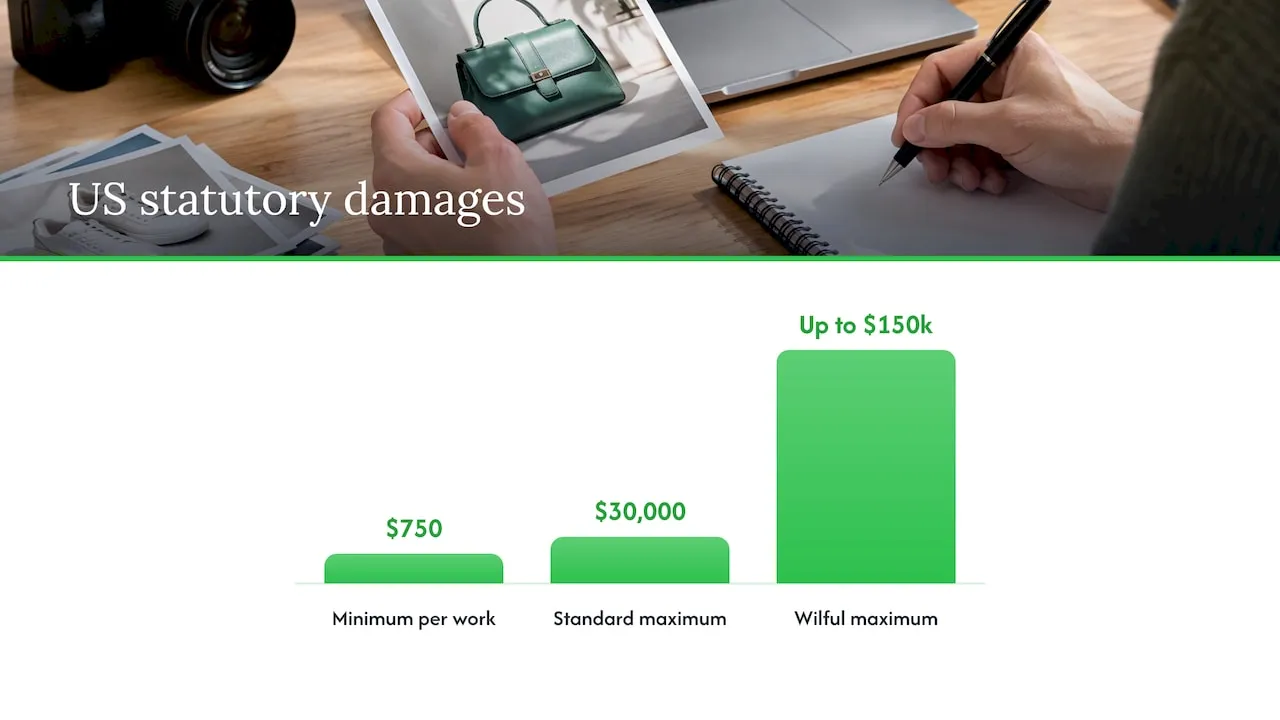
In the US, statutory damages can range from $750 to $30,000 per work, and up to $150,000 per work for wilful infringement, with legal fees and court costs on top. A catalogue of 200 products with several images each multiplies quickly. Federal courts also act against sellers of unauthorised copies: in 2022 the Southern District of Florida granted a preliminary injunction against defendants selling goods bearing unauthorised copies of copyrighted art on ecommerce stores including AliExpress, ordering them to stop and freezing assets.
Whether a particular claim would succeed is a question for an intellectual property attorney. The point for a store owner is that the downside is large and the upside of copying is small.
Takedowns and store problems on Shopify
Shopify’s Acceptable Use Policy prohibits intellectual property infringement. As described by one store-protection guide, rights holders file a notice and Shopify can remove listings or suspend stores on valid reports. According to one Shopify DMCA guide, valid takedown requests are generally processed within 24 to 48 hours. If you receive one for an image you assumed was free, the recommended response is to remove it quickly and replace it with an original photo.
If you believe a notice was sent by mistake, a valid counter-notice has formal requirements, including a signature, identification of the removed content, a statement under penalty of perjury and consent to federal court jurisdiction, as this DMCA response guide sets out. That is not a position you want to be in over a stock supplier photo.
Consequences on AliExpress
Under Clause 6.4 of the Business Program agreement, a participant who infringes the rights of sellers or AliExpress must stop immediately on notice and remove the material from their site, and AliExpress may limit or end their access and freeze their balance. AliExpress’s IPR policy also treats unauthorised use of copyrighted images as infringement and records violations for 365 days.
Google and duplicate content
Even without a legal claim, supplier photos cause trouble. One Google Merchant Center compliance guide warns that AliExpress images may be low quality, used by hundreds of other stores and flagged as duplicate content, or may not represent the product accurately. It recommends your own photos of the actual items or verified supplier images. Our own notes on unique images per SKU cover the duplicate-image side in more detail.
How to get permission and keep the evidence
Permission is the first legitimate route, but do it properly.
- Find out who made the photo. Run a reverse image search. Shopify’s dropshipping guide advises doing your due diligence to make sure photos come from the manufacturer and not another retailer, and says a Google image search shows whether they are original.
- Ask in writing. Message the supplier and ask them to confirm that they own the photos, or that they are licensed to authorise commercial use on your Shopify store. SaleHoo notes that many dropshipping suppliers are happy to provide photos, and advises saving a copy of the email or message as proof.
- Be specific about scope. Name the images, the store URL, ads and marketplaces you will use them on, and whether the permission is exclusive, time-limited or revocable.
- Ask for a signed statement where it matters. A transfer of ownership requires a signed writing under Section 204(a). For a licence only, a clear written grant is the minimum.
- File everything. Keep the message, the date, the image files, the supplier’s account details and the product link in one folder per product.
Be realistic about the limit. One commentator, writing for a US audience, warns that a supplier’s permission may not be theirs to give. If the supplier copied the photos from a brand, their yes does not bind the brand. That is why written permission works best combined with a source you can trace, or with images you create yourself.
Safer options when you cannot verify a licence
If you cannot confirm who owns an image, do not publish it. The ecommerce licensing guide lists three paths: a written licence or rights confirmation from the supplier, your own photos of a sample order, or suppliers who provide a licensed marketing kit. The Shopify community gives similar advice: use manufacturer-provided images with confirmed rights, get explicit permission, or take your own photos.
Here is how the options compare for a store that lists products in volume:
| Option | Who owns or licenses it | Speed at scale | Main consideration |
|---|---|---|---|
| Copy AliExpress photos | Unknown, often not the seller | Fast | No licence, takedown and duplicate-content exposure |
| Written permission from the supplier | Depends on what the supplier holds | Slow, one supplier at a time | Only as good as the supplier’s own rights |
| Your own sample photos | You | Slow and costly per SKU | Needs ordering samples and shooting each one |
| Licensed supplier marketing kit | Licence terms from the supplier | Medium | Read the licence scope and keep a copy |
| Newly generated AI product images | Created for your store through the tool | Fast, in bulk | Check the output matches the real product |
For a catalogue of dozens or hundreds of listings, shooting everything yourself rarely keeps pace with the testing a dropshipper wants to do. That is the gap newly generated images are meant to fill. You can read more about the different image types and where each one fits in our guide to ecommerce product image types.
Do not forget the text and the trademarks
Images are only part of the picture. Product descriptions copied from AliExpress or a competitor are also protected works, and they create the same duplicate-content problem in search. If you are cleaning up images, clean up the copy at the same time. Our overview of copyright in dropshipping and the wider copyright-safe ecommerce checklist walk through the other places sellers get caught, and our piece on product trademark risks covers logos and brand names that sometimes appear inside supplier photos.
A practical audit for an existing store:
- Export your product list and flag every image that came straight from a supplier listing.
- Look for watermarks, brand logos and packaging that show a third party’s branding.
- Reverse-search a sample of images to see how many other stores use them.
- Replace the highest-traffic and highest-ad-spend products first.
- Store written permissions, sample orders and generation records by product.
Our perspective
Most dropshippers do not copy images out of bad intent. They copy them because the workflow pushes them to: import from a supplier link, paste, publish. The legal question only shows up later, as a takedown email or a Merchant Center warning.
We built EcomEye on the idea that the fix has to be as fast as the problem. If sourcing a product takes a minute, clearing its images cannot take a week of emails. Our platform is designed so that the images and descriptions it generates are produced uniquely for each user, even when two stores start from the same product link, which is how we aim to remove copyright and DMCA exposure from the listing process.
Speed matters just as much as safety. Bulk import, bulk generation, size conversion, variant handling and one-click export to Shopify mean you do not trade compliance for time. Our tools also include features aimed at Google Merchant Center requirements, because a catalogue of duplicate supplier pages tends to draw disapprovals as well as legal risk.
Our advice: treat every supplier image as unlicensed until proven otherwise, and build your store on content that belongs to you.
Koen
Build a catalogue of unique, licence-clean pages
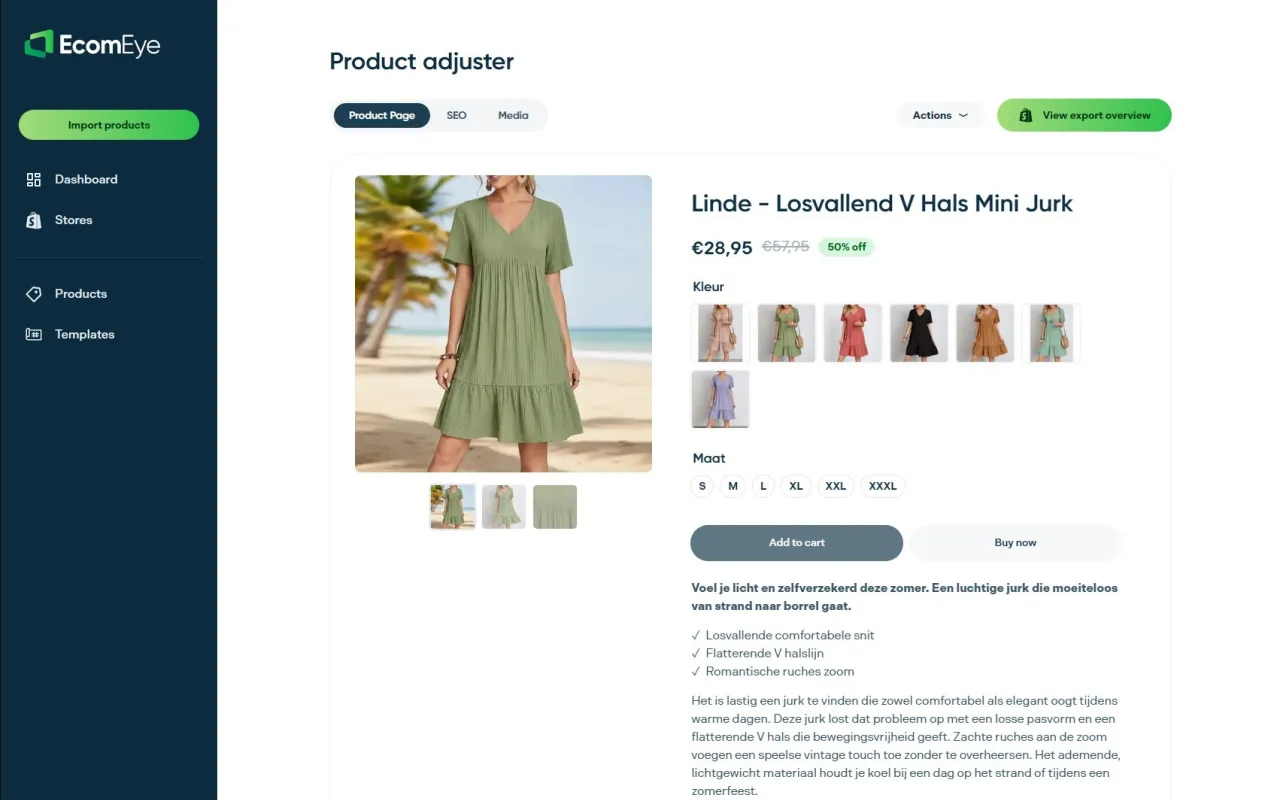
If you want to replace supplier photos and copied text without shooting every product, EcomEye imports product data from AliExpress, Amazon, Temu or competitor Shopify links and generates new titles, descriptions and product images for your store, in multiple languages, then exports to Shopify in one click. You can start with the AI Product Image Generator and pair it with the AI Product Description Generator.
Plans are published on the pricing page: Try-out at €39 per month and Scaler at €99 per month. Review the output against the real product before publishing, as you would with any listing.
FAQ
Can I use AliExpress images on my Shopify store?
Not unless you have permission from the actual rights holder. AliExpress’s agreement bars copying listing content without written agreement and grants no licence in its intellectual property. Your safe options are written permission, your own photos, or images created for your store.
If the AliExpress seller says yes, am I covered?
Only if the seller owns the photo or holds the right to authorise your use. Many supplier photos come from brands or manufacturer catalogues, so a seller’s permission may not be theirs to give. Keep the written message, and prefer images whose source you can trace.
Does fair use apply to dropshipping product photos?
It is a weak defence. Your use is commercial, you usually show the whole image, and you replace a photo the owner could licence. If you are worried about a specific image, speak to an intellectual property attorney.
What happens if I get a DMCA notice from Shopify?
Shopify can remove the listing or suspend the store on a valid report. The usual advice is to take the image down promptly and replace it with an original. A counter-notice is a formal, signed legal step with its own requirements, so consider legal advice first.
Are AI-generated product images a safe alternative?
Images generated uniquely for your store avoid copying a supplier’s photo, which is how we designed our tool to work. Check each output against the real product so it represents what customers will receive.
Sources
- AliExpress Business Program User Agreement
- Selected Sections of the Copyright Act
- Photography Copyright FAQs, PPA
- Image Copyright and Licensing for E-commerce
- Copyright in Your Content and Licensing It as a Creator
- AliExpress Service Agreement for non-Russian Sellers
- Can I Use Product Images on My Website?
- Shopify image copyright guide
- Aliexpress Images Copyright
- Order Granting Preliminary Injunction, S.D. Fla.
- Shopify Account Suspended? Protecting Multiple Stores
- How to File a DMCA Takedown on Shopify
- Shopify DMCA Notice: How to Respond
- AliExpress IPR Protection Policy
- Shopify Dropshipping and Google Merchant Center
- AliExpress Dropshipping With Shopify
- How to Get Photos of Items You Are Dropshipping
- Shopify product photo copyright: who owns them?
- Can you use supplier images on your own website?
- Aliexpress images, Shopify Community
Ready to boost your product pages?
Generate high-converting, SEO-optimized product pages in bulk using AI automation used by e-commerce experts.
No credit card required