Ecommerce Sellers: 6 Step Checklist to Avoid Listing Takedowns
Ecommerce legal guide: which listing content is protected, how marketplaces enforce takedowns, and a 6 step checklist to publish copyright safe listings.

Ecommerce Sellers: 6 Step Checklist to Avoid Listing Takedowns

No: copying the creative parts of a competitor’s listing carries real legal risk. Original description text, product photos and illustrations can be protected under copyright, and the Copyright Office distinguishes that protected expression from unprotected facts. Trademark law through the USPTO and advertising rules from the FTC add further exposure. Reuse facts, write your own text, and licence your images.
TL;DR:
- Copying protected creative content like descriptions and images risks legal action and can lead to account penalties, so ensure original creation and licensing.
- Copying factual information is generally permitted, but copying the wording or protected visuals, especially photos, is illegal without a license.
- Using a competitor’s brand name or packaging cues can cause trademark confusion, while copying reviews or making unsupported claims violates advertising laws.
- Unauthorized takedown claims are often automated and can be abused; maintaining detailed records and provenance of your listings helps defend against false infringement claims.
- Generating unique listings through factual data and custom images with proper provenance safeguards against legal risks and is faster than manual copying.
Table of Contents
- Protected content vs reusable facts: what listing law actually covers
- Marketplace mechanics: how takedowns happen and how they get abused
- Building listings that are original by design, step by step
- If a competitor copies your listing: what to do, in order
- The shortcuts sellers trust that don’t actually work
- Scaling listings safely: what good automation actually requires
- Publishing copyright-safe listings without the manual workload
- FAQ
- Sources
Protected content vs reusable facts: what listing law actually covers
The useful mental split for any listing is expression versus fact. Expression is what a person created: the specific wording of a bullet point, the composition of a product photo, an illustration or diagram someone drew. Facts are what a thing is: its dimensions, its materials, its weight, its compatibility with other products. The Copyright Office treats website text and visual art as protectable creative works, while explicitly excluding ideas, procedures and factual information from that protection. That means you can state that a kettle holds 1.7 litres or that a jacket is made from ripstop nylon; you cannot lift the sentence a competitor wrote to say so.
Photography deserves its own mention because sellers underestimate it constantly. A product photo looks mechanical, but the Copyright Office’s guidance for photographers makes clear that ordinary creative choices, camera angle, lighting, framing, can be enough to make an image original and protected. No registration or copyright notice is required for that protection to exist. Pulling a supplier’s AliExpress photo or a competitor’s hero shot into your own listing is not a grey area; it is reuse of someone else’s protected work unless you have a licence.
Trademark operates on a different question entirely: not “did someone create this” but “will a shopper be confused about who they’re buying from”. The USPTO’s framework for likelihood of confusion looks at whether using a competitor’s brand name, logo or distinctive packaging style in your own listing could make a buyer think the goods are affiliated or endorsed. Naming a competitor’s brand in a comparison is usually fine; echoing their packaging style, font treatment or brand name inside your own product title is where sellers get into trouble.
Then there’s advertising law, which catches a different kind of shortcut. The FTC’s consumer reviews and testimonials rule treats reviews and testimonials as a form of advertising, and it carries civil penalties for knowing violations. Copying a competitor’s five-star reviews into your own listing, or stating a performance claim you cannot back up (“lasts 10 years”, “doubles battery life”), sits squarely inside that rule rather than copyright or trademark.
Put together, three regimes police different pieces of the same listing:
- Copyright covers original text, photography and illustration, never raw facts or specifications.
- Trademark covers brand names, logos and packaging cues that could confuse a shopper about who is selling the item.
- Advertising law (FTC) covers reviews, testimonials and performance claims, whether copied or invented.
One useful registration note: registering a work with the Copyright Office is not required for protection to exist, but it strengthens an owner’s position if they ever need to enforce it or seek statutory damages, which is why sellers who get copied often find registered competitors move faster against them.
Marketplace mechanics: how takedowns happen and how they get abused
Marketplaces like Amazon, eBay and Etsy run notice-and-takedown systems modelled on the DMCA. A rights holder files a complaint claiming infringement, the platform removes or suppresses the listing, often within hours, and the seller gets a policy strike or account flag. The system is built for speed, not judgment: platforms are not courts, and they rarely investigate who actually owns what before acting.
That speed is exactly what makes the system abusable. A bad actor can build a fake “original source” page, backdate it, or simply file a claim they know is weak, betting that the automated review will favour the complainant and the targeted seller will not bother contesting it. Because platforms process enormous volumes of these claims, there is limited human scrutiny of any individual one, so a confident false claim often succeeds purely on process rather than merit.
What typically happens once a complaint lands:
- The platform receives the notice and removes or suppresses the listing, sometimes within the same day.
- The targeted seller is notified and given the chance to file a counter-notice, usually within a set window.
- If a valid counter-notice is filed, many platforms reinstate the listing after a waiting period unless the original complainant escalates to a formal legal filing.
- Repeated or unresolved claims can lead to account-level penalties, including suspension, independent of any single listing’s outcome.
Pro Tip: Keep a dated, timestamped archive of your original listing drafts and image files the moment you publish, not after a dispute starts, so a counter-notice has something concrete to point to.
Clear provenance shortens every stage of this process. A seller who can show an image’s EXIF or IPTC metadata, a licence file, or a registered copyright claim resolves disputes faster than one relying on memory or verbal assurance. The Compendium of Copyright Office practices on website content notes that identifying the correct claimant matters for enforcement, which is another reason to keep your own listing’s authorship records straight from the start rather than scrambling for them during a dispute.
Building listings that are original by design, step by step
Scaling product uploads without copying anyone starts with separating research from writing. The moment those two steps blend together, so does the risk.
- Research: pull factual attributes, dimensions, materials, compatibility, weight and supplier SKU numbers, into a plain spreadsheet or template. Never copy a competitor’s sentences into this step, only the facts themselves.
- Draft: write titles and descriptions from a blank template using those facts, not from a competitor’s page open in another tab. If a claim needs localising (sizing, voltage, certification), verify it against the actual product, not against what a rival listing says.
- Source images: commission original photography, licence stock images with clear terms, or generate AI images created specifically for your listing. Never copy a competitor’s or supplier’s product photo directly into your store.
- Handle claims and reviews: back any performance statement with something you can point to, a spec sheet, a test result, a supplier certificate, and never reproduce a competitor’s or a customer’s review text verbatim, even with minor edits.
- Pre-publish check: run each listing through a short clearance pass before it goes live.
- Record and store: file the drafts, licences and metadata so they exist if anyone ever questions the listing’s origin.
The pre-publish checklist is worth treating as non-negotiable, and sellers can use tools like Dropship Detector to identify dropship-markup listings and price inconsistencies before publishing.
- Trademark clearance: does the title, brand field or imagery echo another brand’s name, logo or packaging style?
- Licence check: is every image either commissioned, properly licensed, or generated specifically for this SKU?
- Claim substantiation: can every performance or comparison statement be backed by a document you hold?
- Platform policy check: does the listing meet the specific marketplace’s content and category rules?
Recordkeeping is the step sellers skip most often, usually because it feels like admin rather than protection. In practice it’s the difference between resolving a dispute in a day and losing a listing for weeks. Keep drafts of every description as written, licence agreements or generation records for every image, supplier invoices that tie a product to its source, and a simple provenance log noting when each asset was created and by what method. A practical audit checklist built around these same steps is worth running across your existing catalogue, not just new uploads, since older listings are often the ones built before anyone was thinking about this.
If a competitor copies your listing: what to do, in order
Finding your own description or photos on a competitor’s page is frustrating, but the response that actually works is procedural, not emotional.
Start with preservation, before you contact anyone:
- Take dated, full-page screenshots of the infringing listing, including the URL and timestamp.
- Save your own original source files: the drafts, the raw image files with intact EXIF or IPTC metadata, and any licence or supplier invoice tied to them.
- Capture a cached or archived version of the offending page in case it gets edited or removed before you act.
Pro Tip: Screenshot the competitor’s listing the moment you notice it. Pages get edited quickly once a seller realises they’ve been spotted, and an undated memory is worth nothing in a dispute.
With that evidence gathered, the marketplace route is usually fastest: file a takedown or IP complaint through the platform’s own reporting tool, attaching your proof of original creation. Most platforms will suppress or remove the competing listing while they review, and if you are ever on the receiving end of a false claim yourself, the counter-notice process exists specifically so you can contest it rather than simply lose the listing.
For disputes that need more than a platform tool, there are two formal legal paths. Registering the work with the Copyright Office is a prerequisite for filing a federal infringement suit and strengthens your position generally, while the Copyright Claims Board offers a lower-cost route for smaller claims that don’t justify full federal litigation. Between those two, a cease-and-desist letter is often the practical middle step: it puts the other seller on formal notice, creates a paper trail, and frequently resolves the matter without further cost. Whether to escalate to an IP lawyer usually comes down to scale: a single copied listing might be worth a letter and a platform complaint, while a pattern of repeated infringement against your catalogue is worth a proper legal consultation.
The shortcuts sellers trust that don’t actually work
The most persistent myth in this space is that changing a handful of words makes a copied description safe. It doesn’t. Courts look at substantial similarity and the overall concept and feel of a work, not a word-count difference, so a lightly reworded paragraph that follows the same structure, examples and phrasing as the original can still be found infringing.
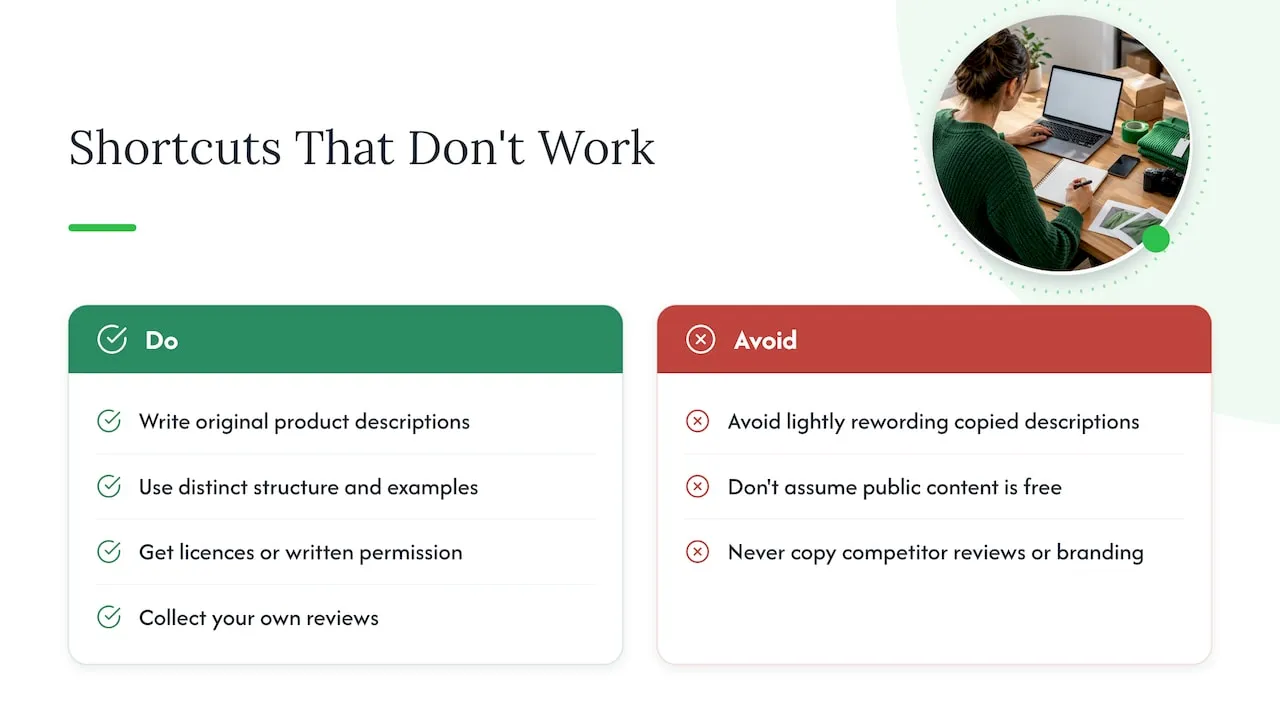
A close second is the belief that anything visible on the public internet is free to use. Visibility and permission are unrelated. A supplier’s product photo, a competitor’s bullet copy, even a customer review sitting in plain view on someone else’s page, remains that creator’s or that platform’s protected content unless a licence says otherwise. Being easy to copy has never been the same thing as being legal to copy, and the ease of right-click-save is precisely what makes this myth so durable.
The myth that compounds fastest is treating reviews and branding as fair game because “everyone does it.” Copying a competitor’s reviews is an FTC advertising problem on top of whatever copyright exposure the original text carries, and echoing their branding or packaging cues adds a trademark question into the same listing. Each shortcut doesn’t just add a little risk; it stacks three separate legal regimes against a single page.
— Koen
Scaling listings safely: what good automation actually requires
Automation isn’t inherently risky; copying is. The distinction that matters is whether a tool generates genuinely new expression per product or simply reshuffles a competitor’s existing text and images. Generating unique titles and descriptions from a facts-first input, rather than rewriting scraped competitor copy, keeps the output in the “original expression” category rather than the “derivative of someone else’s work” category. The same logic applies to imagery: a distinct AI-generated image produced per SKU carries no inherited copyright exposure the way a lifted competitor photo does.
Any tool handling this at scale should offer a few concrete safeguards:
- Per-SKU unique generation, not templated text that only swaps a product name into an otherwise identical paragraph.
- Individually generated images per listing, rather than reusing a single supplier photo across many sellers’ stores.
- Licensing clarity on what rights you hold over generated content once it’s published.
- A facts-first import step, so product attributes come from supplier data rather than a competitor’s page.
In practice, a safe workflow looks like importing product facts from a supplier or competitor product link purely for specifications, generating fresh titles, descriptions and images from those facts rather than the source page’s wording, and exporting the finished listing to Shopify with the generation record kept as your provenance evidence. That sequence, facts in, original expression out, is what keeps bulk publishing on the right side of the line covered in the earlier workflow checklist, rather than turning automation into a faster way to copy.
Publishing copyright-safe listings without the manual workload
We built our platform for sellers who need product pages fast, but can’t afford the copyright, trademark and duplicate-content risk that comes from copying a competitor’s or supplier’s listing. We import product data in bulk from suppliers or competitor product links purely for the factual specifications, then generate unique titles, descriptions and AI product images for each item, with multi-language output and one-click export to Shopify.
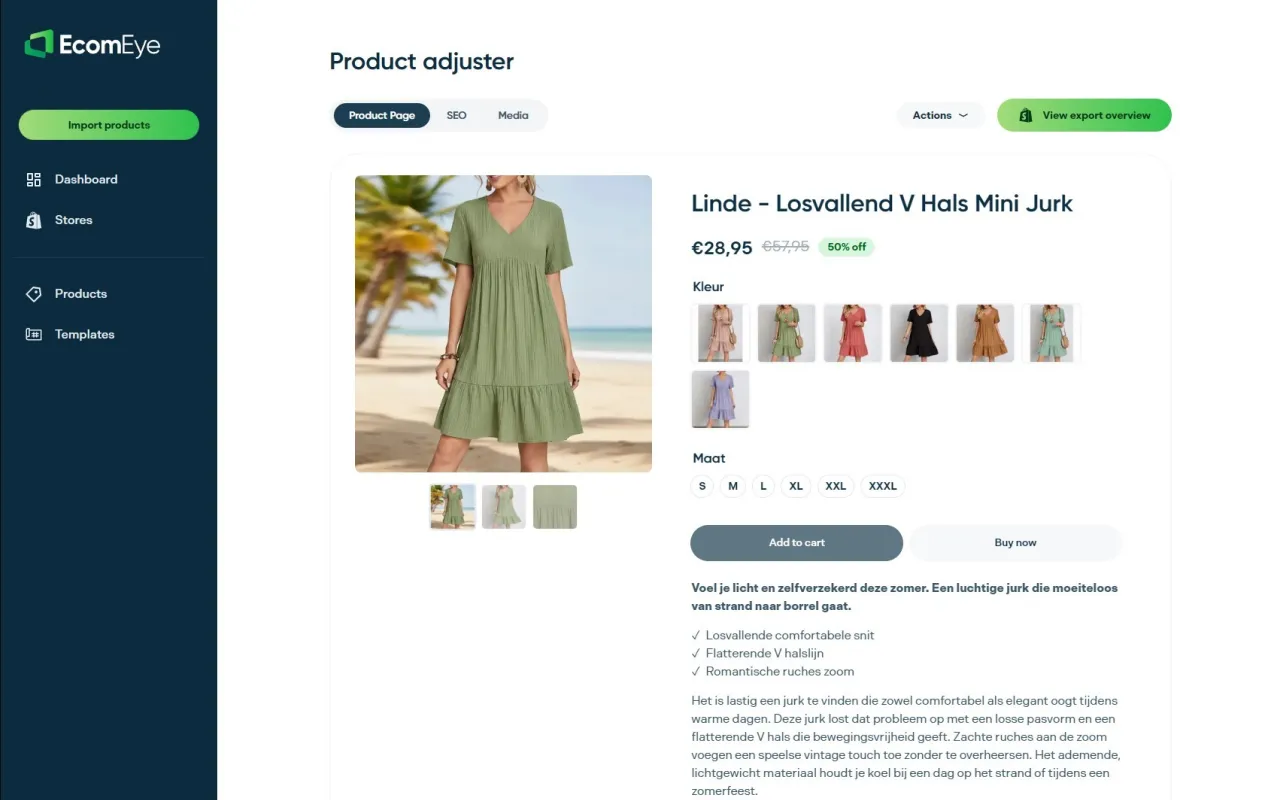
That solves three problems sellers run into constantly: duplicate content that tanks SEO rankings, the licensing headache of sourcing original images for hundreds of SKUs, and the sheer time it takes to write every listing by hand. Each generated listing is unique even when several sellers import the same base product, so there’s no shared text or shared photo sitting across multiple stores waiting to trigger a takedown.
We offer a Try-out plan at €39 per month and a Scaler plan at €99 per month; both are listed on our pricing page, where you can see which fits your catalogue size and start generating copyright-safe pages today.
This article is general information, not a substitute for advice from a qualified lawyer. Consult a qualified legal professional about your own circumstances before acting on anything here.
FAQ
Can you sue someone for copying your content?
Yes, if the copied material is your original expression, text, photos or illustrations, and you can show it was taken without permission, you can pursue a copyright claim. Registering the work with the Copyright Office is required before filing a federal lawsuit, though smaller disputes may be suited to the Copyright Claims Board instead.
Is copying and pasting illegal?
Copying and pasting someone else’s original text or images is copyright infringement if that content is protected expression rather than plain facts. The Copyright Office protects creative text and visual works but explicitly excludes raw facts and ideas, so copying specifications is different from copying sentences.
Can I sue someone for using my design?
You can pursue a claim if your design qualifies as original creative expression, such as a distinctive illustration or photograph, and someone used it without a licence. The Copyright Office’s guidance for photographers notes that creative choices like composition and lighting can make even a simple product image protectable, which strengthens a design owner’s position.
Is it legal to mimic a competitor’s listing structure or format?
Copying the general structure of a listing, such as having a title, bullet points and a photo gallery, is not infringement, since formats and ideas aren’t protected. The risk appears when you copy the actual wording, photos or review text rather than just the layout approach.
What should I do if my listing gets falsely reported for infringement?
File a counter-notice through the marketplace’s dispute process and include your dated evidence of original creation, such as draft files, image metadata and licence records. If the false claim continues or escalates, a cease-and-desist letter or a consultation with an IP lawyer is the next practical step.
Sources
Ready to boost your product pages?
Generate high-converting, SEO-optimized product pages in bulk using AI automation used by e-commerce experts.
No credit card required