Shopify Stores: 150–300 Unique Words Beat Manufacturer Copy
Copying manufacturer text won't penalize you, but it can bury Shopify listings. Keep specs, rewrite persuasive copy, and pilot automation.

Shopify Stores: 150–300 Unique Words Beat Manufacturer Copy

Yes. Pasting manufacturer copy onto your Shopify pages will not get you penalised, but it will get you buried: Google picks one canonical version of duplicated text to rank, and it is rarely the reseller. Keep the factual specs, rewrite the persuasive layer (openers, benefits, use cases), and lean on automation once you’re doing this across more than a handful of SKUs.
TL;DR:
- Copying manufacturer descriptions does not lead to penalties but causes search engines to choose a single canonical page, often favoring the manufacturer’s own site or large retailers with more backlinks.
- It is safe to keep factual data like measurements, SKUs, and ingredients, but benefit-driven claims and comparisons must be rewritten in your own words to avoid duplicate content issues.
- Rewriting should focus on high-impact sections such as benefits, comparisons, and use cases, targeting 150 to 300 unique words that answer specific customer questions for better search visibility.
- Automating description rewriting with tools is viable for large catalogs but requires careful handling of copyright and Google Merchant Center compliance to avoid risks.
- For low-traffic or deep product pages, merging into broader category pages may be more cost-effective than individual rewrites, with focus reserved for pages that generate significant traffic or margins.
Table of Contents
- Why copying manufacturer descriptions kills your rankings
- What to keep and what to rewrite from manufacturer copy
- A step-by-step framework for rewriting product pages at scale
- Manual, hybrid, or automated: how to scale the rewrite
- When rewriting isn’t actually the right fix
- Scale unique product pages without the manual grind
- Sources
- FAQ
Why copying manufacturer descriptions kills your rankings
Google’s own search advocates have confirmed there’s no direct penalty for duplicate product copy. What happens instead is quieter and, for a reseller, far more damaging: Google consolidates duplicate content and picks a single canonical page to show searchers. Everyone else running the same paragraph gets folded into that decision and effectively disappears from those product queries.

The canonical winner is usually whoever has the strongest domain authority for that content, which in practice tends to mean the manufacturer’s own site or a large retailer with more backlinks than your store. You could have better pricing, faster shipping, and a five-star review count, and none of it matters if Google has already decided your page is a duplicate of someone else’s.
This is why swapping a couple of adjectives rarely helps:
- Changing “durable stainless steel construction” to “sturdy stainless steel build” doesn’t create meaningfully different content in Google’s eyes.
- Reordering sentences or paragraphs leaves the underlying phrasing and structure identical.
- Adding one new sentence at the top of an otherwise copied block still reads as the same source text to a crawler comparing large chunks of copy.
PracticalEcommerce has flagged descriptions as a genuine blind spot for merchants, precisely because store owners assume a listing is “theirs” simply because it’s on their domain. Search engines don’t see it that way. They see text, and text that matches text elsewhere gets treated as one thing, not many.
What to keep and what to rewrite from manufacturer copy
Not everything in a manufacturer description is a liability. Facts are facts wherever they appear, and copying them doesn’t create a duplicate-content problem or a copyright one. The U.S. Copyright Office is explicit that copyright protects original expression, not short phrases, mere listings, or factual data. A dimension is a dimension no matter who states it first.
Here’s the practical split for a typical product page:
- Keep verbatim: measurements, weight, materials, SKU or model numbers, ingredient or component lists, care instructions, and certification codes.
- Rewrite completely: the opening hook, any benefit-driven claims (“the ultimate solution for…”), comparisons to other products, suggested use cases, and the call-to-action.
- Restructure where needed: feature bullet points that mix fact and marketing language. Split them, keep the fact, bin the adjective.
So a manufacturer line reading something like “This revolutionary blender delivers unmatched performance for all your smoothie needs” keeps nothing but the underlying claim that it’s a blender that makes smoothies. The wording around it, the enthusiasm, the vague superlatives, all of that needs a full rewrite in your own voice, ideally one that answers a real question a shopper has (does it crush ice, how loud is it, what’s in the box).
Shopify’s own guidance backs this split directly: unique descriptions help search engines tell similar pages apart, and they let you frame benefits the manufacturer’s generic copy usually skips, because manufacturers write for every retailer at once, not for your specific customer.
Pro Tip: Keep a running “facts sheet” per product category (fabric, dimensions, wattage, whatever’s relevant) separate from your marketing copy. When you rewrite, you’re only ever touching the persuasive half, never re-verifying specs from scratch.
A step-by-step framework for rewriting product pages at scale
Start with an audit, not a rewrite. Run a quoted phrase from a suspect description through Google, use Copyscape or a similar duplicate checker, or scrape your own catalogue against competitor and manufacturer sites to see how much of your text matches word for word. You’ll usually find the problem is worse than expected once you check systematically rather than page by page.
Once you know the scope, prioritise. Don’t start alphabetically. Rank pages by:
- Revenue and margin contribution
- Existing organic traffic potential (check Google Search Console impressions)
- Strategic categories you want to own long term
That’s usually where most of your traffic and revenue sits anyway, and it’s where a rewrite pays back fastest.
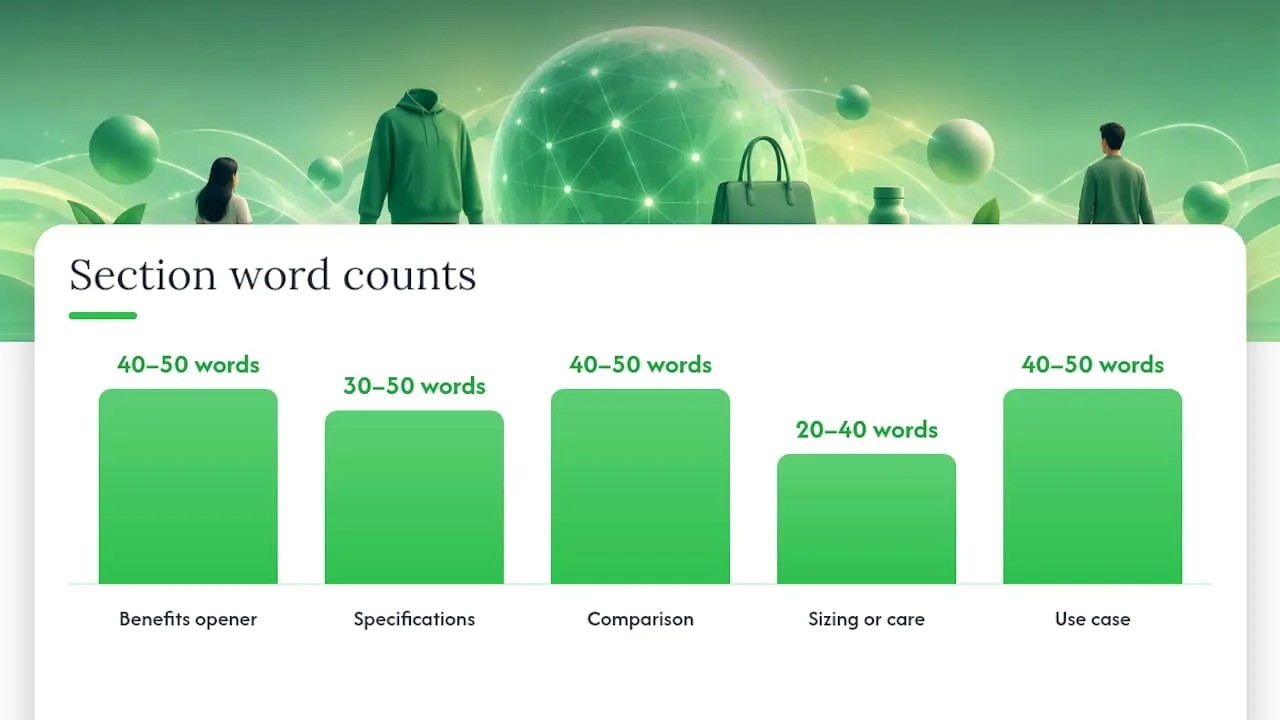
For the actual rewrite, a five-section structure keeps effort proportionate to impact:
| Section | Purpose | Approx. word count | Rewrite priority |
|---|---|---|---|
| Benefits opener | Hook with the core reason to buy | 40 to 50 | High, fully original |
| Specifications | Factual details, materials, dimensions | 30 to 50 | Low, keep as-is |
| Comparison | How it differs from alternatives | 40 to 50 | High, fully original |
| Sizing or care | Practical usage details | 20 to 40 | Low, light edit |
| Use case | Who it’s for, how it’s used | 40 to 50 | High, fully original |
Field observation from SEO audits suggests 150 to 300 unique, high quality words often make a measurable difference in competitive categories, though results vary by niche and existing domain authority. That’s not a magic number to hit and forget. A tight, specific 180 words that answer a real buying question will usually outperform a padded 400 words of filler, because search engines and shoppers both respond to relevance, not length.
Verify the work once it’s live. Search a quoted excerpt of your new opener in Google to confirm it’s not matching anywhere else. Watch Search Console impressions for that URL over the following weeks. If you’re feeding descriptions into Google Merchant Center, check the listing is being accepted rather than flagged. Our guide to product description ideas has worked examples if you want templates for the opener and use-case sections specifically.
Manual, hybrid, or automated: how to scale the rewrite
A single skilled writer can produce a genuinely unique, well-researched description in perhaps 20 to 30 minutes once they know the product. For a 40-product store, that’s a manageable weekend. For a 4,000-SKU dropshipping catalogue, it’s not a task, it’s a department you don’t have.
Three realistic approaches, depending on catalogue size:
- Manual: works for small, high-value catalogues where each product deserves individual research. Assign a writer or two, brief them on the five-section pattern, and budget real hours per product, not minutes.
- Hybrid: build a template per category (electronics, apparel, home goods), batch-edit the persuasive sections against that template, then have someone spot-check a sample for tone and accuracy before publishing.
- Automated: appropriate once you’re importing dozens or hundreds of products regularly from AliExpress, Amazon, or competitor Shopify links, and rewriting each one by hand simply isn’t realistic.
Whichever route you pick, two compliance points matter more with automation. First, Google Merchant Center now requires the structured_description attribute for content created with generative AI, with sub-attributes identifying how the content was composed, so your feed processes correctly. Second, copyright risk sits almost entirely in creative prose, not facts; the Copyright Office’s own framing makes clear that copying a manufacturer’s persuasive paragraph carries real exposure, while copying a spec sheet largely doesn’t.
Pro Tip: If you’re evaluating an automation tool, ask specifically how it handles copyright safety and Google Merchant compliance before you ask about speed. A fast tool that generates thin, templated output can do more damage than the manual problem it replaced.
When rewriting isn’t actually the right fix
Rewriting every page in a large catalogue is expensive in time even with automation, and not every page deserves the effort. If a product only ever gets a handful of monthly searches and sits three clicks deep in your navigation, the honest move is often to merge it into a stronger category page rather than write it a bespoke 300 words nobody will find anyway.
I’d weigh it against expected uplift, not against the principle of uniqueness. A near-identical variant SKU (same product, different colour) rarely needs its own from-scratch rewrite; a template covers it fine. Save your best writing effort for pages that actually carry traffic potential or margin. And if you’re dealing with licensed content, exclusive distribution agreements, or anything contractually murky, that’s a conversation for a solicitor, not a blog post.
— Koen
Scale unique product pages without the manual grind
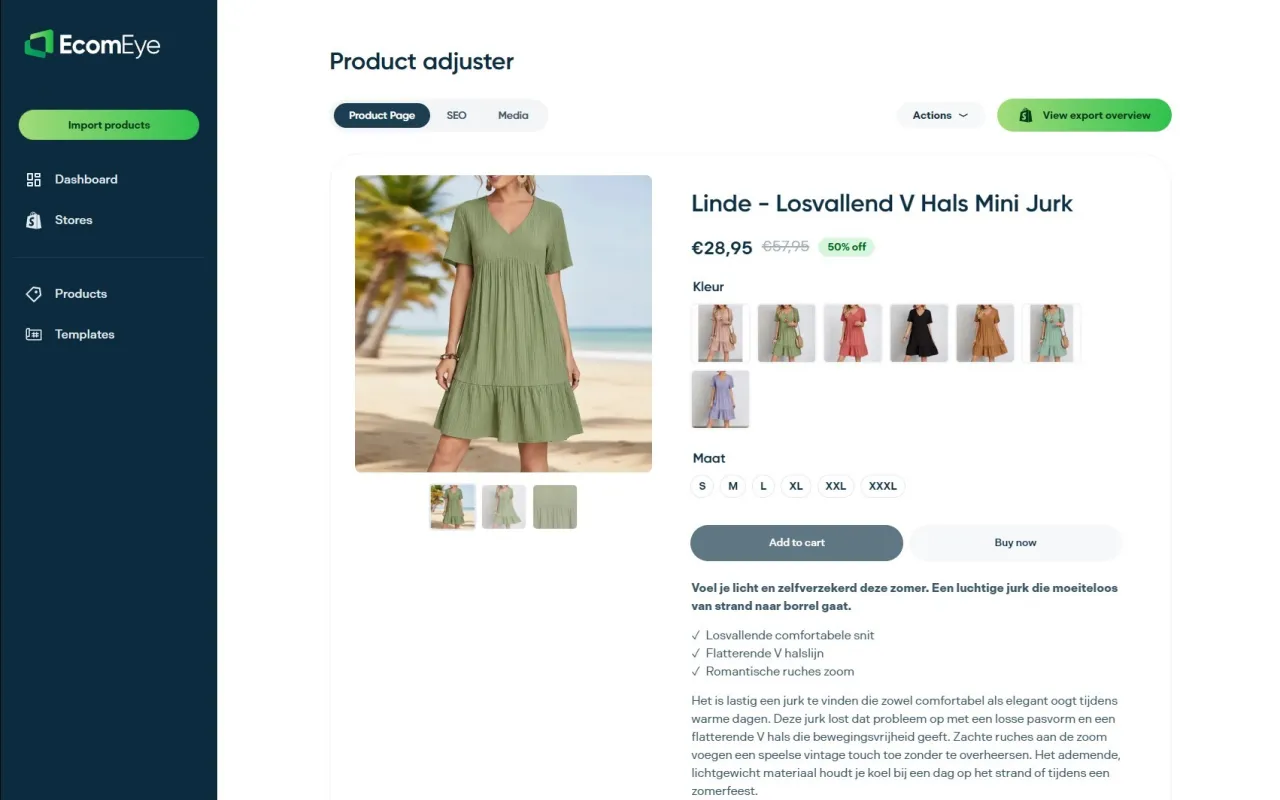
Rewriting persuasive copy by hand works until your catalogue outgrows your team’s hours, and for most dropshippers importing from AliExpress or competitor Shopify links, that point arrives fast. There are tools available that generate unique titles, descriptions, and AI product images in bulk from product source links, then export the finished pages to Shopify in one click, so the specs stay accurate and the persuasive layer stays original for every product published, as explained in Shopify SEO Automation.
If you’re testing it on a pilot batch, run it against a genuine sample: 20 to 50 products, tracked over four to six weeks against Search Console impressions, click-through rate, and actual conversions, the same metrics you’d use to judge any manual rewrite. That comparison tells you honestly whether the automated output is holding up, rather than taking anyone’s word for it. The Try-out plan runs €39 a month, and the Scaler plan at €99 a month suits catalogues moving past that pilot stage. If you want to see the description engine specifically before committing, the AI product description generator page walks through what it produces from a single product link.
Sources
- Google duplicate product descriptions — Search Engine Journal
- 9 simple ways to write product descriptions that sell — Shopify
- Google Merchant Center: requirements for product data — Google Support
- What is copyright? — U.S. Copyright Office
FAQ
Will Google penalise me for using manufacturer descriptions?
No, there’s no direct penalty. Google instead consolidates duplicate content into one canonical result, and that’s usually the manufacturer’s own page, leaving your listing unranked for the same searches.
Can I keep the specifications from a manufacturer description?
Yes. Copyright Office](https://www.copyright.gov/what-is-copyright/index.html) so specs, SKUs, and dimensions are safe to reuse. Rewrite the surrounding persuasive language instead.
How many words of unique content do I actually need per page?
There’s no fixed rule, but audits suggest 150 to 300 unique words of genuine, relevant copy often makes a measurable difference in competitive categories. Quality and relevance matter more than hitting a specific count.
How much does Ecom-eye cost for rewriting product descriptions at scale?
Ecom-eye’s Try-out plan is €39 per month and the Scaler plan is €99 per month, both listed on the pricing page. Both include bulk generation of unique descriptions and images exported straight to Shopify.
Do I need to disclose AI-generated descriptions to Google Merchant Center?
Yes, if you sell through Google Shopping feeds. Google Merchant Center requires the structured_description attribute for content created with generative AI, with sub-attributes identifying how it was composed.
Ready to boost your product pages?
Generate high-converting, SEO-optimized product pages in bulk using AI automation used by e-commerce experts.
No credit card required