Top 4 automatedcommerce.ai Alternatives 2026
Explore 4 automatedcommerce.ai alternatives to help you choose the best option for scaling your dropshipping business and enhancing SEO.

Top 4 automatedcommerce.ai Alternatives 2026

Creating bulk Shopify product pages with consistent branding and copyright-safe content is still too time consuming for merchants without design or coding skills. Many available generators either lock direct Shopify export and multi-language support behind pricey tiers or require tedious manual edits before publishing. This guide outlines core features, plan details and workflow differences across four Shopify product page generators so you can pick one that reduces manual work and fits your launch cadence.
Table of Contents
EcomEye
At a Glance
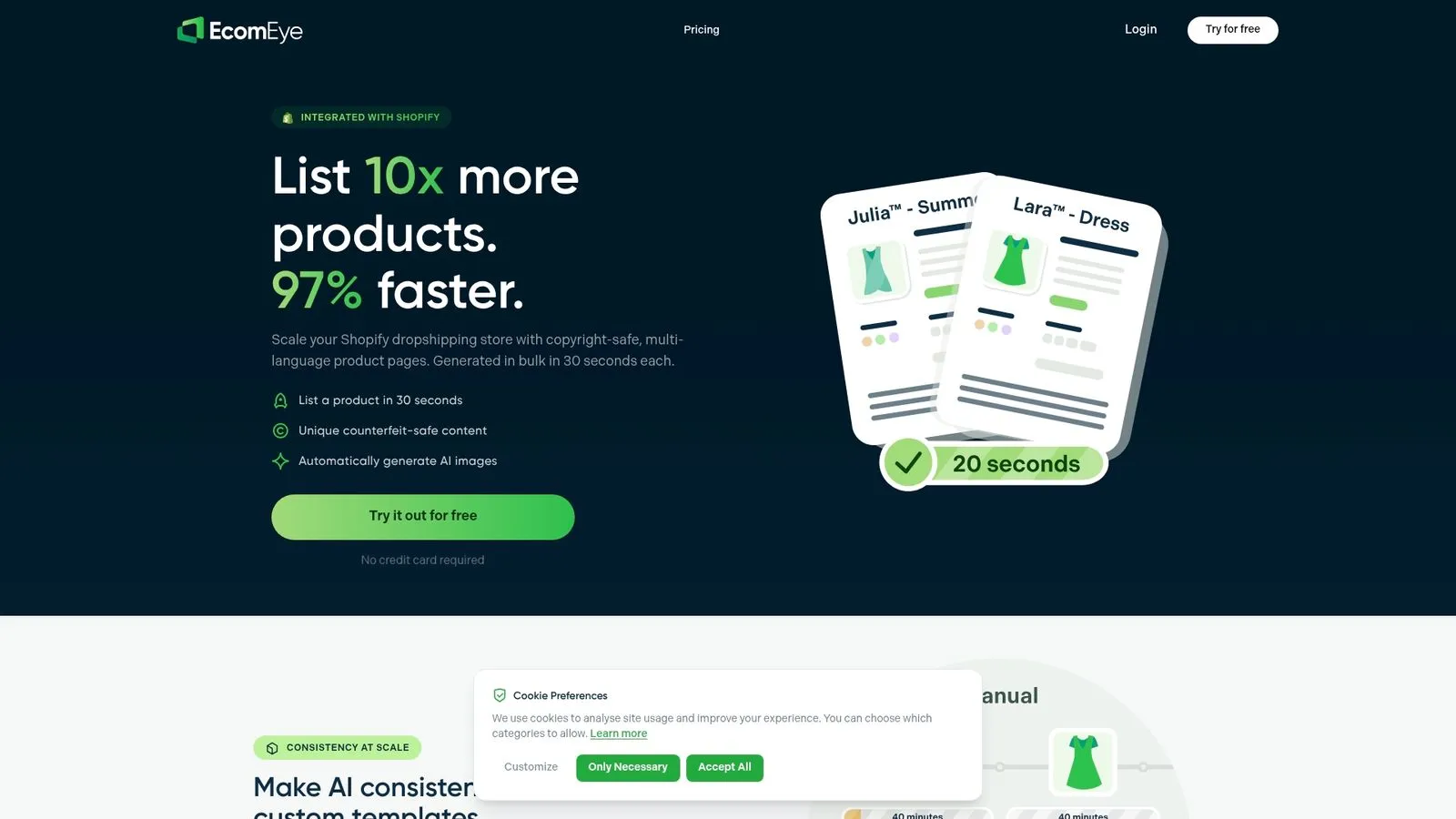
Generates bulk product pages in roughly 30 seconds per product, the vendor advertises — a claim that matters when you need to publish hundreds of listings quickly. EcomEye focuses on copyright-safe, multi-language product pages with direct Shopify export.
Core Features
Starts with bulk product page generation and adds AI-created descriptions and images so each listing is unique. Multi-language and multi-currency support lets you target multiple markets without duplicating effort. Template creation preserves brand voice across large catalogues. One-click export pushes pages straight to Shopify stores.
Key Differentiator
The standout is the combination of bulk automation plus copyright-safe output. EcomEye ties AI generation to a Shopify-first workflow so you do not have to rebuild pages after generation. That combination reduces the manual work of copying and rewriting competitor pages for SEO compliance.
Pros
- Speeds up listing creation dramatically. The vendor claims product page creation is about 97% faster, which reduces hours of manual copywriting into minutes for high-volume sellers.
- Copyright-safe content reduces the legal and Merchant Centre risk of copying competitor pages, so you can scale without duplicate-content penalties.
- Multi-language support means you can prepare the same catalogue for three or more markets while keeping consistent templates and SEO structure.
- Template-based output keeps product descriptions, titles and image style consistent across hundreds or thousands of SKUs, useful for brand cohesion when you scale.
- Pricing starts at €14.95/month, which makes testing bulk generation affordable before committing to larger plans.
Cons
- Requires Shopify integration for best use; it is not a stand-alone storefront solution and depends on Shopify for publishing.
Notable Integrations
- Shopify is the primary integration and the only one listed. EcomEye’s workflow assumes you push generated pages to Shopify stores via the one-click export path rather than using a separate catalogue manager.
Who It’s For
Shopify-based dropshippers and merchants who need to create large numbers of SEO-ready, copyright-safe product pages quickly. Best for owners replacing VA-driven listing work and for merchants expanding into multiple language markets.
Unique Value Proposition
One-click export to Shopify stores turns bulk generation into a deployable workflow. Rather than generating drafts you then manually upload, templates plus direct export let you prepare and publish at scale in a single pass, shortening the time from idea to live listing.
Real World Use Case
A dropshipping owner imports competitor product links and uses the bulk generator to create 1,500 listings in a new language. Templates ensure consistent titles and descriptions. Pages land on Shopify with images created by the AI, cutting weeks of VA work to a few days.
Pricing
Plans run from €14.95/month for Basic up to €199.95/month for the Expert plan. The vendor presents tiered options so you can match monthly cost to catalogue size and features required.
Website: https://ecom-eye.com
PagePilot.ai
At a Glance
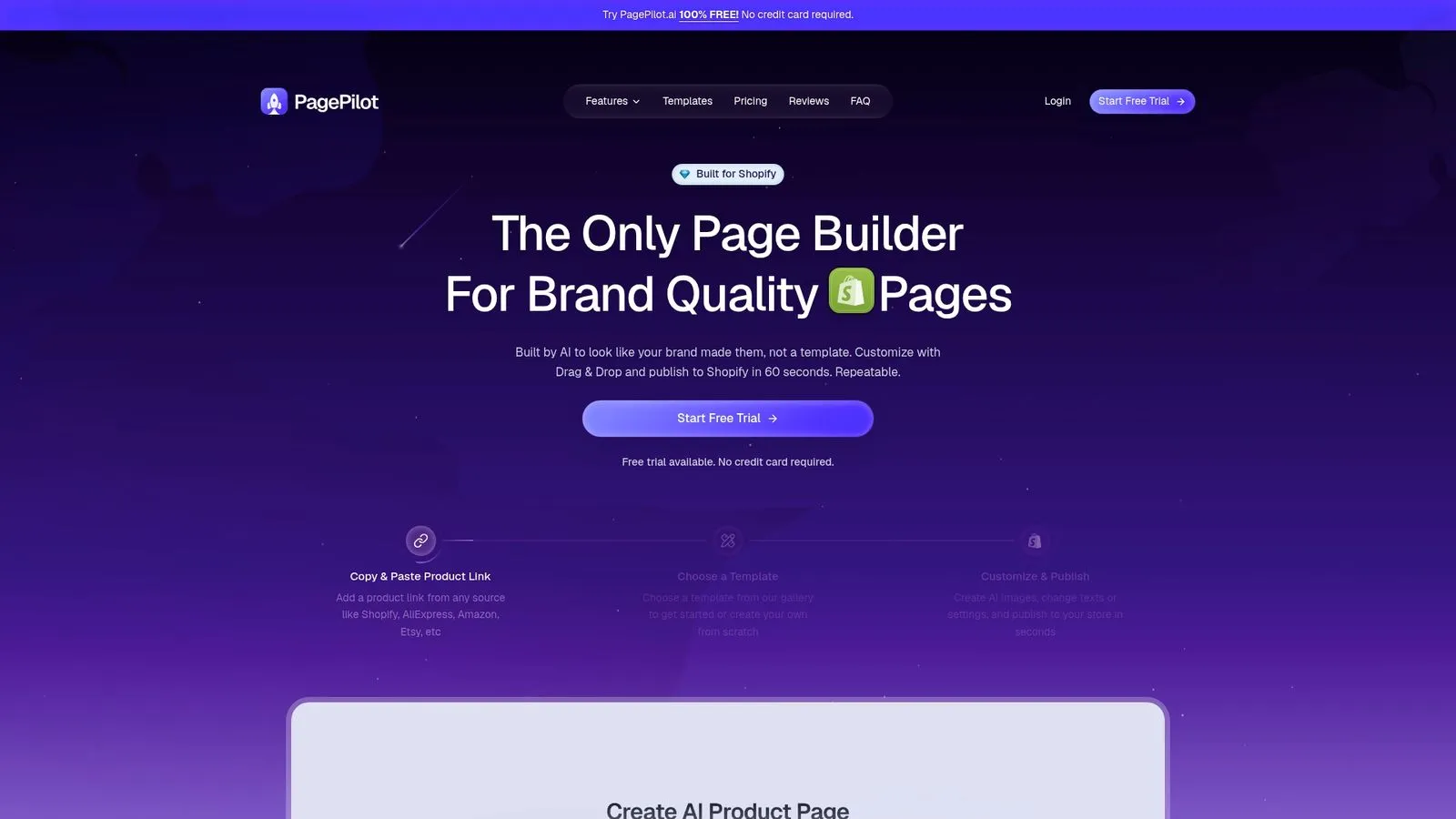
PagePilot.ai’s marketing claims it can generate and import an optimised Shopify product page in under a minute. That speed claim is the headline feature and is pitched alongside AI images, ad copy and bulk product suggestions aimed at rapid testing for dropshippers.
Core Features
The product bundles page generation, creative assets and product research into one workflow that plugs into Shopify themes and apps.
- AI-generated product pages created from a URL or product details.
- One-click Shopify import to push pages directly into your store.
- Pre-designed, customisable templates optimised for conversions and mobile rendering.
- The vendor states support for more than 30 languages for multi-market stores.
- Daily bulk product research with ready-to-import ads and AI product images.
Key Differentiator
The platform’s angle is speed and end-to-end convenience for Shopify sellers. The minute claim above positions PagePilot.ai as a tool for high-velocity testing. If you want to spin up many variants and import them fast, that workflow is the central selling point.
Pros
- Intuitive interface reduces training time. Merchants report being able to build pages without a designer or developer.
- Saves manual copywriting and layout work by generating product descriptions and layouts automatically.
- Templates are customisable so pages can match store themes while remaining conversion-focused.
- Built-in ad creatives and daily product suggestions let you scale A/B testing of offers and creatives rapidly.
- Affordable entry point with a free trial and lower-cost plans that appeal to solo dropshippers and small teams.
Cons
- Several user reviews describe customer support as slow or unresponsive, which matters when pages go live and ads start spending.
- Some users report a complex or problematic refund process after subscribing.
- There are reports of deceptive promotional practices in user feedback, which makes trialing the service with caution sensible.
- Output quality can vary; a few merchants say pages sometimes need manual rewriting to match their brand voice.
When It May Not Fit
If you rely on a rapid, accountable support channel for high ad spend, the reported support gaps make PagePilot.ai a risky primary tool. Agencies needing strict refund contracts should be wary of the refund reports. Enterprises that need guaranteed content consistency will find variable output frustrating.
Who It’s For
Shopify dropshippers and small e-commerce owners who prioritise speed over bespoke craftsmanship. If you run frequent tests and want to scale the number of live product pages quickly, this tool is aimed at your workflow.
Real World Use Case
A dropshipper uses PagePilot.ai to generate five product page variants and accompanying ad creatives in a morning. The pages are imported to Shopify, two variants are put behind ads and the merchant iterates based on early conversion signals rather than manual build time.
Pricing
Free trial available. Paid plans start at $39/month for the Lite plan. Higher tiers add unlimited product pages, support for more stores and extra features suitable for merchants who need larger testing volumes.
Website: https://pagepilot.ai
D2C Bot
At a Glance
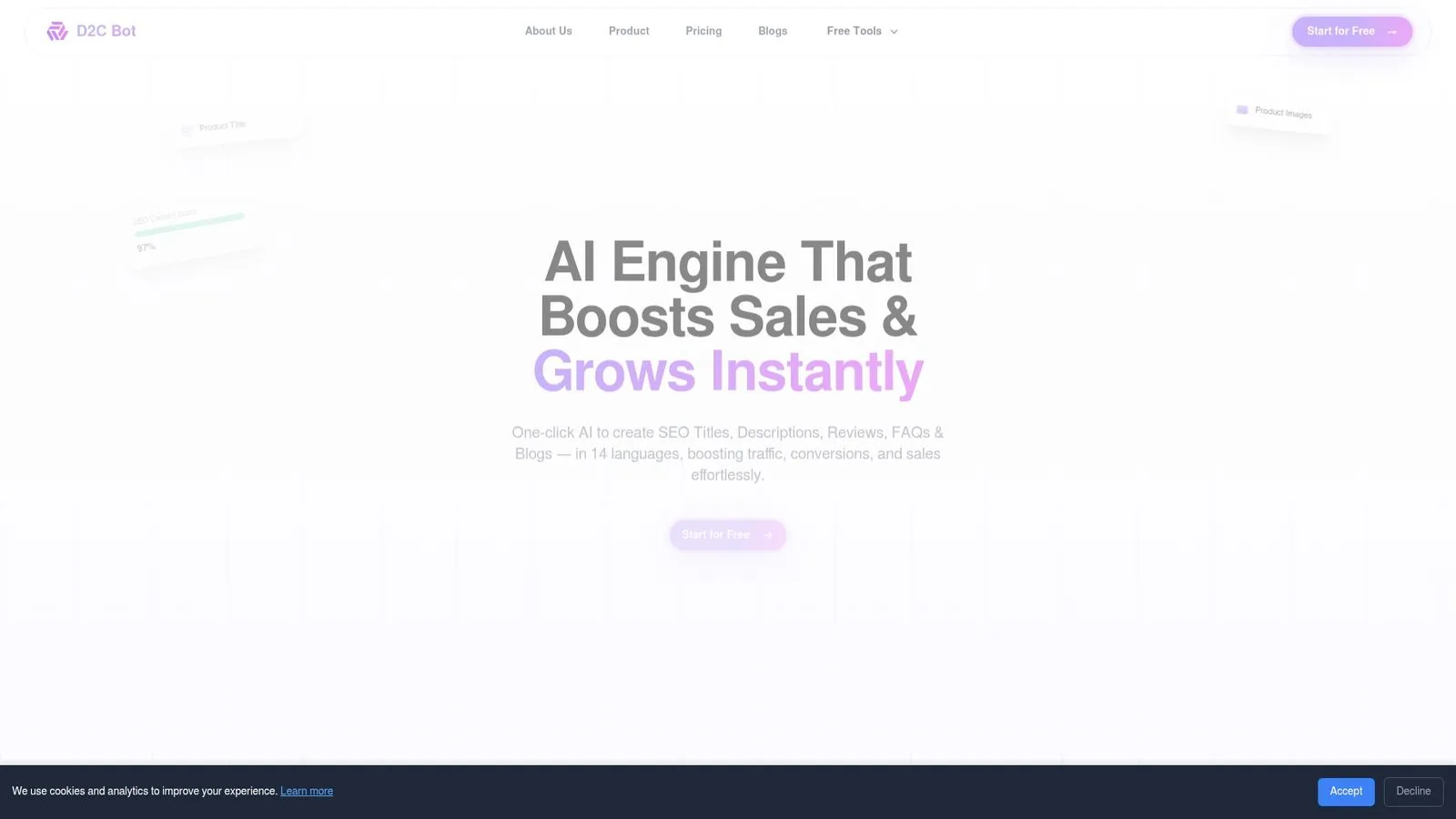
D2C Bot’s marketing materials state an average generation time of 2.5 seconds per item, a claim that positions it for bulk workflows where speed matters. The platform bundles product titles, descriptions, reviews, FAQs, blogs and images into one interface aimed at Shopify merchants.
Core Features
The product delivers AI-generated product copy and long form content with built-in SEO signals. It supports 14+ languages, a vendor claim that targets cross-border merchants and localisation at scale.
Bulk processing lets you queue hundreds of SKUs and push outputs directly to Shopify using the native integration. Image generation is listed among the content tools and video capabilities are noted as coming soon.
Key Differentiator
The defining angle is the native Shopify integration combined with rapid generation across every marketing asset. That combination removes manual export steps and keeps content editing inside the store workflow, which reduces copypaste errors and accelerates publish cadence for large catalogues.
Pros
-
Fast per-item generation. The timing claim above reduces batch turnaround and lets you iterate product copy dozens of times during a planning session.
-
Broad content coverage. Titles, descriptions, reviews, FAQs and blogs are available in one place so you do not stitch multiple tools together.
-
Multi-language capability eases market expansion. The language support above means less manual translation and fewer external localisation costs.
-
Native Shopify sync simplifies deployment. Drafts can be created and published back to your store without CSV gymnastics or manual field mapping.
-
Easy onboarding. The vendor advertises a no-code setup that gets merchants producing content in minutes rather than days.
Cons
-
The public reviews and independent customer feedback are limited, so real-world edge cases are not well documented.
-
AI output will need human editing for high-end branding or category pages that require tone control and bespoke messaging.
-
Image and video generation are not fully live yet, so visual asset needs may currently require a separate tool.
Notable Integrations
- Shopify is the sole documented integration, and it is presented as native. No other third-party platforms are listed in the product data so do not assume additional connectors.
Who It’s For
Shopify merchants, digital marketers and e‑commerce entrepreneurs who manage medium to large catalogues and value speed. It suits teams that prioritise volume publishing and localisation over finely tailored, agency-written product narratives.
Real World Use Case
According to the vendor, a store owner using D2C Bot cut manual writing time by 80 percent while publishing hundreds of product pages. That 80 percent figure frames how much editorial overhead the tool intends to remove before final human polish.
Pricing
Pricing starts at $9 per month for 150 AI credits, with higher tiers for larger volumes. The entry price makes experimentation low cost for single-store owners who want to test bulk content generation without a large commitment.
Website: https://d2cbot.com
Kluck AI
At a Glance
Kluck AI sells one time purchase tiers: Free, Starter at $20 one time, Value at $39 one time and Agency at $69 one time — a pricing model that contrasts with per month subscriptions most competitors use.
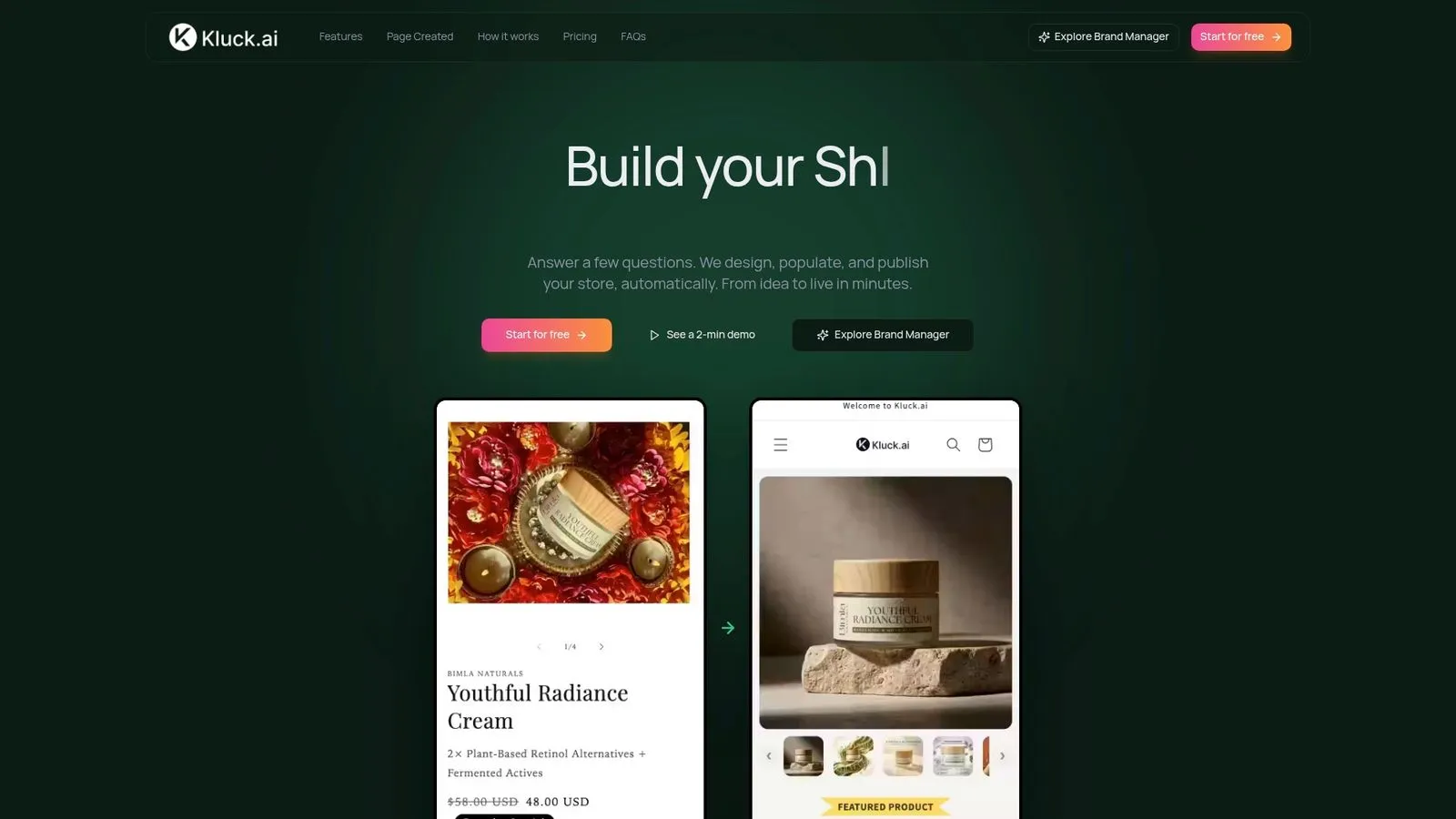
The vendor advertises fully automated store creation that produces complete Shopify stores, product pages, images, policies and publishable sites in minutes with a single click.
Core Features
- AI generated complete Shopify store setup that includes product pages, pages and policies.
- Optimised meta tags and load speed adjustments for basic SEO readiness and performance.
- One click publishing directly to Shopify so a generated store can be pushed live without manual exports.
- Custom built pages and sections created from templates and AI copy and imagery.
Key Differentiator
Kluck AI’s angle is the end to end, one click path from idea to a live Shopify store. That emphasis on automating every piece of store setup reduces the hands on time required to publish a new storefront.
This narrower focus differs from platforms that prioritise deep customisation or complex theme editing. Kluck AI trades advanced flexibility for speed of launch.
Pros
- Speeds store creation for solo sellers and small teams. The automation lets you assemble product pages and policies with minimal manual drafting.
- Eliminates most technical hurdles. No coding or theme editing is needed to get a working Shopify store live.
- One time charges lower ongoing costs for sellers who prefer pay once rather than recurring monthly fees.
- Publishes directly to Shopify which removes the usual export and import friction when moving from a generator into a live shop.
- Good fit for portfolios where you need several similar shops quickly; the agency tier reflects that workflow.
Cons
- Independent user feedback is scarce; third party reviews do not offer detailed assessments of long term reliability or edge case behaviour.
- Customisation appears limited compared with full theme development workflows, so merchants with bespoke design needs may find constraints.
- Advanced merchants who rely on complex apps or custom scripts will still need manual work after the generator finishes.
When It May Not Fit
If you require pixel perfect themes, bespoke checkout flows or heavy third party app orchestration, Kluck AI’s automation model will feel restrictive. Likewise, teams that need independent case studies or detailed vendor reviews before purchase will find the sparse external feedback inconvenient.
Notable Integrations
- Shopify for direct publishing and store management.
Who It’s For
Solo entrepreneurs, small e commerce businesses and agencies that need rapid store launches without technical skills. Best when speed to market and low ongoing cost matter more than deep theme customisation.
Real World Use Case
A new dropshipping seller uses Kluck AI to generate and publish a complete Shopify store in under 10 minutes, including product pages, store policies and marketing assets, so they can start testing ads the same day. That example mirrors the vendor supplied scenario.
Pricing
Tiers are one time fees rather than subscriptions: Free, Starter at $20 one time, Value at $39 one time and Agency at $69 one time. The model reduces recurring spend for small operators who launch stores intermittently.
Website: https://kluck.ai
Comparative Analysis
When selecting a Shopify product page generator, features such as speed, automation, and quality of output play a critical role. Considering different options helps identify the platform most aligned with distinct business needs.
Speed and Automation
EcomEye stands out for its combination of bulk processing and direct Shopify exports, allowing merchants to create and deploy multiple product pages quickly. D2C Bot, however, offers the fastest listed generation time of 2.5 seconds per item, making it a strong choice for users requiring rapid individual content updates. PagePilot.ai focuses on quick initiation, streamlining the process for merchants who run high-frequency page tests, making it apt for agile setups.
Language and Market Adaptability
For businesses seeking multilingual support, EcomEye’s multi-language and multi-currency outputs facilitate expansions into new regions without duplicating work. Alternately, PagePilot.ai’s reported support for 30+ languages may outperform when looking at sheer language capabilities, though reviews suggest variances in output quality. D2C Bot’s significantly smaller scope of 14+ languages makes it a secondary option for this functionality.
Cost Structures
EcomEye’s subscription tiers starting at €14.95/month provide scalability at cost-efficient rates. Conversely, Kluck AI’s one-time purchase tiers may save on recurring costs but present limited flexibility compared to subscription services that can adjust to changing needs. D2C Bot and PagePilot.ai’s respective competitive entry points further cater to varied operational budgets.
Best Fit Scenarios
- EcomEye: Recommended for Shopify-based merchants generating high volumes of copyright-safe, language-customised product pages.
- PagePilot.ai: Best for dropshippers focused on rapid testing cycles due to integrated ad and creative tools.
- D2C Bot: Ideal for merchants requiring ultra-fast individual content generation combined with Shopify integration.
- Kluck AI: Suitable for users prioritising one-time costs and end-to-end store setup.
Selected Recommendation
For most Shopify merchants focused on large-scale, multi-market operations, EcomEye’s copyright-safe page generation combined with multilingual support offers streamlined operational workflows. However, for those seeking different cost structures or prioritising speed of single-item generation, the other competitors provide compelling alternatives.
Comparison of Shopify Product Page Generators
This table highlights the most critical features and differentiators across these platforms, enabling users to identify the best option for streamlined and efficient product page generation.
| Product | Key Feature | Best For | Pricing | Limitation |
|---|---|---|---|---|
| Ecom-eye | AI-powered bulk product page generation with Shopify export | Shopify owners expanding multilingual listings | Plans from €14.95/month | Requires Shopify for optimal operation |
| PagePilot.ai | Customisable templates with AI-driven ad creatives | Fast A/B testing for dropshipping businesses | Plans from $39/month | Inconsistent customer support responsiveness |
| D2C Bot | All-in-one content creation for product and marketing copy | High-volume catalogues expanding to new markets | Plans from $9/month | Limited independent reviews on performance |
| Kluck AI | Automated complete Shopify store creation | Rapid store setups with minimal configuration | One-time from $20 | Limited customisation for advanced designs |
Discover a Smarter Way to Generate Product Pages with EcomEye
If you are searching for reliable automatedcommerce.ai alternatives, you likely face the challenge of producing copyright-safe, SEO optimised product pages at scale without risking Google disapprovals or duplicate content penalties. Many dropshippers struggle with manual rewriting or risky copying from competitors, resulting in low rankings and store setbacks.
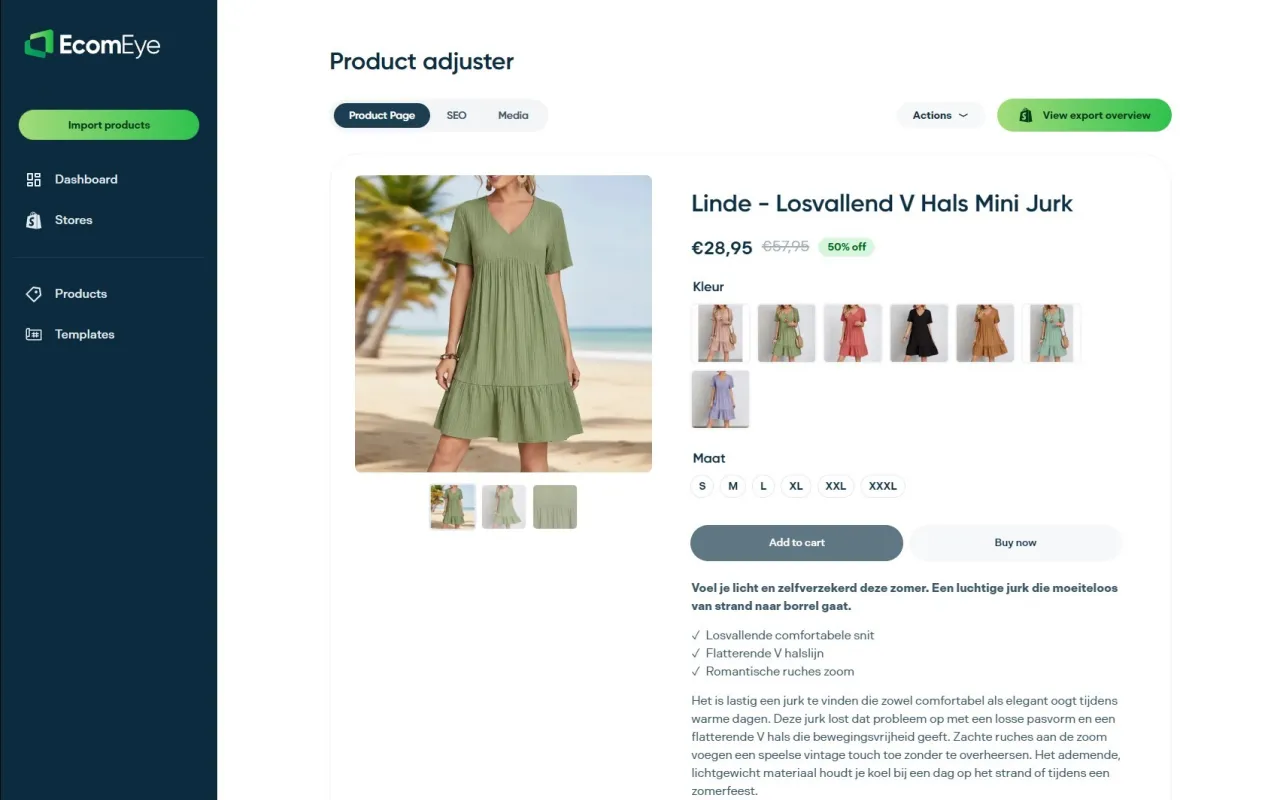
EcomEye offers a powerful solution designed specifically for Shopify dropshipping stores. Import products in bulk from AliExpress or competitor links and automatically generate optimised titles, clean descriptions, AI-created images, and multi-language pages. Then export your listings to Shopify with one click — no manual work, no copyright concerns. Try EcomEye now at https://ecom-eye.com and reduce listing creation time by over 90%. Take control of your dropshipping store content and stay ahead with original SEO-ready pages.
Frequently Asked Questions
How fast can Ecom-eye create product pages compared to other options?
Ecom-eye can generate bulk product pages in roughly 30 seconds per product, making it about 97% faster than traditional manual methods. This rapid generation allows high-volume sellers to publish hundreds of listings quickly. Consider using Ecom-eye if speed and efficiency in creating product pages are your primary goals.
What are the advantages of PagePilot.ai over Ecom-eye?
PagePilot.ai excels in its one-click import to Shopify, allowing users to push pages directly into their store, which simplifies the process significantly. While Ecom-eye also integrates with Shopify, it particularly shines in generating copyright-safe, multi-language product pages for varied markets. If quick experimentation and testing are your priorities, you may want to consider PagePilot.ai.
Can D2C Bot handle multiple languages like Ecom-eye?
Yes, D2C Bot supports 14+ languages, making it suitable for cross-border merchants looking to localise at scale. While Ecom-eye focuses on copyright-safe output and templates to keep brand consistency, D2C Bot’s broad language capabilities are beneficial for businesses wanting extensive market reach. Determine your need for language support when deciding between the two.
What is the pricing model for Ecom-eye compared to Kluck AI?
Ecom-eye’s pricing starts at €14.95 per month, allowing for affordable testing before committing to larger plans. Kluck AI, on the other hand, uses a one-time purchase model with tiered options ranging from free to $69. If you’re cautious about ongoing costs, Kluck AI’s payment structure might better suit your budget management.
How does Ecom-eye ensure copyright-safe content?
Ecom-eye provides copyright-safe content that reduces the legal risks associated with copying competitor pages. Its unique combination of AI generation and a Shopify-first workflow means fewer worries about duplicate content penalties. Opt for Ecom-eye to scale your content generation while maintaining compliance with SEO standards.
Ready to boost your product pages?
Generate high-converting, SEO-optimized product pages in bulk using AI automation used by e-commerce experts.
No credit card required