Boost global ecommerce reach with expert SEO tactics
Unlock your store's potential! Discover what global ecommerce reach is and learn expert SEO tactics to boost international sales.

TL;DR:
- Successfully going global requires deliberate strategy, cultural understanding, and technical SEO work, not just listing products online.
- Localisation and SEO are essential for building trust, improving search rankings, and increasing international conversions on Shopify stores.
Most Shopify store owners believe that going live online automatically means going global. It does not. Listing products and enabling international shipping is just the starting line, not the finish. Real global ecommerce reach requires deliberate strategy, cultural sensitivity, and technical SEO work that most entrepreneurs skip entirely. This guide walks you through what global reach actually means, how localisation and SEO unlock it, and how to optimise your product pages so that international visitors actually convert into paying customers.
Table of Contents
- Defining global ecommerce reach: What does it really mean?
- The role of localisation and SEO in global reach
- Optimising product pages for global audiences
- Overcoming challenges to scaling your global ecommerce reach
- The reality behind global ecommerce reach: What most sellers miss
- Scale your store with powerful automation tools
- Frequently asked questions
Key Takeaways
| Point | Details |
|---|---|
| Global reach requires strategy | Selling worldwide means adapting your site and content for each market, not just shipping globally. |
| Localisation and SEO are essential | Tailoring language, keywords, and product details unlocks true international sales opportunities. |
| Product optimisation drives conversion | Optimising pages for global audiences increases trust and boosts sales. |
| Overcome scaling barriers | Practical solutions to regulation, logistics, and payments help stores expand internationally. |
| Automation smooths global growth | AI-powered tools speed up product listing and SEO for cross-border success. |
Defining global ecommerce reach: What does it really mean?
Global ecommerce reach is not simply about whether someone in Tokyo can technically place an order on your Shopify store. It is about whether that person wants to, whether they trust your store, understand your product, and feel confident the purchase is safe and relevant to them. That distinction matters enormously.
At its core, global ecommerce reach refers to your store’s ability to attract, engage, and convert shoppers across multiple countries. This means your brand is discoverable in local search engines, your product pages speak the language and cultural expectations of each market, and your checkout process removes friction for international buyers. If any one of those elements is missing, you are likely losing sales you do not even know you could have had.
Consider the key benefits of genuine global reach:
- Broader market access: Instead of competing for a fixed pool of domestic buyers, you tap into billions of potential customers across dozens of markets.
- Increased revenue potential: Spreading your customer base internationally reduces dependence on any single economy or seasonal trend.
- Brand authority: An internationally recognised store builds credibility that feeds back into your domestic market as well.
- Lower customer acquisition costs over time: Once localised content ranks organically in target markets, paid acquisition costs drop significantly.
For dropshippers and Shopify sellers specifically, global reach is also about understanding cross-border ecommerce insights so you can structure your store to perform in markets with very different buying behaviours and expectations.
“Global ecommerce is not about translating your homepage. It is about rebuilding trust, from scratch, in every market you enter.”
That quote captures the mindset shift required. Going global is less about technology and more about respect: respect for different languages, currencies, trust signals, and cultural contexts.
The role of localisation and SEO in global reach
Localisation and SEO are the two engines driving genuine international sales growth. Separately, they each have value. Together, they are transformational.
Localisation means adapting your store experience for specific target markets. This goes far beyond translation. It includes adjusting product imagery to reflect the demographics and aesthetics of each region, offering locally preferred payment methods (such as iDEAL in the Netherlands or Alipay in China), displaying prices in local currency, and using culturally appropriate language and messaging. Stores that invest in localisation for SEO consistently outperform those that rely on auto-translate plugins and assume the job is done.

SEO for international markets means researching and targeting the keywords your potential customers actually use in their own language and search context. A product that ranks well in the UK under “wireless earphones” might need entirely different keyword targeting in Germany, Brazil, or South Korea. International SEO also involves technical decisions like hreflang tags, country-specific domains or subdirectories, and structured data that signals to Google which version of your page serves which audience.
Here is a direct comparison of what separates high-performing international stores from those stuck in limbo:
| Feature | Store without localisation | Store with localisation and SEO |
|---|---|---|
| Search ranking in target market | Poor or invisible | Strong organic visibility |
| Cart abandonment rate | High (currency confusion, trust gaps) | Lower (familiar UX, local payment) |
| Customer trust | Weak (foreign feel) | High (native experience) |
| Return visitor rate | Low | Significantly higher |
| Google Merchant approval | Frequently rejected | Consistent approvals |
Research into 3D content for ecommerce also shows that visual content adapted for local audiences drives measurably higher engagement, reinforcing the case for region-specific visual strategies.
To get started with global sales with localisation, here is a practical approach:
- Identify your top three target markets based on existing traffic data or supplier location.
- Research locally preferred search terms using native language keyword tools.
- Create dedicated landing pages or market-specific subdirectories for each region.
- Translate and localise product descriptions, not just page titles.
- Integrate local payment gateways and display region-appropriate trust badges.
- Implement hreflang tags to signal language and regional targeting to search engines.
- Follow a Shopify localisation guide to ensure technical foundations are in place.
Pro Tip: Do not localise every market at once. Pick two or three markets where you already see organic interest, localise those thoroughly, and measure results before scaling further. Half-done localisation in ten markets is far less effective than complete localisation in three.
Optimising product pages for global audiences
Your product page is where international visitors decide whether to buy or bounce. For global audiences, the stakes are even higher because trust has to be established in seconds, often in a language and context that differs completely from your home market.
The following areas deserve focused attention when optimising product pages for international buyers:
- Translated and localised copy: Product titles, descriptions, bullet points, and meta descriptions should be written natively, not machine-translated. A German buyer will immediately recognise auto-translated German and it erodes trust fast.
- Region-specific payment and shipping information: Display estimated delivery times and costs for the buyer’s country. Showing “ships to Germany in 5 to 8 days” on a German-facing page removes a major friction point.
- Local social proof: Reviews from customers in the same country carry significantly more weight than generic five-star ratings. Where possible, surface region-specific reviews near the top of the page.
- Currency conversion: Static pricing in a single currency signals a foreign store. Dynamic currency display based on IP or browser preference dramatically increases purchase confidence.
- Visual adaptation: Product imagery that reflects the target market’s demographics and lifestyle context converts better. According to 3D innovation for e-commerce, interactive 3D models are increasingly used to bridge the gap when lifestyle photography is not yet localised.
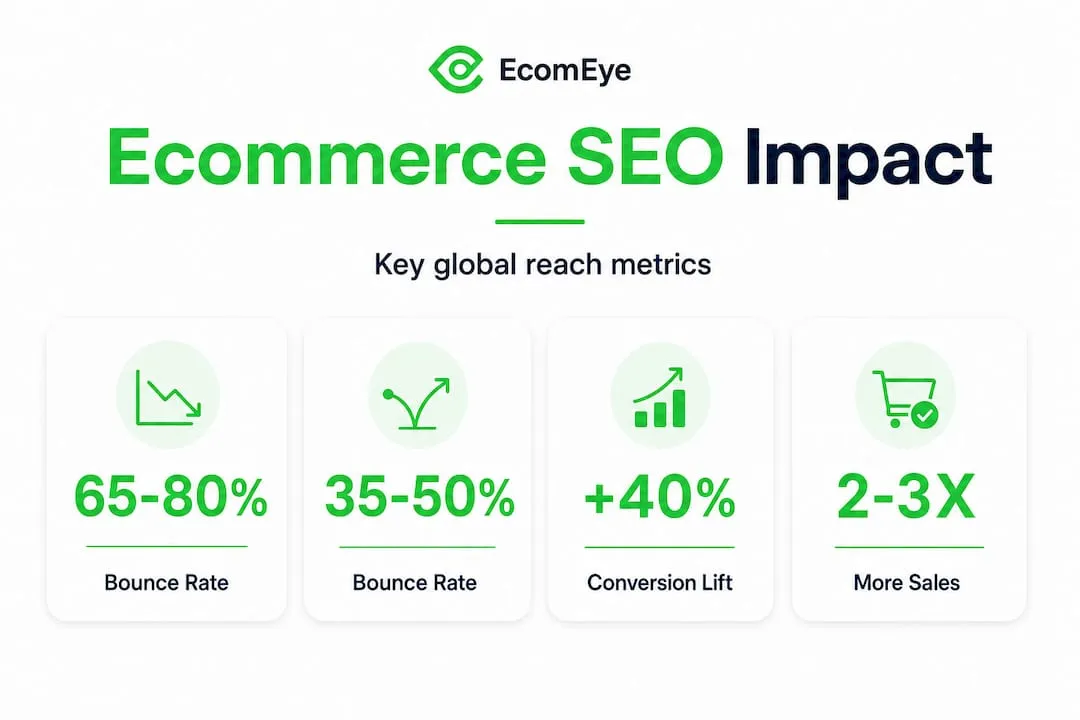
The data on international page optimisation is clear. Stores that tailor content to target regions see substantially lower bounce rates and higher average order values compared to those serving a single generic experience globally.
| Metric | Generic global page | Localised product page |
|---|---|---|
| Bounce rate | 65 to 80% | 35 to 50% |
| Conversion rate | 0.5 to 1% | 2 to 4% |
| Average order value | Baseline | 15 to 30% higher |
| SEO ranking in target market | Poor | Strong |
Staying current with dropshipping trends for 2026 matters here because buyer expectations shift year on year. Markets that accepted basic product photography in 2022 now expect richer content experiences. If you are working through the practical side of building an international presence, the Shopify global expansion guide covers the structural and technical steps in detail.
Pro Tip: When adapting product pages for a new market, start with your ten best-selling SKUs. Fully optimise those pages for the target language, local SEO keywords, and region-specific visuals. Track performance for 60 days before expanding the localisation effort to your wider catalogue.
Overcoming challenges to scaling your global ecommerce reach
Even with the best strategy in place, global scaling surfaces real obstacles. The entrepreneurs who succeed internationally are not those who avoid these challenges. They are the ones who plan for them from the start.
The most common barriers include:
- Regulatory compliance: Different countries have different rules on product labelling, data privacy (GDPR in Europe, LGPD in Brazil), import restrictions, and consumer rights. Failing to account for these can result in fines, blocked shipments, or account suspensions.
- Logistical complexity: Managing multiple supplier relationships, varying shipping timelines, and customs clearance across markets is operationally demanding. Dropshippers scaling globally often underestimate how quickly logistics complexity multiplies.
- Payment localisation gaps: Offering only card payments when a target market predominantly uses digital wallets or bank transfers directly suppresses conversion. Missing one dominant local payment method can cost you the majority of that market.
- Duplicate content risks: Many dropshippers copy product descriptions directly from suppliers or competitors. This creates duplicate content penalties from Google and can trigger Google Merchant disapprovals, cutting off paid traffic entirely.
- Currency and pricing strategy: Flat conversion from your home currency often produces awkward local pricing (such as €17.83 when €17.99 would feel more natural). Dynamic pricing rules tailored per market improve conversion noticeably.
Practical 3D modeling case studies show that stores using richer visual formats reduced return rates in international markets, because buyers had a clearer product understanding before purchasing. This directly addresses one of the trickiest logistical challenges: cross-border returns, which are expensive and time-consuming.
“The businesses that scale globally fastest are not the ones with the biggest budgets. They are the ones who solve compliance, logistics, and trust early, before those issues become crises.”
Understanding ecommerce scalability from the outset helps you build a store architecture that can absorb international growth without constant rebuilding. Similarly, knowing how exports accelerate Shopify growth provides a framework for thinking about market prioritisation. And if regulatory complexity is holding you back, a thorough read of the Shopify compliance guide will give you a clear checklist to work through before entering a new territory.
The reality behind global ecommerce reach: What most sellers miss
Here is a perspective that most guides will not share with you plainly: the majority of Shopify dropshippers who “go global” never truly do. They flip a settings switch, enable international shipping, maybe install a translation app, and call it done. Then they wonder why their German traffic bounces instantly and their French ad campaigns lose money.
The uncomfortable truth is that global ecommerce is an earned position, not a switched-on feature. Markets do not accept foreign stores simply because they exist. Trust is built slowly, through consistent signals: native language content, familiar payment options, credible reviews, and product pages that do not look like they were copied from a Chinese supplier catalogue and run through Google Translate.
What conventional advice gets wrong is the emphasis on tactics over foundations. You will read dozens of articles about hreflang tags and currency converters. Far fewer discuss the foundational work: genuinely understanding what a buyer in your target market values, what vocabulary they use to search, what visual aesthetics they respond to, and which competitors are already earning their trust. Skipping this research and jumping straight to technical implementation is why so many internationalisation efforts fail silently.
Another widely missed point is the iteration required. Your first localised product page will not be perfect. Your first regional keyword strategy will probably be off. The stores that win globally treat internationalisation as a continuous process, not a one-time project. They analyse, adjust, and improve every quarter. That discipline, more than any specific tactic, is what separates genuinely global businesses from those with international settings turned on.
The thought leadership in ecommerce space is full of tactical advice. What is rarer, and more valuable, is the patience to do foundational work properly before scaling.
Scale your store with powerful automation tools
Expanding globally means managing more products, more languages, more markets, and more complexity than any manual process can sustainably handle.
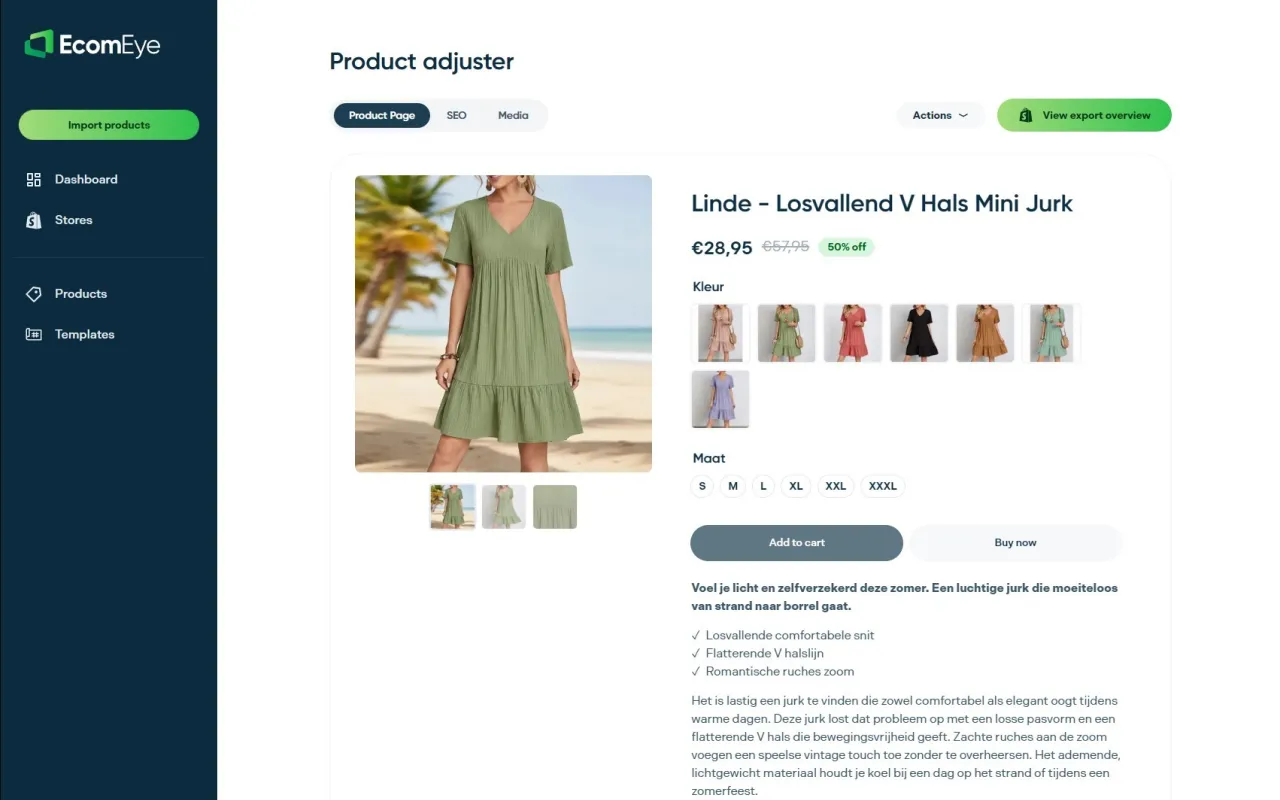
That is exactly the problem EcomEye was built to solve. With the Bulk AI Product Lister, you can import products from AliExpress or competitor links in bulk, and automatically generate SEO-optimised titles, clean original descriptions, and multi-language product pages without rewriting a single line yourself. Every page is copyright-safe, Google Merchant-approved, and ready for international markets. No duplicate content. No manual translation. No copyright risk. Export directly to Shopify in one click and start ranking in new markets faster than you ever thought possible.
Frequently asked questions
What is global ecommerce reach?
Global ecommerce reach refers to a retailer’s ability to sell and deliver products to customers in multiple countries, using strategies tailored for each market.
How can Shopify store owners expand globally?
Store owners can expand worldwide by localising their website, optimising for international SEO, and offering region-specific payment and shipping options, as outlined in this Shopify localisation guide.
What are common challenges in scaling global ecommerce?
Businesses often face regulatory, logistical, and payment barriers when scaling globally, all of which are addressed in detail within this ecommerce compliance guide.
Why is localisation important for international sales?
Localisation increases conversion by making websites feel native in each target market, building the trust that turns international visitors into customers.
How does 3D modelling improve global ecommerce?
3D modelling boosts conversions by showcasing products interactively, reducing uncertainty and building trust with buyers across international markets where lifestyle photography may not yet be localised.
Ready to boost your product pages?
Generate high-converting, SEO-optimized product pages in bulk using AI automation used by e-commerce experts.
No credit card required