What is ecommerce scalability: grow your Shopify store
Learn what ecommerce scalability means for Shopify dropshipping stores. Discover automation strategies, SEO optimisation, and multi-language tactics to grow sustainably whilst avoiding duplicate content penalties and Google Merchant disapprovals.

Most Shopify dropshippers fail within the first year due to duplicate content penalties and poor product page optimisation. Ecommerce scalability isn’t about working harder; it’s about building systems that grow revenue without proportionally increasing costs or workload. This guide reveals proven strategies to scale your dropshipping store through SEO automation, unique content generation, and multi-language support.
Table of Contents
- What Is Ecommerce Scalability?
- Why Scalability Is Critical For Dropshipping Success
- Common Misconceptions About Ecommerce Scalability
- Strategies For Scalable Product Page Optimisation
- Role Of Multi-Language Content In Scalability
- Impact Of Duplicate Content On Scalability
- Framework For Ecommerce Scalability
- Conclusion: Practical Next Steps To Scale Your Shopify Dropshipping Store
- Scale Your Shopify Dropshipping Store With EcomEye
Key takeaways
| Point | Details |
|---|---|
| Ecommerce scalability definition | Growing sales and traffic without linearly increasing operational costs through automation and SEO optimisation. |
| SEO and unique content | Vital for sustainable growth; duplicate content triggers penalties and Google Merchant disapprovals. |
| Automation benefits | Bulk product page creation tools increase efficiency 5x whilst maintaining copyright-safe, unique descriptions. |
| Multi-language expansion | Opening non-English markets significantly boosts organic reach and revenue potential globally. |
| Common scaling mistakes | Copying competitor pages, focusing solely on price, and manual content creation hinder growth. |
What is ecommerce scalability?
Ecommerce scalability is the ability to grow sales and traffic without proportional rises in operational costs, emphasising product page optimisation and automation. For Shopify dropshipping stores managing hundreds or thousands of SKUs, scalability means handling increased volume efficiently whilst maintaining SEO integrity and compliance.
The core principle centres on building repeatable, automated systems rather than manually processing each product. When you optimise one product page manually, you’ve completed one task. When you create a scalable system using AI to generate unique product descriptions, you’ve built infrastructure that handles unlimited products.
Foundational elements of ecommerce scalability include:
- Bulk automated product listing systems that import from suppliers like AliExpress
- Copyright-safe content generation preventing duplicate content penalties
- SEO-optimised titles and meta descriptions created at scale
- Multi-language page generation for international market access
- Streamlined export workflows pushing directly to Shopify
This foundation prepares dropshipping stores to expand product catalogues rapidly without hiring additional staff or sacrificing search rankings. The distinction between scalable and non-scalable operations determines whether growth increases profit margins or simply adds unsustainable workload.
Why scalability is critical for dropshipping success
Dropshipping businesses face unique pressures managing extensive SKU ranges across changing supplier inventories. Without scalable systems, growth creates operational bottlenecks that erode profitability and competitive advantage. Here’s why scalability determines success:
-
Volume management: Dropshippers typically handle 500 to 5,000+ products requiring constant updates, descriptions, and optimisation. Manual processes collapse under this volume.
-
SEO sustainability: SEO-optimised product pages drive 50% more organic traffic and 20% higher conversion rates. Scaling without maintaining SEO standards loses this advantage.
-
Cost efficiency: Automated content creation through Shopify page automation reduces per-product costs by 80% compared to manual writing or outsourcing.
-
Market responsiveness: Trending products require rapid listing. Scalable systems deploy new products in minutes, not days.
-
Compliance maintenance: Google Merchant policies demand unique, non-duplicated content. Scalable content generation ensures every product meets requirements automatically.
Stores attempting growth without scalable infrastructure experience declining margins as labour costs rise faster than revenue. They’re forced to choose between expansion and profitability. Scalable operations eliminate this trade-off, enabling sustainable growth that improves unit economics over time.
Common misconceptions about ecommerce scalability
Several persistent myths misdirect store owners, wasting resources on ineffective tactics whilst ignoring genuine scalability drivers. Understanding these misconceptions prevents costly mistakes.
Myth 1: Duplicate content is a minor SEO issue
Many dropshippers copy product descriptions from suppliers or competitors, believing minor edits suffice. Reality: duplicate content triggers both search ranking penalties and Google Merchant disapprovals, blocking paid advertising channels entirely. Copyright-safe, unique content isn’t optional; it’s foundational to scalable growth.
Myth 2: Price is the primary cart abandonment driver
Store owners obsess over pricing strategies, assuming lower prices solve conversion problems. Research reveals 73% of shoppers abandon carts due to confusing product pages, not price. Unclear descriptions, poor images, and inadequate information drive abandonment far more than cost considerations.
“Price competitiveness matters, but conversion optimisation through clear, detailed product pages delivers far greater ROI than constant price reductions that erode margins.”
Myth 3: Manual content creation maintains quality better than automation
Some believe hand-written descriptions outperform AI-generated content. Modern AI product page creation tools produce unique, SEO-optimised content matching or exceeding manual quality whilst operating 5x faster. Quality and scale aren’t mutually exclusive.
Correcting these misconceptions redirects effort towards proven scalability strategies: unique automated content, conversion-focused page design, and SEO compliance.
Strategies for scalable product page optimisation
Effective product page optimisation balances automation speed with SEO quality, ensuring every page attracts organic traffic whilst maintaining Google compliance. Implement these tactics:
- AI-powered content generation: Deploy tools creating unique titles, descriptions, and meta data automatically. Automation tools generating copyright-safe descriptions increase creation speed 5x whilst ensuring uniqueness.
- Bulk import workflows: Import products from AliExpress or competitor links in batches, processing dozens simultaneously rather than individually.
- Image optimisation: Compress images to under 100KB, use descriptive alt text, and implement lazy loading for faster page speeds.
- Structured data markup: Add schema.org product markup helping search engines understand and feature your listings.
- Meta-data templates: Create SEO-optimised title and description templates automatically populated with product-specific details.
Pro Tip: Conduct quarterly audits comparing your product pages against top-ranking competitors. Identify gaps in description depth, image quality, or technical SEO, then update your automation templates to match or exceed competitor standards systematically.
| Method | Time per product | SEO quality | Uniqueness | Scalability |
|---|---|---|---|---|
| Manual writing | 45-60 minutes | Variable | High | Low |
| Outsourced writing | 24-48 hours | Variable | Medium | Medium |
| Basic templates | 5-10 minutes | Low | Low | Medium |
| AI automation | 2-3 minutes | High | High | Very high |
The data clearly demonstrates AI automation’s superiority for boosting SEO through bulk product page creation. Stores using Shopify SEO automation maintain consistent quality across thousands of products whilst manual approaches inevitably decline as volume increases.
Regular monitoring ensures continued compliance. Set monthly reminders reviewing Google Search Console for indexing issues and Google Merchant Centre for policy warnings. Address problems immediately before they impact rankings or ad campaigns.
Role of multi-language content in scalability
Expanding beyond English-speaking markets multiplies your potential customer base whilst competitors remain monolingual. Multi-language product pages aren’t just translation; they’re strategic market expansion enabling truly scalable international growth.
Non-English markets represent 75% of global ecommerce spending. Creating localised product pages in Spanish, French, German, or other major languages taps massive underserved audiences. These pages rank in local search results, driving organic traffic from regions with less competition and higher conversion rates due to native-language trust.
- Market penetration: Each language opens distinct geographic markets with unique demand patterns and seasonal trends.
- SEO multiplication: Properly implemented multi-language pages create separate ranking opportunities in each language’s search results.
- Customer trust: Shoppers convert 3x higher on native-language pages compared to English alternatives with translation tools.
- Competitive advantage: Most dropshippers ignore non-English markets, leaving substantial first-mover opportunities.
Pro Tip: Implement hreflang tags correctly to tell search engines which language version serves which geographic region. Research local keywords in each target language rather than directly translating English terms, as search behaviour varies culturally. Start with 2-3 high-value languages, measure results, then expand systematically.
Plan multi-language strategies during initial scaling phases rather than retrofitting later. Automated tools generating multi-language content simultaneously prevent duplicated effort and ensure consistency across versions whilst avoiding the content duplication that triggers penalties.
Impact of duplicate content on scalability
Duplicate content remains the single greatest barrier preventing Shopify dropshippers from achieving sustainable scale. The consequences extend beyond minor ranking penalties into complete traffic loss and advertising bans.
When you copy product descriptions from suppliers or competitors, Google identifies the duplication and devalues your pages in search results. Your listings appear on page 5 or beyond, receiving virtually zero organic traffic. Worse, Google Merchant Centre detects policy violations, disapproving products and suspending advertising accounts entirely.
The compounding effect devastates scaling attempts. Each duplicated page weakens your domain authority. As you add more products with copied content, rankings decline across your entire store, not just duplicated pages. Traffic drops whilst advertising channels close, eliminating both organic and paid acquisition channels simultaneously.
- Search ranking suppression: Google shows only one version of duplicated content, almost never choosing the newest or smallest site.
- Google Merchant disapprovals: Policy enforcement removes duplicate listings from Shopping ads, blocking a primary traffic source.
- Domain authority damage: Widespread duplication signals low-quality content, harming rankings site-wide.
- Competitive disadvantage: Competitors with unique content outrank you consistently, capturing market share.
Mitigating duplication requires copyright-safe automation generating distinct descriptions for every product. Tools creating unique content from product data prevent these penalties whilst enabling rapid catalogue expansion. Avoiding duplicate content penalties through automated unique content generation isn’t optional; it’s the foundation enabling scalable growth without compliance risks.
Ignoring this issue guarantees scaling failures. Address content uniqueness before expanding product ranges.

Framework for ecommerce scalability
Successful ecommerce scaling follows a structured approach integrating three essential pillars. This framework applies specifically to Shopify dropshipping stores requiring rapid, compliant growth.

Pillar 1: Bulk automation
Replace manual product listing with automated import and generation systems. Process dozens or hundreds of products simultaneously, reducing time from hours to minutes whilst eliminating human error and inconsistency.
Pillar 2: SEO-optimised unique content
Every product requires distinct, keyword-rich descriptions meeting search engine quality standards. Automated content generation maintains uniqueness at scale, preventing duplicate content penalties that destroy rankings.
Pillar 3: Multi-language and compliance management
Implement international expansion through automated translation and localisation. Continuously monitor Google Merchant policies and search algorithm updates, adjusting systems to maintain compliance automatically.
| Workflow aspect | Manual approach | Automated scalable approach |
|---|---|---|
| Products per hour | 1-2 products | 50-100 products |
| SEO quality | Inconsistent, degrades with fatigue | Consistent, template-based optimisation |
| Uniqueness | Variable, risks unintentional copying | Guaranteed unique through AI generation |
| Multi-language | Requires separate translation, high cost | Simultaneous generation across languages |
| Compliance risk | High, manual monitoring required | Low, automated policy adherence |
| Scaling cost | Linear increase with volume | Fixed infrastructure cost |
This framework transforms scaling from overwhelming challenge into systematic process. Technology handles repetitive tasks whilst you focus on strategy, supplier relationships, and customer experience. The combination enables sustainable growth maintaining quality and compliance regardless of catalogue size.
Integration matters more than individual components. Bulk automation without unique content creates scalable policy violations. Unique content without automation remains too slow for competitive markets. Combine all three pillars for genuine ecommerce scalability.
Conclusion: practical next steps to scale your Shopify dropshipping store
Transforming your dropshipping operation into a scalable business requires deliberate implementation of automation, SEO integrity, and compliance systems. These concrete steps enable immediate progress:
- Audit current content: Review existing product pages for duplication using plagiarism detection tools. Identify and prioritise pages requiring unique content replacement.
- Implement bulk automation: Adopt AI-powered product listing tools creating unique, SEO-optimised descriptions across your entire catalogue simultaneously.
- Establish SEO standards: Define templates ensuring every product includes optimised titles, meta descriptions, structured data, and keyword-rich content.
- Add multi-language support: Select 2-3 target languages based on market research, then generate localised versions of high-performing products first.
- Monitor compliance continuously: Set up alerts for Google Search Console indexing issues and Google Merchant Centre policy warnings, addressing problems immediately.
Pro Tip: Begin automation with your top 50 best-selling products rather than your entire catalogue. Test, refine templates based on performance data, then scale across remaining inventory. This approach minimises risk whilst validating your systems before full deployment.
Scalability isn’t achieved overnight, but systematic implementation compounds rapidly. Each automated process frees time for strategic activities whilst expanding capacity. Start with one pillar, perfect execution, then add the next. Within 90 days, you’ll operate a genuinely scalable Shopify dropshipping store positioned for sustainable long-term growth.
The EcomEye bulk AI product lister provides the infrastructure supporting these strategies, enabling rapid, compliant scaling from day one.
Scale your Shopify dropshipping store with EcomEye
Implementing the scalability strategies detailed throughout this guide requires robust automation infrastructure. EcomEye delivers exactly that, purpose-built for Shopify dropshipping stores serious about sustainable growth.
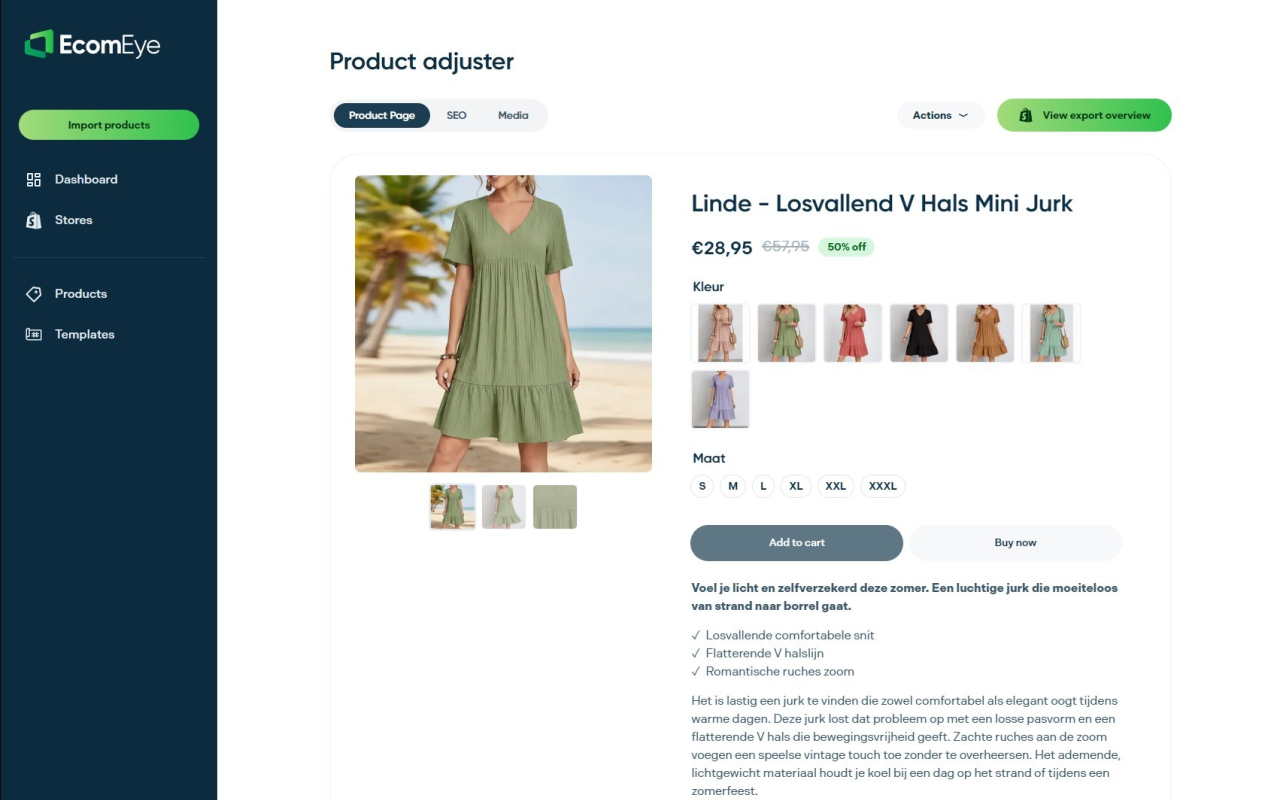
Our bulk AI product lister generates copyright-safe, SEO-optimised product pages in minutes, not hours. Import products from AliExpress or competitor links, then automatically create unique titles, descriptions, and multi-language versions. Export directly to Shopify in one click, eliminating manual rewriting whilst ensuring Google compliance.
EcomEye solves the duplicate content problem destroying most dropshippers’ scaling attempts. Every product receives distinct, keyword-rich content preventing search penalties and Merchant Centre disapprovals. Flexible pricing plans accommodate stores at every growth stage, from testing initial products to managing thousands of SKUs internationally.
The platform embodies best practices discussed in this guide: bulk automation, unique content generation, multi-language support, and compliance management. You gain immediate competitive advantage through systems established dropshippers spent years developing.
Stop manually creating product pages. Start scaling systematically with tools designed specifically for Shopify dropshipping success.
FAQ
What is ecommerce scalability?
Ecommerce scalability is the capacity of an online store to grow sales and traffic efficiently without proportional cost increases, primarily through automation and SEO optimisation. It enables Shopify dropshipping stores to expand product ranges and markets sustainably, maintaining profitability as volume increases.
How does duplicate content affect my Shopify store’s growth?
Duplicate content significantly lowers Google search rankings, pushing your pages beyond the first several results pages where they receive virtually no organic traffic. Additionally, Google Merchant Centre detects policy violations from duplicated descriptions, disapproving products and suspending advertising accounts entirely. Maintaining unique, SEO-friendly product pages is essential for preserving both traffic sources and enabling scalable growth.
What are practical ways to automate scalable product page creation?
Use AI-powered bulk product listing tools to generate unique titles and descriptions automatically from product data. Integrate SEO best practices within automation templates to increase organic traffic and conversions systematically. Regularly update your automation systems and content standards to stay compliant with evolving search algorithms and marketplace policies.
Why is multi-language support important for scaling dropshipping stores?
Multi-language content expands your addressable market to non-English speaking regions representing 75% of global ecommerce spending, significantly increasing organic traffic and sales opportunities. Proper implementation with hreflang tags and localised keywords prevents duplicate content issues across languages whilst building separate ranking opportunities in each market’s search results. This geographical diversification reduces dependence on single markets and accelerates overall growth.
Ready to boost your product pages?
Generate high-converting, SEO-optimized product pages in bulk using AI automation used by e-commerce experts.
No credit card required